
How Much Does an Eurail Pass Cost?
Updated on | Researched and reviewed by Alec Pow, Founder & Pricing Investigator
Prices, claims, and calculations checked against 16 cited sources. See our research methodology and corrections policy.
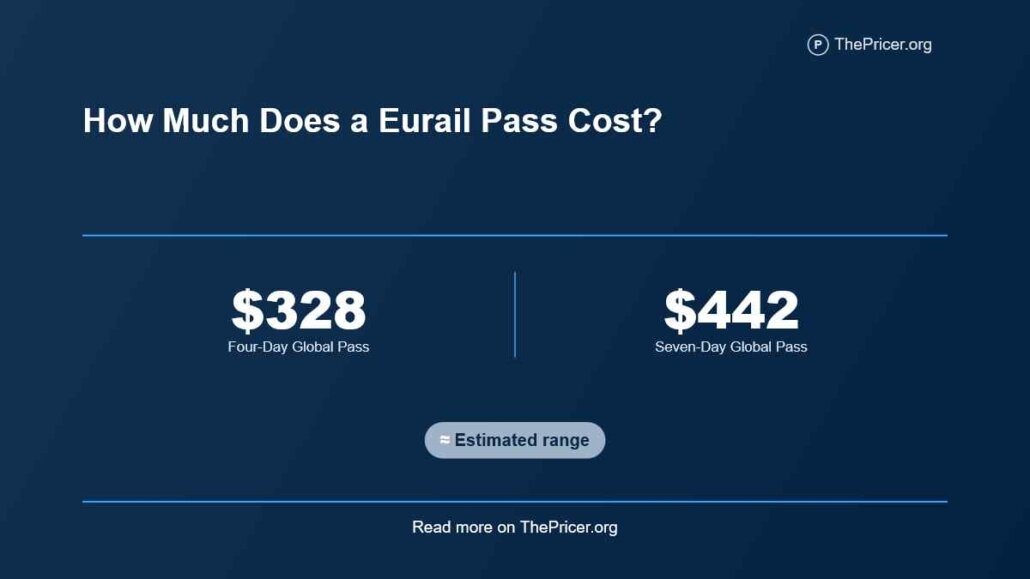
A Eurail Pass costs approximately $328 for four travel days, $442 for seven travel days, or $552 for 15 consecutive days, based on adult second-class prices recorded in August 2026. The corresponding official European price schedule lists €283, €381, and €476. Seat reservations can increase the final cost, especially on Eurostar, French TGV, Italian high-speed, and overnight trains.
Eurail became Interrail on September 9, 2026. The two former brands now operate under the Interrail name worldwide. According to the company’s November 2026 announcement, previously purchased Eurail passes remain valid, and the underlying travel benefits have not changed.
This means travelers searching for Eurail prices should now compare Interrail Global and One Country passes. The price depends on the number of travel days, how those days are distributed, age, seating class, and the specific trains used.
Article Highlights
Jump to sections
- An adult second-class four-day Global Pass has a published 2026 reference price of €283, equivalent to an observed August 2026 US listing of $328.
- The seven-day Global Pass costs €381, while 15 continuous days cost €476 at standard European prices.
- Reservations are extra on standard passes. Eurostar’s London–Paris Standard reservation is listed at €35.
- Interrail adds a €2 per person, per train booking charge when reservations are purchased through its platform.
- Travelers taking regional trains or buying discounted point-to-point tickets may spend less without a Global Pass.
How Much Does a Eurail Pass Cost?
The 2026 Global Pass price schedule published by Deutsche Bahn provides a consistent euro-denominated comparison for adult travelers. Its rates apply to standard second-class passes, before reservations or other purchases.
| Global Pass | Adult, second class | Adult, first class |
|---|---|---|
| 4 days within 1 month | €283 | €367 |
| 5 days within 1 month | €318 | €413 |
| 7 days within 1 month | €381 | €495 |
| 10 days within 2 months | €447 | €581 |
| 15 days within 2 months | €553 | €718 |
| 15 continuous days | €476 | €618 |
| 22 continuous days | €586 | €761 |
| 1 continuous month | €696 | €904 |
| 2 continuous months | €826 | €1,073 |
| 3 continuous months | €956 | €1,242 |
These are standard reference prices, not promises of a particular dollar checkout amount. The US-denominated August 2026 price comparison recorded $328 for four travel days and $442 for seven days, but displayed currency and sales can change what an American buyer pays.
The current Global Pass sales page lets buyers select traveler ages, first or second class, and a pass duration. Check those selections carefully. The default traveler shown on some product pages can be a youth, whose ticket costs less than an adult ticket.
Flexi or Continuous?
A Flexi Pass allows travel on a limited number of chosen days within a broader validity period. A continuous pass allows travel on every day of its validity period. Both can cover multiple train journeys within the rules for an active travel day.
The distinction can produce a surprising result. A 15-day continuous second-class pass costs €476, while a 15-day Flexi Pass valid across two months costs €553. The continuous version is €77 cheaper, even though it offers daily travel throughout its shorter validity window.
That difference is useful only if the trip fits within 15 consecutive days. Someone traveling through Europe for six weeks, with long stays between train journeys, may need the Flexi Pass despite its higher price.
The same scheduling question applies to shorter itineraries. Four train-travel days within a month cost €283, while seven cost €381. The extra three travel days add €98. If a traveler needs only one additional short journey, buying a separate ticket for that trip could cost less than upgrading the pass.
Independent rail specialist The Man in Seat 61 recommends working from the itinerary and checking ordinary train fares before choosing the number of pass days. A travel day should be allocated to a journey that would otherwise be relatively expensive.
Seat Reservation Costs
A standard pass covers eligible train travel, but it does not automatically reserve a seat. On many regional trains, travelers can board without a paid reservation. Most long-distance high-speed services in France, Spain, and Italy require one.
Interrail’s reservation fee overview gives planning averages of about €10 for domestic trains and €15 for international services. Night-train accommodation can cost substantially more. Exact charges depend on the train and departure.
Some common examples from the operator’s detailed schedules are:
- Italy, Frecciarossa: Common second-class reservation charges of €10–€13 on major domestic routes.
- France, TGV: Reservations on major routes may be priced at €10–€20, depending on the service.
- Eurostar, London–Paris or Brussels: A Standard passholder reservation of €35.
- Eurostar, upgraded seating: London–Paris Eurostar Plus reservations of €40, subject to holding the appropriate pass.
Those examples are drawn from the domestic reservation schedule and the separate international train schedule. Both describe indicative charges rather than guaranteed availability.
Booking through Interrail also brings a €2 fee per passenger per train. A reservation listed at €35 can therefore become €37 when bought through that service. Six reservations booked in the same way add €12 in platform charges alone.
For Eurostar, the price is only part of the issue. Passholder places are limited on certain departures, and a pass does not guarantee that a reservation will be available. The official Eurostar booking instructions advise securing seats early.
What About Night Trains?
Night trains can reduce daytime travel but often need separate spending on a seat, couchette, or sleeping compartment. The ordinary pass does not include a bed.
The current night-train fee list shows why a single average supplement is misleading. One listed overnight service charges €11–€21 for a budget seat, while a five-berth cabin costs €64–€74. Private cabins can cost considerably more.
Some operators use dynamic pricing, meaning the sleeper supplement changes with the route, date, accommodation category, and available inventory. A traveler selecting a private compartment can face a much larger charge than someone reserving a reclining seat.
Compare the sleeper supplement with the cost of a separate hotel night, but also consider departure and arrival times. An overnight trip that arrives very early may still leave the traveler paying for luggage storage or an additional accommodation arrangement.
Real Trip Budgets
The following examples use the published 2026 adult second-class pass prices. Reservation quantities are explicit planning assumptions, not records of actual traveler purchases.
Four-day multi-country trip. Start with the four-day Global Pass at €283. Assume two Italian high-speed reservations at €10 each, one Eurostar Standard reservation at €35, and all three reservations booked through Interrail at €2 per train.
- Four-day Global Pass: €283
- Two Italian high-speed reservations: €20
- One Eurostar reservation: €35
- Three booking fees: €6
- Modeled total: €344
The reservations increase the base-pass bill by €61, or about 22%. The total excludes local transport, accommodation, meals, and trains that are not covered by the pass. If ordinary point-to-point tickets for those same journeys cost less than €344, the pass offers no direct ticket-price saving in this example.
Two-week city-hopping trip. A traveler taking trains on seven selected days could buy the €381 Flexi Pass. If six trains each require a €10 reservation, plus six €2 booking fees, the modeled transport total becomes €453. The remaining day of the two-week stay does not require an active travel day unless the traveler boards a covered train.
That is a different product from a 15-day continuous pass at €476. The latter costs only €23 more before reservations and permits travel on every day of the 15-day window. Travelers planning to ride on eight or more days should compare these products closely rather than assuming the seven-day option is always the economical choice.
Age and Class Discounts
The published pass categories are youth ages 12–27, adults ages 28–59, and seniors aged 60 and older. Eligible children under 12 can travel with a free Child Pass under the program’s family rules. The official pass catalog explains the available traveler categories and country-specific products.
For the four-day Global Pass, the 2026 second-class prices are €212 for youth, €283 for adults, and €255 for seniors. That makes the youth pass €71 cheaper than the adult version, while the senior pass saves €28.
First class increases the price, but it does not eliminate reservation charges. On the four-day adult pass, first class costs €367 versus €283 for second class, an €84 premium. Buyers should check both the pass class and the reservation class before comparing totals.
For families, the child-pass benefit can be valuable on expensive intercity journeys. Yet individual seat reservations may still be payable for children, and eligibility rules limit the number of free Child Passes associated with an accompanying passholder.
Cheaper Rail Alternatives
A Global Pass is most useful when the itinerary crosses borders or includes multiple substantial train journeys. Someone traveling exclusively within one country should compare a One Country Pass and that country’s own train offers.
Italy provides a useful distinction. A One Country Pass can cover eligible train services across the national network, subject to any required reservations. Trenitalia’s separate Italia in Tour offer costs €35 for three consecutive days or €59 for five consecutive days, but it is restricted mainly to participating regional services and has geographic exclusions.
A traveler using only eligible regional trains for three days could spend €35 on that product instead of buying a broader rail pass. The saving is substantial, but the products are not equivalent because the regional ticket does not provide the same high-speed and cross-border flexibility.
Germany has comparable regional-ticket options. Deutsche Bahn’s Bavaria regional day ticket covers eligible regional travel within its defined area and validity rules. It should not be compared directly with a Global Pass that also covers international and long-distance routes.
Point-to-point advance fares are another option. A fixed itinerary with a few inexpensive journeys may cost less when purchased directly from each operator. The key comparison is the total for the actual trains and dates, including luggage conditions, reservation requirements, and flexibility.
For readers comparing European rail passes with other train experiences, the California Zephyr is a useful example of conventional long-distance ticket pricing. The Royal Scotsman and Maharajas’ Express illustrate a different category, where luxury accommodations and bundled experiences dominate the fare.
Plus Pass and Refunds

The Interrail Plus Pass is designed for itineraries with paid reservations. Its official product description says many eligible seat reservations are included when booked through its system, although high-demand services may consume reservation credits. Night-train sleeping accommodation and some other items remain outside the benefit.
A Plus Pass should be compared against the standard pass plus the specific reservations needed. If the premium costs more than the reservations it replaces, the standard pass may be cheaper. The value depends on the intended trains and the availability of qualifying reservations.
Refund conditions also affect the financial risk. Under the current standard-pass refund policy, qualifying unused mobile passes are fully refundable within seven days of purchase. After that window, the standard refund normally carries a 10% fee. Exchanges and promotional products can follow different conditions.
That policy should not be confused with refunds for individual seat reservations. Those depend on the train operator and reservation type. Some reservations cannot be refunded, and booking or shipping fees may remain nonrefundable.
A paper pass can also introduce delivery costs and return requirements. Travelers who intend to depart soon may find a mobile pass more convenient, but they should verify device compatibility and activation rules before travel.
Which Pass Makes Sense?
The price decision begins with the actual number of train-travel days. Write down each planned journey, compare ordinary tickets on those dates, and add any mandatory reservations to the pass total.
Makes sense if
- You plan several expensive intercity or international journeys.
- You value the ability to change travel dates or routes.
- You can use a Flexi Pass on expensive travel days while buying cheap short trips separately.
- Your itinerary uses many reservation-free trains.
Does not make sense if
- You have only two or three inexpensive train journeys.
- Most travel takes place on regional trains covered by a cheaper local product.
- Advance point-to-point fares are much lower for your fixed itinerary.
- The required reservations are unavailable on the trains you need.
The most overlooked limitation is availability. A valid Global Pass is not a guaranteed seat on every departure. Interrail’s pass conditions explain mandatory reservations, carrier supplements, and the possibility of limited passholder seats.
Answers to Common Questions
How much is a four-day Eurail Pass?
The 2026 adult second-class Global Pass reference price is €283. An August 2026 US-dollar listing showed $328. Current checkout prices can vary.
Is Eurail still available in 2026?
The Eurail brand became Interrail in September 2026. Previously issued Eurail passes remain valid, while new purchases use the Interrail name.
Are reservations included?
Not with a standard pass. Mandatory high-speed and night-train reservations cost extra. Some reservation expenses are covered by qualifying Plus Pass products.
Can I use a pass on Eurostar?
Yes, with an appropriate mandatory passholder reservation. A listed London–Paris Standard reservation costs €35, before any separate booking fee.
Is a rail pass cheaper than regular tickets?
It depends on the exact itinerary. Compare the pass, reservation charges, and any booking fees with ordinary tickets for the same trains and dates. Regional travel and advance fares can make individual tickets cheaper.
Disclosure: Educational content, not financial advice. Prices reflect public information as of the dates cited and can change. Confirm current rates, fees, taxes, and terms with official sources before purchasing. See our methodology and corrections policy.