
How Much Does an Exotic-Animal Vet Visit Cost?
Published on | Written by Alec Pow
This article was researched using 11 sources. See our methodology and corrections policy.
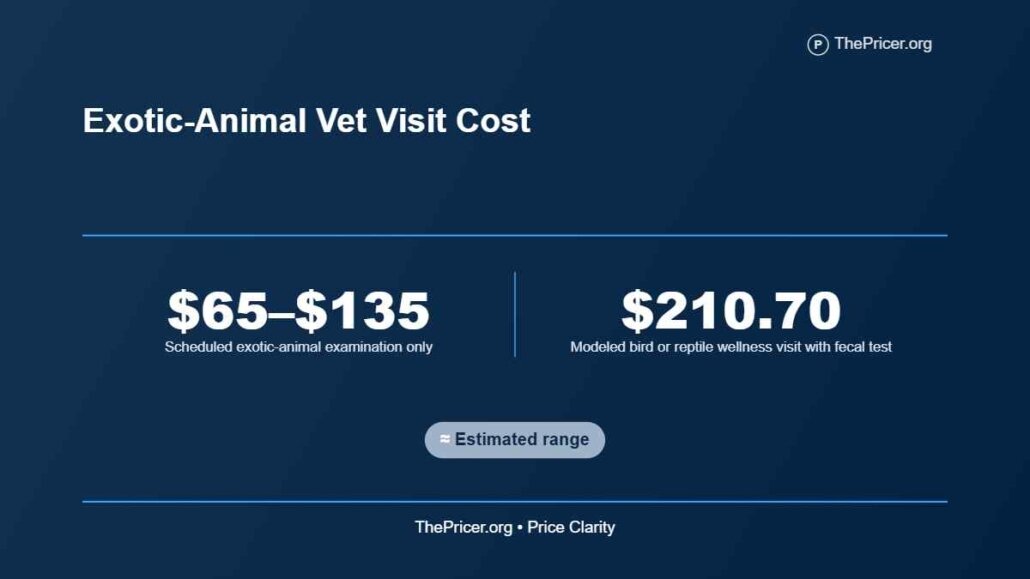
An exotic-animal vet visit can cost about $65–$135 for a scheduled examination alone, based on the U.S. clinic examples below. Tests, medication, sedation, and treatment can raise the bill well beyond the consultation fee.
A calculated bird or reptile wellness visit with one fecal test totals $210.70 at one published schedule, while emergency exam and surcharge combinations reach $210–$320 at another provider before diagnostics or treatment.
These are advertised fees and defined calculations, not a representative national average. Prices were checked in October 2026, although several schedules are undated. The scope covers privately owned birds, reptiles, amphibians, rabbits, and other small exotic pets in the United States. Zoo animals, livestock calls, and complete surgical treatment plans require separate estimates.
Article Highlights
Jump to sections
- Published scheduled exam examples run from $65 to $135, excluding separately charged services.
- A bird or reptile exam, medical-waste fee, and fecal test total $210.70 in the worked example.
- One provider lists bird and reptile blood panels at $158 and fecal parasite testing at $58, before the visit charge.
- Emergency exam fees can sit beside a separate surcharge, making the entry cost $210–$320 at the network examined.
- The appointment type and tests ordered can change the bill more than the pet’s purchase price.
How Much Does an Exotic-Animal Vet Visit Cost?
The lower end has a direct published benchmark. Roxbury Animal Clinic’s 2026 avian and exotic schedule lists an examination at $65. Its rabbit surgery prices are separate, with castration at $600–$700 and spaying at $700–$800.
The distinction matters for anyone booking a consultation before a procedure. Paying for the examination does not mean the surgery has been purchased, and a surgical estimate should identify which preparatory services it includes.
In Florida, Exotic Animal Hospital of Orlando advertises a $85 wellness examination, an emergency examination at $155–$185, and a technician nail trim at $13 on its published veterinary service menu, which notes that tax is excluded.
A nail appointment is a different service from a veterinarian’s health assessment. It should not be used as a cheaper substitute for a sick-pet examination.
Another comparison comes from Urban Veterinary Associates in Westmont, Illinois, where the exotic wellness and sick visits are listed at $96 and $102. The practice cautions that exotic fees vary and complex cases can incur additional charges.
Together, these examples give a usable starting point for a phone quote, but they do not establish the cheapest practice, regional averages, or the final cost of treating a particular illness.
What the Visit Buys
An exotic appointment is veterinary care for a particular species, rather than one standardized package for every unusual pet. A rabbit, tortoise, parrot, and aquarium fish can require different examination methods and different diagnostic plans.
The booking description should name both the animal and the reason for the visit. A wellness appointment, a consultation about symptoms, and a referral for an unresolved problem are distinct services even when the same veterinarian provides them.
VCA’s discussion of a new reptile veterinary examination describes a physical assessment, a review of feeding and housing, and possible blood, fecal, microbiological, or imaging tests. It also explains that sedation may be needed depending on the animal and procedure. That clinical description does not mean every listed test is included in the examination charge. The practice’s written estimate determines what is bundled and what is billed separately.
For budgeting, separate the veterinarian’s assessment from the investigations and treatment it may lead to. Ask which services are planned before authorizing them, and which results could change the next step.
Bring the clinic’s requested records and habitat information so the appointment addresses the animal’s actual circumstances. The wider cost of owning a rabbit also includes housing and daily care, which belong outside a visit-only comparison.
Tests Raise the Total
Diagnostic charges can exceed the examination fee. Bell Family Veterinary Service lists $158 for a basic avian blood panel and the same amount for a basic reptile panel, with $58 for either species’ fecal parasite test and $90 for an avian fecal Gram stain on its bird and reptile laboratory menu. Those are test prices offered with in-home veterinary visits. They are not complete mobile-visit packages, and the published page does not establish a combined examination and travel total.
Using that one provider’s laboratory rates, a chosen blood-panel-plus-parasite-test scenario costs $216, calculated as $158 + $58, before the visit itself. If a veterinarian also recommends the separately listed avian Gram stain, the chosen bird-testing subtotal becomes $306. This is a conditional service combination, not a recommended screening panel for every pet. It shows why asking only about the consultation can leave a substantial budget gap.
Test names matter. A fecal parasite examination and a Gram stain are different line items, so two clinics’ “stool test” quotes may cover different work. Ask for the panel name, whether sample collection and interpretation are included, and whether an outside laboratory is involved.
Request a separate estimate for imaging or sedation if proposed. Without matching the species, test, and inclusions, a cheaper laboratory figure may be a smaller service rather than a better deal.
A Worked Visit Budget
A coherent example can be built entirely from Erlanger Veterinary Hospital’s itemized exotic service prices. It lists an avian or reptile wellness examination at $97.50, an additional medical-waste fee of $7.30, and avian or reptile fecal sedimentation testing at $105.90. The scenario assumes one animal, one scheduled wellness examination, and one veterinarian-approved fecal test.
| Illustrative bird or reptile visit | Published charge in USD | Scope |
|---|---|---|
| Wellness examination | $97.50 | One avian or reptile patient |
| Medical-waste fee | $7.30 | Listed additional exam charge |
| Fecal sedimentation test | $105.90 | One selected diagnostic service |
| Calculated subtotal | $210.70 | Before any other applicable charges |
The arithmetic is $97.50 + $7.30 + $105.90 = $210.70. The test and waste charge add $113.20 to the advertised examination, increasing the subtotal by about 116%. This calculated visit illustrates a practical distinction between “exam price” and “money needed for the appointment.” It excludes medication, bloodwork, imaging, sedation, treatment, transport, and any applicable tax.
Not every patient needs this combination. An exam-only quote should remain exam-only if no additional services are authorized. The useful planning step is to obtain a second number for the services the veterinarian anticipates, rather than automatically buying every available test or assuming a health check will stop at the base fee.
Emergency Fee
 Emergency pricing deserves a line-by-line reading. Exotic Pet Vets’ state-specific examination and emergency fees list Arizona wellness exams at $90, medical exams at $100, and urgent-care exams at $150. For the listed after-hours periods, the schedule shows a $100 emergency examination alongside a $110 emergency fee. Colorado and Oregon list wellness exams at $115, medical exams at $135, urgent care at $185, and after-hours examination and emergency charges of $200 and $120.
Adding the two after-hours line items produces an entry subtotal of $210 in Arizona and $320 in Colorado or Oregon. These calculations assume both listed charges apply, which the clinic should confirm when booking. They exclude testing and treatment. Reading only the emergency examination line would omit $110–$120 from the anticipated bill.
The same schedule distinguishes longer second-opinion appointments at $200–$235 and aquatic examinations at $200–$235, while rechecks are $70–$80. Appointment scope matters as much as geography. Ask which category applies and whether the pet’s species can be seen at that hour. An open emergency hospital and an available exotic-animal clinician are separate questions. A price comparison is useful only after the facility confirms it can assess the animal.
Hidden Price of Follow-Up
The hidden price is the cost of the next stage. An initial examination, a recheck, another test, and a procedure should be treated as separate potential commitments until the estimate says they are bundled. The recheck prices already listed above show that a return appointment can have its own charge.
Ask what the initial visit includes after you leave, whether discussing results is included, and what triggers another examination fee.
There is also a difference between medical follow-up and a new opinion. If the animal is referred elsewhere, ask the receiving hospital whether it requires a new consultation and whether it can use the existing results.
Sending records may help the second practice understand the case, but it does not establish a fee waiver or guarantee that testing will not be repeated. Budget from the receiving clinic’s terms rather than subtracting the first consultation from an unrelated estimate.
For a new owner, keep surgery and continuing treatment outside the small exam-only allowance. The rabbit surgical examples above illustrate a different scale of commitment. For bird owners, parrot purchase and ownership costs provide a separate planning context.
A low purchase price does not set the cost of professional care. Before leaving the first appointment, request the expected follow-up date, the next visit’s estimated charge, and a written account of what remains unresolved.
Insurance and Cash Reserves
Insurance changes who may reimburse a bill, rather than what a clinic charges. Nationwide’s exotic-pet coverage and exclusions describe accident and illness coverage, reimbursement of eligible expenses, species restrictions, and product-dependent annual limits.
The page states that wellness coverage is unavailable for exotic pets at present. It also says pre-existing conditions are usually excluded, with possible review of cured conditions. Individual policy terms control coverage, so an annual checkup should not automatically be counted as reimbursable.
Keep routine-care money separate from an emergency reserve. The former pays for planned examinations and selected preventive services. The latter remains available if an unexpected illness needs diagnostics or treatment.
Money held in reserve is not a veterinary expense until it is spent. Combining the two into one annual “cost” can make ownership look more expensive than actual spending while still obscuring how much cash must be accessible.
For a concrete planning approach, obtain a local scheduled-visit estimate and a separate emergency entry quote. Then ask what payment is required if testing, hospitalization, or surgery follows. Do not assume an insurance claim provides immediate cash at reception. Confirm the deductible, reimbursement basis, relevant exclusions, and claims process in your own documents before using expected reimbursement to size the reserve. A species-specific quote is more useful than an insurance price advertised for dogs or cats.
Choosing a Suitable Clinic
For a planned appointment, compare the same species and service at practices that can provide the required care. A low-cost small-mammal clinic may be a sensible option for a rabbit consultation while having no appointment suitable for a bird.
Check the clinician’s species experience, the available diagnostic services, and the referral arrangements before comparing totals. Directory membership is a starting point for finding candidates, rather than proof that every listed practice offers every service.
Ask for an examination quote plus anticipated extras, and say whether the animal is healthy, newly acquired, or showing symptoms. Clarify the cancellation and deposit terms before booking. For continuing bird ownership, the wider cockatiel care budget helps separate acquisition costs from ongoing commitments. Clinic selection should account for the care required now and the route to additional care if the first assessment cannot resolve the problem.
Makes sense if
- The practice confirms experience with your exact species.
- The written estimate separates the exam, tests, and treatment.
- You have confirmed how urgent problems are handled.
Does not make sense if
- You compare a technician nail trim with a veterinarian’s examination.
- You assume an emergency exam includes every surcharge.
- You choose from an old advertised fee without checking current availability.
Answers to Common Questions
Can an exotic vet visit cost less than $100?
Yes. The published exam-only examples include $65, $85, and $96. Tests, treatment, and other applicable charges can take the completed visit above $100.
Does a wellness exam include bloodwork?
Do not assume it does. The schedules discussed list examinations and laboratory services separately. Ask which tests are included in the clinic’s specific package.
Are birds always more expensive to examine than rabbits?
No universal species ranking follows from these schedules. Appointment type, provider, handling needs, and diagnostic scope must be matched before comparing prices.
Is an emergency exam the complete emergency bill?
No. A separate emergency surcharge may apply, and diagnostics or treatment can add further charges. Confirm the combined entry cost with the hospital.
Disclosure: Educational content, not medical advice. Pricing varies by provider, location, and insurance. Confirm eligibility, coverage, and out-of-pocket costs with a licensed clinician and your insurer. See our methodology and corrections policy.