
How Much Does an F-15SA Cost?
Published on | Written by Alec Pow
This article was researched using 14 sources. See our methodology and corrections policy.
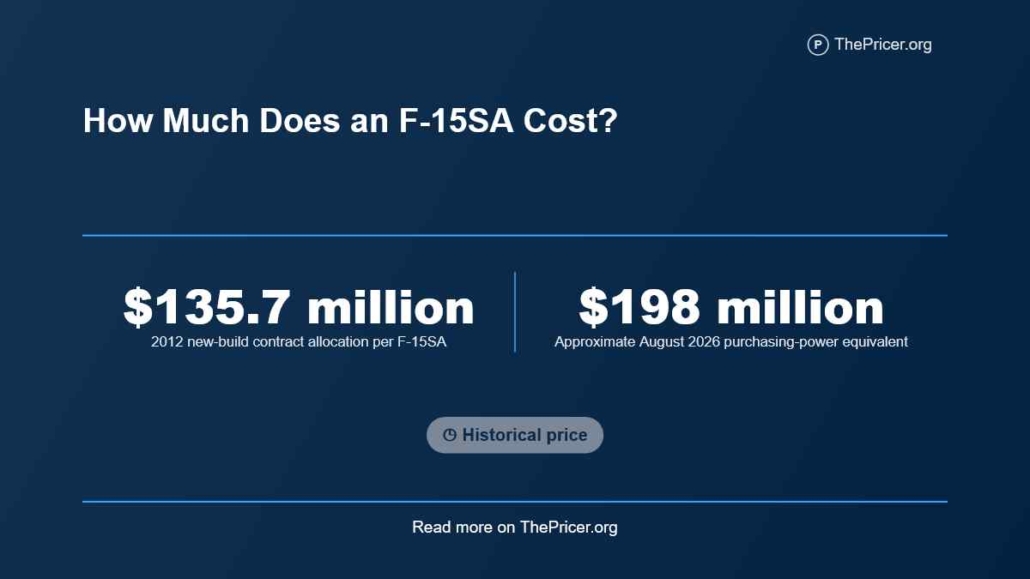
An F-15SA’s best documented new-build procurement benchmark is about $135.7 million per aircraft in 2012 contract dollars. That comes from an 11.4 billion dollar Boeing award covering development and procurement of 84 new Saudi fighters, plus associated systems and munitions.
A rough consumer-price translation puts that allocation near $198 million in August 2026 dollars, but it is not a current Boeing quote. The figure is back in focus after Yemen’s Houthis claimed on September 16 that they shot down a Saudi F-15 over Marib. Reuters reported that Riyadh had not confirmed the loss, while later wreckage analysis indicated that a Saudi F-15 was destroyed and raised an important model distinction discussed below.
Article Highlights
Jump to sections
- The 84 new F-15SAs were tied to an $11.4 billion (at $30 per hour, earning that amount would take about 183 thousand years of full-time work, before taxes) production and development contract.
- Dividing that award by 84 gives about $135.7 million per aircraft in 2012 contract dollars.
- The broader Saudi F-15 agreement was $29.4 billion, but it also covered 70 planned upgrades, weapons, training, spares and support.
- An inflation-only translation puts the new-build allocation near $198 million in August 2026 dollars.
- Saudi Arabia also received approval in 2026 for a possible $3 billion F-15 sustainment package that buys no new fighters.
How Much Does an F-15SA Cost?
The strongest aircraft-specific price anchor comes from the March 2012 contract award rather than the much larger national package. The Boeing contract was valued at $11.4 billion (about 183 thousand years of full-time work at $30 per hour) for development and procurement work on 84 new F-15SA aircraft, along with associated systems and munitions. Dividing $11.4 billion by 84 gives $135.714 million, which rounds to about $135.7 million per aircraft.
That calculation is a new-build program allocation, not a bare flyaway price. The contract itself covered more than aluminum, engines and an assembled airframe. Systems, development work and munitions were attached to the award, so the result is wider than the type of clean recurring flyaway figure sometimes published for a mature U.S. production lot. The useful conclusion is that $135.7 million is much closer to the documented value of a new Saudi aircraft than a number derived from the full national sales agreement.
The distinction matters because F-15SA pricing is still quoted in several incompatible ways. One number may describe a new-production contract. Another may allocate every weapon, upgrade and support activity in a decade-long foreign military sale across the new jets. A third may translate an old dollar value into current purchasing power. Readers comparing the Saudi aircraft with a current F-15E cost benchmark should keep those accounting scopes separate.
Full Saudi Package
Saudi Arabia’s signed Foreign Military Sales agreement was valued at $29.4 billion (about 471 thousand years of full-time work at $30 per hour), far above the $11.4 billion new-production contract. The 2011 White House description says the agreement included 84 new F-15SAs, modernization of 70 existing F-15S aircraft, munitions, spare parts, training, maintenance and logistics. The national package was a fleet-modernization program rather than an order for 84 identical bare fighters.
Dividing the whole $29.4 billion by 84 gives $350 million per new aircraft. The arithmetic is simple, but the interpretation is wrong because it allocates spending on the older Saudi fleet and non-aircraft support to the new jets. Compared with the $135.7 million new-build allocation, the $350 million result is about 2.58 times as large, or roughly 158 percent higher.
This is the main pricing trap in the F-15SA story. National fighter packages often combine aircraft with weapons, training, simulators, initial spares, technical documentation, construction and years of support. A country can sign a $29.4 billion aviation package without buying aircraft that individually cost $350 million. The same distinction appears in modern F-35 package pricing, where national acquisition totals can sit far above published flyaway values.
What Saudi Arabia Bought
The F-15SA was not simply another batch of Saudi F-15S aircraft. The U.S. Air Force’s first-flight program description identifies fly-by-wire flight controls, a Digital Electronic Warfare Suite, infrared search and track, Active Electronically Scanned Array radar, advanced cockpit displays and Joint Helmet Mounted Cueing Systems. Two additional weapon stations increased payload capacity.
Those features explain part of the cost difference between a modernized export Strike Eagle and much older F-15 price references. The buyer was paying for a new configuration with sensors, electronic warfare and flight-control changes integrated into the aircraft. The surrounding foreign military sale also funded the support network required to operate the fleet, which included training and logistics alongside the fighters.
The 84 new aircraft were only one side of the Saudi modernization effort. Existing F-15S fighters were also scheduled to receive SA-standard improvements through a separate conversion program. The result was meant to create a much larger fleet with broadly related capabilities rather than two completely different groups of Strike Eagles. That program structure is why the cost question is best answered with separate new-build, conversion and sustainment figures instead of one blended average. It also matters when valuing any aircraft loss because a new-production F-15SA and a converted Saudi F-15 can share many capabilities without having the same acquisition history.
Upgrading the Existing F-15S Fleet
The modernization of Saudi Arabia’s existing fighters had its own large contract. Robins Air Force Base announced a 3.749 billion dollar conversion award for development and procurement of kits needed to convert 70 F-15S aircraft toward the F-15SA configuration. The work also included test and evaluation, aircrew familiarization, initial spares and support equipment.
Using the original 70-aircraft plan gives an allocation of about $53.6 million per planned conversion. The calculation is $3.749 billion divided by 70. That number is not the price of a box of upgrade parts because the award covered development, testing and support activities as well as conversion kits. It still provides a useful scale for showing why the full $29.4 billion package cannot sensibly be assigned only to the 84 new aircraft.
The planned conversion count later changed as the Saudi fleet evolved. Public Air Force material tied the conversion contract to 70 existing aircraft, while later reporting commonly refers to 68 retrofitted F-15S fighters. The article keeps the $53.6 million calculation tied to the original 70-aircraft contract scope rather than silently applying that denominator to a different final fleet count. This kind of scope change is common in long defense programs and is another reason to label the date and quantity behind every per-aircraft calculation.
Fleet Costs to Support
Buying the aircraft did not end the spending. On February 3, 2026, the State Department approved a possible Saudi F-15 sustainment sale estimated at $3 billion. The 2026 sustainment notification covers spare and repair parts, consumables, ground equipment, software support, technical documentation, training, repair-and-return work and U.S. government and contractor engineering and logistics services.
That $3 billion buys no new F-15SA aircraft. Its value is about 26.3 percent of the nominal $11.4 billion new-build contract, a comparison that shows how substantial the support tail can become after aircraft enter service. It would be wrong to divide the sustainment package by 84 and add the result to the original F-15SA unit price because the 2026 case supports a broader Saudi F-15 fleet and services rather than one fixed set of new aircraft.
The support figure also has a different time horizon from aircraft acquisition. The 2026 notification is an estimated ceiling for a possible Foreign Military Sale rather than evidence that the full amount has already been obligated. The listed work can be ordered across a fleet and can cover repair pipelines, software, training and technical services over time. That makes the comparison useful for scale but unsuitable for calculating one aircraft’s annual maintenance bill. Acquisition cost, fleet sustainment and money actually obligated under later orders are separate public-money questions.
Why the F-15SA Is in the News
The F-15SA is receiving renewed attention because fighting between Saudi Arabia and Yemen’s Houthis intensified in September 2026. Reuters reported on September 16 that Houthi military spokesman Yahya Saree claimed the group had shot down a Saudi F-15 over Yemen. At the time of the Reuters conflict report, Riyadh had not confirmed the aircraft loss. Reuters also reported a wider escalation involving Saudi air operations and Houthi missile and drone attacks.
Later imagery adds evidence of an aircraft loss but does not settle every detail of the Houthi account. The War Zone’s wreckage assessment says the available imagery establishes that a Saudi F-15 was destroyed. It initially describes the aircraft as appearing to be an F-15SA, then identifies apparent tail number 5539 and says that airframe is understood to belong to the retrofitted Saudi fleet, commonly called F-15SR, rather than one of the 84 new-build jets.
That distinction matters to a cost article. The incident should not be described as a confirmed loss of one newly built $135.7 million F-15SA. A converted F-15S brought toward the SA standard has a different acquisition history. The Houthi claim about how the aircraft was lost also remains separate from the evidence that a Saudi F-15 was destroyed. The value of the incident is that it puts the cost of Saudi Eagle capability back in public focus, not that it supplies a clean replacement invoice.
F-15SA vs F-15EX and F-15QA
 Modern Eagle-family prices provide useful context if the scopes stay attached. Qatar’s 2017 F-15QA production contract was $6.1735 billion for 36 aircraft. The Defense Department Qatar award produces a simple contract allocation of about $171.5 million per aircraft. That does not prove an F-15QA had a bare flyaway price of exactly $171.5 million, but it shows that later export production awards can occupy a higher nominal price band than the Saudi 2012 contract.
The U.S. F-15EX gives a different kind of benchmark. The Air Force’s FY2025 aircraft procurement material lists a flyaway unit cost of $95.754 million for that year’s planned aircraft and a gross weapon-system unit cost of $113.137 million. The Air Force procurement budget makes those scopes explicit.
Neither benchmark replaces the F-15SA figure. The F-15QA contract is an export award from a later period with its own configuration. The F-15EX number comes from U.S. budget accounting and separates flyaway from wider weapon-system cost. Their value is comparative. They show why readers should ask whether a source is quoting a flyaway figure, a production-contract allocation or a national package before comparing fighter prices.
The F-15SA in 2026 Dollars
A purchasing-power translation can make a 2012 number easier to read today. The historical CPI-U series gives a 2012 annual average of 229.594. The BLS historical CPI table provides that input. The August 2026 CPI-U level is 334.980 in the latest BLS release.
Dividing 334.980 by 229.594 gives about 1.459. Applying that factor to the $135.7 million new-build allocation produces roughly $198 million in August 2026 consumer-price dollars. The calculation gives a purchasing-power comparison, not the price of restarting an F-15SA production line today.
Military aerospace costs can move differently from consumer inflation because engines, radar, electronic warfare hardware, software, specialized labor and production quantities have their own cost pressures.
The current F-15EX figures above demonstrate why CPI alone cannot generate a replacement quote. The $198 million result is still useful when reading a 14-year-old contract because it shows the scale of the historical commitment in today’s general price level. A procurement analyst estimating an actual replacement aircraft would need a current configuration, production lot, support scope and contract rather than a CPI multiplier.
| F-15 cost signal | Amount | What it represents |
|---|---|---|
| F-15SA new-build allocation | $135.7 million | 2012 contract dollars, new-build award divided by 84 |
| F-15SA purchasing-power translation | About $198 million | August 2026 CPI comparison only |
| Full Saudi F-15 agreement | $29.4 billion | New jets, upgrades, weapons and support |
| F-15S conversion allocation | About $53.6 million | Conversion award divided by 70 planned conversions |
| 2026 Saudi sustainment case | $3 billion | Fleet support, no new fighters |
| F-15QA production allocation | About $171.5 million | 2017 contract value divided by 36 |
What Public Numbers Cannot Tell Us
No public source reviewed here provides a clean 2026 replacement quote for one Saudi F-15SA. The $135.7 million benchmark is tied to a 2012 new-production award. The $198 million figure is a purchasing-power translation. The $29.4 billion agreement is far too broad to serve as a unit price, while the $3 billion 2026 sustainment case buys support rather than aircraft.
Operating cost is another missing layer. Saudi flight hours, maintenance practices, mission equipment, weapons expenditure and depot arrangements are not exposed in a way that permits a clean current annual cost per F-15SA. U.S. F-15E reimbursable flight-hour figures can provide Eagle-family context, but substituting those rates for Royal Saudi Air Force operating cost would create false precision.
Answers to Common Questions
How much did one new F-15SA cost?
The best documented contract allocation is about $135.7 million per aircraft in 2012 dollars, based on $11.4 billion divided across 84 new fighters. The underlying award also covered development and associated systems.
Does an F-15SA cost $350 million?
No. That figure comes from dividing the complete $29.4 billion Saudi package by 84 new aircraft even though the package also funded upgrades, munitions, training, spares, maintenance and logistics.
What would an F-15SA cost in today’s dollars?
A general CPI translation puts the historical new-build allocation near $198 million in August 2026 dollars. That is a purchasing-power comparison, not a current Boeing sale price.
Was an F-15SA shot down over Yemen in September 2026?
The Houthis claimed they shot down a Saudi F-15, and later imagery supports that a Saudi F-15 was destroyed. Riyadh had not confirmed the loss in the latest reporting reviewed. Wreckage analysis points to an aircraft in the SA-standard family but indicates the apparent tail number may belong to a retrofitted F-15S, commonly called F-15SR, rather than one of the 84 new-build F-15SAs.
Disclosure: Educational content, not financial advice. Prices reflect public information as of the dates cited and can change. Confirm current rates, fees, taxes, and terms with official sources before purchasing. See our methodology and corrections policy.