
How Much Does an Indian Wedding Cost?
Updated on | Written by Alec Pow
This article was researched using 11 sources. See our methodology and corrections policy.
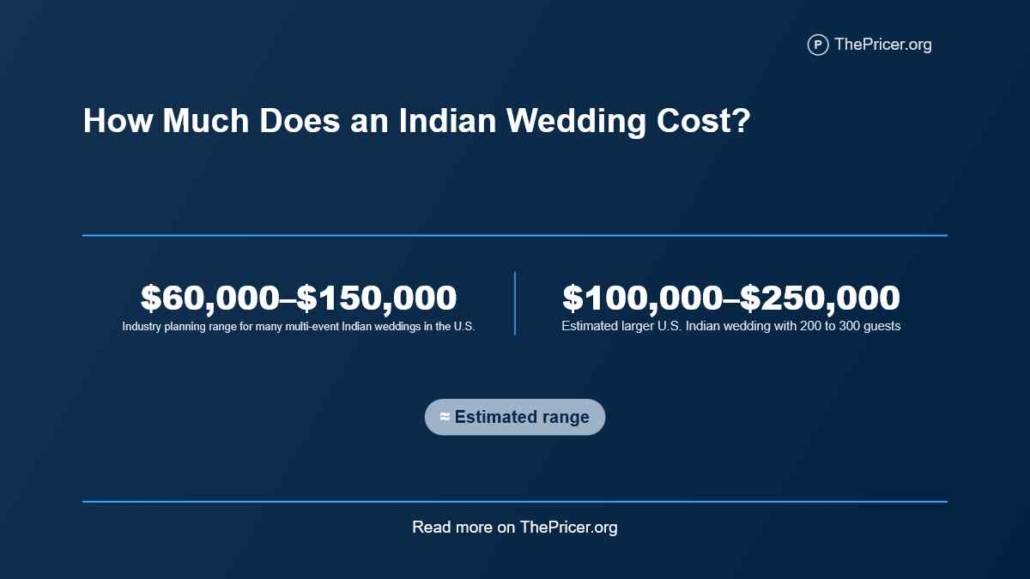
An Indian wedding in the United States can cost approximately $60,000 to $150,000 for a multi-event celebration, while larger weddings with 200 to 300 guests may require $100,000 to $250,000. Smaller gatherings can cost $30,000 to $80,000, and elaborate weddings with several hundred guests may exceed $250,000. These are 2026 industry planning ranges, not a statistically established national average for Indian weddings.
The biggest expenses are usually venues, catering across several functions, decoration, photography, entertainment, and planning. Unlike a wedding with one ceremony and reception, a South Asian wedding may involve separate mehndi, haldi, sangeet, wedding, and reception events. Each additional catered function creates its own guest count, staffing, venue, and production costs. Location and the number of people attending each function matter more than the wedding’s cultural label alone.
Article Highlights
Jump to sections
- Many U.S. multi-event Indian weddings fall within an estimated $60,000–$150,000 (at $30 per hour, earning that amount would take about 1 to 2.4 years of full-time work, before taxes) planning range; larger productions can exceed $250,000.
- Full-service Indian wedding catering commonly runs $85–$150 per guest per event, with premium menus costing more.
- PhotoKumar publishes multi-day photography and videography packages starting at $10,500.
- Spring Blooms Decor advertises wedding decoration packages from $3,999 to $10,000+.
- Published Indian wedding DJ packages start around $1,500–$7,000, depending on coverage and production.
- Repeated catering, vendor minimums, service charges, overtime, and guest accommodation create substantial additional costs.
How Much Does an Indian Wedding Cost?
Published Indian-American wedding estimates vary because they describe different guest counts, event schedules, and cities.
My Brown Wedding’s April 2026 guide estimates approximately $65,000 to $150,000 (about 1 to 2.4 years of full-time work at $30 per hour) for many U.S. Indian weddings across multiple events.
Marigold’s 2026 wedding guide estimates $100,000 to $250,000 for 200-to-300-guest weddings and $30,000 to $80,000 for smaller celebrations with 50 to 100 guests.
The ranges overlap but are not measured averages. Both are wedding-industry planning estimates, and neither establishes a representative national survey specifically of Indian-American couples.
| Wedding scope | Indicative total budget | What changes the price |
|---|---|---|
| Intimate, 50–100 guests | $30,000–$80,000 | Fewer guests, limited functions |
| Multi-event, moderate scale | $60,000–$150,000 | Two or more catered events |
| Large, 200–300 guests | $100,000–$250,000 | Several venues, large receptions |
| Luxury, 300–500+ guests | $250,000–$400,000+ | Extensive production and hospitality |
For context, The Knot’s 2026 Real Weddings Study reports average U.S. wedding spending of $34,200, based on 10,474 couples married in 2025.
That national figure is not an Indian-wedding average. It covers weddings across the country with different guest counts, traditions, and event structures. Comparing it directly with a three-day, 300-person wedding would be misleading.
Catering Across Multiple Events
Food is one of the most consequential parts of an Indian wedding budget because several functions may require separate meals.
My Brown Wedding’s April 2026 catering research estimates $85 to $150 (about 2.8 to 5 hours of work at $30 per hour) per guest for a full-service Indian buffet, including food, staffing, and basic service equipment under the quoted scope.
Its researched midrange catering prices vary by city:
| U.S. metro area | Midrange catering per person |
|---|---|
| Houston | $75–$120 |
| Dallas–Fort Worth | $80–$130 |
| Chicago | $90–$140 |
| Los Angeles | $100–$160 |
| New York / New Jersey | $110–$170 |
These figures describe catered meals, not the entire wedding. Menu complexity, live stations, beverages, service charges, taxes, and gratuity can change the invoice.
For example, a 250-person reception at $120 per guest costs $30,000 in catering before charges outside the quoted per-person rate.
Add a sangeet dinner for 150 guests at $80 each, and another $12,000 is required. The combined catering base becomes $42,000 for 400 guest-meals across the two events.
The difference between 400 guest-meals and 250 invited guests is central to budgeting. Counting only the largest event understates the food requirement.
Menus also matter. The same catering guide reports that chaat stations can add approximately $15 to $25 per guest, while additional live cooking stations require dedicated staff.
Venue, Mandap, and Floral Décor
Venue and decoration quotes should distinguish room rental from production work. A hotel may supply tables and service staff while a separate decorator provides the mandap, draping, centerpieces, entrance installations, and stage.
Zivaara Studio’s 2026 cost breakdown estimates hotel ballroom packages for 300 guests over two days around $25,000 to $60,000, while community halls and cultural centers may cost approximately $5,000 to $15,000.
These are venue-market estimates, not directly comparable quotes for the same services. In particular, catering and room rental may be combined in hotel packages.
For a documented decorator example, Spring Blooms Decor publishes:
- Silver Blossoms, basic mandap and ten centerpieces: from $3,999
- Golden Marigold, custom mandap, florals, and 25 centerpieces: from $5,500
- Royal Heritage, expanded custom décor: from $10,000
- Separate celebration decoration package: from $1,200
The packages include different quantities and services. A starting price for a basic mandap is not evidence that a custom ceiling installation or heavily floral wedding costs the same amount.
Weddings.io’s North American analysis estimates large full-service décor productions around $25,000 to $120,000, showing how far heavily customized design can differ from a modest package.
Mandaps are relevant to many Hindu ceremonies, but the appropriate ceremonial setting varies by faith and community. A Sikh Anand Karaj, Muslim nikah, or other South Asian ceremony does not necessarily use the same décor or venue setup.
Photography, Video, and Music
Several days of celebrations require more coverage hours than a single-day wedding. Vendors may charge per event, per day, or through a combined package.
PhotoKumar in Dallas publishes one-event photography packages starting at $3,500, wedding-day photo-and-video coverage starting at $7,500, and complete multi-day photo-and-video coverage starting at $10,500.
Its multi-day option identifies haldi, mehndi, sangeet, wedding, and reception coverage. Exact hours and staffing require a customized quote.
My Brown Wedding’s photography research places multi-day photography commonly around $5,000 to $10,000, with comprehensive photography and videography reaching $10,000 to $20,000.
Entertainment can involve the reception DJ, MC, dhol player, ceremony sound, lighting, and separate performances.
DJ Anjna’s published packages begin at $1,500 for DJ and sound, rise to $4,000 for DJ, MC, and reception lighting, and reach $7,000 for broader wedding production.
The $7,000 package includes coverage across ceremony, baraat, cocktail hour, and reception with additional production services. It should not be compared directly with a DJ-only booking.
Mehndi, Clothing, and Other Costs
Bridal mehndi is a distinct service from inexpensive guest designs. Coverage, artist time, location, and the number of guests receiving henna can change the cost.
ThePricer’s henna tattoo pricing guide, updated in August 2026, documents bridal packages around $350 to $800 at some U.S. providers and event artist rates around $85 to $175 per hour.
Outfits also need an event-by-event budget. A bride or groom may purchase or rent clothing for several functions rather than only one ceremony outfit.
Zivaara’s Indian-American wedding research estimates bridal clothing for multiple events at approximately $2,000 to $10,000+, with substantial variation for designer garments and custom work.
Jewelry should be treated separately from clothing. Purchased gold jewelry may retain material value, and family-owned pieces may be worn without a new purchase. Counting the full value of inherited jewelry as current wedding expenditure would exaggerate the cash budget.
For related individual purchases, ThePricer’s wedding shoes guide and designer wedding dress guide illustrate how accessory and designer prices differ from the complete celebration budget.
Worked Budget for 200 Guests
Consider an illustrative U.S. Indian wedding with a 200-person ceremony and reception, a 150-person sangeet, and a 60-person family mehndi gathering.
The following assumptions use the range of published catering, vendor, and package prices examined. They are not a documented wedding invoice.
| Expense | Modeled cost |
|---|---|
| Reception catering: 200 × $110 | $22,000 |
| Sangeet catering: 150 × $75 | $11,250 |
| Mehndi refreshments: 60 × $25 | $1,500 |
| Venue rentals across events | $12,000 |
| Décor, florals, and mandap | $9,000 |
| Multi-day photo and video | $10,500 |
| Music, DJ, and sound | $4,000 |
| Attire and beauty services | $5,000 |
| Planning and coordination | $5,000 |
| Invitations, officiant, and miscellaneous | $2,000 |
| Base vendor subtotal | $82,250 |
| Illustrative 15% contingency | $12,337.50 |
| Modeled planning total | $94,587.50 |
The $12,000 venue allocation, $5,000 attire and beauty allocation, and other rounded allowances are assumptions rather than matched provider quotations. The contingency is a reserve, not a confirmed tax or service-charge calculation.
This example excludes guest hotel rooms, purchased jewelry, a honeymoon, and any charges already outside the chosen package terms.
The modeled wedding has 410 catered guest-meals across three functions, although the largest event contains only 200 people.
Its $34,750 catering subtotal represents approximately 42% of base vendor spending before contingency. This illustrates why counting meals across events is essential.
The Hidden Cost of Guest Hospitality
One of the largest uncertainties is whether the hosts pay for guests’ rooms, transportation, or only the events themselves.
Marigold’s 2026 guide estimates guest accommodation allowances around $5,000 to $20,000 in some Indian-American weddings, depending on the number of rooms and nights covered.
For example, 40 hotel rooms at an assumed $150 per night for two nights cost $12,000 before hotel taxes, resort fees, or parking.
Adding that expense to the modeled $94,587.50 wedding raises the planning figure to $106,587.50, approximately 13% more.
Other quote omissions may include vendor meals, venue service charges, gratuities, overtime, travel, equipment rentals, power, cleanup, and additional event staffing.
Wedding planners can help coordinate these obligations but add their own fees. My Brown Wedding’s April 2026 planner guide estimates $3,500 to $35,000 across different planning service levels.
Before comparing proposals, identify charges included in each package so that catering service fees, rental charges, or décor labor are not counted twice.
Reducing the Wedding Budget

Preserving meaningful ceremonies does not require every function to have identical guest counts, catering complexity, or venue spending.
Makes sense if
- Creating a separate guest count and meal budget for every event.
- Using smaller family gatherings for functions that do not require the entire guest list.
- Comparing combined multi-event vendor packages against separate bookings.
- Reusing suitable décor where setup and transport costs make it economical.
- Reviewing catering minimums, staffing, service charges, and room-block obligations before signing.
Does not make sense if
- Multiplying the reception’s guest count by one catering rate and treating it as the complete food budget.
- Applying a one-day photography quote to three days of coverage.
- Assuming a décor package includes unlimited flowers or multiple separate events.
- Including jewelry, honeymoon, or guest hotels in one estimate but excluding them from a competing estimate.
One additional hundred guests at a reception catering rate of $110 per person adds $11,000 in base food costs alone. Limiting guest-count growth can therefore have a larger impact than reducing inexpensive accessories.
Answers to Common Questions
How much does an Indian wedding cost in America?
Industry planning estimates place many multi-event celebrations around $60,000 to $150,000. Larger 200-to-300-guest productions may cost $100,000 to $250,000, depending on venue, catering, and location.
How much does a 300-person Indian wedding cost?
A large U.S. multi-event celebration can reach approximately $100,000 to $250,000 or more. The number of guests at each separate catered event is important, not merely the wedding-day count.
How much does Indian wedding catering cost per person?
Full-service Indian wedding catering commonly runs around $85 to $150 per person per event, with higher-priced metro markets and premium live-station menus costing more.
Is an Indian wedding always several days long?
No. Ceremonies and celebrations vary by family, faith, region, and personal preference. Some are consolidated into a single day, while others involve multiple functions.
Who pays for an Indian wedding?
There is no universal arrangement. Couples and families may contribute in different proportions or divide expenses by function. The financial plan should reflect actual agreements rather than assumptions about tradition.
What is the biggest way to save?
Reducing the number of catered guest-meals is often highly effective. For example, 100 fewer reception meals at $110 per person reduce the modeled catering subtotal by $11,000 before any related staffing or service adjustments.
Disclosure: Educational content, not financial advice. Prices reflect public information as of the dates cited and can change. Confirm current rates, fees, taxes, and terms with official sources before purchasing. See our methodology and corrections policy.