
How Much Does an M109A7 Self-Propelled Howitzer Cost?
Updated on | Written by Alec Pow
This article was researched using 14 sources. See our methodology and corrections policy.
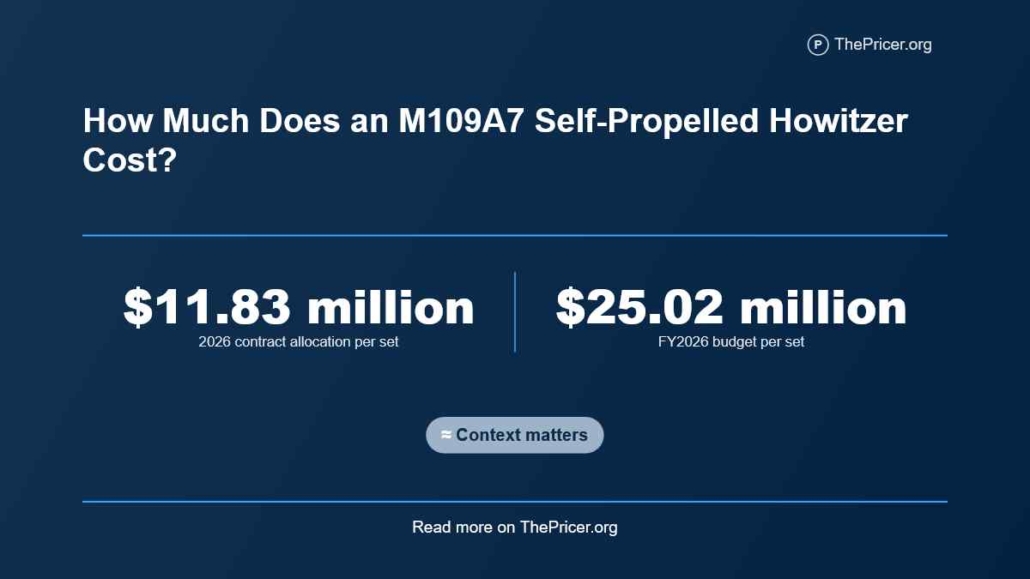
The best recent divisible contract benchmark for an M109A7 Paladin is about $11.83 million per two-vehicle set. That figure comes from a $473 million U.S. Army production award for 40 sets announced in January 2026. Each set contains one M109A7 155mm self-propelled howitzer and one M992A3 Carrier Ammunition Tracked vehicle, plus contract support. An exact stand-alone price for the M109A7 howitzer itself is not publicly broken out.
A broader Army procurement budget can look much higher. The FY2026 request contained $250.2 million for 10 Paladin sets, equal to about $25.02 million per budgeted set. That is not evidence that one physical howitzer suddenly costs $25 million. The contract and budget figures cover different scopes, which is the main reason published M109A7 “unit prices” can vary so widely.
Article Highlights
Jump to sections
- A January 2026 production award works out to about $11.83 million (at $30 per hour, earning that amount would take about 190 years of full-time work, before taxes) per M109A7/M992A3 set.
- The FY2026 Army procurement request works out to about $25.02 million per set when its broader program funding is divided by 10 sets.
- A Paladin set contains two tracked vehicles, not one M109A7 alone.
- A comparable 2022 award for 40 sets averaged about $7.48 million per set.
- The 2026 contract allocation is about 58% above the 2022 allocation, although changes in contract scope mean that is not a pure inflation measure.
- A separate five-year M109 fleet sustainment contract is worth up to $318 million.
- The latest $535 million 2026 production award does not disclose a set quantity, so it cannot support a clean unit-price calculation.
How Much Does an M109A7 Self-Propelled Howitzer Cost?
BAE Systems announced on January 21, 2026 that the Army had awarded $473 million (about 7.6 thousand years of full-time work at $30 per hour) for 40 additional Paladin sets. The 40-set production award states that each set includes the M109A7 howitzer and its M992A3 ammunition-loading vehicle. Dividing $473 million by 40 gives $11.825 million per set.
That is the cleanest recent public calculation because both contract value and quantity are disclosed. It still is not a bare M109A7 factory price. The same award includes technical support packages, post-production refurbishment, and welding-compliance work. The correct description is a $11.83 million contract allocation per complete Paladin set.
The Army’s own procurement planning supports a similar manufacturing-scale number. Its FY2026 justification book lists a FY2024 manufacturing quantity of 42 sets with a unit manufacturing cost of about $11.80 million. The Army procurement justification identifies Paladin Integrated Management as a paired M109A7 and M992A3 system.
Army Budget Shows $25 Million
The FY2026 weapons-system summary gives a very different number. The Army requested $250.2 million (about 4 thousand years of full-time work at $30 per hour) in procurement for 10 PIM sets, according to the FY2026 weapon-system budget. Dividing the procurement line by 10 yields about $25.02 million per budgeted set.
That number answers a different question from the $11.83 million contract allocation. Procurement appropriations can carry program-level costs tied to fielding, government support, kits, production activity, and related procurement work. A contract award reflects the scope awarded under that contract. Dividing both totals by vehicle quantity and calling both numbers “the price of an M109A7” erases the difference between those scopes.
The same pattern appears in FY2025. The Department of Defense listed $417.741 million for 20 Paladin sets in the President’s Budget, equal to roughly $20.89 million per budgeted set. The FY2025 procurement exhibit records the quantity and total directly. That budget-derived figure should not be substituted for a manufacturer price.
One Paladin Set
The M109A7 price question has an unusual unit problem. The Army buys Paladin Integrated Management as a two-vehicle system. One half is the M109A7 Self-Propelled Howitzer. The other is the M992A3 Carrier Ammunition Tracked vehicle, which moves ammunition and supports the gun in the field.
The Army’s acquisition portfolio describes the M109A7 and M992A3 together as the Paladin family-of-vehicles package. The M109A7 supplies the 155mm firing platform, while the CAT supports ammunition handling and resupply. The two share modernized automotive components and are fielded together.
This means a $11.83 million set allocation represents two major armored vehicles and associated contract work. It cannot responsibly be halved and presented as a $5.91 million M109A7 price. The two vehicles are not known to cost equal amounts, and the award also contains support items that do not belong to either vehicle alone.
The distinction resembles the problem found in many defense contracts. A launcher, aircraft, or armored vehicle can sit inside a package containing support equipment, spares, training, fielding, and other systems. The same issue appears in current HIMARS procurement pricing, where package totals can be many times the budgeted launcher figure.
Contract Allocations
A July 2022 BAE Systems award provides a useful earlier comparison. The company received $299 million for 40 M109A7 and M992A3 sets, including delivery and spare parts. The 2022 Paladin contract works out to about $7.475 million per set.
Compare that with the January 2026 allocation of $11.825 million. The difference is $4.35 million per set, or about 58.2%. Across 40 sets, the difference between the two proportional contract totals is $174 million.
That 58.2% figure should not be labeled four years of Paladin price inflation. The 2022 award included production, delivery, and spare parts. The 2026 award includes production plus technical packages, refurbishment, and welding work. Quantities match, which makes the comparison useful, but inclusions do not match perfectly.
The Army has also cited lower production quantities and higher economic rates as reasons for manufacturing-cost changes. Its earlier procurement history showed FY2022, FY2023, and FY2024 manufacturing estimates moving as quantities and market conditions changed. A defense production line does not produce a fixed retail sticker price independent of annual volume.
The Latest $535 Million Award
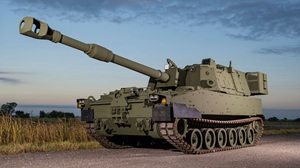 BAE announced another $535 million Paladin production award in June 2026. The June production contract covers additional M109A7 howitzers and M992A3 ammunition carriers, but the public announcement does not state how many sets are attached to the award.
Without quantity, dividing $535 million by a guessed number of vehicles would create a false unit price. This is why the January $473 million award remains the better current divisible benchmark even though it is not the newest contract total.
The missing quantity also matters because the Army’s Paladin purchasing plan has changed during 2026. Janes reported that work tied to the $535 million contract is expected in 2029 and that the Army’s FY2027 request contains no new Paladin sets.
A large contract issued near the end of a production run can fund deliveries, production continuity, components, and other work spanning several years. Its headline value is valuable program evidence. It is not enough to calculate a price for one howitzer.
Sustainment
Buying the vehicle sets does not cover the full cost of operating the fleet. In 2024 BAE Systems received a contract worth up to $318 million over five years to support M109A6 and M109A7 howitzers and their companion ammunition carriers. The five-year sustainment award covers engineering, logistics, maintenance support, testing, and new capability work.
A simple annual allocation would be about $63.6 million per year, but that is not an M109A7 annual maintenance price. The contract covers multiple M109 variants and companion vehicles across the fleet. Fleet size, workload, individual task orders, and engineering activity are not apportioned equally to every howitzer.
Hidden cost range. A realistic Paladin budget must extend beyond the production set into fielding kits, ammunition, maintenance, depot work, engineering support, crew training, transport, fuel, replacement components, and future modifications. Public documents provide substantial totals for some of these categories, but they do not support one credible lifetime-cost figure for an individual M109A7.
This is similar to armored-vehicle procurement more broadly. A modern battle tank package can appear several times more expensive than a vehicle-only benchmark once ammunition, engineering vehicles, spares, training, and support are included.
An 18-Howitzer Battalion
Army writing on Paladin operations says an M109A7 battalion consists of 18 howitzers divided among three batteries. The Army’s Paladin operations analysis also lists a 42-projectile combat load per howitzer and describes the battalion structure.
Using the January 2026 contract only as a proportional benchmark, 18 complete Paladin sets would represent about $212.85 million. The arithmetic is 18 × $11.825 million. That modeled amount contains 18 M109A7s, 18 M992A3 carriers, and a proportional share of the support scope in the 40-set award.
A six-howitzer battery under the same assumption comes to about $70.95 million for six paired sets. Three such batteries produce the $212.85 million battalion-equivalent figure.
This is an illustrative contract allocation, not an Army quote for forming a new battalion. It excludes separately funded ammunition, personnel, training infrastructure, communications systems, transport equipment, fuel, and other unit costs. Applying the broader FY2026 budget allocation of $25.02 million per set to the same 18-set quantity would produce about $450.4 million. The gap between $212.85 million and $450.4 million shows how much the chosen procurement scope can alter a seemingly simple “cost per battalion” calculation.
M109A7 vs Other Weapons
The January contract allocation of $11.83 million per paired Paladin set is higher than the Army’s current launcher-level budget benchmark for HIMARS, which is about $7.77 million. The difference is roughly $4.06 million, or 52%. That does not mean the M109A7 itself costs 52% more than a HIMARS launcher because the Paladin number contains two tracked vehicles and contract support.
The comparison is still useful because it exposes the unit problem. HIMARS pricing can refer to a launcher, while Paladin acquisition normally refers to an M109A7 plus M992A3 set. Comparing those numbers without naming what each buys creates a false equipment ranking.
Another comparison comes from directed-energy and missile-defense programs, where system totals often include radars, power equipment, command systems, support vehicles, and development work. The same scope discipline used for an Iron Beam system cost applies here. Contract total divided by headline platform count is useful only after the package contents are identified.
The M109A7 is also a modernization of an existing weapon family rather than a wholly separate artillery concept. The Army reused the M109A6 armament and cab structure while introducing a new chassis and automotive architecture with components common to the Bradley family. That procurement history helps explain why one simple new-build consumer-style price does not exist.
Production close to End Point
The Army is now planning beyond the Paladin production line. Breaking Defense reported in April 2026 that Army leaders were asking lawmakers to support ending new Paladin purchases as the service pursues a lighter self-propelled cannon. The reporting cites $715 million received for 40 Paladins in FY2026 while the FY2027 request moves away from additional set procurement.
The Army’s FY2027 justification material says FY2026 is the final year of production contract awards, with later funding focused on vehicle fielding as the program moves into sustainment. That means the $11.83 million contract allocation should be read as a late-production benchmark, not a guaranteed price available for future unlimited orders.
Production ending also changes the meaning of “replacement cost.” If an M109A7 is lost years after new production stops, its accounting value, depot replacement path, and cost of the Army’s successor system can differ from the historical production-set allocation. A 2026 contract number does not remain a permanent replacement quote.
The Army still plans to operate the Paladin family for years. The FY2026 weapon-system document lists a planned acquisition objective of 689 PIM sets and sustainment through 2050. Ending new procurement does not mean the vehicles already fielded immediately disappear from armored formations.
What we verified
- Checked the July 2024 DoD award record and confirmed that M109A7 and M992A3 production contracts obligate Army tracked-combat-vehicle procurement funds.
- Confirmed through the Army production justification record that the planned production vehicle set contains one M109A7 and one M992A3, along with fielding and depot-support work.
- Cross-referenced the program’s historical status with the Army’s first-production delivery record, which confirms that the A7 replaced the M109A6 as the Army’s modernized Paladin variant.
Answers to Common Questions
How much does an M109A7 Paladin cost?
The best recent divisible production benchmark is about $11.83 million per complete Paladin set from a $473 million award for 40 sets. Each set includes an M109A7 and an M992A3 ammunition carrier, so this is not a stand-alone howitzer price.
Why do some M109A7 cost estimates exceed $20 million?
Army procurement budgets contain broader program costs. The FY2026 request contained $250.2 million for 10 sets, equal to about $25.02 million per budgeted set. That figure covers a different scope from the production-contract allocation.
How much did Paladin sets cost in 2022?
A $299 million award for 40 sets produced a proportional allocation of about $7.48 million per set. The contract included production, delivery, and spare parts.
Does the M109A7 price include ammunition?
The public production contracts discussed here cover the M109A7, M992A3, and specified support items. They should not be read as an all-in artillery-unit price with a complete ammunition stockpile, personnel, fuel, training, and infrastructure included.
Is the Army still buying new M109A7s?
Production awards continued in 2026, including a $535 million award announced in June. Army FY2027 planning points toward ending new Paladin set purchases and moving the program toward fielding and sustainment while a lighter successor is pursued.
Disclosure: Educational content, not financial advice. Prices reflect public information as of the dates cited and can change. Confirm current rates, fees, taxes, and terms with official sources before purchasing. See our methodology and corrections policy.