
How Much Does an MH-139A Grey Wolf Helicopter Cost?
Updated on | Written by Alec Pow
This article was researched using 14 sources. See our methodology and corrections policy.
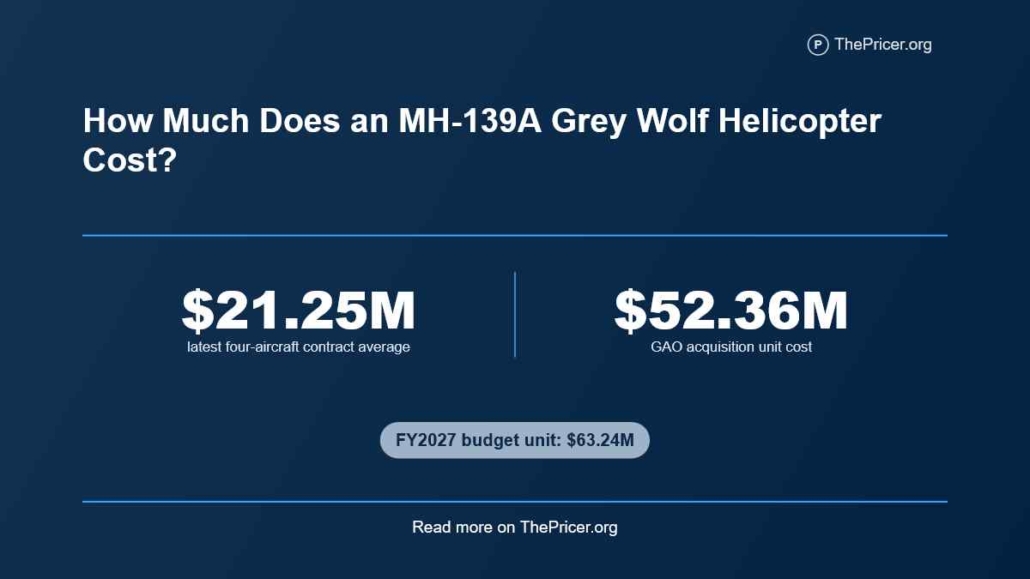
An MH-139A Grey Wolf can look like a roughly $21.25 million helicopter in the latest production contract, a $36.98 million procurement aircraft in current program math, a $52.36 million acquisition unit in GAO reporting, or a $63.237 million weapon-system unit in the Air Force’s FY2027 budget. All four numbers can be valid because they measure different slices of the same program.
The newest full-rate production order covers four helicopters for roughly $85 million, including some sustainment work. The Air Force budget tells a very different story because it also funds training, support equipment, depot activation, contractor support, site work and other fielding costs. The MH-139A is a Boeing-militarized version of Leonardo’s AW139 commercial helicopter, built for nuclear missile-field security, transport and related Air Force missions.
Article Highlights
Jump to sections
- The September 2026 full-rate order is roughly $85 million (at $30 per hour, earning that amount would take about 1.4 thousand years of full-time work, before taxes) for four Grey Wolves, or about $21.25 million per ordered helicopter before separating the included sustainment work.
- The FY2027 Air Force budget lists a $63.237 million gross weapon-system unit cost for a four-aircraft lot.
- Only about $22.34 million per aircraft of that FY2027 request is the calculated flyaway subtotal. Support and fielding account for about 64.7% of the full line.
- GAO puts current program acquisition cost at $2.932 billion, equal to $52.36 million per acquisition unit across 56 units.
- The planned fleet fell from 80 aircraft to 56, which reduced total acquisition cost but pushed unit cost higher because development and other program costs were spread across fewer helicopters.
- The original 2018 contract was worth up to $2.38 billion and was reported as $1.7 billion below the Air Force’s earlier cost estimate.
How Much Does an MH-139A Grey Wolf Helicopter Cost?
The first full-rate lot gives the lowest current headline. Defense News reported that Boeing’s September 25, 2026 award covered $85 million for four aircraft, included some sustainment work, raised the total under contract to 42 and followed 27 deliveries. Divided evenly, the award is about $21.25 million (about 341 years of full-time work at $30 per hour) per ordered helicopter.
GAO’s July 2026 assessment uses a broader measure. It reports $2.932 billion across 56 acquisition units and $1.849 billion in procurement for 50 production helicopters, with a reported acquisition unit cost of $52.36 million. Procurement alone works out to about $36.98 million per production aircraft.
| Cost view | Published amount | Calculated per-helicopter figure | What it measures |
|---|---|---|---|
| Latest full-rate contract | $85 million for 4 | About $21.25 million | Four aircraft plus some sustainment |
| FY2027 flyaway subtotal | $89.36 million for 4 | About $22.34 million | Airframe and contractor-furnished equipment plus other flyaway costs |
| GAO procurement average | $1.849 billion for 50 production aircraft | About $36.98 million | Program procurement cost spread across production quantity |
| GAO acquisition unit cost | $2.932 billion across 56 units | $52.36 million | Development plus procurement and other acquisition costs |
| FY2027 gross weapon-system unit | $252.949 million for 4 | $63.237 million | Annual budget lot with major support and fielding costs |
For a production-contract headline, about $21 million is defensible. For a fully burdened annual budget lot, the figure can exceed $60 million.
What the Grey Wolf Actually Buys
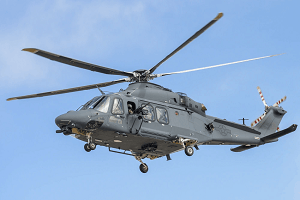
The MH-139A is not a clean-sheet military helicopter. Leonardo builds the underlying AW139 at its Philadelphia production line, then transfers the aircraft to Boeing in Ridley Park for military equipment installation and integration. Leonardo’s low-rate production announcement describes that split and identifies the AW139 as the commercial foundation.
The military version has to do work the commercial aircraft does not. It supports security forces protecting intercontinental ballistic missile sites and convoys, moves personnel and cargo, and carries military communications, defensive equipment and mission-specific systems. That integration changes both the aircraft configuration and the accounting around it. A commercial airframe price cannot be substituted for an MH-139A procurement figure.
The Air Force also buys more than helicopters. Training systems, support and test equipment, technical data, initial spares, depot capability and contractor support appear across program documents. Readers comparing the Grey Wolf with a civilian helicopter purchase are looking at a different cost basket. Military fielding has infrastructure, training and sustainment layers that do not sit on a civilian dealer invoice. The commercial lineage reduces the amount of basic aircraft development needed, but it does not remove the cost of turning that aircraft into a military system.
Contract Lots Tell Different Stories
Recent production lots cluster much more tightly than the program-level figures suggest. The 2023 low-rate lot was $285 million for 13 aircraft plus sustainment and support, which works out to about $21.92 million (about 351 years of full-time work at $30 per hour) per ordered helicopter.
Boeing’s October 2025 release records a prior $178 million seven-aircraft award and a new $173 million-plus eight-aircraft award, both with support services. Simple division gives about $25.43 million and at least $21.63 million per aircraft. A January 2026 order added four more helicopters and pushed the combined value of those two newest awards above $262 million.
The latest four-aircraft full-rate order returns to about $21.25 million per helicopter by simple division. The cluster around $21 million to $25 million is useful for recurring lot scale, but each award mixes aircraft and support differently. The narrow lot range is much more stable than the broader program-unit figures because it excludes many fielding and acquisition layers.
Why FY2027 Looks So Expensive
The Air Force’s FY2027 procurement book lists $252.949 million for four aircraft, $66.64 million in airframe and contractor-furnished equipment, $22.72 million in other flyaway costs and $163.589 million in support. It prints a $63.237 million gross weapon-system unit cost.
The same budget shows $66.64 million for airframe and contractor-furnished equipment, or $16.66 million each. Other flyaway costs lift the flyaway subtotal to $89.36 million, about $22.34 million per aircraft.
Support drives the jump. The FY2027 line contains $163.589 million in support costs, about 64.7% of the full request and 1.83 times the flyaway subtotal. Interim contractor support alone is $75.22 million.
Worked FY2027 total
- Airframe and contractor-furnished equipment was $66.64 million
- Other flyaway costs were $22.72 million
- Flyaway subtotal was $89.36 million
- Support subtotal was $163.589 million
- Gross weapon-system cost was $252.949 million
- Gross weapon-system unit cost across four was $63.237 million
A roughly $21 million contract average and a $63.237 million budget unit are not contradictory. The latter carries major fielding and support costs.
Program Cost per Acquisition Unit
 GAO uses another accounting layer. Its 2026 weapon-systems assessment lists $1.849 billion in procurement and $734 million in development, with 50 procurement aircraft and six development aircraft. Total acquisition cost is reported at $2.932 billion and unit cost at $52.36 million in fiscal 2025 dollars.
Dividing procurement cost alone by the 50 production helicopters gives about $36.98 million per aircraft. The reported acquisition unit cost of $52.36 million is about $15.38 million, or 41.6%, higher than that procurement-only average. That gap reflects the broader program denominator and costs beyond production procurement. It should not be interpreted as an extra fee attached to each delivered helicopter.
The result also explains why a program-level price can remain far above a recurring contract lot even after production matures. Development, testing, training systems and other acquisition spending do not disappear just because the next physical helicopter is cheaper to build. A similar accounting problem appears when comparing the Black Hawk helicopter cost or the Apache helicopter cost, where budget, contract and program unit figures answer different questions.
The Fleet Cut
The Grey Wolf’s unit-cost story changed when the Air Force reduced the planned fleet. GAO’s 2025 assessment says the fleet fell from 80 to 56 while acquisition cost dropped from $3.337 billion to $2.923 billion and unit cost rose from $41.71 million to $52.20 million. Fewer aircraft were left to absorb costs that do not fall in direct proportion to quantity.
The June 2024 Selected Acquisition Report shows how serious that change became. It records unit-cost growth after the quantity cut and the resulting Nunn-McCurdy breach. The later program of record settled at 56 total units, with GAO describing 50 procurement aircraft and six development aircraft.
This is a quantity problem as much as a manufacturing-price problem. Cutting 30% of the fleet did not cut 30% of development, program management, training-system and integration costs. A smaller buy can lower the total check while making each reported acquisition unit more expensive.
GAO’s 2026 update put acquisition cost at $2.932 billion and unit cost at $52.36 million, almost unchanged from the prior assessment. The program has moved into full-rate production, so the current cost question is now less about whether the helicopter will enter service and more about how the remaining fleet and support structure are funded.
The Original Contract
The 2018 award describes an older and broader plan. The Air Force announced a $2.38 billion firm-fixed-price contract for up to 84 helicopters and an initial $375 million four-aircraft award, against an earlier service estimate of $4.1 billion. The larger contract also covered training devices, support equipment and sustainment.
Dividing $2.38 billion by 84 gives about $28.33 million, but that is not a reliable current unit price. The contract covered more than airframes, assumed the exercise of options, and was tied to a fleet plan that has since changed. Dividing the first $375 million award by four gives an even more misleading $93.75 million per helicopter because the initial action carried integration and program-start work.
The contrast with the latest four-aircraft order is striking. The first four-aircraft award was about $375 million, while the latest four-aircraft full-rate order is roughly $85 million. The contract headline has fallen about 77%, but that does not mean Boeing cut the price of the same four helicopters by 77%. The two awards contain very different stages of program work.
The original deal was still a major acquisition win at award. Air Force officials said the service’s earlier estimate was $4.1 billion, so the $2.38 billion contract was about $1.7 billion lower, a reduction of roughly 42% from that estimate.
Which Price Should You Use?
Use roughly $21 million to $22 million when discussing current production-lot contracts. That is close to a recurring aircraft-plus-limited-support figure, not a bare airframe price.
Use $36.98 million for current procurement cost spread across 50 production helicopters, $52.36 million for GAO’s acquisition-unit metric, and $63.237 million for the FY2027 budget lot.
Boeing’s September 2026 production update says 27 helicopters had been delivered, four more entered the production queue, and the program had cleared full-rate production and Initial Operational Capability.
The safest shorthand is to state the cost label first, then give the number, rather than presenting one figure as a universal helicopter price.
Use the production-lot figure when
- Comparing current Boeing aircraft orders.
- Discussing recurring aircraft-plus-limited-support contract scale.
- Matching one production lot against another production lot.
Do not use that figure when
- Estimating the full cost to field a squadron.
- Describing development and acquisition cost across the program.
- Comparing a contract award with a fully burdened annual budget line.
Military aircraft do not have one sticker price. Contract lots, annual budgets and program acquisition metrics measure different cost baskets, so the label must stay attached to the number.
Answers to Common Questions
How much does one MH-139A Grey Wolf cost?
A current production-lot contract points to roughly $21 million to $22 million per ordered helicopter, while broader procurement and acquisition accounting produces figures from about $37 million to more than $63 million per unit depending on included costs.
Why does the Air Force budget show $63 million per helicopter?
The FY2027 line includes far more than the aircraft. Training, support equipment, depot activation, contractor support and other fielding expenses push the four-aircraft request to $252.949 million, or $63.237 million per unit.
How much is the entire MH-139A program expected to cost?
GAO’s latest public assessment lists total acquisition cost at about $2.932 billion for 56 units in fiscal 2025 dollars.
How many MH-139A helicopters will the Air Force buy?
The current program of record is 56 units. GAO describes that as 50 procurement aircraft plus six development aircraft.
Is the MH-139A just a military AW139?
It uses the Leonardo AW139 as its commercial foundation, but Boeing adds military-specific equipment and integration. The Air Force also buys training, support and fielding capability that is not part of a normal commercial helicopter purchase.
Disclosure: Educational content, not financial advice. Prices reflect public information as of the dates cited and can change. Confirm current rates, fees, taxes, and terms with official sources before purchasing. See our methodology and corrections policy.