
How Much Does an NFL Football Cost?
Updated on | Researched and reviewed by Alec Pow, Founder & Pricing Investigator
Prices, claims, and calculations checked against 14 cited sources. See our research methodology and corrections policy.
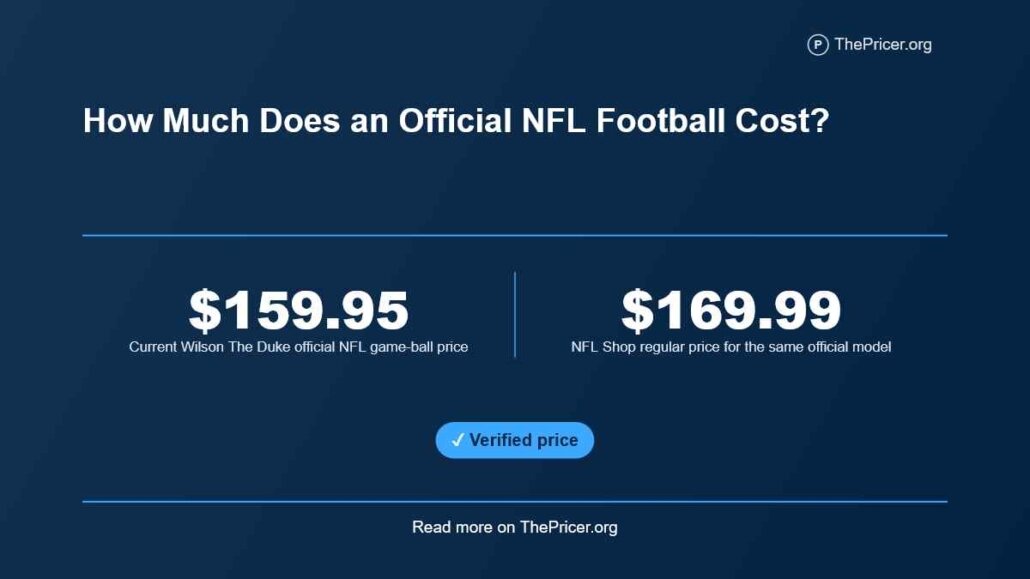
The actual Wilson “The Duke” football sold as the NFL’s official game-ball model costs $159.95 direct from Wilson’s current Duke lineup. NFL Shop shows a regular price of $169.99 for the same official leather game-ball model on its NFL Shop Duke listing. Cheaper NFL-branded footballs are different products.
Composite team balls, mini replicas, recreational models, special editions, and signed collectibles can all carry an NFL logo without being the leather ball model specified for league play. For someone asking what the real NFL football costs, the useful answer is about $160 to $170 new, before sales tax or optional accessories.
Article Highlights
Jump to sections
- The current Wilson “The Duke” costs $159.95 direct from Wilson.
- NFL Shop currently lists the official leather game-ball model at $169.99.
- Official-size composite NFL team footballs can cost about $38.99.
- Mini NFL replica footballs can cost about $16.99.
- Current authenticated signed Duke examples can reach roughly $650 to $1,100+.
- The Duke costs about 4.1 times as much as one current official-size composite team football.
What Counts as the NFL Ball
“Official NFL football” can mean two different things in retail conversations. The first is Wilson “The Duke,” the leather model built to the league’s specifications. The second is any football carrying official NFL licensing, such as a team-logo composite ball. Those products can have similar dimensions and NFL branding while using different cover materials, construction, or intended use. They should not be priced as if they are interchangeable.
The 2026 NFL rulebook devotes Rule 2 to the ball and requires a Wilson football meeting league dimensions, weight, leather-cover, and inflation specifications. That league standard is the reason a consumer asking for the same model associated with NFL games should start with The Duke rather than a generic “official-size” football. Official size describes dimensions. It does not mean NFL game-ball construction.
There is another distinction between a retail Duke and a football with documented NFL game use. Buying the commercial Duke model does not give the ball game-used provenance. Retail is not game-used. That difference matters most for collectors, because a new retail Duke should not be described or valued as a game-used football merely because it is the official model.
How Much Does an Official NFL Football Cost?
The current product ladder runs from inexpensive replicas to the leather Duke. DICK’S Sporting Goods lists a Wilson mini replica at $16.99 and multiple Wilson composite official-size team footballs at $38.99 on its current NFL football listings. Wilson’s NFL team football catalog currently spans models from $20.96 for a sale-priced Team Tailgate ball to $49.95 for the Sandstone Series.
| Football type | Current price example | Best fit |
|---|---|---|
| Mini NFL replica | $16.99 | Display, gifts, collecting |
| NFL team recreational ball | $20.96 to $49.95 | Casual throwing and team branding |
| Official-size composite team ball | $38.99 | Backyard play with adult-size dimensions |
| Wilson “The Duke” | $159.95 | Buyer wanting the official NFL game-ball model |
These categories answer different buying questions. A mini replica is mainly a fan item. An official-size composite can be practical for backyard use because it gives an adult-size feel without the cost or care needs of leather. The Duke is the choice for someone who wants the actual Wilson model tied to NFL game specifications. Price follows product class, not the presence of an NFL shield alone.
The Duke vs Replica Footballs
The biggest pricing mistake is treating “official size” as another way to say “official NFL game ball.” DICK’S currently sells official-size Wilson composite team footballs for $38.99, yet The Duke costs $159.95 from Wilson. Both can be full adult size. The difference is the material, construction, league-game specification, and intended buyer rather than size alone.
Using those two current prices, The Duke costs $120.96 more than the $38.99 composite ball. Divide $159.95 by $38.99 and the leather Duke is about 4.1 times the price. That calculation gives a backyard player a useful decision threshold. If the goal is simply throwing a full-size NFL-branded football with friends, the composite option preserves about $121 of the budget. If the goal is owning the NFL’s official game-ball model, that savings comes from buying a different product.
The same distinction applies to other football equipment. A fan display item and competition equipment can look similar while serving different purposes. Anyone building a playing setup can compare the ball purchase with the cost of a football helmet. Buyers shopping across sports can also compare how regulation equipment differs from fan products through soccer goal prices and golf ball costs.
Why The Duke Costs More
The Duke is a leather game ball rather than a printed composite fan football. Wilson describes a six-step manufacturing process involving cutting, stamping, sewing, turning, lacing, molding, and inspection on its NFL football manufacturing page. Four leather panels stay together through production, the shell is sewn inside out, the ball is turned by hand, a bladder is inserted, and the finished football is laced and inspected.
That production helps explain why material alone does not tell the whole price story. Wilson also sells other leather game footballs below or near the Duke’s price, while composite NFL fan balls can cost a fraction as much. The buyer is paying for the particular NFL model, its leather construction, its manufacturing process, and its connection to league specifications. A leather ball from another competition level is not automatically an NFL football.
The higher price also brings different maintenance expectations. Natural leather changes with use and conditioning, while composite covers are easier for casual owners who do not want a break-in routine. The Duke makes more financial sense when the specific model matters. Paying the premium solely because a cheaper composite ball is assumed to be the wrong size would be based on a false comparison.
Custom and Special Editions
Customization adds another product class. Wilson’s current football customizer allows buyers to personalize an NFL Duke with team treatment, logo style, and text. Wilson does not show one universal final custom price on the main customizer page because the configuration changes the order. That makes the old idea of a fixed $120 to $300 custom-football range too broad to publish as a current standard.
Special-edition pricing also proves that “The Duke” name by itself does not identify one material or one price. Wilson’s special-edition football catalog currently shows a Wilson x Post Malone Tailgate Football marked down to $47.97 from $79.95, while a sold-out special-edition Duke is listed at $159.95. These are commemorative or collaboration products, not substitutes for the standard Duke solely because the names look similar.
A buyer ordering personalization should compare the configured checkout price with the standard $159.95 Duke price already established. Custom text or graphics may be valuable for a retirement gift, coach gift, team award, or display piece, but personalization does not create autograph provenance. A custom message from the factory is not the same thing as a player-signed football with third-party or retailer-backed authentication.
Autographed NFL Footballs

Signed footballs belong in the memorabilia market, not the equipment market. NFL Shop’s current collectible football listings include authenticated Duke examples at $649.99 for a Joe Burrow and Ja’Marr Chase signed ball, $699.99 for a Drake Maye signed Duke, $849.99 for a Joe Montana and Jerry Rice signed Duke, and $1,099.99 for a Jalen Hurts Super Bowl LIX Champions Duke with an inscription. These are current asking prices for named collectibles, not an average for every autograph. Price spreads are large.
A separate Fanatics listing prices a Terry Bradshaw signed Duke with a Hall of Fame inscription at $999.99 and states that the piece carries an individually numbered, tamper-evident hologram in its tamper-evident authentication details. Player, inscription, authentication, ball type, condition, scarcity, and edition size can all change collectible value.
Compare the $999.99 Bradshaw example with the standard $159.95 Duke. The signed collectible costs $840.04 more, or about 6.25 times the direct retail Duke price. Most of that premium is tied to the collectible and signature, not to a better football for playing catch.
Buyer Cost Comparison
A useful purchase plan depends on what the ball will do after it arrives. Consider a fan who wants one authentic Duke to keep in good condition and a cheaper full-size ball for backyard throwing. The standard Duke costs $159.95, while the current official-size composite example costs $38.99. Buying both creates a pre-tax total of $198.94.
The itemized math is simple. The display or collection Duke contributes $159.95. The play ball contributes $38.99. Together they cost $198.94, excluding sales tax and any retailer-specific shipping. That setup costs only $38.99 more than buying the Duke alone, yet it gives the owner a separate ball for rougher use. For someone who wants to preserve the leather ball, the extra composite purchase can be cheaper than treating the Duke as both a collectible and a heavily used backyard ball.
A different buyer should spend differently. Someone who only wants an NFL-branded gift can stay near $17 to $50 with mini, tailgate, or team-logo options. A player who cares about the NFL model can spend around $160 to $170. A memorabilia buyer may spend hundreds or more because authentication and the signer become the central pricing attributes. These are separate markets, and putting them into one $20 to $500 range hides the decision that actually changes the bill.
Care and Buying Decision
Leather Duke care should not be copied from generic synthetic-ball cleaning advice. Wilson’s leather football preparation guidance says to keep water away from the leather and lace holes, avoid soap on leather, use a football-safe brush, and condition the ball with products made for leather football preparation. That conflicts with advice to rinse a Duke under clean water or scrub it with household soap.
Composite footballs are less demanding for casual use. The buyer should still follow the care instructions for the exact material rather than assuming that every NFL-branded ball has a leather cover. A Duke kept mainly for display needs less field preparation than one used for repeated throwing sessions. A signed ball should be treated as memorabilia and protected from handling that could damage the signature or authentication elements.
Makes sense if
- You want the same commercial Wilson Duke model associated with NFL game specifications.
- You value genuine leather construction and the Ada-made manufacturing process.
- You are buying a display or gift item where the model itself matters.
- You accept the extra care that leather footballs require.
Does not make sense if
- You only need an inexpensive ball for casual backyard throwing.
- A $38.99 official-size composite already meets your size and use needs.
- You are paying extra for an autograph without reliable authentication.
- You expect a retail Duke to be an actual game-used NFL football.
Answers to Common Questions
How much does the official NFL football cost?
The Wilson “The Duke” official NFL game-ball model currently costs $159.95 direct from Wilson, while NFL Shop shows a regular price of $169.99.
What football does the NFL use?
The NFL uses a Wilson football built to league specifications. The retail model associated with NFL game play is Wilson “The Duke.”
How much is a cheaper NFL replica football?
Current NFL-branded mini and recreational footballs can cost about $16.99 to $49.95, while one current official-size composite team ball costs $38.99.
How much does an autographed NFL football cost?
Current authenticated Duke examples can cost roughly $650 to $1,100+, with prices changing sharply by signer, inscription, authentication, condition, and scarcity.
Is The Duke worth buying for backyard play?
It depends on whether owning the actual NFL game-ball model matters to you. A current official-size composite at $38.99 costs about $121 less and can be a more practical casual-use choice.
Disclosure: Educational content, not financial advice. Prices reflect public information as of the dates cited and can change. Confirm current rates, fees, taxes, and terms with official sources before purchasing. See our methodology and corrections policy.