
How Much Does an Oil Tanker Cost?
Published on | Written by Alec Pow
This article was researched using 15 sources. See our methodology and corrections policy.
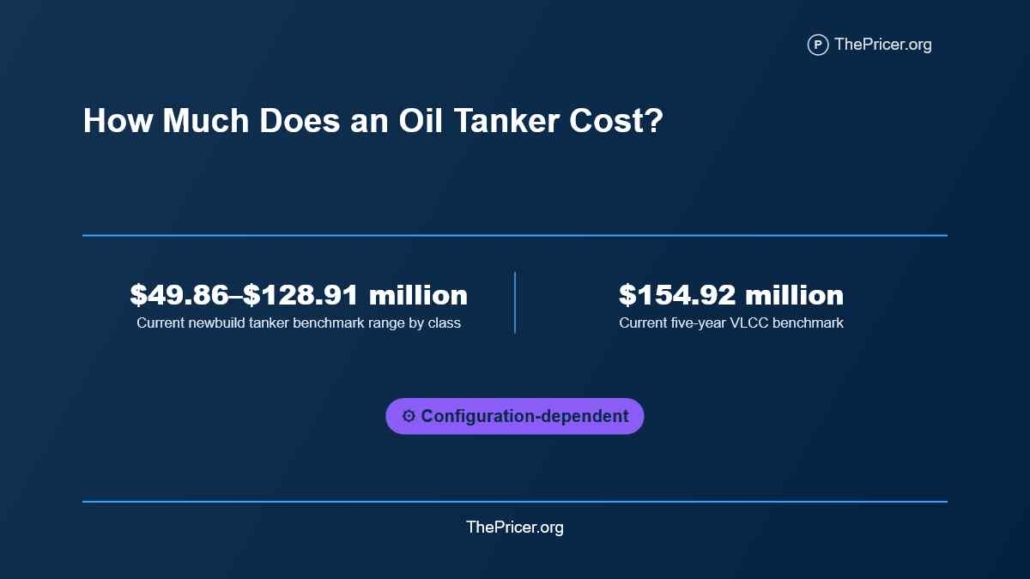
A new commercial oil tanker in the international market currently costs about $49.86 million for a 50,000-dwt MR product tanker up to about $128.91 million for a 320,000-dwt VLCC, based on September tanker price benchmarks from Korea Ocean Business Corporation. Suezmax, Aframax, LR2, and LR1 newbuilds sit between those endpoints.
Actual contracts can move above or below the benchmarks because shipyard, delivery date, cargo systems, scrubbers, fuel-efficiency specifications, and transaction structure differ.
The purchase price is only one layer of tanker economics. A buyer may pay more for a young secondhand ship than for a nominal newbuild because the used vessel can trade sooner. The September 2026 U.S.-Iran war has also made route access and prompt tanker availability unusually important around the Strait of Hormuz, where September 9 shipping data showed commodity-vessel traffic below its recent average. Operating expenses, financing, voyage costs, drydocking, and insurance continue after delivery, and they should not be folded into a single unsupported ownership figure.
Article Highlights
Jump to sections
- A 50,000-dwt MR newbuild benchmark is $49.86 million (at $30 per hour, earning that amount would take about 799 years of full-time work, before taxes).
- A 160,000-dwt Suezmax newbuild benchmark is $86.95 million.
- A 320,000-dwt VLCC newbuild benchmark is $128.91 million.
- A five-year VLCC benchmark is $154.92 million, which is above the matching newbuild benchmark.
- One current operator reported Daily Opex of $9,936 per day in Q2 2026, including technical management fees.
How Much Does an Oil Tanker Cost?
The table below uses KOBC’s September 3, 2026 tanker newbuilding assessments, all stated in U.S. dollars. Because every class comes from the same dated source, the comparison avoids mixing ship prices from different years or market cycles. The figures are market benchmarks rather than guaranteed shipyard quotations for every owner.
| Tanker class | Benchmark size | Newbuild price |
|---|---|---|
| MR product tanker | 50,000 dwt | $49.86 million (about 799 years of full-time work at $30 per hour) |
| LR1 product tanker | 74,000 dwt | $60.92 million |
| Aframax crude tanker | 110,000 dwt | $75.69 million |
| LR2 product tanker | 110,000 dwt | $77.40 million |
| Suezmax crude tanker | 160,000 dwt | $86.95 million |
| VLCC crude tanker | 320,000 dwt | $128.91 million |
The 110,000-dwt comparison shows why deadweight alone does not determine cost. The Aframax benchmark is $75.69 million while the LR2 benchmark is $77.40 million. They have the same displayed deadweight but different commercial roles and vessel specifications. The $1.71 million gap is small beside the full asset value, yet it is large enough to show that a simple dollars-per-ton rule cannot replace class-specific pricing.
Newbuild price also does not mean immediate ownership. Shipbuilding contracts commonly have milestone payments tied to signing, steel cutting, keel laying, launching, and delivery. The buyer may commit to the full vessel price years before the ship starts earning revenue, which makes delivery timing part of the economic cost.
Tanker Classes and Capacity
Oil tankers are priced by more than hull length. The most useful commercial measure is deadweight, written as dwt, which expresses how much weight the ship can carry including cargo, fuel, stores, and other load. The current tanker market commonly separates smaller product carriers such as MR and LR1 from larger LR2, Aframax, Suezmax, and VLCC vessels. The classes do different jobs, so a single average tanker price hides the trade and capacity the buyer is actually purchasing.
MR and LR product tankers are designed to carry refined products such as gasoline, diesel, jet fuel, and related liquid cargoes. Aframax, Suezmax, and VLCC vessels are strongly associated with crude transportation, though exact employment depends on vessel specification and commercial use. Two ships with similar deadweight can still have different values because cargo systems, coatings, pumps, emissions equipment, yard quality, and fuel consumption differ.
Capacity also changes route flexibility. A VLCC carries much more than an MR tanker but cannot simply replace one on every voyage or at every terminal. A buyer comparing commercial ships should match the price to the intended trade first. Readers comparing tankers with other commercial vessels can use the cargo ship cost page for broader ship context, but container and dry-bulk vessels have different revenue models and equipment.
What Used Tankers Cost
KOBC’s September secondhand tanker table shows how strongly age and availability affect value. A five-year VLCC is assessed at $154.92 million (about 2.5 thousand years of full-time work at $30 per hour), a ten-year VLCC at $127.25 million, and a resale VLCC at $173.09 million. For Suezmaxes, the matching figures are $96.97 million, $82.72 million, and $116.22 million.
The same pattern is less extreme for smaller product tankers. A five-year LR1 is $59.66 million against a newbuild benchmark of $60.92 million, while a five-year MR is $48.91 million against $49.86 million new. Ten-year values fall further to $48.00 million for LR1 and $38.37 million for MR.
Age should still be treated as one input rather than a complete valuation formula. Survey status, drydock timing, engine condition, cargo coatings, emissions equipment, yard, charter attachment, and maintenance history can move a specific vessel away from a market benchmark.
A ten-year ship with costly work approaching may need a larger economic discount than its sale price suggests. A young ship with prompt availability can command a premium when earnings are strong. Buyers also need to check whether a quoted resale value reflects an existing vessel, a shipbuilding contract being resold before delivery, or a vessel carrying an attached charter.
Real 2026 Purchase Deals
Current transactions show how negotiated prices move around the benchmark table. Bruton signed four 319,000-dwt VLCC contracts at $124.75 million per vessel, with deliveries scheduled through 2028. Frontline agreed to acquire nine latest-generation scrubber-fitted ECO VLCC newbuildings for $1.224 billion in total. An equal division gives $136 million per vessel, though the transaction is a package acquisition rather than nine separately negotiated identical prices.
Navios gives another VLCC example. It agreed to acquire three scrubber-fitted newbuild VLCCs for $361.5 million in aggregate, equal to $120.5 million per vessel under a straight division. These three VLCC deal groups span about $120.5 million to $136 million per ship on their disclosed package math, but that is a selected transaction band, not an industry average.
Suezmax and MR deals show the same variation. Performance Shipping ordered two 158,000-dwt Suezmaxes at $81.5 million each. Hafnia contracted eight MR product tankers for about $405 million total, equal to about $50.625 million each under an even split. The deal evidence is most useful when the vessel size, delivery year, equipment, and transaction type remain attached to the number. Removing those details turns a documented contract into a weak market comparison.
Why Used Can Cost More
The current VLCC market reverses the usual assumption that a five-year asset must be cheaper than a new one. Using the September 3 benchmarks already cited, the five-year VLCC value of $154.92 million exceeds the $128.91 million newbuild benchmark by $26.01 million. Dividing that difference by the newbuild value gives a premium of about 20.18 percent. A buyer is paying more for an older hull, but also for a vessel that can enter service far sooner than a fresh shipyard order.
The Suezmax and Aframax benchmarks show smaller versions of the same effect. Five-year Suezmax value is $96.97 million versus $86.95 million new, a $10.02 million premium. Five-year Aframax value is $82.71 million versus $75.69 million new, a $7.02 million premium. By comparison, five-year MR and LR1 values sit slightly below their newbuild benchmarks.
Current freight and security conditions help explain why prompt ships have financial value. The U.S. Energy Information Administration reported that Middle East VLCC rates reached their highest level since its series began in 2005 after Iran’s March 2026 closure of the Strait of Hormuz reduced available tanker capacity and pushed war-risk insurance and physical-risk costs higher. That freight spike does not guarantee future vessel values, but it shows why immediate earning capacity can command a premium during a tight market.
The security problem remains active in September. Reuters reported that several merchant vessels were damaged by disabling fire in the northern Gulf and Gulf of Oman during overnight military activity on September 9. That kind of disruption can reduce effective tanker availability and raise the commercial value of ships that can trade on safer or accessible routes. It does not mean a shipyard’s newbuild construction price rises by the same amount or on the same timetable.
Cost per Ton of Capacity
Larger tankers cost more in total dollars but less per unit of deadweight capacity. Using the same newbuild figures from the main table, an MR works out to about $997 per dwt, an LR1 to about $823 per dwt, an Aframax to about $688 per dwt, an LR2 to about $704 per dwt, a Suezmax to about $543 per dwt, and a VLCC to about $403 per dwt. These are ThePricer calculations based on assessed ship price divided by benchmark deadweight.
The MR figure is about 2.48 times the VLCC figure on this capital-cost normalization. That result makes the scale advantage visible. A VLCC costs more than twice as much as an MR in total, but it offers more than six times the displayed deadweight. Large crude carriers spread major hull, machinery, navigation, and regulatory costs across much greater carrying capacity.
Cost per dwt is useful for scale analysis, not for deciding which ship is best for a route. Deadweight includes more than saleable cargo, and product tankers require cargo-handling systems that differ from crude carriers. Port limits, parcel sizes, voyage length, customer requirements, draft restrictions, and cargo segregation can make a smaller ship commercially preferable even when its capital cost per dwt is higher.
Operating Cost After Purchase
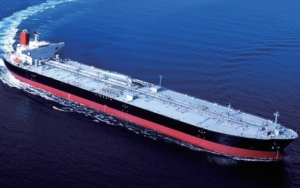 Buying the hull does not end the owner’s cash requirements. Okeanis Eco Tankers reported Q2 2026 Daily Opex of $9,936 per calendar day across its modern VLCC and Suezmax fleet, including management fees. The company defines Daily Opex as vessel operating expenses plus technical management fees divided by calendar days. It reports voyage expenses separately, so the figure is not a complete cost for sailing a loaded tanker from one port to another.
An illustrative first-year calculation can combine the current VLCC newbuild benchmark with that documented fleetwide Opex measure. Annualized routine Opex is $9,936 multiplied by 365 days, or $3,626,640. Add that to the $128.91 million VLCC acquisition benchmark and the result is $132,536,640, or about $132.54 million, for capital plus one year of that reported Opex measure.
The annualized Opex equals about 2.81 percent of the purchase benchmark. This worked amount excludes financing cost, bunker and other voyage expenses, commissions, drydock projects, off-hire, taxes, and any buyer-specific acquisition expense. It is a bounded capital-plus-routine-Opex example, not a universal first-year ownership total. For comparison with another oil-industry capital asset, the oil rig cost page separates asset purchase from daily commercial rates in a similar way.
What Changes the Price
Shipyard and delivery position can move the price before the vessel enters service. Bruton’s contracts use staged payments and leave 50 percent due at delivery, while Performance Shipping’s Suezmax contracts leave 55 percent due at delivery. A buyer comparing two headline contract values should also compare when cash is due and when the vessel can start earning. Financing cost can differ even when the nominal ship prices are close.
Specification matters as well. Scorpio Tankers disclosed two scrubber-fitted MR newbuilds at $46.25 million per vessel under a letter of intent, while the same announcement covered four 2014-2015 LR2 sale agreements totaling $285.8 million. Dividing the package produces $71.45 million per ship, but the company did not assign an individual sale price to each vessel.
Age, survey position, efficiency, coatings, cargo systems, scrubbers, alternative-fuel readiness, engine condition, charter attachment, and current freight earnings can all alter what a rational buyer pays. Immediate delivery can outweigh depreciation in a strong market, while an older vessel approaching major drydock work can carry costs that are not visible in the purchase price.
Makes sense if
- The selected class matches the intended crude or refined-product trade.
- A young secondhand premium is justified by earlier revenue availability.
- The buyer has modeled financing, operating costs, and route-specific voyage expenses separately.
- The vessel specification fits expected ports, cargoes, and emissions requirements.
Does not make sense if
- The comparison assumes every used tanker should cost less than a newbuild.
- An MR product tanker and a VLCC are treated as interchangeable assets.
- A temporary freight-rate surge is treated as a permanent earnings level.
- The shipyard contract price is treated as the complete cost of ownership.
Answers to Common Questions
How much does a new oil tanker cost?
Current international benchmarks run from about $49.86 million for a 50,000-dwt MR product tanker to about $128.91 million for a 320,000-dwt VLCC.
How much does a VLCC oil tanker cost?
The September 3, 2026 newbuild benchmark is $128.91 million. Selected 2026 public VLCC transaction groups work out from about $120.5 million to $136 million per vessel on their disclosed package math.
Is a used oil tanker cheaper than a new one?
Not always. A five-year VLCC benchmark is currently $154.92 million, which is $26.01 million above the matching $128.91 million newbuild value.
How much does an oil tanker cost to operate each day?
One current large-tanker operator reported fleetwide Daily Opex of $9,936 per day in Q2 2026, including management fees. That measure excludes separately accounted voyage expenses and should not be treated as a universal tanker operating rate.
Does the tanker purchase price include the oil cargo?
No. The vessel price buys the ship or the rights under a shipbuilding or resale transaction. The crude oil or refined products carried aboard are separate commercial cargo with their own value.
Disclosure: Educational content, not financial advice. Prices reflect public information as of the dates cited and can change. Confirm current rates, fees, taxes, and terms with official sources before purchasing. See our methodology and corrections policy.