
How Much Does an Online Degree Cost?
Published on | Written by Alec Pow
This article was researched using 14 sources. See our methodology and corrections policy.
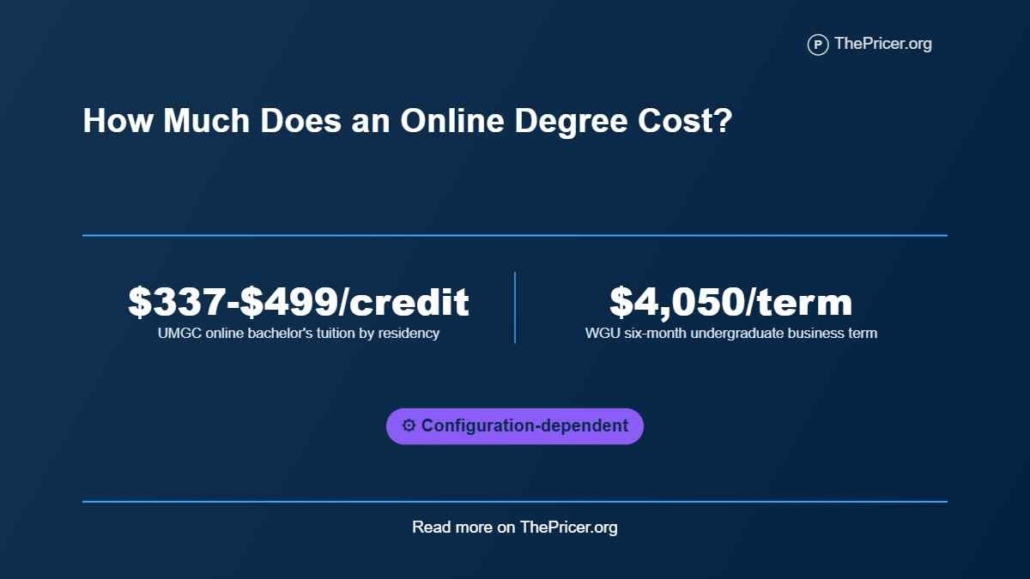
Among the U.S. schools reviewed, current online bachelor’s tuition includes $337 per credit for Maryland residents and $499 per credit for out-of-state students in UMGC’s General Studies program, which lists resident and nonresident tuition. WGU prices an undergraduate business term at $3,850 tuition plus a $200 e-books and resources fee per six-month term, or $4,050 total. These are different billing units, not the endpoints of a national price range.
Southern New Hampshire University (SNHU) and University of Maryland Global Campus (UMGC) use per-credit undergraduate pricing, Penn State World Campus moves full-time students to semester pricing, Arizona State University, or ASU, combines tuition with load-dependent fees, Purdue Global uses quarter credits, Oregon State Ecampus varies some rates by program, and Western Governors University (WGU) charges by six-month term. Together, these schools show why an online degree cannot be compared on one advertised number alone.
The final bachelor’s degree total can shift with residency, major, enrollment load, accepted transfer work, completion pace, grants, and employer benefits. A useful comparison measures the cost to finish the requirements you still need, plus mandatory fees, rather than multiplying one advertised rate by a generic credit count. Direct tuition, required school charges, living-cost allowances, and aid should remain separate until the last step so two programs are compared on the same basis.
Article Highlights
Jump to sections
- SNHU lists 2026-27 online undergraduate tuition at $354 (at $30 per hour, earning that amount would take about 1.5 full-time workdays, before taxes) per credit.
- Penn State World Campus charges a semester flat rate once an undergraduate reaches 12 credits.
- ASU’s Fall 2026 resident online tuition stops rising after 11 credits, although required fees can continue to rise.
- WGU Business Management currently costs $4,050 per six-month term after its resource fee.
- The maximum Federal Pell Grant for 2026-27 is $7,395 for eligible students.
How Much Does an Online Degree Cost?
The table compares published undergraduate prices without forcing them into one billing unit. It is a snapshot of selected providers, not a national average. Degree totals still depend on program requirements, accepted transfer work, future price changes, and required charges outside the base tuition line. SNHU publishes 2026-27 online tuition at $354 (about 1.5 full-time workdays at $30 per hour) per credit. The Penn State, Purdue Global, and UMGC figures use the official schedules cited in the surrounding text.
| School | Published undergraduate price | Billing scope |
|---|---|---|
| Southern New Hampshire University | $354 per credit | 2026-27 online undergraduate rate |
| Penn State World Campus | $644 to $692 per credit | 2026-27 part-time undergraduate rate based on accumulated credits |
| Purdue Global | $371 per quarter credit | Standard online undergraduate programs with some program exceptions |
| UMGC General Studies | $337 per credit in state and $499 per credit out of state | 120-credit online bachelor’s program |
The table also shows why a raw price sort can mislead. The displayed figures mix semester credits, quarter credits, residency categories, and load-based caps. A comparison should preserve each school’s actual billing unit until the remaining degree requirements are known. Converting too early can create a tidy spreadsheet that does not match the registrar’s bill. The useful output is the price of the credits or paid terms still required for the same academic endpoint.
How Schools Charge Tuition
Per-credit billing is the easiest model to recognize, but even that model has variations. Some schools use semester credits and others use quarter credits. Purdue Global lists standard undergraduate tuition at $371 (about 1.5 full-time workdays at $30 per hour) per quarter credit. Other schools switch from per-credit billing to a flat semester amount once a student reaches a defined course load. Multiplying every displayed credit rate by 120 can produce a false comparison because the units and caps are not equivalent.
Flat-term pricing changes the question from “How many credits cost money?” to “How many paid terms will I need?” If a program permits more coursework within one paid term, completion pace becomes part of the price calculation. A student who needs extra terms pays for those terms even if the degree itself has not added a new credit requirement. That makes a term count estimate necessary before comparing flat-term tuition with a per-credit school.
Enrollment load can also create a break point. Penn State World Campus publishes part-time undergraduate tuition of $644 per credit for students with 59 or fewer accumulated credits and $692 per credit at 60 or more when taking 11 or fewer credits. At 12 through 19 credits, the respective semester prices are $7,833 and $8,455. A 15-credit schedule is not billed as 15 times the part-time rate.
What Online Degree Cost Includes
An online degree price has at least three layers. Tuition is the charge for instruction. Required school fees can cover technology, student services, matriculation, graduation, or other institutional costs. A college’s cost of attendance adds planning allowances such as books, housing, food, transportation, and personal expenses. Those living-cost allowances are useful for aid and budgeting, but they are not the same thing as the amount billed for online tuition.
The cleaner comparison starts with direct billed costs. Add tuition for the credits or terms you expect to need, then add mandatory program and school fees. Keep living expenses in a separate household budget unless the school actually bills them. That separation matters for online students who may keep their current housing and commute costs while studying. A campus cost-of-attendance figure can make an online program look much more expensive than the direct invoice.
Net price is different again. Grants, scholarships, military benefits, or employer help can lower what a student pays. Loans change the timing of payment, not the price itself. The student affordability toolkit can help turn annual tuition and personal expenses into a monthly planning figure after the school bill has been identified.
Fees Beyond the Headline Rate
Tuition can sit beside charges that appear at admission, registration, or the start of a student’s first term. Oregon State Ecampus provides a clear current example. For 2026-27, it sets regular undergraduate tuition at $409 per credit including a $15 per-credit distance education fee, lists a one-time undergraduate matriculation fee of $450, and prices listed online business programs at $438 per credit.
That structure shows why fee treatment belongs in the same worksheet as tuition. A fee already embedded in the advertised rate should not be added again. A one-time charge should be added once rather than multiplied by semesters. A program differential belongs only to the majors that carry it. Those distinctions prevent double counting while keeping real mandatory charges in view.
Materials need the same treatment. Check the program’s required-material list and identify which items are already bundled into a billed charge. Do not assign a made-up book allowance to every provider. Add only the costs that remain outside tuition and required resource fees. The related paralegal certificate cost guide applies the same separation to a shorter credential with tuition, materials, school fees, and optional certification expenses.
Residency and Enrollment Load
Residency can still affect an online bill. Using the UMGC General Studies rates cited above, $499 minus $337 gives a $162 per-credit residency gap. Over 30 assumed credits at those same rates, the tuition difference would be $4,860. Residency can also interact with load-based tuition caps, which can make a straight per-credit multiplication miss the actual term bill. The effect can recur across multiple enrolled terms. For repeated full loads, the billing rule can outweigh the usefulness of the advertised single-credit figure.
For Undergraduate College Fee 1, ASU lists 15-credit resident charges that contain $6,089 in resident tuition, a $330 college fee, a $78 student-initiated fee, and a $100 advanced technology fee. The itemized total is $6,597. A ThePricer calculation using 15 times $580 would produce $8,700, overstating that resident bill by $2,103.
The matching ASU table prices the same nonresident load at $9,208 for the 15-credit load and fee category. That is $2,611 above the resident total. This is a term-specific comparison, not a promise about every ASU major, because college fee categories differ. It shows why residency and enrollment load belong in the same calculation.
Transfer Credits and Completion Pace
 Transfer credit can cut the remaining bill, but the useful number is accepted credit that applies to the new degree. UMGC allows up to 90 transfer credits toward its 120-credit online Applied Technology degree. That maximum does not mean every applicant will receive 90 usable credits. The receiving school still decides how prior coursework fits the degree requirements.
A simple SNHU scenario shows the size of that variable. Assume a 120-credit bachelor’s student has 60 accepted credits that all satisfy degree requirements, leaving 60 credits. Using the table’s current $354 per-credit rate, remaining tuition is 60 times $354, or $21,240. This scenario isolates tuition and does not add fees or materials that would depend on the student’s actual program and course choices. It is arithmetic, not a forecast of one student’s transfer evaluation.
Term-priced programs react to pace instead. Using the WGU undergraduate business inputs cited near the start of the article, one current six-month term totals $4,050. Four assumed terms at that rate cost $16,200. Six assumed terms cost $24,300. Two extra terms add $8,100. Those term counts are illustrative assumptions, not completion promises, but the arithmetic shows why time to completion is a direct price driver under flat-term billing.
Aid Can Change the Net Cost
Published tuition is a starting figure for students who qualify for aid. Federal Student Aid states that the maximum Federal Pell Grant for 2026-27 is $7,395 and that Pell funds can be used at eligible online schools. Pell eligibility and the amount awarded depend on the federal aid calculation and enrollment conditions, so the maximum should not be subtracted from every online program by default.
Employer educational assistance can reduce an employee’s personal cost through a different channel. The IRS reported in April 2026 that qualifying Section 127 benefits up to $5,250 can be excluded from an employee’s gross income for calendar year 2026. Check your own employer plan for reimbursement timing, grade rules, eligible programs, and whether payment occurs before or after the course.
Sticker tuition, direct billed cost, and personal net cost should stay separate on a comparison sheet. That distinction also matters in campus pricing. The Pratt Institute cost analysis separates tuition from broader attendance budgets. For an online student, the same method prevents housing estimates or borrowed money from being mistaken for a tuition discount.
How to Compare Two Programs
Start with the same academic endpoint. Compare two bachelor’s programs only after checking the credits each requires and how many of your existing credits each school accepts toward those requirements. Then normalize the billing unit. Semester credits, quarter credits, flat semesters, and six-month terms should not share a single per-credit column unless the conversion is valid for the program being priced.
Build one direct-cost total for each school using remaining tuition, mandatory school fees, program charges, required materials, and completion charges. Keep grants and employer help on separate lines so you can see both sticker cost and expected personal cost. Use the current academic-year schedule, then allow room for future rate changes when the program spans several years. Price alone should not replace checks on program fit, accreditation, graduation outcomes, debt, and career goals.
Makes sense if
- You have a written transfer evaluation or a reasonable credit estimate from each school.
- You can compare the same remaining degree requirements under each billing model.
- You have identified mandatory fees and material costs outside tuition.
- You can sustain the course load assumed in a flat-term or full-time tuition calculation.
Does not make sense if
- You multiply every advertised credit rate by 120 without checking caps or credit systems.
- You treat a maximum transfer allowance as guaranteed accepted credit.
- You subtract the maximum grant before confirming personal eligibility.
- You compare a term-priced program with a per-credit program without estimating completion pace.
Answers to Common Questions
How much does an online bachelor’s degree cost?
There is no single U.S. price. Current examples in this review range from $337 per credit for UMGC Maryland residents to higher per-credit rates and flat-term models. The useful total depends on remaining credits, fees, residency, and billing method.
Is online college cheaper than campus college?
It can be, especially when a student avoids relocation or commuting costs, but delivery format alone does not set tuition. Compare direct tuition and fees for the same degree, then keep personal living costs separate.
Do transfer credits lower online degree cost?
Accepted credits can lower the remaining tuition when they satisfy degree requirements. A school’s maximum transfer allowance is not a guarantee that every prior course will apply.
Can financial aid pay for an online degree?
Eligible students at eligible online schools can use federal aid. The 2026-27 maximum Pell Grant is $7,395, but each student’s award depends on federal eligibility and enrollment factors.
Disclosure: Educational content, not financial advice. Prices reflect public information as of the dates cited and can change. Confirm current rates, fees, taxes, and terms with official sources before purchasing. See our methodology and corrections policy.