
How Much Does an RAF Hawk T2 Cost?
Published on | Written by Alec Pow
This article was researched using 11 sources. See our methodology and corrections policy.
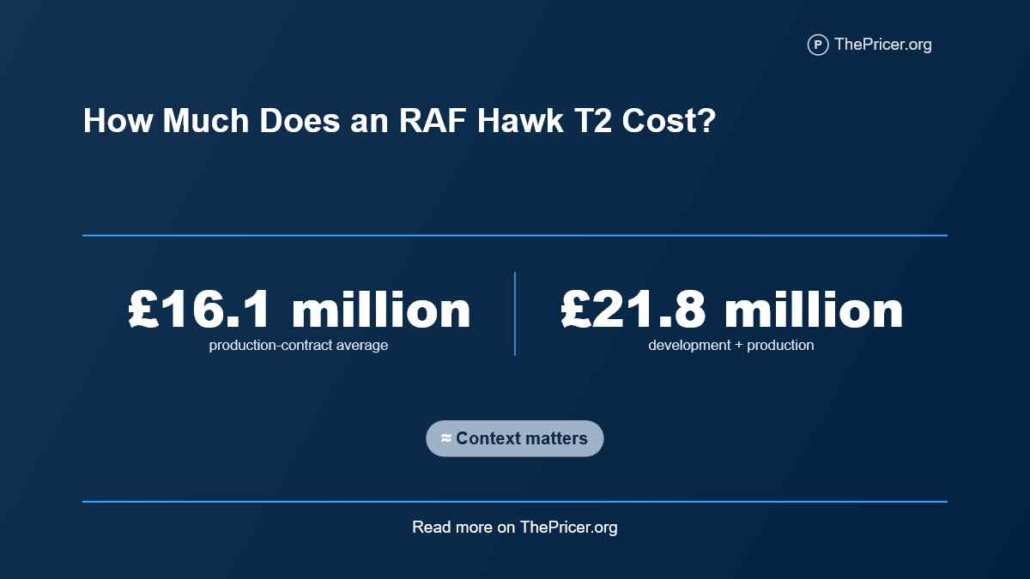
An RAF Hawk T2 cost about £16.1 million per aircraft based on the original production contract. The UK Ministry of Defence paid £450 million for 28 Hawk 128 Advanced Jet Trainers, the aircraft designated Hawk T2 in RAF service. There was also a separate £160 million design and development contract, so spreading both known contracts across the 28 delivered aircraft gives an equivalent programme cost of about £21.8 million per Hawk T2 in mid-2000s contract values.
That £16.1 million figure should not be treated as the price of buying a replacement Hawk T2 today. BAE Systems’ UK Hawk production line closed in 2020, and the RAF is now moving toward a new fast-jet trainer programme. The cost of keeping the existing Hawks flying has also become substantial.
In 2022, the Ministry of Defence announced £695 million of Hawk support contracts over 11 years, covering T2 airframe support, Hawk engines, and support associated with the Hawk T1s used by the Red Arrows.
Article Highlights
Jump to sections
- The RAF ordered 28 Hawk T2 aircraft for £450 million, equal to about £16.1 million per aircraft when the production contract is divided by the fleet.
- A separate £160 million design and development contract takes known development plus production spending to £610 million, or about £21.8 million per delivered T2 when spread across 28 jets.
- The Ministry of Defence announced another £695 million over 11 years for Hawk support in 2022.
- That support package averages approximately £63.2 million per year, although it is not exclusively a per-aircraft Hawk T2 bill.
- An RAF Hawk T2 crashed near RAF Valley on September 23, 2026. Both crew members ejected, and Hawk flying was subsequently paused while the incident is investigated.
- A replacement T2 cannot simply be ordered from the old production line because UK Hawk production ended in 2020.
How Much Does an RAF Hawk T2 Cost?
The clearest official purchase figure comes from the Ministry of Defence’s 2006-07 annual report. It records a £450 million contract for 28 Hawk 128 Advanced Jet Trainers.
| Hawk T2 cost item | Published cost | Calculated cost |
|---|---|---|
| Production of 28 Hawk 128/T2 aircraft | £450 million | £16.1 million per aircraft |
| Design and development | £160 million | Separate programme cost |
| Development + production | £610 million | £21.8 million per delivered aircraft |
| 2022 Hawk support package | £695 million | About £63.2 million per year over 11 years |
The arithmetic behind the headline price is £450 million divided by 28 aircraft, which equals approximately £16.07 million per Hawk T2.
That is a production-contract average rather than a modern retail-style unit price. Government aircraft contracts can include equipment, engineering activity, documentation, testing, support work, and other deliverables that are not necessarily allocated evenly to each airframe.
The Ministry of Defence also placed a £160 million design and development contract with BAE Systems in December 2004. A later Defence publication describing the Hawk programme confirms that the £450 million production contract followed in October 2006.
If the £160 million development contract and £450 million production order are combined, known expenditure reaches £610 million. Divide that by 28 and the result is approximately £21.79 million per delivered aircraft. That figure is useful for understanding the scale of the programme, but it is not the amount paid for each physical airframe.
What Is the Hawk T2?
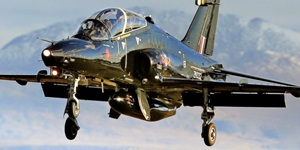
The Hawk T2, also called the Hawk Mk 128, is the RAF’s two-seat advanced fast-jet trainer. The RAF’s Hawk T2 specification lists a Rolls-Royce/Turbomeca Adour Mk 951 turbofan, a maximum speed of 555 knots, a maximum altitude of 42,000 feet, and a crew of one or two.
Its job is not front-line combat. The T2 prepares pilots to move into aircraft such as the Eurofighter Typhoon and F-35 Lightning. The cockpit, avionics, synthetic radar, electronic-warfare simulation, and tactical training systems let students practice fighter procedures without using a much more expensive operational fighter for every training sortie.
This distinction matters when comparing price. Our F-35 cost guide puts the latest F-35B flyaway price far above the historic Hawk T2 figure. A Hawk’s purpose is partly to keep expensive front-line fighters and their flight hours out of training tasks that can be performed on a dedicated trainer.
The £695 Million Support Bill
The purchase price is now a relatively small part of the Hawk programme’s historical spending. In March 2022, the Ministry of Defence announced £695 million in new Hawk support contracts covering an 11-year period.
The package was split into £590 million for BAE Systems and £105 million for Rolls-Royce. BAE’s portion covers Hawk T2 airframe support and work associated with maintaining the Red Arrows’ Hawk T1 aircraft. Rolls-Royce provides engine support.
BAE separately describes its £590 million award as an 11-year contract supporting RAF Hawk availability and maintenance.
Dividing the entire £695 million package by 11 gives an average of approximately £63.18 million per year. That is not a £63 million annual bill specifically for the 28 Hawk T2s because part of the work supports the T1 fleet and the contract includes different support functions.
It does show an important ownership-cost reality. The 2022 support package alone is £245 million larger than the original £450 million T2 production contract. That is about 54.4% more than the amount initially contracted to manufacture all 28 T2 aircraft.
No Reliable Cost Per Flight Hour
There is no current Ministry of Defence figure that cleanly captures fuel, personnel, maintenance, engine work, airframe support, infrastructure, and other costs in one public number.
It would also be misleading to divide the £695 million support package by Hawk T2 flying hours and call the result an operating cost. The contracts cover fixed support obligations, the T1 fleet, maintenance, engine services, and costs that do not rise and fall directly with every additional hour flown.
Parliamentary evidence does provide the flying-hour scale. BAE Systems said its support arrangement initially called for 7,800 Hawk T2 flying hours and 6,540 hours in subsequent years. The same evidence records 28 T2 airframes, with 23 intended for the forward available fleet and five normally in depth maintenance.
Engine Problems
 Hawk T2 ownership became more expensive in practical terms after problems emerged with the Adour Mk 951 engine. The House of Commons Defence Committee’s aviation procurement report records that technical issues discovered in 2022 reduced the planned engine design life from 4,000 hours to 1,700 hours.
BAE told Parliament that the problem reduced the number of serviceable aircraft to an average of about eight per day during 2022-23 and cut the forecast flying rate to roughly 3,700 hours, about half the contracted level.
The monetary consequence extended beyond repairing engines. The Defence Committee reported that the Ministry of Defence planned to spend more than £55 million on overseas fast-jet training as part of its response to training-capacity problems. Its figures included approximately £2 million per trainee for additional training in the United States and about £2.2 million per trainee in Italy.
Those sums should not be added directly to the £16.1 million price of an aircraft. They are a good example of why the economic cost of poor fleet availability can extend far beyond spare parts or fuel.
The Hawk T2 Lost in September 2026
On September 23, 2026, a Hawk T2 crashed shortly after taking off from RAF Valley in Anglesey. Both crew members ejected. In a same-day government statement, Defence Secretary Wes Streeting confirmed that the aircraft had gone down and that an investigation had begun.
Reporting from Sky News said the pilots were treated for injuries thought to be minor. Subsequent reporting said RAF Hawk operations were temporarily suspended as a precaution.
If the question is simply what that aircraft originally cost, the best public benchmark is approximately £16.1 million, based on the £450 million production contract divided across the 28 aircraft.
That does not mean yesterday’s loss has an economic value of exactly £16.1 million. The aircraft had already accumulated years of service, its government book value is not public, and a new Hawk T2 cannot now be purchased from the original production line.
Before the crash, the RAF’s original T2 holding was 28 aircraft. The loss of one airframe therefore represents about 3.6% of the original T2 fleet. Unlike a commercially produced aircraft that could be reordered, the T2’s replacement problem is now tied to the RAF’s wider next-generation training programme.
A Replacement Hawk Cannot Be Ordered
BAE’s UK Hawk production line closed in 2020. A Defence Committee report on future combat air notes that the closure ended the UK’s active Hawk manufacturing capability.
The significance for cost is straightforward. £16.1 million is a historical production average, not today’s replacement quote. Restarting an old production system, if technically possible, would involve tooling, suppliers, certification, workforce, obsolete components, and engineering costs that are not represented by the original 2006 contract.
The government’s 2025 Strategic Defence Review instead recommended replacing both Hawk T1 and Hawk T2 with a cost-effective fast-jet trainer.
The direction became more concrete in 2026. The Defence Investment Plan summary from the House of Commons Library says the government has committed to recapitalising the jet-trainer system and procuring a new aircraft to replace Hawk. The replacement type and final programme cost have not yet been published.
Hawk T2 Cost vs Fighter Aircraft
The historic £16.1 million Hawk T2 production average is far below the acquisition cost of the fighters its students eventually fly, but a trainer and combat aircraft should not be treated as interchangeable products.
An advanced fighter carries radar, electronic warfare systems, weapons interfaces, combat sensors, defensive equipment, and other systems a dedicated trainer can simulate rather than physically carry. Our current F-16 price guide shows modern F-16 production costs well above the Hawk’s original contract average, while our Rafale cost guide illustrates how weapons and support packages can take fighter acquisitions into nine-figure territory per aircraft.
The Hawk therefore saves money partly by absorbing training hours that would otherwise have to be flown on expensive front-line aircraft. The relevant question is not whether a Hawk can perform the same mission as a Typhoon or F-35. It cannot. The question is how cheaply it can prepare a pilot to use those aircraft effectively.
New Simulators
The RAF is already shifting more training away from physical Hawk sorties. In April 2026 it announced mixed-reality upgrades to 11 training devices at RAF Valley.
The service says the programme should save up to £4 million per year while allowing pilots to practice circuits, formation flying, and low-level navigation before using live aircraft.
At that claimed saving rate, five years would equal up to £20 million, more than the historic production-contract average for one Hawk T2. Synthetic training does not remove the requirement for live flying, but it can reduce the number of expensive real-aircraft hours required to reach a given training standard.
Three Ways to Look at Price
Aircraft-production view: Use about £16.1 million per jet. This comes directly from dividing the £450 million manufacturing contract by 28 aircraft and is the cleanest answer to “what did an RAF Hawk T2 cost?”
Programme-development view: Use about £21.8 million per delivered aircraft if you want to spread the known £160 million development programme and £450 million production contract across all 28 aircraft. Do not call this the factory price of one jet.
Lifetime-support view: There is no sensible fixed per-aircraft total. The UK later committed £695 million to an 11-year Hawk support package, and the fleet has incurred additional costs for engines, training infrastructure, simulators, personnel, fuel, overseas training, and other support.
What We Verified
- The Ministry of Defence recorded a £450 million contract for 28 Hawk 128 Advanced Jet Trainers, producing the approximately £16.1 million aircraft average used in this article.
- Government material separately records a £160 million design and development contract.
- The RAF announced £695 million of Hawk support investment over 11 years in 2022, including £590 million for BAE Systems and £105 million for Rolls-Royce.
- The RAF continues to identify the Hawk T2 as its advanced fast-jet trainer at RAF Valley.
- A Hawk T2 crashed after takeoff from RAF Valley on September 23, 2026. Both crew members ejected and an investigation is underway.
- The 2026 Defence Investment Plan commits the government to a new jet-training system and replacement aircraft, but no final replacement purchase price has been announced.
Answers to Common Questions
How much does an RAF Hawk T2 cost?
The original £450 million production contract for 28 Hawk T2s works out to approximately £16.1 million per aircraft.
Did the entire Hawk T2 programme cost only £450 million?
No. A separate £160 million design and development contract raises known development and production spending to about £610 million. Support, engines, training, maintenance, and later upgrades add further costs.
How much does it cost to maintain the RAF Hawk fleet?
The Ministry of Defence announced £695 million of support contracts over 11 years in 2022. That package covers Hawk T2 support as well as work connected with the Hawk T1 fleet, so it should not be divided by 28 and presented as a clean T2 maintenance price.
How much was the Hawk T2 that crashed in September 2026 worth?
The best public historic purchase benchmark is about £16.1 million. Its actual book value immediately before the crash has not been publicly stated, and there is no current new-build Hawk T2 replacement price because the production line is closed.
Can the RAF buy another Hawk T2?
Not through the original production programme. Hawk production in the UK ended in 2020. The government is now funding a programme to procure a new fast-jet trainer to replace the Hawk fleet.
Bottom line: Use about £16.1 million as the historic production-contract cost of one RAF Hawk T2. Including the separate development contract produces a broader programme equivalent of about £21.8 million per delivered aircraft. Those figures do not represent the price of replacing a lost Hawk today, and the £695 million support package shows that keeping the fleet operating has ultimately cost far more than the original airframe purchase alone.
Disclosure: Educational content, not financial advice. Prices reflect public information as of the dates cited and can change. Confirm current rates, fees, taxes, and terms with official sources before purchasing. See our methodology and corrections policy.