
How Much Does an SM-3 Missile Cost?
Updated on | Written by Alec Pow
This article was researched using 9 sources. See our methodology and corrections policy.
An SM-3 missile costs approximately $12.5 million to $30 million per interceptor in recent U.S. procurement records, depending on the variant, production lot, and accounting scope. The Missile Defense Agency’s fiscal year 2026 budget history lists SM-3 Block IB purchases at $12.5 million per missile for a 2024 lot and $18.333 million for a smaller 2025 lot. The more capable SM-3 Block IIA reached approximately $28.7 million per round in its fiscal year 2025 procurement history.
Those figures are especially relevant after Raytheon announced a new contract worth up to $6.3 billion on October 8, 2026, to manufacture and sustain SM-3 Block IB interceptors. The agreement covers five years with two additional option years, but its announcement does not identify a fixed missile quantity from which a reliable per-round price can be calculated.
Understanding the cost requires separating the missile’s production price from launch equipment, Aegis missile-defense infrastructure, program support, and long-term replacement spending.
Article Highlights
Jump to sections
- Recent SM-3 Block IB procurement history lists unit costs from $12.5 million to $18.333 million for fiscal 2024 and 2025 lots.
- The SM-3 Block IIA’s fiscal 2025 procurement history shows approximately $28.703 million per missile.
- Raytheon received a new contract worth up to $6.3 billion on October 8, 2026, covering Block IB production and sustainment.
- A separate August 2026 contract valued at $745 million supports Block IIA production and sustainment.
- Japan’s 2019 approved package for up to 73 Block IIA missiles totaled $3.295 billion, including additional equipment and services.
- SM-3 interceptors destroy ballistic missile targets through kinetic impact rather than an explosive warhead.
How Much Does an SM-3 Missile Cost?
The Standard Missile-3 belongs to the U.S. Navy’s Aegis Ballistic Missile Defense system. It is manufactured by Raytheon, an RTX business, and is designed to intercept ballistic missiles outside the atmosphere during the midcourse portion of flight.
Three variants account for much of the publicly documented price history. Block IA is the older model, Block IB incorporates an upgraded seeker and maneuvering capability, and Block IIA uses a larger propulsion system and improved kill vehicle.
| SM-3 variant or lot | Published unit cost | Procurement context |
|---|---|---|
| Block IA | $8.1 million to $9.9 million | Historical FY2009–FY2012 lots |
| Block IB, FY2023 | $8.980 million | 47 missiles |
| Block IB, FY2024 | $12.500 million | 27 missiles |
| Block IB, FY2025 | $18.333 million | 6 missiles |
| Block IIA, FY2024 | $31.386 million | 12 missiles |
| Block IIA, FY2025 | $28.703 million | 12 missiles |
The Block IB figures come from the FY2026 Missile Defense Agency procurement book. The Block IIA and earlier production-history figures are also assembled in a database of MDA procurement records.
These figures refer to particular budget lots rather than a universal current selling price. They cannot be averaged indiscriminately because quantities, production dates, configurations, and included procurement costs differ.
The price of a missile being delivered in 2028 can also reflect procurement decisions made several years earlier. Delivery date and budget year are separate concepts.
Why Block IIA Costs More
The SM-3 Block IIA is more expensive because it represents a substantially redesigned interceptor rather than a minor software upgrade. Developed cooperatively with Japan, it uses larger rocket motors, an improved seeker, and a more capable kinetic warhead.
The Missile Defense Agency’s Block IIA announcement explains that the upgraded missile provides a wider defensive engagement capability than earlier SM-3 versions.
The resulting price premium is substantial. Comparing the FY2025 Block IIA figure of $28.703 million with the FY2024 Block IB figure of $12.500 million gives a difference of $16.203 million, or approximately 130%.
That is a comparison between different variants and different procurement years, not a controlled estimate of the manufacturing cost added by the Block IIA design. Production quantities and contracting conditions also influence the difference.
At the subsystem level, SM-3 engineering includes high-performance propulsion, infrared target discrimination, precision guidance, and a divert-and-attitude-control system that positions the kinetic warhead for interception. Its task is to strike a ballistic missile target traveling at extraordinary speed.
The New $6.3 Billion Contract
On October 8, 2026, RTX announced that Raytheon had secured a contract worth up to $6.3 billion for production and sustainment of SM-3 Block IB interceptors.
The five-year Block IB agreement includes two additional option years and is intended to replenish missile inventories while supporting longer-term manufacturing stability. Production will be concentrated at facilities in Tucson, Arizona, and Huntsville, Alabama.
The contract’s ceiling does not establish how many missiles will ultimately be delivered, the mix of production and sustainment work, or the amount the government will actually obligate under every option.
Dividing $6.3 billion by the FY2024 Block IB unit figure of $12.5 million produces 504 missile-equivalents. That is only an arithmetic comparison. It is not evidence that the government ordered 504 interceptors.
Likewise, dividing by the FY2025 price of $18.333 million produces approximately 344 missile-equivalents. The wide difference demonstrates how sensitive such calculations are to the assumed unit price.
Contemporary Reuters reporting on the award places the contract within the U.S. government’s wider effort to rebuild missile-defense inventories and expand manufacturing capacity.
The important distinction is contractual. A production-and-sustainment ceiling cannot be treated as a fixed-price purchase of a published number of identical missiles.
Recent Production Awards
The October agreement follows several other SM-3 production actions that illustrate the scale of government spending and the difficulty of deriving a standalone missile price from announcements.
In March 2026, a Missile Defense Agency contract modification increased a previously announced Block IB production value to $1.3659 billion. The modification covered an additional 23 all-up rounds, raising the relevant production quantity to 78, and included one-time costs associated with restarting the Block IB production line.
The government’s broader contract value rose to approximately $3.315 billion after definitization. That total covered additional contract work and should not be divided by 78 to claim an ordinary unit production price.
Raytheon subsequently announced a separate Block IIA production agreement worth $745 million in August 2026. That award also included sustainment, and its announcement did not publish a complete missile quantity and recurring unit-cost breakdown.
These separate programs involve different designs. The presence of both contracts shows why headlines describing SM-3 production without specifying the missile block can create misleading cost comparisons.
The Cost of a Missile Interception
One SM-3 interceptor is expended when launched. Its replacement cost is therefore central to understanding the price of an engagement, but missile procurement is only one part of operating the defense system.
An illustrative firing of two Block IB interceptors at the FY2024 unit figure would consume missile hardware budgeted at $25 million. Two Block IIA interceptors at the FY2025 unit figure would represent approximately $57.406 million.
These are modeled expenditure values, not verified costs of specific combat interceptions. They assume the respective budget unit costs are suitable replacement-price proxies.
A larger hypothetical engagement involving four Block IB interceptors at $12.5 million each produces the following calculation.
- 4 Block IB interceptors at $12.5 million each: $50 million
- Assumed allocated ship, sensor, and operating cost: excluded because a verified marginal rate is unavailable
- Assumed missile replenishment value: $50 million before any future price changes
The estimate excludes launch-system operation, tracking sensors, ship deployment, contractor support, maintenance, and replacement procurement overhead.
Nor does it establish how many interceptors are necessary for a given threat. Actual engagements depend on targeting information, operational doctrine, weapon availability, and circumstances not captured by this budget model.
Japan’s SM-3 Purchase Costs
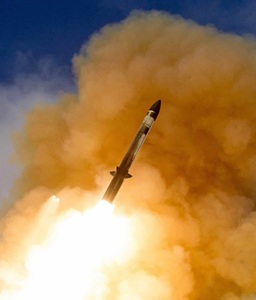 Japan is an important international partner in SM-3 development and procurement. In August 2019, the U.S. State Department approved a potential foreign military sale of up to 73 SM-3 Block IIA missiles with an estimated package value of $3.295 billion.
The CSIS assessment of Japan’s approval describes the cooperative development program and extended-range missile design.
Dividing the proposed package ceiling of $3.295 billion by 73 missiles gives approximately $45.14 million per missile-equivalent.
That is not the bare interceptor’s factory price. Japan’s approved package also included launch canisters, transportation and handling arrangements, technical assistance, and logistical and program support.
The calculation explains why international purchase announcements can appear significantly more expensive than U.S. procurement-line prices. The numerator includes items and services beyond the interceptor itself.
The approved ceiling also does not prove that all 73 missiles were ultimately delivered at the originally notified total. Foreign military sale notifications establish authorized potential transactions, not necessarily final invoices.
Rebuilding Inventories
Missile replacement is more complicated than multiplying the number of interceptors fired by a historical unit cost. Production capacity, industrial facilities, supplier contracts, testing, and inventory management can add substantial expenses.
Raytheon’s 2026 Block IIA announcement disclosed a $115 million expansion at its Alabama missile integration facility, intended to increase integration and delivery capacity by more than 50%. The facility investment is industrial infrastructure rather than the cost of one additional missile.
A related Block IB technology-refresh order was valued at up to approximately $48 million in June 2026. Technology refresh work is another cost category that should not be mislabeled as completed missile deliveries.
The distinction matters when evaluating government spending. Missile purchase obligations, production-line investment, research and engineering, and operational support answer separate questions.
As a replacement-spending illustration, acquiring 100 Block IB interceptors at the FY2024 unit figure would require $1.25 billion in missile procurement value. Using the FY2025 figure would increase that amount to approximately $1.833 billion, a difference of $583 million.
That sensitivity does not forecast the price of the next 100 missiles. It demonstrates why higher production volumes, contracting terms, and manufacturing investment need to be examined before assuming that a historical price will carry forward.
SM-3 vs Other Defense Missiles
The SM-3’s cost also becomes easier to understand alongside other missile-defense weapons, provided their missions and procurement scopes remain distinct.
The Navy’s SM-6 missile procurement costs are substantially lower, with current published figures around $5.5 million to $7.841 million per round for different variants. Unlike SM-3’s emphasis on exoatmospheric ballistic missile interception, SM-6 performs multiple air-defense and surface-target missions.
A THAAD interceptor cost is approximately $12 million to $15 million in recent procurement estimates. THAAD defends against ballistic missiles in a different engagement environment and uses land-based batteries.
The Patriot missile system adds another comparison, using launchers, radars, and PAC-series interceptors to provide regional air and missile defense. A full Patriot battery price is not comparable with the purchase price of one SM-3.
SM-3’s higher Block IIA unit cost does not automatically indicate a poorer financial choice. Each interceptor family is designed for different threat profiles, engagement ranges, infrastructure, and military requirements. The cost comparison is useful only after those differences are identified.
What the Government Buys
The SM-3 is not sold in a civilian retail market. It is controlled military equipment acquired through government defense procurement and approved international military sales.
Applicable cost comparisons
- Use missile-level procurement figures when estimating the replacement value of expended interceptors.
- Use full contract obligations when measuring actual government spending under an award.
- Use foreign military sale ceilings when describing the maximum notified value of an international package.
Misleading cost comparisons
- Dividing a multiyear contract ceiling by an assumed missile quantity and calling the result an official unit price.
- Comparing a supported international package with a U.S. missile-only production lot.
- Combining Block IB and Block IIA prices without identifying their different capabilities.
What We Verified
- Compared Block IB and Block IIA procurement histories, keeping specific fiscal years and lot sizes attached to each quoted figure.
- Confirmed the October 8, 2026 Raytheon announcement and distinguished its contract ceiling from unit procurement costs.
- Checked the March 2026 Block IB contract modification and its production-line restart provisions.
- Verified the August 2026 Block IIA award against Raytheon’s announcement.
- Reviewed Japan’s 2019 approval and separated the broader package ceiling from a missile-only production price.
- Recalculated the illustrative salvo, replacement, and foreign-sale missile-equivalent amounts using the stated assumptions.
Answers to Common Questions
How much does one SM-3 Block IB missile cost?
Recent procurement history lists $12.5 million per Block IB interceptor in a fiscal 2024 lot and $18.333 million in a smaller fiscal 2025 lot. These are budget-year unit figures, not a fixed price for every future missile.
How much does an SM-3 Block IIA cost?
The fiscal year 2025 procurement history shows approximately $28.703 million per Block IIA interceptor. Other production lots have differed.
Did the Pentagon buy $6.3 billion worth of SM-3 missiles?
Raytheon announced a contract ceiling of up to $6.3 billion on October 8, 2026. The contract includes Block IB production and sustainment across a multiyear period, with options. The announcement does not establish the final number of interceptors or the ultimate amount spent.
How much does firing an SM-3 missile cost?
The expended interceptor represents a procurement value measured in millions of dollars, depending on its variant and lot. Total operational and replacement costs may be higher because the launch relies on military infrastructure, personnel, sensors, and support systems.
Can an SM-3 intercept an intercontinental ballistic missile?
The Block IIA demonstrated interception of an ICBM-representative target in a 2020 test. That demonstration does not mean every SM-3 variant or operational configuration can reliably defeat every ICBM threat. The system is primarily associated with regional ballistic missile defense.
Disclosure: Educational content, not financial advice. Prices reflect public information as of the dates cited and can change. Confirm current rates, fees, taxes, and terms with official sources before purchasing. See our methodology and corrections policy.