
How Much Does an SM-6 Missile Cost?
Published on | Written by Alec Pow
This article was researched using 10 sources. See our methodology and corrections policy.
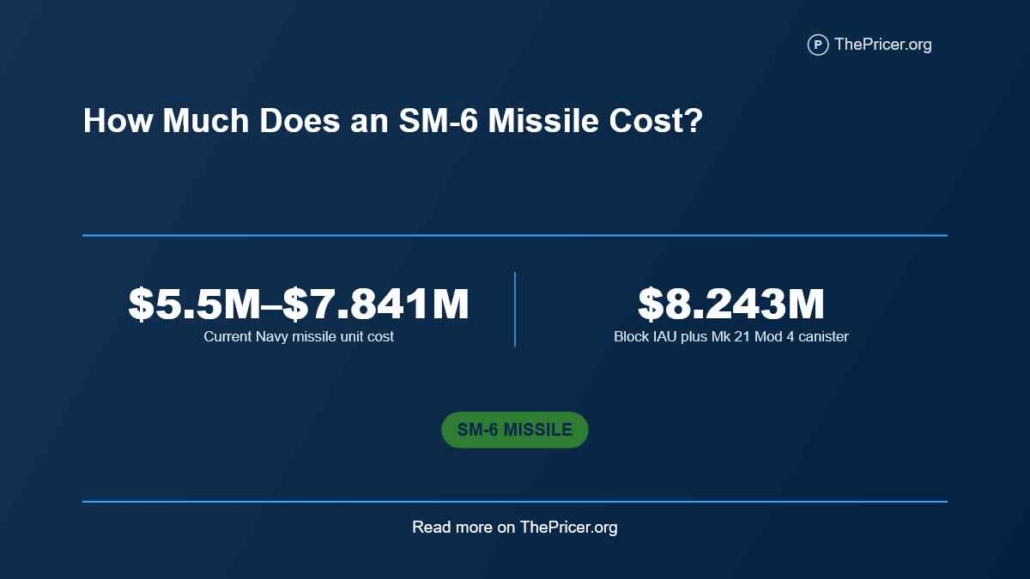
A U.S. Navy SM-6 currently costs about $5.5 million to $7.841 million per missile, depending on the version being purchased. The Navy’s fiscal year 2027 procurement plan prices the mature SM-6 Block IA at $5.5 million per round and the newer Block IAU at $7.841 million. A Mk 21 Mod 4 launch canister adds another $402,000, pushing a Block IAU missile-and-canister combination to about $8.243 million.
Those numbers matter because a much larger figure entered the news on October 1, 2026. Raytheon received a new U.S. Navy contract worth up to $24.4 billion for SM-6 production over five years plus two option years. That contract is designed to raise annual production above 500 missiles, but it is not a published $24.4 billion purchase of a fixed number of identical rounds. Dividing the contract ceiling by an assumed missile count can produce a misleading unit price.
The SM-6 is expensive partly because one missile family performs several jobs. It can defend ships against aircraft and cruise missiles, intercept some ballistic missiles in their terminal phase, attack surface targets, and launch from both Aegis warships and the Army’s ground-based Typhon system.
The price also changes with the missile version, canister, annual production quantity, support equipment, testing, and whether the buyer is the U.S. military or a foreign government purchasing a complete support package.
Article Highlights
Jump to sections
- The latest Navy budget prices the SM-6 Block IA at $5.5 million (at $30 per hour, earning that amount would take about 88 years of full-time work, before taxes) and the Block IAU at $7.841 million per missile.
- The Mk 21 Mod 4 canister costs about $402,000, making a Block IAU missile plus canister about $8.243 million.
- The Navy awarded Raytheon a new contract worth up to $24.4 billion on October 1, 2026.
- The contract supports an annual production rate of more than 500 SM-6 missiles, but its ceiling is not a clean missile-only unit price.
- The FY2027 plan calls for 540 SM-6s, more than three times the 166 rounds shown in the latest FY2026 program display.
- Japan’s approved $900 million package for up to 150 SM-6 Block I missiles works out to $6 million per missile-equivalent, but that package also includes canisters, training, test equipment, engineering, and support.
- An older CBO model estimated the future SM-6 Block IB at about $6 million including the canister, but that is a planning estimate rather than a current production price.
How Much Does an SM-6 Cost?
The best current missile-level figures appear in the Navy’s FY2027 weapons procurement book. The Navy plans to fund 239 Block IA missiles at $5.5 million (about 88 years of full-time work at $30 per hour) each and 301 Block IAU missiles at $7.841 million each.
| SM-6 cost measure | Current figure | What it represents |
|---|---|---|
| SM-6 Block IA | $5.5M | FY2027 missile unit cost |
| SM-6 Block IAU | $7.841M | FY2027 missile unit cost |
| Mk 21 Mod 4 canister | $402,000 | Transport, storage and launch canister |
| Block IA plus canister | About $5.902M | Calculated missile-and-canister cost |
| Block IAU plus canister | About $8.243M | Calculated missile-and-canister cost |
The difference between Block IA and IAU is large enough to matter. At current budget prices, the IAU missile costs $2.341 million more per round before adding the canister. That is about 42.6% more than the $5.5 million Block IA unit price.
Older SM-6 prices should not be carried forward without checking the procurement year. The FY2026 Navy budget listed Block IA at about $5.3 million per all-up round. FY2024 was also about $5.3 million, while FY2025 reached $5.5 million. Production quantity, material prices, contract structure, and the version being purchased all influence the number.
The $24.4 Billion Contract
Raytheon’s new contract is the reason SM-6 pricing is back in the news. On October 1, 2026, RTX announced a five-year SM-6 contract worth up to $24.4 billion, with two additional option years.
The award is tied to a major increase in production. Raytheon had already announced earlier in 2026 that the new production framework would push SM-6 output to more than 500 missiles per year. Reuters reported that the contract comes as the Navy works to rebuild and deepen missile stocks following heavy operational demand. The contract also gives suppliers a longer demand signal for investments in tooling, labor, rocket motors, electronics, and other production capacity.
The headline contract should not be divided by 500 and called the price of one missile. Five hundred is an annual production-rate target, not the total number explicitly purchased by the award. The $24.4 billion (about 391 thousand years of full-time work at $30 per hour) is also a ceiling covering as many as seven years rather than money necessarily spent immediately.
An illustrative calculation shows the problem. If someone assumed exactly 500 missiles per year for five years, that would be 2,500 rounds and:
$24.4 billion ÷ 2,500 = $9.76 million per missile-equivalent.
Stretch the same ceiling across seven years at 500 per year and the result becomes:
$24.4 billion ÷ 3,500 = $6.97 million per missile-equivalent.
Neither figure is the SM-6 sticker price. They show how dramatically an assumed contract quantity changes the result. The Navy’s published variant-level unit costs are much better evidence for answering what one missile costs.
What the Price Buys
An SM-6 price refers to an all-up round rather than a pile of individual missile components. The Navy describes the weapon as its primary extended-range air-defense missile for Aegis surface combatants. The Navy’s Standard Missile profile explains that SM-6 combines Standard Missile propulsion with an active radar seeker derived from AMRAAM technology, allowing engagements beyond the launching ship’s own radar horizon when the wider combat network provides targeting data.
The missile’s role is broader than air defense. SM-6 has been developed and tested for anti-air warfare, anti-surface warfare, and terminal ballistic-missile defense. During a 2024 Missile Defense Agency test, USS Preble used upgraded SM-6 Dual II rounds to intercept a medium-range ballistic missile target.
The Army also uses SM-6 differently. Its Typhon mid-range missile system adapts a Mk 41-style launcher for ground use. During Talisman Sabre 2025, the Army fired an SM-6 from land against a maritime target at approximately 166 kilometers.
That multi-role design makes a direct comparison with a single-purpose interceptor difficult. The same family can consume budget dollars for fleet air defense, ballistic-missile defense, land-based fires, and anti-ship missions.
The Hidden Price
The missile price is only part of the cost of putting an SM-6 into an operational magazine.
The current FY2027 procurement plan separately prices 540 Mk 21 Mod 4 canisters at $402,000 each. Those canisters alone account for:
540 × $402,000 = $217.08 million.
Pairing one canister with one Block IA missile creates a calculated hardware subtotal of:
$5.5 million + $402,000 = $5.902 million.
For a Block IAU:
$7.841 million + $402,000 = $8.243 million.
The same Navy budget also includes production-engineering support, diminishing-manufacturing-source work, containers, fleet documentation, and installation, checkout, and training materials. Those costs are one reason a procurement line or contract value can be much larger than the number obtained by multiplying missiles by the published unit price.
This distinction appears across other missile programs. A current AMRAAM price can refer to the all-up round, while export packages may include containers, software, spares, training, transportation, and engineering. SM-6 accounting follows the same basic problem on a larger dollar scale.
A Ship Loadout
The Navy does not publish the exact wartime missile mix carried by every destroyer or cruiser, and an Aegis vertical-launch magazine can hold several different weapons. A useful way to understand the cost is to model a small SM-6 allocation without pretending it represents a real classified loadout.
Take eight Block IAU missiles, each paired with a current $402,000 canister:
- 8 Block IAU missiles: 8 × $7.841M = $62.728M
- 8 canisters: 8 × $0.402M = $3.216M
- Missiles plus canisters: $65.944M
A notional 16-round allocation doubles that hardware value to approximately $131.888 million.
Those totals exclude the ship, Aegis radar and combat system, Mk 41 launch cells, crew, maintenance, reload logistics, combat-system upgrades, and the sensors or other platforms supplying targeting data. They measure only the current missile-and-canister hardware value using published FY2027 inputs.
The calculation also helps explain why commanders care about matching the interceptor to the threat. Using an SM-6 against a target that could be defeated by a much cheaper weapon can create an unfavorable cost exchange. The Navy has openly examined lower-cost defenses for some drone threats rather than relying exclusively on expensive Standard Missiles. The broader cost of shooting down a drone can vary from inexpensive gun or electronic solutions to multimillion-dollar missile shots.
Block IB Cost
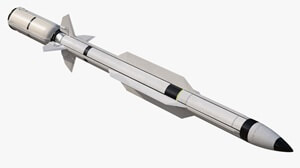 Block IB creates a separate price question because it is not simply today’s $5.5 million Block IA with a different label. The Navy is developing Block IB with a larger 21-inch rocket motor and greater speed and range, especially for longer-range surface strike.
The Congressional Budget Office modeled the future version in its study of hypersonic weapons and alternatives. Using information supplied by the Navy, CBO estimated that a hypothetical 300-missile Block IB purchase could average approximately $6 million per missile including its canister.
That $6 million figure should not be substituted for today’s Block IB price. It was a planning estimate based on a hypothetical production quantity, and Block IB development has continued since the study. Current Navy budget documents still fund rocket-motor work, electronics, Aegis integration, test hardware, and experimentation rather than publishing a normal full-rate Block IB production unit cost.
The contrast with Block IAU matters too. Block IAU is primarily an upgrade needed to address electronics obsolescence in the existing Block IA family rather than the larger performance step represented by Block IB. That is why a reader can encounter Block IA, IAU, and IB figures in the same budget discussion without those prices being interchangeable.
Export Price
Foreign sales provide another useful price angle because they show how much support around the missile can add to the headline package.
In January 2025, the State Department approved Japan to purchase up to 150 SM-6 Block I missiles and related equipment for an estimated $900 million package ceiling.
A simple division gives:
$900 million ÷ 150 = $6 million per missile-equivalent.
That sounds close to the U.S. unit figures, but it is not a missile-only quote. Japan’s package also includes Mk 21 Mod 3 canisters, support equipment, engineering and integration work, test and handling equipment, training, technical publications, government assistance, contractor assistance, and logistics support.
The $6 million calculation is useful as a package benchmark, not as proof that Japan pays exactly $6 million for each missile. The Defense Security Cooperation Agency also warns that notified Foreign Military Sale values represent maximum estimated quantities and dollar values. Final agreements can be lower.
This is the same reason a foreign THAAD interceptor package can produce a much higher per-round-equivalent number than the U.S. missile-level procurement figure. Support scope matters as much as the weapon count.
Production Surge
The price story in 2026 is inseparable from quantity. The Navy is trying to move SM-6 from a relatively constrained production line toward mass production by modern missile-defense standards.
The latest FY2027 program table shows 166 missiles in FY2026 and a requested 540 missiles in FY2027. Moving from 166 to 540 represents an increase of about:
(540 – 166) ÷ 166 = 225%.
Put another way, the planned annual quantity is roughly 3.25 times the FY2026 level.
The 540-missile buy itself contains two very different prices. Using the Navy’s published quantities and missile-level unit costs:
239 × $5.5M = $1.3145B for Block IA.
301 × $7.841M = $2.360141B for Block IAU.
That creates $3.674641 billion in missile hardware before canisters. Dividing by all 540 rounds produces a weighted missile-only average of approximately $6.805 million per round.
Add the published $402,000 canister price across 540 rounds and the calculated average becomes about $7.207 million per missile-and-canister combination.
This is one of the most useful ways to reconcile the public numbers. The Navy can truthfully quote individual variant prices of $5.5 million and $7.841 million while the mixed 540-round purchase lands near $7.2 million per round once canisters are included.
Raytheon’s new $24.4 billion contract aims to sustain much higher output across several years rather than merely fund one annual lot. A previous $333.3 million SM-6 production award in late 2024 could rise to about $908.1 million with options, showing how sharply the scale of the new acquisition vehicle has changed.
Missile Comparisons
SM-6 occupies an expensive middle ground among U.S. guided missiles. It costs much more than an air-to-air missile such as AMRAAM, but less than the highest-tier ballistic-missile interceptors.
The current AMRAAM cost is around $1.17 million for a recent U.S. all-up-round benchmark. A $5.5 million SM-6 Block IA is roughly 4.7 times that amount, while the $7.841 million IAU is about 6.7 times as expensive.
A current THAAD interceptor sits above the SM-6 at roughly $12 million to $15 million. Using those ranges, the $7.841 million IAU costs about 52% to 65% as much as one THAAD missile. The missions are different, but the comparison places SM-6 in the broader missile-defense price hierarchy.
Tomahawk is another useful contrast because it shares launch infrastructure and can also serve as a long-range strike weapon. The Tomahawk missile cost is lower on a missile-only basis in many recent U.S. buys, but a Tomahawk is primarily a long-range cruise missile rather than a fleet air-defense interceptor.
That is the central reason the SM-6 price cannot be judged only by dollars per round. One family covers air defense, missile defense, anti-ship attack, and some land-based strike roles. Whether that versatility is worth several million dollars per shot depends on what threat the round is assigned to defeat.
Answers to Common Questions
How much does one SM-6 missile cost?
The latest U.S. Navy procurement figures put the SM-6 Block IA at about $5.5 million and the Block IAU at $7.841 million per missile.
How much is an SM-6 with its launch canister?
The FY2027 Mk 21 Mod 4 canister is about $402,000. That produces a calculated subtotal of about $5.902 million for a Block IA plus canister or $8.243 million for a Block IAU plus canister.
Does the new $24.4 billion contract mean SM-6 missiles cost almost $10 million each?
No. The contract spans five years with two option years and supports a major production expansion. The total fixed missile quantity and every contract cost element are not published in a way that makes the contract ceiling a reliable per-missile price.
How many SM-6 missiles does the Navy plan to buy?
The FY2027 budget plan calls for 540 missiles, including 239 Block IA and 301 Block IAU rounds. The new production framework is intended to support annual output above 500 missiles.
How much would eight SM-6 missiles cost?
Eight Block IAU missiles with their current canister price would represent about $65.944 million in missile-and-canister hardware. That excludes the ship, launcher, radar, combat system, support, and reload infrastructure.
How much will the SM-6 Block IB cost?
CBO previously estimated about $6 million per Block IB including the canister in a hypothetical 300-missile procurement. The Navy has not yet published a current full-rate production unit price for Block IB, so that older planning estimate should not be treated as today’s contract price.
Can the Army fire SM-6 missiles?
Yes. The Army’s Typhon system uses a ground-based launcher derived from the Mk 41 Vertical Launching System and can fire both SM-6 and Tomahawk missiles.
Disclosure: Educational content, not financial advice. Prices reflect public information as of the dates cited and can change. Confirm current rates, fees, taxes, and terms with official sources before purchasing. See our methodology and corrections policy.