
How Much Does Appliance Repair vs. Replacement Cost?
Published on | Written by Alec Pow
This article was researched using 13 sources. See our methodology and corrections policy.
Appliance repair usually costs less upfront than replacement. A March 2026 national dataset puts minor appliance repair prices at $129 to $329, with about $206 paid. A comparable new major appliance can cost much more before installation and removal.
Repair becomes less attractive when the machine is old, the failed component is expensive, warranty coverage has ended, or a newer model has a meaningful operating-cost advantage.
For refrigerators, washing machines, dryers, dishwashers, and ranges or ovens, the cost comparison turns on the repair quote, service-call or diagnostic fee, parts and labor, matched new-unit price, installation, haul-away, hookup work, warranty status, appliance age, repair history, and energy use.
Compressor, motor, control-board, pump, heating-element, valve, and igniter failures can place two appliances of the same age in very different cost positions.
Compare the written repair quote with a similar replacement that includes every required installation, removal, and connection charge. Then weigh age, prior failures, warranty coverage, and documented operating-cost differences.
That all-in comparison answers the real question: how much cash does the repair preserve now, and what extra service life is that spending likely to buy?
Article Highlights
Jump to sections
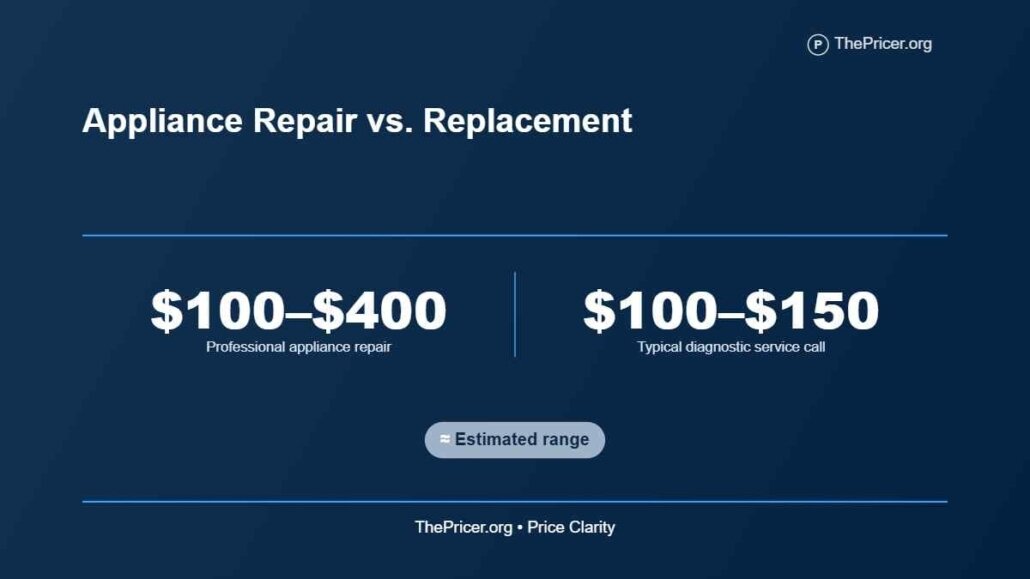
- Professional repair commonly lands around $100 to $400, while diagnosis creates a minimum bill before major parts are added.
- Across five major appliances, midpoint repair costs work out to about 20% to 26% of midpoint new-unit prices before replacement add-ons.
- The 50% rule works better when the denominator includes installation and other unavoidable replacement charges.
- A major refrigerator compressor repair can cost $700 to $1,250, which can erase the usual repair advantage.
- An old refrigerator can add about $95 per year in operating cost compared with a new ENERGY STAR certified model.
Which Option Costs Less?
Published appliance-specific repair ranges put washing-machine repairs at $100 to $400, dryer repairs at $100 to $300, refrigerator repairs at $125 to $500, oven repairs at $150 to $350, and dishwasher repairs at $100 to $300. Its figures include parts and labor. Those ranges are wide because a switch, belt, valve, pump, board, motor, and sealed refrigeration system do not create the same job.
Replacement prices span a wider field. Published average new-unit price bands place costs at $700 to $1,300 for washers, $800 to $1,200 for dryers, $600 to $2,300 for refrigerators, $600 to $1,300 for ranges, and $800 to $1,200 for dishwashers.
The table below uses the midpoint of each cited repair range and the midpoint of each cited average new-unit range. Installation and removal are excluded, so the replacement side is conservative.
| Appliance | Repair range | Repair midpoint | Average new-unit range | Midpoint repair share |
|---|---|---|---|---|
| Washer | $100 to $400 | $250 | $700 to $1,300 | 25.0% |
| Dryer | $100 to $300 | $200 | $800 to $1,200 | 20.0% |
| Refrigerator | $125 to $500 | $312.50 | $600 to $2,300 | 21.6% |
| Range or oven | $150 to $350 | $250 | $600 to $1,300 | 26.3% |
| Dishwasher | $100 to $300 | $200 | $800 to $1,200 | 20.0% |
This midpoint comparison is a ThePricer calculation from published ranges, not a national quote average. It shows why repair often wins on immediate cash cost. A household with a routine failure can be far below the price of a new machine. A premium model, an unusually cheap replacement sale, or a major component failure can move that ratio fast.
Make the 50% Rule Honest
The familiar rule says replacement deserves a closer look when the repair reaches about half the cost of a comparable new appliance. A current repair-versus-replacement cost example gives a useful illustration.
A dishwasher priced at $300 plus $175 for professional installation creates a $475 replacement figure. Half is $237.50, not $150. Comparing the repair with the appliance sticker alone makes replacement look cheaper than the installed transaction really is.
The rule is a screen, not a guarantee. Age and failure type still matter. A contained latch, belt, igniter, valve, or heating-element failure is different from a compressor, tub assembly, or repeated control problem. A percentage near 50% should trigger a matched replacement quote, not an automatic purchase.
Use the same capability on both sides. Replacing a basic ten-year-old washer with a premium connected washer inflates the denominator and can make a repair look artificially cheap. Comparing an older high-capacity refrigerator with a tiny entry model does the reverse. Match size, fuel type, installation class, and the features the household actually needs. That keeps the percentage tied to the same job.
Why the Service Call Matters
 A low-cost failure can still carry a meaningful minimum bill because diagnosis has a floor. A current in-home diagnostic fee policy lists $100 to $150 for most appliances, with the amount varying by service area and appliance type. The fee is waived when the customer proceeds with the recommended repair. The technician then provides a complete estimate covering parts, labor, and applicable taxes.
This is why two repair companies can quote the same part but produce different totals. Ask whether the diagnostic charge is credited if you authorize the repair, whether a second visit for a special-order part adds labor or travel, and whether the quote includes tax and disposal of the failed component.
A written quote should separate the failure being repaired from optional maintenance or unrelated work. A service call that becomes a credited deposit behaves differently from a fee charged on top of the repair.
Major parts can break the usual pattern even when the diagnosis fee is modest. A motor, sealed-system part, or electronic board can move a job from the lower end of the repair market toward replacement territory. Dryer owners can compare a specific motor quote with dryer motor replacement pricing before pricing a new machine.
Age Shrinks Repair Value
Age changes what a successful repair buys. Published appliance lifespan planning benchmarks list about 9 years for dishwashers, 10 for washers, 13 for refrigerators and dryers, 13 for electric ranges, and 15 for gas ranges.
These are benchmarks rather than expiration dates. A nine-year-old machine with one isolated failure can still have useful service left. A same-age machine with leaks, noisy bearings, and a prior board replacement presents a weaker repair case.
A useful question is how much extra life the repair is likely to purchase, not just whether the technician can restore operation. A $250 repair that buys another four years costs an illustrative $62.50 per added year. The same $250 repair followed by another major failure six months later has a very different outcome. That second scenario is not a forecast, but it shows why repair history belongs beside age.
Appliance type matters too. Recent washer repair cost data lists median out-of-pocket repair ranges of $158 to $214 for front-load washers, $123 to $175 for top-load agitator models, and $142 to $213 for top-load high-efficiency machines, excluding the service quote fee.
That puts many washer repairs well below replacement cost while the machine is still in a healthy part of its service life. Readers comparing replacement models can also use washing-machine price coverage to match capacity and class.
Replacement Costs Beyond the Sticker
The store price can understate replacement cost. Published major-appliance installation ranges list dishwasher replacement labor at $200 to $500, range labor at $100 to $300, washing-machine labor at $75 to $200, and old-appliance removal at $25 to $150. New electrical work, plumbing, or cabinet changes can push the project higher. A tight cabinet opening can also turn a simple swap into extra labor.
Dishwashers show the difference. Using the cited source’s unit range of $400 to $1,200, labor range of $200 to $500, and removal range of $25 to $150, the midpoints are $800, $350, and $87.50. The modeled pre-tax replacement total is $1,237.50. Half is $618.75. A $300 repair is 24.2% of that total and preserves $937.50 of immediate cash. These are midpoint assumptions, not a contractor invoice.
That calculation exposes a common comparison error. If the homeowner uses the $800 appliance price alone, the halfway mark is $400. Adding modeled installation and removal raises the halfway mark by $218.75. A midpriced repair can cross that mistaken sticker-only threshold while staying far below half of the full replacement transaction.
Warranty and Repeat Failures
Warranty coverage can make repair the cheaper cash choice even when the retail repair price looks high. The manufacturer’s limited-warranty terms overview says its appliance limited warranty typically lasts one year from delivery, with coverage varying by model.
It also says some refrigerator models carry individual sealed-system parts coverage from the second through fifth years. A compressor problem during component coverage should be priced from the actual warranty terms before a homeowner compares a full retail repair with replacement.
The written terms matter because coverage can separate parts, labor, delivery, access work, and damage caused by installation or misuse. A nominally covered part does not prove every dollar of the service visit disappears.
Start with the model and serial number, purchase date, proof of purchase, and warranty document. A service plan, retailer plan, credit-card benefit, or recall can also change the owner’s cash exposure, but those benefits must be confirmed for the specific machine.
Repair history changes the economics in the opposite direction. One isolated failure on a machine that has otherwise performed well is easier to defend than the third paid service call in two years. Track what has already been replaced, how much was spent, whether the same symptom returned, and whether another major system is showing wear. For refrigerators, compare those future costs with the price class in refrigerator replacement pricing rather than using the original purchase price from a decade ago.
Energy Can Reverse the Result
Electricity and water rarely make a routine repair instantly more expensive than replacement, but old inefficient equipment can narrow the gap over several years. ENERGY STAR says a refrigerator more than 15 years old could cost about $95 more per year to operate than a new ENERGY STAR certified refrigerator. That older-refrigerator operating-cost estimate creates a useful holding-period test.
Assume a refrigerator older than 15 years needs a $500 repair and the cited $95 annual operating penalty persists for five years. The added operating cost is $475. Repair plus that incremental energy cost totals $975 across the five-year scenario before any later breakdown.
The result does not prove that replacement wins. It tells the owner that a $500 repair is not economically identical to a $500 repair on a newer efficient refrigerator.
Laundry equipment has a similar ownership layer. ENERGY STAR says a full-size certified electric dryer can save about $210 in energy bills over the life of the product. The dryer lifetime-savings estimate should be treated as a lifetime figure, not an immediate discount against the purchase price. Use the yellow EnergyGuide label for the exact replacement model when annual energy cost is material to the choice.
Run the Decision on Your Quote
A household can now run the comparison in a fixed order. Get a written diagnosis and all-in repair quote. Price a replacement with similar capacity and required features. Add installation, removal, connection work, and any required accessories.
Check age, repair history, warranty coverage, and a measurable operating-cost difference. Then divide the repair quote by that all-in replacement total. The result shows how much of the replacement transaction the repair consumes.
Using the cited inputs above, three scenarios show why the answer changes. The washer midpoints are $250 for repair and $1,000 for a new unit, or 25% before installation. The dishwasher’s $300 repair against the earlier $1,237.50 modeled total is 24.2%. The old-refrigerator assumption combines a $500 repair with the five-year $475 energy penalty. The first two preserve more immediate cash. The refrigerator needs a longer-horizon comparison.
Use these conditions as decision filters rather than automatic commands.
Makes sense if
- The repair is well below half of a matched all-in replacement total.
- The appliance is still in a reasonable part of its service life.
- The failure is isolated and the machine performed well before it broke.
- Warranty or service-plan coverage reduces the owner’s repair bill.
Does not make sense if
- The repair approaches the cost of a comparable installed replacement.
- The appliance has repeated paid failures or another major system is deteriorating.
- A major component is expensive and the appliance is near its normal life-span range.
- Documented operating-cost savings materially reduce the replacement premium.
Answers to Common Questions
Is it cheaper to repair or replace an appliance?
Repair is usually cheaper upfront for a routine failure. The decision becomes less favorable to repair when the quote approaches half of a comparable all-in replacement, the appliance is old, or it has repeated failures.
Should the 50% rule use the appliance sticker price?
No. Use the cost of a comparable replacement plus required installation and other unavoidable transaction costs. That gives the repair percentage a fair denominator.
How much does an appliance service call cost?
A Sears in-home diagnostic visit typically falls around $100 to $150 for most appliances under the cited current policy. Ask whether the fee is credited toward the repair before authorizing the visit.
When can an old refrigerator be cheaper to replace?
Replacement deserves closer comparison when a high repair quote combines with advanced age, repeat failures, or a documented energy penalty. ENERGY STAR’s old-refrigerator figure can add about $475 over five years at the cited annual difference.
Disclosure: Educational content, not financial advice. Prices reflect public information as of the dates cited and can change. Confirm current rates, fees, taxes, and terms with official sources before purchasing. See our methodology and corrections policy.