
How Much Does Basement Waterproofing Cost?
Updated on | Written by Alec Pow
This article was researched using 10 sources. See our methodology and corrections policy.
Basement waterproofing costs approximately $2,500 to $8,200 for many residential projects in the United States, but the price depends heavily on what is causing the water problem. A complete interior drainage system typically costs $6,000 to $12,000, while exterior excavation and waterproofing commonly costs $10,000 to $18,000. A localized crack repair, drainage correction, or moisture-control treatment may cost substantially less.
The important distinction is between preventing water from reaching the foundation, collecting water that enters, and controlling humidity. Those are different services with different costs. A dehumidifier cannot stop groundwater entering through a foundation wall, while a costly perimeter drain may be unnecessary when a disconnected downspout is causing the problem.
The prices below reflect US estimates reviewed in October 2026. Complete-system costs generally include installation, but excavation, pumps, finishes, damaged materials, and restoration must be checked against each contractor’s written scope.
Article Highlights
Jump to sections
- Angi reports an average basement waterproofing cost of approximately $5,245.
- Complete interior systems commonly cost $6,000–$12,000.
- Exterior foundation waterproofing commonly costs $10,000–$18,000.
- Interior perimeter drains cost approximately $40–$85 per linear foot.
- Installing a sump pump generally costs $600–$2,500.
- Correcting grading or downspouts can eliminate the need for a major system when surface runoff is the cause.
How Much Does Basement Waterproofing Cost?
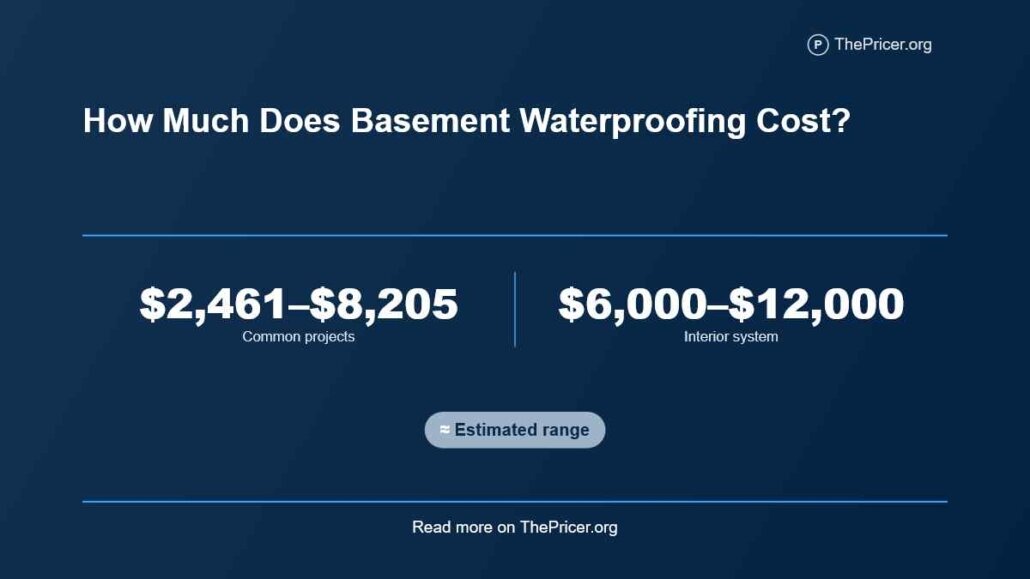
Angi’s July 2026 waterproofing cost research reports a national average of $5,245, with most projects ranging from $2,461 to $8,205. Its sample includes relatively minor repairs as well as larger systems.
HomeGuide’s 2026 basement waterproofing estimates focus more heavily on complete professional systems, placing interior work at $6,000–$12,000 and exterior projects at $10,000–$18,000.
Those prices describe different project mixes. Averaging them together would produce a misleading number for homeowners deciding between a small repair and a complete drainage installation.
| Waterproofing Method | Published Cost | Purpose |
|---|---|---|
| Foundation crack injection | $250–$800+ per crack | Repair localized leakage |
| Waterproof coating | $2–$10/sq ft | Control limited wall dampness |
| Exterior regrading | $1,000–$5,000 | Redirect surface runoff |
| Sump pump installation | $600–$2,500+ | Remove collected water |
| Interior basement drain | $4,000–$17,000 | Collect perimeter seepage |
| Complete interior system | $6,000–$12,000 | Drainage, pumping and associated work |
| Exterior foundation system | $10,000–$18,000 | Excavation, membrane and drainage |
The table contains overlapping services, not a list of charges to add together. A complete interior waterproofing quote may already include drain tile and a sump pump. An exterior project may include the membrane, footing drain, excavation, and backfilling within one contract.
Find the Water Source
The University of Minnesota Extension’s basement moisture diagnosis guidance identifies three major sources: rain or groundwater, moisture generated indoors, and humid outdoor air condensing on cooler basement surfaces.
Water can also enter through foundation cracks, masonry joints, the floor-wall connection, utility penetrations, or poorly maintained window wells. A musty basement without visible leaks is not necessarily experiencing the same problem as a basement that floods after rain.
The EPA’s home moisture-control recommendations emphasize repairing leaks, correcting drainage, and directing water away from the foundation.
Start by documenting when the problem occurs. Water appearing immediately after storms points toward runoff, drainage, or groundwater. Condensation appearing on cold surfaces during humid weather can point toward a different solution.
Exterior grading and downspouts deserve attention before committing to an expensive interior system. Minnesota Extension recommends soil sloping away from the house at least one inch per foot over the first six feet where feasible.
A dehumidifier may improve damp air, but it cannot repair an active foundation leak. Interior waterproof paint may hide staining temporarily while water continues to move through the masonry.
Interior Drains and Sump Pumps
An interior perimeter drainage system collects water near the foundation wall or footing and routes it toward a sump pump or suitable drainage outlet. Installation commonly involves cutting a channel through the basement slab, placing drainage materials, and restoring the concrete surface.
HomeGuide’s February 2026 French drain research places interior basement drainage at $40 to $85 per linear foot, with typical project totals of $4,000 to $17,000.
The published prices usually involve drainage installation as a system, sometimes including sump equipment. A homeowner should not automatically add a separate pump charge to an installed-perimeter price without confirming what the contractor includes.
HomeGuide’s sump pump installation data places a new installed pump at $600 to $2,500, while replacing an existing unit in a suitable basin may cost approximately $400 to $700.
That difference is useful for a house with functioning perimeter drains but a failed pump. Replacing the pump is not equivalent to constructing a new drainage system.
Backup pumps, discharge modifications, a new sump basin, and electrical work may increase costs. Pump sizing should reflect actual water volume and discharge conditions rather than simply choosing the largest available model.
The related sump pump replacement costs provide additional context for households that already have drainage infrastructure.
Exterior Waterproofing
Exterior waterproofing exposes the foundation wall so damaged surfaces can be repaired and a suitable waterproof membrane, drainage material, and footing drain installed. The excavated soil must then be replaced, with disturbed landscaping or pavement restored.
The EPA’s foundation drainage guidance recommends managing surface water outside the building through grading, downspouts, and appropriate drainage.
Deep excavation can become expensive when contractors encounter restricted access, patios, retaining walls, buried utilities, clay soil, or substantial foundation depth. These conditions affect labor and restoration more than the basement’s floor area alone.
HomeGuide estimates installed exterior footing drains at $30 to $90 per linear foot and exterior waterproof membranes at approximately $4 to $7 per square foot of treated wall.
These component prices cannot be added without checking scope. A complete exterior-system quote may already include footing drainage, membrane installation, and ordinary backfill.
U.S. Waterproofing’s contractor assessment of waterproofing costs emphasizes differences among poured-concrete, block, brick, and stone foundations. The construction type helps determine which repair methods are appropriate.
Exterior work is often useful when water must be stopped before reaching foundation walls, but it is not universally necessary for every damp basement. A proper diagnosis determines whether the added excavation expense addresses a real problem.
The Perimeter Matters
Many pricing guides express basement waterproofing costs per square foot of basement floor space. That works as a broad comparison, but it can be misleading when a contractor is installing perimeter drainage.
Consider two rectangular basements with the same 1,000-square-foot floor area. One measures 25 by 40 feet, producing 130 linear feet of perimeter. The other measures 10 by 100 feet, producing 220 linear feet.
Using HomeGuide’s $40 to $85 per linear foot interior-drain range, the first layout produces a modeled drainage price of $5,200 to $11,050. The elongated layout produces $8,800 to $18,700.
At the same selected rate of $60 per foot, drainage would cost $7,800 in the first basement and $13,200 in the second, a difference of $5,400 despite identical floor area.
This is a geometry-based calculation, not two observed contractor invoices. It assumes all perimeter walls require treatment and that the same installation rate applies to both layouts.
The result explains why a homeowner should request measurements of the actual drainage length. Treating a basement’s floor area as the only cost driver may conceal a substantial difference in required work.
It also makes partial-perimeter repairs worth investigating. If seepage is confined to one section, the contractor should explain whether treating only the affected walls is technically appropriate.
A Complete Waterproofing Budget

Consider a hypothetical 30-by-30-foot basement with recurring water entry around its floor-wall joint. The full perimeter measures 120 linear feet. Assume an interior drain priced at $60 per foot, within the published market range, is needed along all four walls.
For this example, assume the selected drain price excludes a new sump pump. Also assume the contractor’s base drain price includes normal channel excavation, drainage materials, concrete restoration, and labor.
- 120 feet of interior drainage at $60 per foot: $7,200.
- New sump pump installation, assumed within published range: $1,600.
- Separate discharge modification allowance, assumed: $350.
- Illustrative project total: $9,150.
The $1,600 pump amount is HomeGuide’s reported average. The $350 discharge allowance is a scenario assumption, not a published national average.
The pump and discharge work add $1,950, or approximately 27% above the drainage-only estimate. That is a meaningful difference if a quote advertises only the perimeter installation.
However, if another contractor quotes a complete drain-and-pump package at $8,800, with equivalent work and discharge requirements included, that package would be $350 cheaper than the modeled itemized project.
The comparison depends entirely on matching the included work. If the original $60-per-foot price already includes a pump, adding the second pump charge would be double counting.
Hidden Expenses
The largest avoidable expense may be purchasing a waterproofing system when simpler exterior drainage corrections would resolve the problem.
HomeGuide estimates regrading near a house at $1,000 to $5,000. Angi also identifies underground downspout extensions, gutter work, and grading as separate services rather than compulsory elements of every waterproofing installation.
A homeowner with confirmed runoff entering beside a foundation might reasonably compare a $2,000 drainage-correction proposal with a $9,000 interior waterproofing proposal. If the simpler work genuinely resolves the water source, the difference would be $7,000.
Those two figures are illustrative offers, not verified prices for one real property. The calculation demonstrates a conditional saving, not a recommendation to reject a drainage system without investigation.
Other expenses can be substantial. Angi reports mold remediation around $500 to $3,500, water-damage repairs around $1,360 to $6,290, and permits around $75 to $500 where required.
Those charges depend on existing damage and the work’s scope. A household with clean unfinished concrete does not automatically need mold remediation, and an exterior waterproofing contract may already include necessary permitting.
Where water has damaged framing, finishes, or insulation, the cost of mold remediation is a separate consideration. If water has caused foundation movement or serious cracking, review the cost of foundation repairs rather than expecting ordinary waterproofing to resolve structural failure.
Insurance coverage is another potential misunderstanding. Basement seepage, groundwater flooding, plumbing leaks, and surface flooding may be treated differently under homeowners and flood policies. The cost of flood insurance is worth examining when assessing future flood exposure, but buying a policy does not retroactively cover an existing loss.
The Right Waterproofing System
The cheapest appropriate repair depends on the source of the moisture and the condition of the foundation. A damp wall during humid weather, a localized crack leaking after rain, and groundwater accumulating at the floor joint require different responses.
BasementLocal’s 2026 contractor pricing comparison puts full interior drain systems around $3,000 to $7,000 for the more limited configurations it describes. This is lower than HomeGuide’s complete-system estimates, reinforcing why the exact drain length, sump arrangement, and included components matter.
Another regional waterproofing cost comparison reports approximately $3,000 to $8,000 for many interior systems and higher prices for extensive exterior excavation. These narrower estimates are useful context but are not proof that every full perimeter installation should fall within them.
Some basements need both exterior runoff corrections and interior drainage. Others need only a localized repair. A basement with persistent condensation may need improved humidity management rather than excavation.
Crawl spaces require different assemblies, and the related crawl space encapsulation costs should not be substituted for a basement drainage quote.
Makes sense if
- The selected repair addresses an identified source of water intrusion.
- The quote specifies drainage length, included pumps, discharge, and restoration.
- Exterior runoff has been evaluated before selecting extensive interior work.
- The contractor provides clear warranty terms and explains maintenance requirements.
Does not make sense if
- Waterproof paint is being proposed as the sole remedy for active groundwater pressure.
- A full perimeter system is recommended without investigating the cause of leakage.
- Drainage and sump charges overlap between line items.
- Structural foundation problems remain unresolved beneath a cosmetic treatment.
What We Verified
- Compared 2026 national prices from Angi and HomeGuide, including their different project scopes.
- Inspected University of Minnesota and EPA guidance on moisture sources, grading, and drainage.
- Checked current contractor explanations of interior and exterior methods.
- Verified component prices for perimeter drains, sump pumps, and exterior grading.
- Reviewed relevant ThePricer articles covering foundation repairs, pumps, mold, flooding, and crawl spaces.
- Developed separate calculations for perimeter geometry, included-system pricing, and potential drainage-correction savings.
Answers to Common Questions
How much does it cost to waterproof a 1,000-square-foot basement?
The total depends on the method and perimeter. Angi’s broad area-based estimates suggest approximately $3,000 to $10,000, while complete interior or exterior systems can cost more.
Is interior or exterior basement waterproofing cheaper?
Interior work is typically less expensive because it avoids deep exterior excavation. HomeGuide estimates complete interior projects at $6,000 to $12,000 and exterior work at $10,000 to $18,000.
Can waterproof paint stop basement flooding?
No. Coatings may help with limited dampness, but they cannot reliably stop water driven by substantial hydrostatic pressure. Drainage or foundation repairs may be needed.
Does a French drain require a sump pump?
Not always. Gravity drainage may be possible where a suitable outlet exists. Interior systems commonly use a sump pump, so its inclusion should be checked before comparing prices.
Should I waterproof before finishing my basement?
Yes. Water intrusion and humidity problems should be diagnosed and corrected before installing vulnerable flooring, drywall, or insulation. Covering damp materials can conceal ongoing damage.
Disclosure: Educational content, not financial advice. Prices reflect public information as of the dates cited and can change. Confirm current rates, fees, taxes, and terms with official sources before purchasing. See our methodology and corrections policy.