
How Much Does Bismuth Cost Per Pound?
Updated on | Written by Alec Pow
This article was researched using 14 sources. See our methodology and corrections policy.
\Bismuth is worth about $20.40 to $20.70 per pound in the current U.S. industrial market for 99.99% metal, with an average quote of $20.55 per pound on September 18, 2026. Small retail orders cost more. A current one-pound 99.99% bismuth chunk sells for $35.99 before shipping, while decorative rainbow crystals are priced as finished specimens rather than raw metal.
Purity, order size, form, seller margin, shipping, and crystal appearance can all change what a buyer pays. The old idea that bismuth normally costs only a few dollars per pound no longer fits the market after the sharp 2025 price increase and continued U.S. supply pressure.
Article Highlights
Jump to sections
- Current U.S. 99.99% bismuth is quoted around $20.40 to $20.70 (at $30 per hour, earning that amount would take about 41 minutes, before taxes) per pound in the industrial market.
- A one-pound retail chunk currently costs about $35.99 before shipping.
- An eight-pound retail package works out to about $29.88 per pound, showing the effect of order size.
- Bismuth reached a 2025 monthly average as high as $34.22 per pound after Chinese export controls disrupted the market.
- Decorative crystals can sell far above raw metal value because shape, color, labor, size, and display quality affect the price.
How Much Is Bismuth Worth Per Pound?
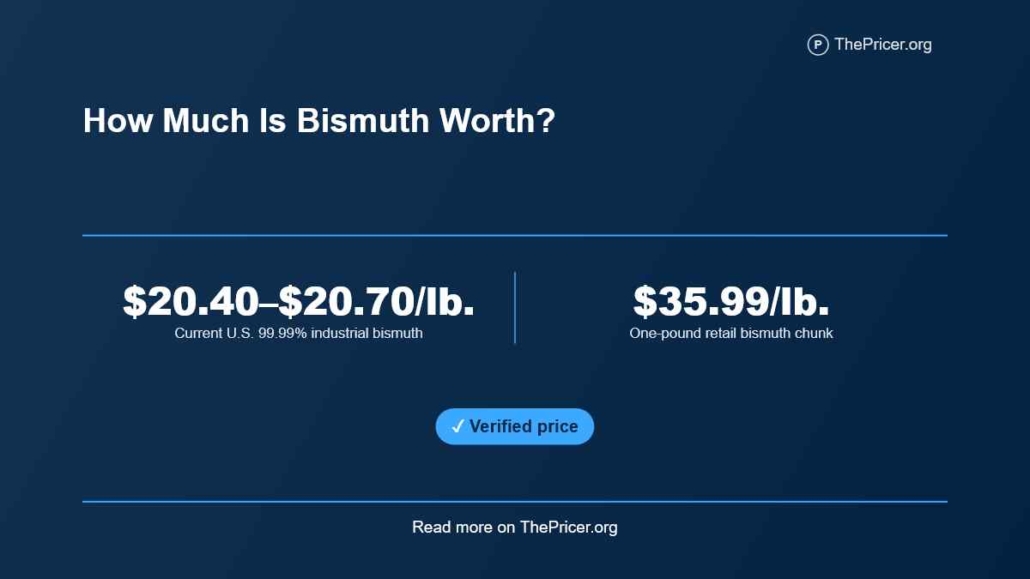
The strongest current reference for raw U.S. metal is the current U.S. bismuth quote. On September 18, 2026, 99.99% bismuth ingot was quoted at $20.40 to $20.70 (about 41 minutes at $30 per hour) per pound, with an average of $20.55 per pound. That is a commodity-market figure for qualifying metal in the United States, not the price a hobbyist should expect to pay for one pound delivered to a home.
Retail pricing is higher because small orders carry packaging, handling, inventory, seller margin, and shipping costs. RotoMetals currently lists a one-pound retail chunk of 99.99% bismuth at $35.99. That is about 75% above the $20.55 industrial benchmark before shipping. A buyer asking what a pound of bismuth costs should first decide whether the question concerns commodity metal, a small retail ingot, or a decorative crystal.
| Bismuth form | Current price example | How to use the price |
|---|---|---|
| U.S. 99.99% industrial ingot | $20.40 to $20.70 per pound | Commodity benchmark, not a one-pound consumer order |
| One-pound 99.99% retail chunk | $35.99 | Small-quantity retail metal before shipping |
| Eight-pound 99.99% retail package | $239, about $29.88 per pound | Bulk retail example before shipping |
| 85-gram decorative specimen | $26.95 | Finished crystal sold by the piece |
Raw Metal and Crystal Prices
Raw ingot and rainbow crystal pricing should not be blended into one range. A current 85-gram bismuth specimen is listed at $26.95 (about 54 minutes at $30 per hour). That price reflects a finished display object rather than a commodity lot. Weight still matters, but so do crystal form, iridescent color, symmetry, damage, presentation, and the work required to grow and finish the specimen.
Most of the stepped rainbow bismuth sold in crystal shops is produced by melting refined bismuth and allowing it to crystallize again. Retailers sometimes describe these pieces as lab-grown. That does not mean the element itself was synthesized from nothing. The seller is changing the physical form of refined metal. The rainbow surface comes from a thin oxide layer that develops on the crystal as it cools and reacts with air.
This distinction changes resale value. A plain 99.99% ingot can be compared by weight and purity. A decorative hopper crystal is closer to a crafted mineral specimen. A seller asking $100 for a large, visually strong piece is not claiming that ordinary bismuth metal is worth $100 per pound. Buyers comparing collectible materials can see the same split between raw material and specimen value in pyrite prices and amethyst pricing.
Why Bismuth Prices Jumped
Bismuth went through an unusually sharp price move in 2025. The USGS 2026 commodity summary reports that monthly bismuth prices rose from $5.96 per pound in January 2025 to a peak monthly average of $34.22 per pound in March. The estimated 2025 annual average was $20 per pound, almost four times the 2024 average. The same report ties the March spike to Chinese export controls introduced after new U.S. tariffs, estimates 2025 world refinery production near 16,000 metric tons with China supplying 88%, and says U.S. imports of bismuth metal from China fell by about 40% from 2024.
That concentration helps explain why the market can move sharply when trade rules or export availability change. Bismuth is a relatively small specialty-metal market, and much of its supply is linked to refining other metals. A disruption at a major supplier can affect available metal faster than a new mine or refinery can add replacement output. The 2025 episode is useful price history, but it is not a forecast that every future disruption will create the same price movement.
The price has since moved away from the March 2025 peak without returning to the old single-digit range. Using the cited $34.22 per pound March 2025 monthly average and the current $20.55 per pound U.S. benchmark, the current figure is about 40% below that peak. It is still slightly above the cited $20 per pound 2025 annual average. The comparison shows why a dated price matters more than an old evergreen range for a volatile minor metal.
Purity and Quantity
Purity is one of the first numbers to check when comparing raw bismuth. The main U.S. market references use 99.99% metal, often called 4N bismuth. A seller offering an alloy, mixed scrap, bismuth-bearing material, or an item with no purity specification should not be compared directly with certified 99.99% ingot. For a buyer who plans to cast metal or grow crystals, the relevant questions are weight, stated purity, form, documentation, and delivered price.
Order size can lower the retail price per pound. A current eight-pound 99.99% package is listed at $239. Dividing that total by eight gives about $29.88 per pound. Compared with the $35.99 one-pound retail price cited earlier, the larger package is about 17% cheaper per pound. It is still about 45% above the $20.55 industrial benchmark.
The difference shows why commodity quotes are poor checkout estimates for hobby buyers. Eight pounds at the current $20.55 benchmark represents $164.40 of metal at the benchmark rate. The retail package costs $74.60 more before shipping. That gap does not create an automatic arbitrage opportunity because industrial benchmarks cover different quantities, commercial terms, delivery conditions, and counterparties. It does show how much small and medium retail distribution can add to the apparent price of the same purity level.
What Bismuth Actually Is
Bismuth is the chemical element Bi, atomic number 83. It is a brittle, silvery metal with a slight pinkish cast. It is not a gemstone in the way jade or amethyst is, even though rainbow bismuth is commonly sold beside crystals and mineral specimens. Its stepped hopper-crystal form and oxide colors make it attractive for display, but those features come from the way refined metal crystallizes and oxidizes rather than from gemstone cutting or a gemological grading system.

The physical properties also explain why hobby sellers can reshape it. The National Library of Medicine lists a melting point near 271°C, or about 520°F, in its elemental bismuth record. Bismuth is dense and brittle, so ingot chunks can fracture during shipping. A broken edge does not automatically mean the metal has lost value if weight and purity remain the same.
Natural native bismuth exists, but the colorful staircase-shaped crystals sold widely online are commonly made by remelting refined metal and controlling how it cools. That distinction matters to collectors. A manufactured rainbow crystal can be attractive and valuable as a display piece, while a documented natural specimen belongs to a different collector market. Buyers should not assume that a vivid oxide surface proves a piece came from the ground in that form.
What Bismuth Is Used For
Bismuth has uses far beyond decorative crystals. The U.S. Geological Survey lists solders, alloys, metallurgical additives, medications, atomic research, ceramic glazes, fishing sinkers, plumbing brasses, lubricating greases, and waterfowl shot among its applications. Several of those uses take advantage of bismuth as a lower-toxicity replacement for lead. Low-melting bismuth alloys also appear in specialty industrial products where a predictable melting behavior is useful.
The medical connection needs precise wording. Pepto-Bismol does not contain pieces of elemental metal. Its active ingredient is bismuth subsalicylate. The current official OTC drug label lists bismuth subsalicylate as an upset-stomach reliever and antidiarrheal. That pharmaceutical use does not make raw bismuth ingot a medicine, and it does not support taking elemental bismuth by mouth.
Decorative demand is visible to consumers, but it should not be treated as the whole bismuth market. Manufacturers use bismuth compounds and alloys in pigments, cosmetics, pharmaceuticals, metallurgy, solders, and specialty products. Crystal-shop claims about serenity, friendships, energy, or similar metaphysical effects are seller beliefs, not a metal specification. They should not increase the appraised raw-metal value in the way documented purity, weight, or a real collector premium can.
Supply, Recycling
U.S. bismuth pricing is exposed to foreign supply. A 2026 USGS study reports 94% U.S. net import reliance for bismuth metal, alloys, and scrap in its reference data, with China accounting for 63% of U.S. apparent consumption. Those figures help explain why trade policy and Chinese supply can matter so much to U.S. buyers even when the physical amount purchased by a hobbyist is only a pound or two.
Recycling exists, but current documented volumes are small. USGS technical work for the 2025 critical-minerals methodology refers to about 40 metric tons of recycled bismuth, thought to be new scrap. That is very different from saying bismuth cannot be recycled. Some end uses disperse bismuth into chemicals, pigments, medicines, or complex products that are difficult to recover economically, while cleaner production scrap can be more practical to recycle.
Sustainability does not lead to a guaranteed price direction. Recycling rates, substitution, industrial demand, tariffs, export controls, inventories, mining and refining output, and new supply projects can move the market in different directions. A buyer should treat claims that bismuth is certain to become more expensive as speculation. The recent record proves that bismuth can be volatile, not that every future move will be upward.
Buying, Selling
For raw metal, start with purity and weight. Ask whether the material is 99.99% bismuth, an alloy, scrap, or a finished crystal. Compare delivered cost per pound rather than item price alone because shipping can materially change a small order. Technical buyers may also want a certificate of analysis. Hobby buyers should still check stated purity, actual weight, seller reputation, and return terms.
For decorative material, compare pieces as objects rather than forcing every crystal into one price per pound. Size, staircase formation, oxide color, damage, symmetry, and presentation can change the asking price. Natural native bismuth should be separated from a recrystallized piece. The same need to identify form appears in jade pricing.
Bismuth melts near 271°C, but molten-metal work carries burn and fume risks. A current bismuth safety data sheet notes that processing such as melting can generate airborne particulate or fumes. Use dedicated metalworking equipment, eye and heat protection, ventilation, and dry heat-safe tools. Do not return metalworking cookware to food use or rely on improvised foil containers. Keep moisture away from molten metal because sudden steam can throw hot material.
Makes sense if
- You are comparing 99.99% metal with another offer of the same stated purity.
- You need enough material for casting, alloying, or repeated crystal growth.
- A larger order lowers the delivered price per pound enough to offset extra inventory.
- You are buying a decorative specimen for its form rather than treating it as raw metal.
Does not make sense if
- A seller will not state the purity or actual weight of raw metal.
- You are valuing a decorative crystal only from the commodity price per pound.
- You expect metaphysical descriptions to create a predictable resale premium.
- You plan to melt metal with food cookware, wet tools, or improvised containers.
Verification checks
- Checked the active U.S. benchmark specification for 99.99% bismuth priced in U.S. dollars per pound.
- Confirmed bismuth appears on the final 2025 critical-minerals list published by the U.S. Geological Survey.
- Cross-referenced a current bismuth safety sheet listing a melting point near 271°C and protective handling information.
Answers to Common Questions
How much is a pound of bismuth worth?
Current U.S. 99.99% industrial bismuth is around $20.40 to $20.70 per pound. A one-pound retail chunk can cost closer to $35.99 before shipping.
Why are bismuth crystals more expensive than raw bismuth?
Decorative crystals are sold as finished specimens. Their price can include crystal-growth labor, size, shape, oxide color, symmetry, damage, seller margin, and presentation rather than only the weight of the metal.
Is bismuth a gemstone?
No. Bismuth is a metallic chemical element. The colorful stepped crystals sold in many shops are commonly made by melting refined bismuth and allowing it to crystallize again.
Is bismuth recyclable?
Yes, bismuth can be recycled, although documented recovery volumes are small and some uses make economical recovery difficult.
Can bismuth be melted at home?
Bismuth melts near 271°C, or about 520°F, but molten-metal work can cause severe burns and can create airborne particulate or fumes. Dedicated equipment, dry tools, ventilation, and proper protective gear are needed.
Disclosure: Educational content, not financial advice. Prices reflect public information as of the dates cited and can change. Confirm current rates, fees, taxes, and terms with official sources before purchasing. See our methodology and corrections policy.