
How Much Does Botox Cost?
Updated on | Written by Alec Pow
This article was researched using 18 sources. See our methodology and corrections policy.
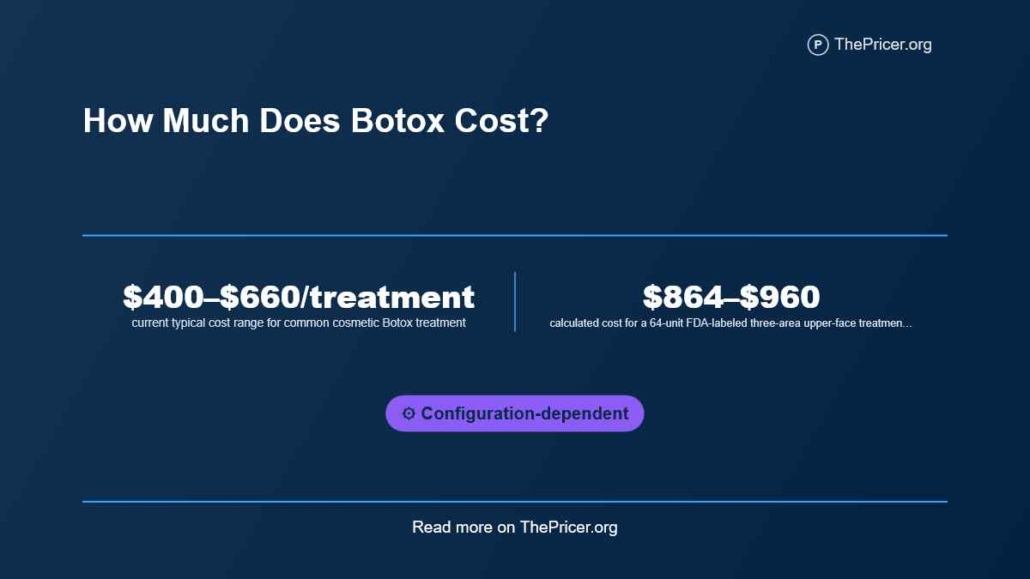
Botox Cosmetic usually costs about $400 to $660 per treatment for common facial line treatment, based on current Allergan Aesthetics pricing. The amount can be lower for a small unit count or much higher when several areas are treated. Clinic menus can also vary sharply on the price charged for each Botox unit.
The number of Botox units matters more than a vague label like “one area.” FDA-labeled cosmetic dosing uses 20 units for frown lines, 24 units for crow’s feet, 40 units for forehead plus frown lines, and 64 units for all three upper-face areas. Cosmetic Botox is normally paid out of pocket. Medical Botox follows different dosing, billing, and insurance rules.
Article Highlights
Jump to sections
- Allergan Aesthetics currently places common cosmetic Botox treatment around $400 to $660 (at $30 per hour, earning that amount would take about 1.7 to 2.8 full-time workdays, before taxes).
- Current clinic menus reviewed list Botox at $13.50 to $15 per unit outside New York City, while one NYC practice quotes $20 to $35 per unit.
- FDA-labeled upper-face dosing totals 20 units for frown lines, 24 for crow’s feet, 40 for forehead plus frown lines, and 64 for all three areas.
- A full 64-unit upper-face treatment works out to $864 at $13.50 per unit or $960 at $15 per unit.
- Botox Cosmetic units cannot be converted directly into Dysport, Xeomin, Jeuveau, Daxxify, or other botulinum toxin units.
- Medical Botox for chronic migraine uses a different FDA-labeled dose of 155 units across 31 injection sites every 12 weeks.
How Much Does Botox Cost?
The American Society of Plastic Surgeons reports an average physician fee of $435 (about 1.8 full-time workdays at $30 per hour) for the broader botulinum toxin category. That statistic includes Botox and competing neurotoxins, so it should not be read as a Botox-only quote. ASPS lists product amount, provider qualifications, treatment time, and office location among the factors that can move the price.
Patient-reported Botox pricing data currently show an average of $586, with reported treatments ranging from small micro-treatments to multi-area sessions above $1,000. The wide spread is useful because it shows why one generic national range cannot describe every dose or treatment map.
A practical cash budget for a routine cosmetic appointment is $400 to $700, with larger plans capable of crossing $1,000. The most reliable quote states the Botox unit price, the planned unit count, the treatment areas, and whether follow-up assessment is included. Some practices charge by area instead of units, so ask how many Botox units an area fee covers and how extra units are priced. The quote can also change when a practice bundles consultation or follow-up time. Small treatment maps can cost less.
Units Drive the Bill
Botox Cosmetic is measured in biological units. The current FDA-approved upper-face dosing uses 20 units for glabellar frown lines, 24 units for crow’s feet, and 20 units in the forehead together with 20 units in the glabella. Treating forehead lines under the labeled regimen is a 40-unit plan, not simply a 20-unit forehead purchase.
All three upper-face areas use 64 units. That total is made from 20 units for frown lines, 24 units for crow’s feet, and 20 additional forehead units. Treatments should be spaced at least 90 days apart. The FDA also approved Botox Cosmetic for moderate to severe platysma bands in 2024, with labeled dosing of 26, 31, or 36 units depending on the band pattern.
Dilution does not create cheaper Botox units. The current FDA label specifies how the vial is reconstituted and how many units are delivered at each injection site. Adding more saline changes concentration and injection volume. It does not turn 20 required units into 10 biological units. The same label says Botox Cosmetic units cannot be compared or converted directly into units of another botulinum toxin product.
Price Examples by Area
Current posted menus give useful unit-rate anchors. Skin Pharm Nashville pricing lists Botox and Dysport at $13.50 (about 27 minutes at $30 per hour) per unit. Anu Medical Spa pricing in New Jersey lists Botox at $15 per unit and a first-time Botox rate of $14 per unit. These are individual clinic offers, not national averages.
| FDA-labeled cosmetic scope | Botox units | At $13.50 per unit | At $15 per unit |
|---|---|---|---|
| Frown lines | 20 | $270 | $300 |
| Crow’s feet | 24 | $324 | $360 |
| Forehead plus frown lines | 40 | $540 | $600 |
| Three upper-face areas | 64 | $864 | $960 |
| Platysma bands | 26 to 36 | $351 to $486 | $390 to $540 |
The full upper-face calculation is especially useful. A 64-unit FDA-labeled plan costs $864 at the Nashville $13.50 rate and $960 at the New Jersey $15 rate. That is why a clinic can truthfully advertise a modest unit price while the final session still approaches four figures.
Off-label areas including masseter treatment, lip flips, bunny lines, and chin dimpling should not be assigned one universal unit count. Dosing depends on anatomy, treatment goal, and clinician judgment. A quote should identify the planned units rather than borrowing the FDA dose from a different facial muscle.
Why Location Changes Price
Geography can move the unit price sharply. The Nashville menu above lists $13.50 per unit, while the New Jersey clinic lists $15 per unit. A New York City dermatology practice publishes a much higher local range of $20 to $35 per unit and about $500 to $650 per treatment area. Its jaw Botox pricing reaches $1,000 to $1,400.
Applied to the FDA-labeled 64-unit upper-face dose, a $20 unit rate produces $1,280. At $35 per unit, the same unit count produces $2,240. The $1,376 spread between that high NYC example and the $864 Nashville example comes from unit price alone, before any difference in treatment scope.
Provider training, practice overhead, local demand, and pricing model can all affect the quote. Some practices charge per unit while others charge by treatment area. Compare quotes only after confirming the expected unit count. A $500 area fee that includes 30 units is financially different from a $500 fee that includes 20.
Readers comparing other aesthetic approaches can also see current TriLift treatment costs and radiofrequency skin-tightening costs. Those procedures use different mechanisms and pricing units.
Cosmetic vs Medical Botox
Cosmetic Botox and medical Botox should not share one price range. Elective wrinkle treatment is usually self-pay. Cleveland Clinic notes that insurance rarely covers elective cosmetic injections. Medical Botox may be covered when the diagnosis, prior treatment history, plan rules, and authorization requirements are met.
Chronic migraine shows how different the medical dose can be. The FDA-labeled migraine protocol uses 155 units divided across 31 sites in seven head and neck muscle areas, with retreatment recommended every 12 weeks. Pricing that dose at a cosmetic clinic’s per-unit rate would create a misleading estimate because medical treatment can involve insurer-negotiated drug reimbursement, procedure billing, specialty pharmacy rules, and patient cost sharing.
For medical Botox, the patient’s cost may include a drug benefit, procedure charge, deductible, coinsurance, or specialty-pharmacy arrangement. Those parts depend on the health plan and diagnosis. That is why a cosmetic clinic’s cash unit price should not be multiplied by a medical dose and presented as an insured patient’s expected bill.
Botox also has approved medical uses beyond migraine. Those uses have their own doses and billing paths. A cosmetic $15 per unit menu should never be used as a shortcut for predicting a medical patient’s covered cost. For excessive underarm sweating, MiraDry treatment costs provide a different non-drug price comparison.
Annual Spending
Botox Cosmetic is temporary. Cleveland Clinic describes a common effect duration of roughly three to four months. Maintenance frequency should follow the treatment response and clinician assessment rather than a fixed calendar promise, and cosmetic retreatment should respect the product’s labeled timing.

Using the FDA-labeled 64-unit three-area dose established above, a chosen three-visit annual scenario costs $864 per visit and $2,592 per year at the cited Nashville rate of $13.50 per unit. At the cited New Jersey rate of $15 per unit, the same dose and visit count become $960 per visit and $2,880 per year.
This annual calculation is more useful than multiplying a generic “average session.” It preserves the same product, unit count, and visit schedule. It excludes tax, separate consultation charges if a practice has them, off-label treatment, and any promotional credit.
A smaller 20-unit frown-line plan at $13.50 costs $270 per treatment. Three equal visits would total $810. The gap between that scenario and the 64-unit plan is $1,782 per year, showing how treatment scope can affect annual spending more than small changes in unit price.
Discounts and Comparisons
Allergan’s Allē rewards program lets members earn points on Botox Cosmetic and other eligible treatments, redeem rewards, access member offers, and use payment plans powered by Cherry where available. Promotions can lower a particular visit, but a temporary discount should not be treated as the normal maintenance price.
Other botulinum toxin products include Dysport, Xeomin, Jeuveau, Daxxify, and Letybo. Comparing their advertised price per unit directly with Botox is a major pricing mistake. Allergan’s current product information states that Botox potency units cannot be compared with another botulinum toxin product. A $5 competing-product unit and a $15 Botox unit are not three-to-one evidence of treatment price without a matched treatment plan.
A useful comparison asks each provider for the named product, planned treatment area, expected dose, and full session price. That produces a matched quote without inventing a conversion ratio. A cheaper displayed unit rate can still lead to a similar or higher session total when the product, dose, or treatment map changes.
Readers comparing other approaches to facial aging can review dermal filler costs. Fillers add volume and are priced by syringe, while Botox reduces selected muscle activity and is commonly priced by unit. Combining their price units produces another false comparison.
Safety, Follow-Ups
A low quote matters only if it refers to genuine FDA-approved product administered by a properly licensed and trained clinician. The FDA botulinum toxin warning issued in November 2025 describes websites illegally marketing unapproved and misbranded products after adverse events linked to such products. Product source and provider credentials belong in the price decision.
Botox cannot be dissolved after injection the way some hyaluronic acid fillers can. The current prescribing information says botulinum antitoxin used for overdose does not reverse effects that are already apparent when it is given. The FDA label carries a boxed warning about distant spread of toxin effect, including potentially serious swallowing, speaking, or breathing problems. Common cosmetic adverse effects vary by treated area and include headache, eyelid droop, brow droop, swelling, and injection-site discomfort.
A follow-up visit may be included in the original fee or charged separately, depending on the practice. Ask before treatment what happens if asymmetry appears, whether a scheduled review is included, and how added units are priced. Do not budget on the assumption that an unwanted Botox effect can simply be reversed for a small correction fee.
Makes sense if
- The quote states the exact Botox unit price and expected unit count.
- The provider uses authentic FDA-approved product from an authorized supply chain.
- You can budget for repeat treatment if maintaining the effect is important to you.
- You compare competing neurotoxins by matched treatment scope rather than unit price alone.
Does not make sense if
- The seller will not identify the product, dose, or licensed injector.
- A discount depends on comparing non-equivalent Botox and Dysport units.
- You are budgeting as though one cosmetic session will create permanent results.
- You expect unwanted effects to be dissolved immediately after injection.
Answers to Common Questions
How much does Botox cost per unit?
Current clinic examples reviewed for this update list Botox at $13.50 to $15 per unit in Nashville and New Jersey, while one New York City dermatology practice quotes $20 to $35 per unit. Local pricing varies.
How much is Botox for the forehead?
The FDA-labeled forehead regimen uses 20 forehead units together with 20 units for the glabellar area, for 40 units total. At $15 per unit, that labeled 40-unit plan would cost $600.
How much is Botox for three facial areas?
The FDA-labeled dose for forehead lines, frown lines, and crow’s feet totals 64 units. That equals $864 at $13.50 per unit or $960 at $15 per unit.
Does insurance pay for Botox?
Insurance rarely covers elective cosmetic Botox. Therapeutic Botox for an approved medical condition may be covered when the patient’s diagnosis and health plan requirements are met.
Can Botox be dissolved if too much is injected?
No. Botox is not dissolved with an enzyme the way some hyaluronic acid fillers can be. Its effect is temporary and fades as nerve-to-muscle signaling recovers.
Disclosure: Educational content, not medical advice. Pricing varies by provider, location, and insurance. Confirm eligibility, coverage, and out-of-pocket costs with a licensed clinician and your insurer. See our methodology and corrections policy.