
How Much Does Cabin Air Filter Replacement Cost?
Updated on | Researched and reviewed by Alec Pow, Founder & Pricing Investigator
Prices, claims, and calculations checked against 11 cited sources. See our research methodology and corrections policy.
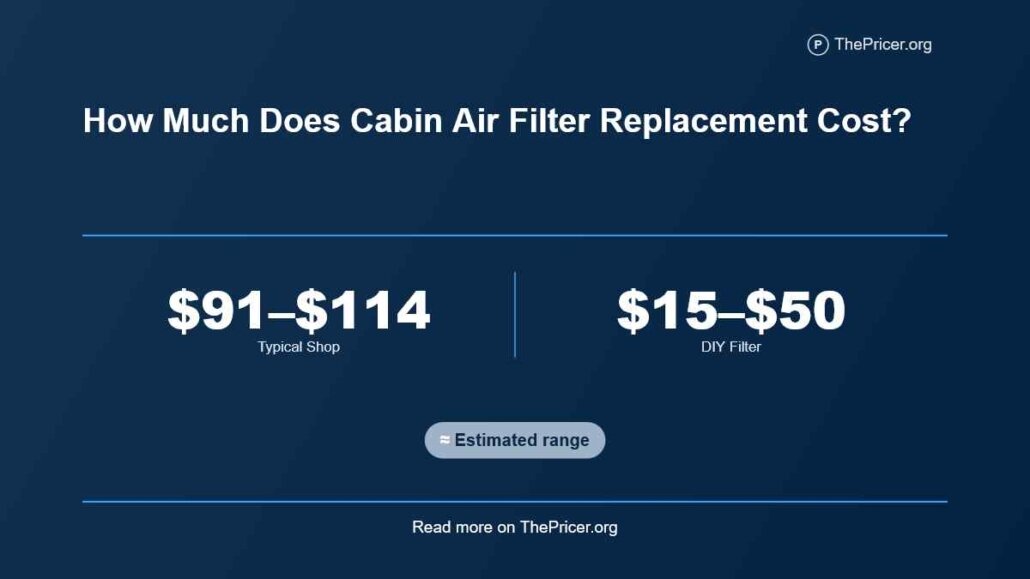
Cabin air filter replacement costs approximately $60 to $130 at many U.S. repair shops, although higher-priced services can reach $120 to $220. RepairPal’s September 2026 national estimate is $91 to $114, including $45 to $66 for labor and approximately $47 to $48 for the filter. Replacing an easily accessible filter yourself can cost $15 to $50 for the part alone.
The final bill depends on the vehicle, filter quality, access difficulty, and the shop’s pricing. A 2020 Toyota Camry standard replacement filter currently sells for $23.99 at AutoZone, while an upgraded version costs $38.49.
For many vehicles, the most useful decision is whether professional installation is worth paying for. A cabin filter is often accessible behind the glove box, making it one of the simpler maintenance jobs owners can perform themselves. Some vehicles require additional trim removal or more complicated access.
Article Highlights
Jump to sections
- Professional replacement: RepairPal estimates $91–$114 nationally.
- NAPA service range: $120–$220, depending on vehicle and service requirements.
- DIY replacement: Approximately $15–$50 for many standard filters.
- 2020 Camry filter: $23.99 standard or $38.49 for one upgraded version.
- Labor: RepairPal estimates $45–$66 nationally.
- Replacement timing: Follow the vehicle’s maintenance schedule, with earlier inspection in dusty conditions.
How Much Does Cabin Air Filter Replacement Cost?
RepairPal’s September 2026 estimate places professional cabin filter replacement at $91 to $114 nationally. That figure excludes taxes, local adjustments, and related repairs.
The estimate includes approximately $47 to $48 for parts and $45 to $66 for labor. Parts represent roughly 42% to 52% of the estimated bill, depending on which endpoints are compared.
NAPA Auto Care publishes a higher $120 to $220 range for cabin filter replacement through its service network.
These are different published service estimates, not necessarily quotes for the same vehicle at competing shops.
| Service option | Price reference | What it includes |
|---|---|---|
| DIY standard filter | $15–$50 | Replacement part |
| RepairPal national estimate | $91–$114 | Parts and labor |
| NAPA Auto Care | $120–$220 | Professional service |
| Complicated access | Varies by model | Additional labor possible |
A low retail parts price does not mean a repair shop must sell the filter at that amount. Shops may use different brands, apply parts markups, and charge for their installation time.
However, a simple filter replacement does not ordinarily require refrigerant recovery, air-conditioning recharge, or major dashboard disassembly. Additional charges for those services require a separate explanation.
Replacement Costs by Vehicle
Vehicle-specific estimates provide a more defensible comparison than assigning arbitrary prices to economy, luxury, and SUV categories.
RepairPal’s current estimator publishes the following model-wide figures:
| Vehicle | Professional estimate |
|---|---|
| Honda Civic | $61–$76 |
| Honda Accord | $68–$87 |
| Honda CR-V | $70–$89 |
| Nissan Altima | $78–$100 |
| Ford F-150 | $90–$111 |
| Toyota Camry | $94–$115 |
| Toyota Corolla | $113–$140 |
These model-wide estimates appear in RepairPal’s vehicle comparison. Model year and location can alter the actual quote.
For example, RepairPal estimates Ford F-150 replacement at $91 to $112, including approximately $45 in parts.
Its Hyundai Palisade estimate is $77 to $94, while a 2017 Chevrolet Impala reaches $136 to $153 because the estimated part alone costs approximately $99.
The examples show why vehicle age and parts specification can matter as much as whether a vehicle is considered expensive or luxurious.
Standard, Carbon, and Premium Filters
Not every cabin air filter provides identical filtration or odor control.
Standard particulate filters are designed to capture dust, pollen, leaves, and other airborne debris before it enters the passenger compartment.
Activated-carbon filters add material intended to absorb certain odors and gases. Their effectiveness depends on filter design, carbon quantity, and exposure conditions.
Higher-efficiency filters target finer particles, although shoppers should not assume every product advertised as HEPA meets the same test standard or fits every vehicle.
For a 2020 Toyota Camry, AutoZone’s fitment catalog lists a standard STP CAF1950P for $23.99, an STP Max CAF1950M for $31.49, and an STP Max CAF1950MHP for $38.49.
The $38.49 example costs $14.50 more than the standard filter, an increase of approximately 60% in the part price.
That difference may matter for a DIY buyer, but it is smaller than the labor component in many professional estimates.
FRAM’s Fresh Breeze product information describes activated carbon and baking soda intended to reduce selected odors, alongside particle filtration.
Its advertised filtration performance applies to specific tested particle sizes and conditions. It should not be interpreted as a guarantee to remove every gas, odor, bacterium, or airborne contaminant.
DIY Versus Professional Installation
Many vehicles position the cabin filter behind a glove box that can be lowered after releasing a retaining arm or side clips.
A Toyota dealership parts guide explains how certain Toyota owners can access and replace the filter with minimal disassembly.
FRAM also publishes vehicle-specific instructions, including glove-box replacement steps for compatible applications.
Before starting, identify the filter’s exact part number and the manufacturer’s required airflow orientation. An incorrectly fitted filter can leave gaps or restrict airflow.
RepairPal cautions that some vehicles require removal of dashboard trim or lower windshield cowling. The work is not equally simple for every model.
For a straightforward vehicle, DIY replacement avoids the shop labor charge. The savings become particularly meaningful when a household has several cars needing routine filters.
Use vehicle-specific instructions rather than assuming every glove box can be detached with the same procedure.
A Worked Camry Cost Comparison
Consider a 2020 Toyota Camry owner choosing between a replacement at a repair shop and doing the work at home.
AutoZone lists the compatible standard STP filter at $23.99. RepairPal’s Camry model-wide professional estimate is $94 to $115.
The following is a comparison of two published purchasing channels, not a quote for a matched filter and labor package.
| Option | Cost |
|---|---|
| DIY standard filter | $23.99 |
| DIY upgraded filter | $38.49 |
| Professional replacement estimate | $94–$115 |
Using the standard DIY filter instead of the professional estimate leaves a difference of approximately $70 to $91 before tax or any delivery expense.
Even selecting the $38.49 upgraded filter leaves a difference of approximately $56 to $77.
The comparison illustrates the potential reward for a simple, correctly performed DIY replacement. It does not mean the shop necessarily uses the same retail STP filter or that every owner can complete the work without tools.
Before rejecting a professional quote, check whether the vehicle’s actual filter access is easy and whether other service work is genuinely included.
When a Premium Filter Is Worth It
Choosing between a standard filter and an odor-control or higher-efficiency version should depend on the actual problem.
If the existing filter is clogged with dust and leaves, a correct-fitting standard replacement may be sufficient.
When odors from traffic or the outside environment are a recurring concern, an activated-carbon product can be worth considering.
However, a persistent musty smell can also originate from moisture or contamination inside the HVAC system, rather than the filter itself.
Replacing the filter may reduce incoming debris without removing contamination already present on the evaporator or in the ventilation housing.
That distinction matters financially. Our professional car detailing cost guide covers interior cleaning services, but ordinary detailing and cabin-filter replacement are not substitutes for diagnosing an HVAC odor source.
A filter should also not be represented as a treatment for allergies or a guarantee of medically safe air. Its role is to reduce the airborne particles it is designed to capture.
Hidden Charges and Unnecessary Work
A cabin-filter recommendation is often made during an oil change or multipoint service inspection.
This creates an opportunity to combine work efficiently, but it can also make a small maintenance item difficult to evaluate inside a larger service estimate.
Ask for the filter’s part number, the price of the part, installation labor, and any additional fees.
One verified-service customer review published on CARFAX in May 2026 described an approximately $100.98 cabin-filter recommendation, consisting of $49.99 for the filter and $50.99 for labor. The owner reported buying a replacement for a little over $12 instead.
That is a single customer account, not a national shop-price average. It demonstrates the value of checking the specific part cost before authorizing installation.
A cabin-filter change is also distinct from work on an engine air filter, an evaporator, a blower motor, or a refrigerant system.
Our car blower motor replacement guide explains the much higher costs involved when the fan moving air through the HVAC system actually fails.
Likewise, a weak cooling complaint does not automatically justify the cost of an AC refrigerant recharge. A dirty cabin filter and low refrigerant are different faults requiring different checks.
Request evidence of the diagnosed problem rather than authorizing multiple HVAC services solely because the vents do not feel as strong as usual.
How Often Should You Replace It?
There is no reliable universal cabin-filter replacement interval for every vehicle.
Manufacturer schedules vary by model, climate, air pollution, and operating conditions.
A published Honda service-manual procedure calls for replacement every 18,000 miles or 12 months for its covered application, with more frequent replacement if airflow becomes restricted.
Toyota’s official cabin-filter guidance recommends inspection at least every 15,000 kilometers in the market covered by that guidance, adjusted for driving conditions.
Neither instruction should override the schedule for a different U.S. vehicle.
Driving regularly on dusty roads or through heavy pollution may justify more frequent inspection. A filter that looks slightly dark is not automatically defective, but heavy debris or restricted airflow supports replacement.
More expensive filters do not necessarily last longer. Follow the stated service interval and the condition of the actual component.
When the Filter Is Not the Problem
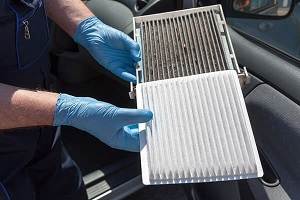
Reduced airflow, unpleasant odors, and weak climate-control performance are reasons to inspect the cabin filter, not proof that it has failed.
Weak fan operation can result from a blower motor or electrical issue. The wrong outlet temperature may involve the temperature-control doors and actuators.
Our blend door actuator cost guide covers the separate repair needed when the system cannot direct or regulate air temperature correctly.
A clogged filter can restrict airflow, but it does not directly control the refrigerant charge or make the compressor consume more refrigerant.
If the replacement filter does not restore normal operation, further diagnosis may be necessary. Repeatedly buying more expensive filters will not repair a failed fan, temperature door, or damaged evaporator.
The most economical order is to verify the filter condition, confirm proper fitment, then investigate other components if the symptoms remain.
What We Verified
- Compared RepairPal’s September 2026 national estimate with NAPA’s published service range.
- Checked model-specific professional estimates rather than retaining unsupported vehicle prices.
- Compared compatible retail filter prices for a 2020 Toyota Camry.
- Reviewed vehicle-specific replacement instructions and manufacturer interval guidance.
- Examined carbon-filter performance claims and fitment limitations.
- Calculated standard versus upgraded filter costs and potential DIY savings.
- Checked related ThePricer articles on HVAC repairs, refrigerant service, and interior cleaning.
Answers to Common Questions
How much does it cost to replace a cabin air filter?
RepairPal’s September 2026 national estimate is $91 to $114 for professional replacement. NAPA publishes a broader service range of $120 to $220. Many DIY replacements cost approximately $15 to $50 for the filter.
Can I change a cabin air filter myself?
Often, yes. Many filters are accessible behind the glove box and can be replaced with basic tools or no tools. Check the instructions for the exact vehicle before purchasing a replacement.
How long does cabin air filter replacement take?
Simple replacements can take approximately 10 to 20 minutes. Vehicles requiring trim or cowling removal may take longer.
Is an expensive cabin filter better?
Not automatically. Activated-carbon and higher-efficiency products may provide additional filtration or odor-control features, but fitment, airflow compatibility, and the actual problem matter more than price alone.
How often should a cabin filter be changed?
Follow the manufacturer’s vehicle-specific schedule and inspect sooner in dusty conditions. Some applications specify annual replacement, while others use mileage-based intervals.
Does a dirty cabin filter affect air conditioning?
A clogged filter can restrict airflow through the ventilation system, reducing comfort and defrosting performance. It does not directly determine refrigerant charge or prove that the air-conditioning compressor is defective.
Disclosure: Educational content, not financial advice. Prices reflect public information as of the dates cited and can change. Confirm current rates, fees, taxes, and terms with official sources before purchasing. See our methodology and corrections policy.