
How Much Does Carpet Cleaning Cost?
Published on | Written by Alec Pow
This article was researched using 14 sources. See our methodology and corrections policy.
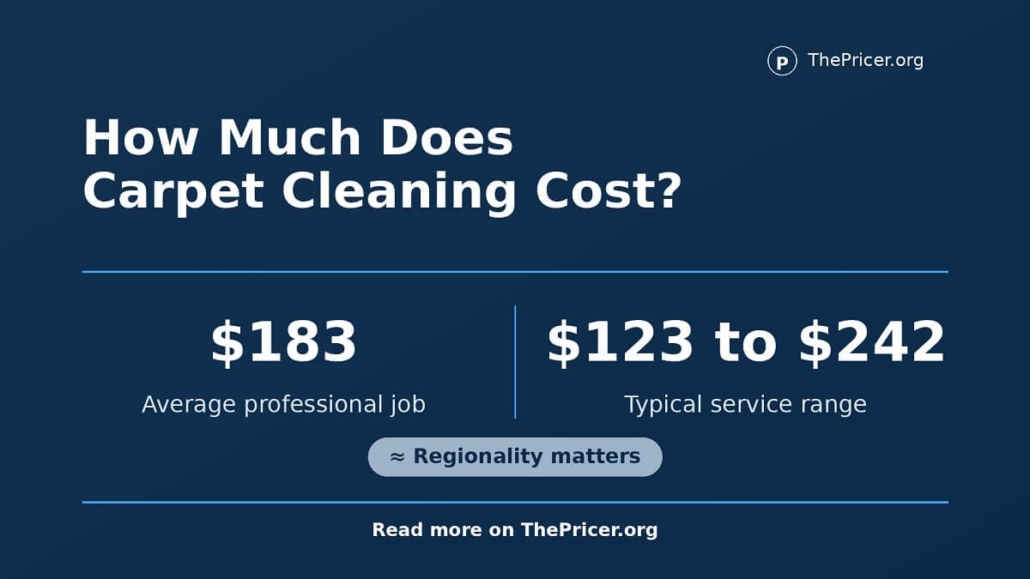
A professional service visit for installed carpet can combine vacuuming, pretreatment, hot-water extraction or a low-moisture method, spot work, and moisture removal. U.S. homeowners pay around $183, with many professional jobs between $123 and $242 according to Angi’s figures updated in August 2026. Room count, measured area, cleaning method, fiber type, stains, and added treatments move the final bill.
The invoice is built from technician labor, equipment, cleaning solution, the room or square-foot scope, and work beyond the base service. Stairs, pet urine, odor treatment, furniture handling, difficult access, and a service minimum can add labor or separate line items. A phone estimate may remain provisional until the technician confirms the carpeted area and condition.
Angi, HomeAdvisor, homeyou, ServicePro, Maid VIP, Shiny Rhino, Zerorez, Advanced Cleaning Service, Petersen’s Carpet & Flooring, My Carpet Cleaning, and Rug Doctor by BISSELL cover different parts of the U.S. market. Their published material spans national consumer estimates, regional service offers, provider policies, trade pricing, commercial square-foot billing, and DIY rental terms. The connected quote items are room definitions, carpeted square footage, technician labor, cleaning method, stain work, pet treatment, stairs, furniture handling, equipment access, service minimums, and rental supplies.
For carpet cleaning, billing may be per room, per square foot, or per visit, with region and add-ons changing the total. A room cap, stair charge, pet treatment, or minimum visit can matter more than the advertised base rate on a small or complicated job.
How Much Does Carpet Cleaning Cost?
Jump to sections
- Entry to high end. homeyou lists residential jobs from $39 to $314 (at $30 per hour, earning that amount would take about 0.2 to 1.3 full-time workdays, before taxes), with an average near $184, in its figures updated in July 2026.
- Per room. Shiny Rhino places room pricing at $40 to $75 and three-room jobs at $120 to $225 in its room figures published in July.
- DIY machine. Rug Doctor by BISSELL lists a 24-hour machine rental at $39.99 and a 48-hour option at $49.99, with location-based variation noted in its current rental terms and pricing.
What you’re buying
Professional carpet cleaning is an on-site service rather than a bottle of detergent or a rented machine. A technician brings extraction or low-moisture equipment, prepares the carpet, treats the cleaning area, removes suspended soil, and manages moisture left in the fibers. Depending on the method and the carpet, the visit can include vacuuming, pretreatment, agitation, extraction, grooming, and targeted spot work. The service is different from routine vacuuming, which mainly removes loose debris from the surface and upper pile.
It also differs from a machine rental. With a rental, the homeowner transports the equipment, buys or supplies the cleaning product, fills and empties tanks, performs the extraction passes, cleans the machine, and returns it. A professional service transfers that labor and equipment handling to the cleaner. Carpet type, soil load, pet contamination, stairs, and drying conditions can change how much work the technician performs.
A 400-square-foot job
One useful way to test a quote is to separate base cleaning from treatments billed by area. HomeAdvisor’s June 2026 square-foot pricing table places 200 to 400 square feet at $80 to $130 (about 2.7 to 4.3 hours of work at $30 per hour) and deodorizing at $0.10 to $0.30 per square foot, so using the upper base figure and low deodorizing rate for 400 square feet gives $130 + $40 = $170, because $0.10 × 400 = $40. That total is a planning calculation built from published inputs, not a contractor quote.
A cleaner may define the scope differently, bundle deodorizing, use a room rate, or charge separately for stain treatment. The calculation is useful because it shows which line item creates the gap between a base cleaning figure and the final invoice. It also gives a homeowner a concrete way to compare a flat quote with one built from measured carpet area.
An itemized estimate should identify the carpeted area, base method, pretreatment, spot work, deodorizing, stairs, furniture policy, and any minimum charge. If one of those items is missing, the written estimate is harder to compare with another bid.
Room, square foot, and job size
Residential companies can quote a flat amount for each room, measure carpet area, or set a minimum visit charge before square-foot math matters. Fixr’s January 2025 square-foot data puts carpet cleaning at $0.18 to $0.36 per square foot and gives a national project band of $75 to $300 (about 0.3 to 1.3 full-time workdays at $30 per hour). The figures are recent historical context rather than an August 2026 contractor quote.
| Billing method | What the cleaner measures | Where it fits | Main quote risk |
|---|---|---|---|
| Per room | Count of qualifying carpeted rooms | Bedrooms and standard layouts | Large rooms may count as multiple units |
| Per square foot | Measured carpet area | Open plans and larger jobs | Hallways and stairs may be separate |
| Per visit | Minimum service scope | Small jobs or service calls | A small area can still trigger the minimum |
Room pricing is easy to read, but the company’s room definition matters. Square-foot billing gives a cleaner comparison across large open areas because measured carpet becomes the unit. Small jobs can get expensive. Travel, setup, hoses, machine preparation, and cleanup still happen when only a limited area is cleaned. A room cap can also turn one large family room into two billable units, so room count alone does not describe the full scope.
Ask the cleaner to state the billing unit on the estimate and identify hallways, landings, stairs, closets, and oversized rooms separately. That makes two bids easier to compare without assuming both companies use the same definition of a room or include the same preparation work.
Technician time and equipment
Labor is not limited to pushing an extraction wand across open carpet. The visit can include equipment setup, vacuuming, pretreatment, agitation, repeated extraction passes, spot work, hose management, moisture removal, grooming, and packing the equipment afterward. Zerorez states in its current service policies that baseline cleaning can take 15 to 30 minutes per room, that a room at many locations is 200 to 250 square feet, and that layout, stains, pretreatments, access, and the number of surfaces affect service time. The same policy says its technicians do not move furniture.
Those rules show why two quotes with the same room count can cover different work. One cleaner may expect chairs, toys, and furniture cleared before arrival. Another may price some furniture handling into the job.
Truck-mounted extraction can require a practical hose path from the vehicle to the carpet, whereas a portable extractor can reach spaces where that route is unavailable. Stairs are slow work. Corners, landings, upper floors, and furniture-packed rooms reduce the amount of carpet a technician can clean in a continuous pass and can increase setup or handling time without changing the measured floor area.
Quote line items
Stains, odor, stairs, pet contamination, carpet protector, and furniture handling are quote categories to confirm before the appointment. A low room rate may cover basic extraction without covering every condition found during inspection. The written scope should identify which treatments are included before work starts and which services require approval as added work.
Hidden-cost check. Advanced Cleaning Service lists pet treatment at $30 to $150 and stair cleaning at $2 to $4 per step in its June 2026 Tennessee pricing discussion. Ask the written quote to separate base cleaning, stain work, pet treatment, stairs, protector, deodorizer, and furniture handling.
Change orders are the practical risk. A phone quote may describe ordinary soil, then the technician finds urine contamination, heavily matted traffic lanes, or rooms larger than the provider’s room cap. Get the room definition and included treatments in writing before service starts. If a company plans to price extra work after inspection, the quote should state which items can change and how the homeowner approves them. That makes the final invoice easier to trace back to the original scope.
Regional pricing and access complexity
 Local labor costs and property layouts can move a quote even when the carpet itself is similar. Angi’s August 2026 New York figures put the citywide professional average near $207, with many projects between $148 and $299, and list an entire New York apartment at $300 to $600. Those metro figures show why a national midpoint should not be treated as a local bid.
Access can be part of that regional difference. Urban work may involve elevators, parking restrictions, long hose runs, upper floors, loading rules, or portable equipment where truck-mounted extraction cannot reach the carpet. A detached suburban house with driveway access presents a different setup. The carpeted square footage may match, but technician movement and equipment handling do not. Regional comparisons work better when the bids use the same cleaning method, room definition, stain scope, furniture policy, and stair treatment. A lower room rate can lose its advantage once excluded labor or access work enters the invoice.
Three cleaning jobs
Promotional residential job. Using Zerorez Bay Area’s offer ending August 31, 2026, three rooms at $149, with up to 200 square feet per room, work out to about $49.67 per room because $149 ÷ 3 = $49.67 before excluded or added services. The primary driver is the promotional room bundle rather than measured square footage alone.
Large-city residential job. A household in a dense metro can face a higher starting band because room size, local labor, parking, equipment access, and building layout all enter the quote. The New York figures above illustrate that effect without assuming the same provider, method, or add-ons apply elsewhere. This buyer’s primary driver is geography and access rather than pet treatment or a limited-time package.
Commercial job. Commercial carpet is commonly billed on measured area because offices and retail floors contain large continuous sections. A commercial provider’s July 2026 square-foot figures list hot-water extraction at $0.15 to $0.50 per square foot and a visit minimum of $200 to $300. The primary driver shifts from room count to carpeted square footage, soil level, access, and the minimum service charge.
DIY changes the equation again. A renter supplies the labor, transport, solution handling, tank filling, extraction passes, cleanup, and return trip. The current Rug Doctor rental cost discussion is useful when comparing that workload with a technician visit rather than comparing machine rent with a professional invoice as if the scopes were identical.
Who this cost makes sense for
Paying a technician is easier to justify when the job contains labor that a rental does not remove from the homeowner’s schedule. Carpet area matters, but so do pet urine, stairs, furniture, repeated extraction passes, drying management, and a deadline tied to moving or property turnover. A small lightly soiled room is a different decision from a multiroom home with odor treatment and stair carpet.
Makes sense if
- Several carpeted rooms can be cleaned during the same service visit.
- Pet stains or odor require treatment beyond ordinary extraction.
- Stairs, upper floors, or equipment access make DIY handling difficult.
- A move-in or move-out deadline puts a premium on paid labor.
Doesn’t make sense if
- The area is small and a service minimum would dominate the bill.
- You already have suitable equipment and can supply the labor.
- The carpet is close to removal and cleaning would add little useful life.
- The problem is limited enough for spot treatment rather than a full-room service.
Carpet cleaning can also be compared with a broader deep house cleaning cost when the goal is property turnover rather than flooring alone. If fibers, backing, or padding are badly worn or damaged, compare the cleaning quote with a carpet installation budget before putting money into a short-lived cleaning result.
What we verified
- Cross-referenced ServicePro’s August 2026 trade pricing data for per-room, square-foot, and minimum-job billing structures.
- Confirmed Maid VIP’s July 2026 provider pricing discussion for room billing, measured-area billing, service minimums, stairs, and carpet condition.
- Verified Petersen’s Carpet & Flooring’s July 2026 service-method discussion for room count, square footage, stains, furniture requirements, and cleaning method as quote inputs.
Answers to Common Questions
How much does it cost to clean one room of carpet?
Per-room charges vary with room size, method, location, and the provider’s room definition. Published 2026 provider figures cited above show why a room quote should be checked against square-foot caps and add-ons before it is treated as an all-in figure.
Is carpet cleaning priced by the room or square foot?
Both methods are used. Room pricing is common for residential work, and square-foot pricing fits open areas and commercial carpet. A minimum service charge can override either method on a small job.
Does carpet cleaning include stain and pet odor removal?
Not automatically. Some providers include basic spot work, but deeper stain treatment, urine treatment, deodorizing, and protector can be separate line items. The written quote should identify what the base service covers.
Is renting a carpet cleaner cheaper than hiring a professional?
The machine charge can be lower than a professional invoice, but the comparison changes once cleaning solution, transport, homeowner labor, furniture preparation, machine cleanup, and return requirements are included. Heavy staining, stairs, and odor treatment can also change the practical choice.
Disclosure: Educational content, not financial advice. Prices reflect public information as of the dates cited and can change. Confirm current rates, fees, taxes, and terms with official sources before purchasing. See our methodology and corrections policy.