
How Much Does Cat Insurance Cost?
Published on | Written by Alec Pow
This article was researched using 13 sources. See our methodology and corrections policy.
The premium buys a defined share of eligible veterinary expenses. It does not eliminate your veterinary bill. Insurers such as Pets Best, Lemonade, Trupanion, and ASPCA Pet Health Insurance use different coverage terms, deductibles, and payment arrangements. The useful comparison is your annual premium plus the expenses you retain when a claim occurs, including excluded services and any amount above the policy limit.
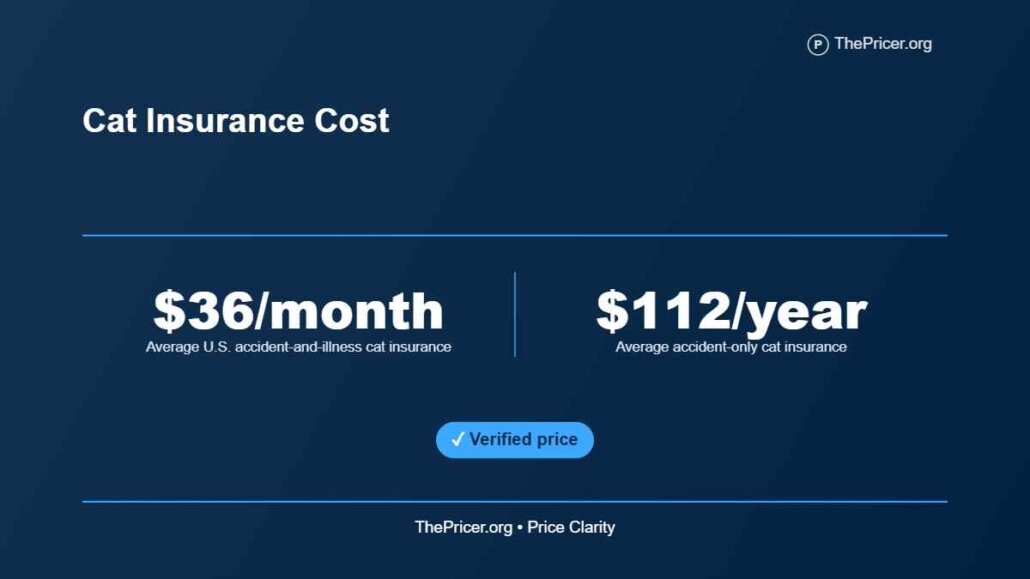
Cat insurance costs about $36 per month, or $435 per year, for accident-and-illness coverage in the United States, based on 2025 industry premiums reported in 2026. A practical starting budget is $20 to $50 per month, although that is a planning range rather than a guaranteed quote. Accident-only policies cost less, while older cats and broader coverage can cost much more.
Article Highlights
Jump to sections
- The industry benchmark for accident-and-illness cat insurance is $435 annually, about $36 monthly.
- Accident-only coverage averages $112 annually, but does not cover illnesses.
- One published insurer quote series rises from $20.14 monthly at age two to $107.09 at age fourteen.
- Pets Best wellness add-ons currently advertise $14 to $32.58 monthly, depending on plan and eligibility.
- A modeled $3,000 covered bill leaves an owner paying $1,435 to $1,535 including annual premiums under two different claims formulas.
How Much Does Cat Insurance Cost?
NerdWallet reports NAPHIA’s 2025 annual cat premiums at $435 for accident-and-illness policies, $112 for accident-only coverage, and $859 for accident, illness, and wellness combined. Those are industry benchmarks, not prices offered to every applicant. Its separate city quote sample for a two-year-old domestic shorthair spans $12 to $34 monthly, using a $250 deductible, 80% reimbursement, and a $5,000 annual limit where available.
A different dataset produces a lower headline number. Insurify’s June 2026 quote benchmarks put cats at $23 monthly, with state figures including $11 in Mississippi and $31 in Massachusetts. Its figures are rolling medians drawn from partner quotes, rather than the same industry-wide premium measure. The two results should not be blended into a new claimed national average.
For a new buyer, the difference means a quote below the industry benchmark is plausible without being suspicious. Compare the annual payout limit, deductible, reimbursement percentage, and included services before judging the price.
A low quote with a narrow benefit can be expensive during a large claim. A higher quote may buy protection you need, or benefits you would seldom use. The policy details settle that comparison.
What the Policy Buys
Cat insurance transfers part of the financial risk of eligible veterinary treatment to an insurer. The contract defines which events qualify, which expenses count, and how the insurer calculates its payment. The National Association of Insurance Commissioners advises comparing covered conditions and reimbursement terms, including waiting periods and benefit limits. A coverage label alone cannot answer those questions.
Accident-only and accident-and-illness policies serve different purposes. The first addresses specified accidental injuries. The second can also address eligible sickness. Wellness benefits handle planned preventive spending under their own terms.
These categories can appear together in a quote, but a buyer should still identify which component pays for which event. A routine examination and an examination prompted by a covered illness can receive different treatment.
When budgeting for a breed purchase such as an Oriental Shorthair kitten, keep the acquisition cost separate from this protection. Insurance is a recurring commitment, and a breeder’s health guarantee is a different agreement.
Ask for the policy wording and a sample reimbursement calculation. The declaration page establishes your chosen limits, while the contract explains restrictions that a monthly price comparison can miss.
Age and Renewal Costs
 A kitten’s premium is a starting point, not a lifetime price promise. NerdWallet’s published cat quote series for Pets Best in Katy, Texas, uses a $5,000 annual limit, $250 deductible, and 80% reimbursement. Monthly prices are $20.14 at age two, $40.69 at eight, $91.41 at twelve, and $107.09 at fourteen. These are age-specific sample quotes, not the observed renewals of one cat.
The oldest sample is about 5.3 times the age-two price. That difference shows why multiplying today’s premium by an assumed lifespan can produce a misleading ownership budget. It does not predict your cat’s renewal path. A younger cat’s low premium can coexist with a substantial later commitment, and future pricing remains unknown when you enroll.
Two owners can face very different decisions. A healthy young cat owner can compare new policies before a large medical history develops. An owner already paying for a covered chronic condition must consider what would happen to that condition under a replacement contract.
The initial savings from switching may be small beside the treatment expense that becomes excluded. When requesting renewal information, ask whether the company can provide illustrative quotes at older ages with the same plan settings. Treat those figures as budgeting evidence rather than a guarantee.
Exclusions That Change Value
Pre-existing conditions can make the cheapest new policy a poor match for the cat you actually own. ASPCA Pet Health Insurance states that a curable condition may become eligible after it is cured and free of symptoms and treatment for 180 days, with an exception for knee and ligament conditions. That is one provider’s rule, not a market-wide promise that every old diagnosis becomes covered.
A useful quote comparison starts with the veterinary record. List existing diagnoses, recurring symptoms, and past treatment, then ask how each would be handled. Do not assume the absence of a formal diagnosis means an earlier symptom is irrelevant. Obtain the insurer’s applicable definition and written explanation before relying on a policy to finance a known problem.
Service exclusions matter too. Fetch advertises sick-visit exam fee coverage and dental illness benefits, subject to its terms. That gives a concrete feature to compare with competing contracts. For a treatment pathway such as cat abscess care, identify the examination, testing, procedure, and medication separately when asking about benefits. Coverage of the diagnosis does not by itself establish that every invoice line will be reimbursed. A matched comparison needs the same clinical expense categories.
The Hidden Price of Claims
The largest overlooked expense can be the amount you retain after reimbursement. Lemonade explains that it applies coinsurance before the deductible. With that structure, reimbursement is the eligible bill multiplied by the covered percentage, minus the remaining deductible. A deductible-first contract instead subtracts the deductible before multiplying. Both can advertise the same percentage and deductible while producing different payments.
Using an assumed $500 remaining deductible and 80% reimbursement, the difference between these formulas is $100 once the bill is large enough for both to pay. The calculation is $500 × 20% = $100. This is a formula comparison, not a claim that every insurer uses either method identically. Annual limits and noncovered charges can change the result. Check the sequence.
Deductible timing creates another distinction. Trupanion advertises a lifetime deductible per condition, rather than an annual reset, and direct payment at participating hospitals with the required software and approval. A recurring condition and several unrelated conditions can have different deductible economics. Direct payment also addresses cash flow.
An eventual reimbursement does not help you pay today’s deposit unless the clinic accepts that arrangement. Confirm the hospital’s payment process before assuming insurance removes the need for accessible emergency funds.
Wellness Add-On Economics
Pets Best currently publishes monthly wellness prices and caps of $14 to $21.75 for EssentialWellness, with up to $305 in annual benefits, and $26 to $32.58 for BestWellness, with up to $535. Prices, schedules, and reimbursement amounts vary by state and pet age. Benefits have service-specific limits, so the headline annual allowance is not an unrestricted refund of any preventive invoice.
Calculated at the advertised endpoints, EssentialWellness costs $168 to $261 annually. Its maximum benefit exceeds those premiums by $44 to $137. BestWellness costs $312 to $390.96 annually, leaving maximum headroom of $144.04 to $223. These are ceilings on possible savings before considering unused benefits, not expected savings. The actual schedule attached to your quote controls.
An illustrative owner who would receive only $200 in eligible EssentialWellness reimbursements gains $32 at the low premium but loses $61 at the high premium. The same planned care changes the purchase decision. Add the reimbursements for care your veterinarian expects, applying each category cap, then compare that sum with the full annual add-on price.
Planned sterilization, including routine spay versus emergency surgery, should be evaluated under the correct benefit category. A preventive allowance and illness coverage do different jobs.
A Year With a Claim
This illustrative cat insurance scenario uses the published $435 industry annual premium as a budgeting input, then assumes a $3,000 fully eligible veterinary bill, a $500 remaining annual deductible, 80% reimbursement, and sufficient unused payout limit. It is not an insurer quote or a real invoice. Routine care, wellness add-ons, excluded fees, and financing charges are omitted. The modeled bill is a chosen amount, not a price estimate for a particular treatment.
| Annual expense or payment | Deductible applied first | Reimbursement percentage applied first |
|---|---|---|
| Insurance premium | $435 | $435 |
| Eligible veterinary bill | $3,000 | $3,000 |
| Insurer reimbursement | $2,000 | $1,900 |
| Owner’s share of veterinary bill | $1,000 | $1,100 |
| Owner’s total including premium | $1,435 | $1,535 |
The deductible-first payment is the bill minus $500, multiplied by 80%. The other payment is 80% of the bill minus $500. Against paying the assumed bill uninsured, the annual net savings are $1,565 and $1,465. Without an eligible claim, the premium remains an expense and there is no reimbursement.
A second calculation identifies the annual cash break-even point. Under these assumptions, a deductible-first policy reimburses more than its $435 annual premium once eligible expenses exceed about $1,044, calculated as $500 + $435 ÷ 0.80.
With reimbursement applied first, the threshold is about $1,169, calculated as the sum of $435 and $500, divided by 0.80. These thresholds measure one year’s cash outcome. They do not predict whether illness will occur or measure the value of protection against a much larger loss.
Choosing an Affordable Policy
Compare quotes using the same cat details and plan settings, then inspect differences the quote form cannot standardize. Request the same deductible, reimbursement rate, and annual limit. Identify exam fees, dental benefits, prescriptions, and the claims formula separately. A premium discount cannot repair an exclusion that removes the expense you most need covered.
MetLife publishes eligible employer and occupational discounts, including potential 10% discounts for specified groups and employer enrollment, subject to eligibility and availability. Ask for the final discounted quote rather than subtracting every advertised discount yourself.
Also compare annual premium totals and any payment fees shown in your offer. A small monthly reduction is useful only if the resulting coverage remains suitable.
A self-funded veterinary reserve is another budgeting choice. At an assumed $36 monthly deposit, it accumulates $432 after a year before interest, if nothing is withdrawn. That money remains yours, but it cannot finance the modeled $3,000 emergency early in the saving period.
An insured owner still needs funds for the retained bill and payment timing. The strongest comparison considers available savings today, affordable recurring premiums, and the contract’s actual coverage.
Makes sense if
- A large eligible veterinary bill would exceed your accessible savings.
- You can sustain premiums as the cat ages.
- The policy covers the expense categories you want protected.
Does not make sense if
- You expect a new policy to pay for an excluded existing condition.
- The premium would leave you unable to fund the deductible.
- You are buying wellness benefits whose usable reimbursements fall below their annual price.
Answers to Common Questions
What is the average monthly cost of cat insurance?
The industry benchmark for accident-and-illness coverage is about $36 monthly, based on $435 in annual 2025 premiums reported in 2026. Your quote depends on the cat and policy.
Is accident-only cat insurance enough?
It can protect against specified accidental injuries, but it does not replace illness coverage. Choose it only if that narrower scope fits the risk you want insured.
Does 80% reimbursement mean I pay only 20%?
No. The deductible, excluded charges, annual payout limit, and calculation sequence can all increase your retained expense. Premiums are separate from the claim payment.
Are wellness add-ons automatically a good deal?
No. Compare the annual add-on premium with usable reimbursements after applying the service caps. The maximum advertised benefit is not a guaranteed saving.
Disclosure: Educational content, not medical advice. Pricing varies by provider, location, and insurance. Confirm eligibility, coverage, and out-of-pocket costs with a licensed clinician and your insurer. See our methodology and corrections policy.