
How Much Does Caves Valley Golf Club Membership Cost?
Updated on | Researched and reviewed by Alec Pow, Founder & Pricing Investigator
Prices, claims, and calculations checked against 11 cited sources. See our research methodology and corrections policy.
Caves Valley Golf Club is one of Maryland’s most exclusive private golf clubs, with an invitation-only membership, a championship course, and a reputation for business entertaining. Membership prices are not published by the club, but several independent sources provide estimates of the financial commitment.
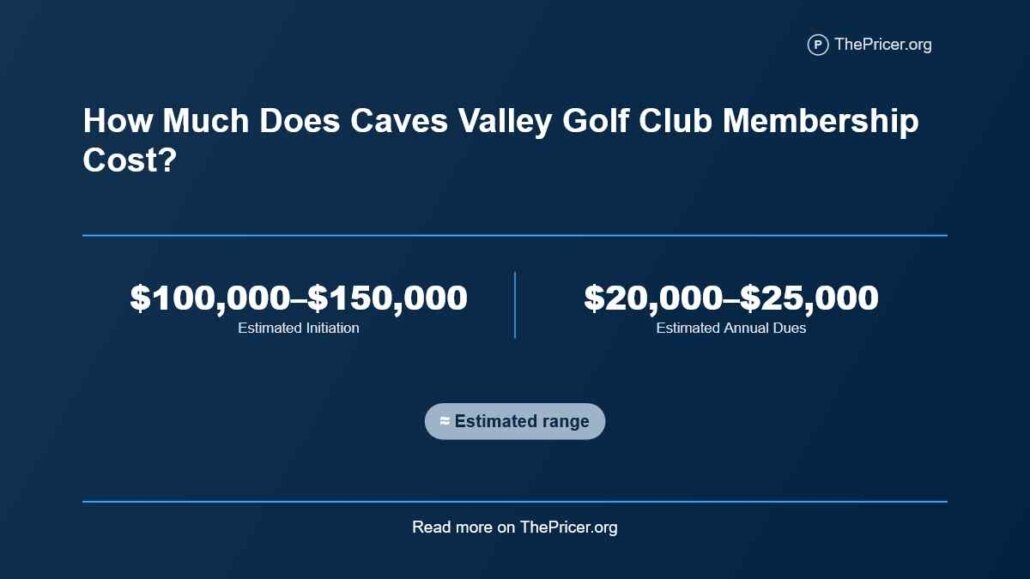
Caves Valley Golf Club membership is estimated to require a $100,000–$150,000 initiation fee, plus approximately $20,000–$25,000 in annual dues. Using those third-party estimates, the first-year membership commitment would be approximately $120,000–$175,000 before caddies, guest charges, dining, lodging, assessments, and other expenses.
These are 2026 planning estimates, not a verified club quotation. Published sources disagree on both initiation fees and dues, and Caves Valley does not disclose a current membership price schedule.
How Much Does Caves Valley Membership Cost?
Jump to sections
The most useful current pricing evidence comes from independent club directories and golf publications, although none establishes an official rate.
A 2026 membership estimate from Country of Clubs places initiation at approximately $125,000 and annual dues at approximately $22,500. It also identifies a broader reported range of $100,000–$150,000 for initiation and $20,000–$25,000 for yearly dues.
Another 2026 club review uses the same broad ranges. However, other sources report different figures, so those estimates should not be mistaken for independently confirmed membership invoices.
| Membership Expense | Estimated Cost | Confidence and Scope |
|---|---|---|
| Initiation fee | $100,000–$150,000 | Third-party estimate, not an official quote |
| Annual membership dues | $20,000–$25,000 | Common 2026 estimate; published figures conflict |
| First year, initiation and dues | $120,000–$175,000 | Calculated range before additional charges |
| Typical midpoint scenario | $147,500 | $125,000 initiation plus $22,500 dues |
| Caddie fees | Not publicly disclosed | Caddie required for every golfer |
| Guest golf charges | Not officially published | Guest access must be arranged through a member |
| Golf cart charges | Not officially published | Carts restricted to golfers unable to walk |
| Club rentals | Nominal fee; amount unpublished | Confirmed service without a public rate |
| Dining, lodging, and assessments | Not publicly disclosed | Depend on applicable membership terms and usage |
The table’s midpoint is a budgeting scenario, not the club’s quoted standard membership. Actual terms may depend on the membership category, admission timing, and the agreement offered to an approved applicant.
Why Published Fees Differ
Private-club pricing is especially difficult to verify because fees are rarely advertised, and reports may describe different years or membership classifications.
A January 2025 Forbes club profile described Caves Valley initiation fees as exceeding $100,000, with annual dues around $10,000. Forbes also noted that some club-pricing figures in its feature were estimates obtained from another publication.
That dues figure is considerably below the $20,000–$25,000 estimates circulating in 2026. A separate membership-cost directory estimates annual dues at $10,000–$15,000, adding to the discrepancy.
The evidence therefore supports a broad high-cost membership category, but not a precise, universally applicable annual dues amount. The $20,000–$25,000 range is useful as a more conservative planning allowance, while the lower published figures demonstrate why an applicant should request the actual classification-specific schedule.
There is also an important attribution issue in the older article: Forbes’ reference to a $150,000 initiation fee with dues exceeding $15,000 concerned Winged Foot Golf Club, not Caves Valley. That figure should not be presented as a verified Caves Valley price.
The strongest direct information remains the club’s own description of its private member-owned operation, facilities, and guest experience. Its official website does not provide public initiation or dues figures.
First-Year Membership Budget
The initiation fee creates the largest financial hurdle. Annual dues then become the recurring cost of maintaining membership, regardless of how frequently someone plays.
Three scenarios show how the reported figures affect an applicant’s starting budget:
| Scenario | Initiation | Annual Dues | First-Year Base |
|---|---|---|---|
| Lower reported figures | $100,000 | $20,000 | $120,000 |
| Midpoint estimate | $125,000 | $22,500 | $147,500 |
| Upper reported figures | $150,000 | $25,000 | $175,000 |
All three examples assume a full year’s dues and a one-time initiation payment. They exclude joining-related taxes, if applicable, and all other member-account spending.
The difference between the lowest and highest planning cases is $55,000 in the first year. Most of that variation comes from the initiation fee, which accounts for $50,000 of the difference. The annual dues assumption accounts for the remaining $5,000.
This matters when reviewing an invitation. A lower initiation fee can have a much larger immediate financial effect than a modest difference in annual dues, although the latter becomes increasingly important with time.
Five-Year Membership Cost
The annual dues commitment continues after the initiation fee has been paid. A five-year projection gives a more useful view than the first-year number alone.
Using the midpoint estimate:
- One-time initiation: $125,000
- Five years of dues: $22,500 × 5 = $112,500
- Five-year base: $237,500
Across the full reported range, the same five-year calculation produces $200,000–$275,000, assuming dues remain unchanged.
Those are fixed-fee scenarios, not predictions of actual billing. Dues may increase, and the club could have additional obligations that are not publicly documented.
Consider a separate illustrative sensitivity test. If a member begins at $22,500 in annual dues and faces a hypothetical 5% increase each year, five years of dues would total approximately $124,326. Adding the assumed $125,000 initiation fee produces approximately $249,326.
That is about $11,826 more than the flat-dues scenario. The 5% assumption is a budgeting stress test, not a published Caves Valley increase.
Industry research explains why dues escalation deserves attention. A Club Management Association briefing reported substantial median operating-dues revenue increases among clubs during 2022 and 2023. Those industry figures are historical benchmarks and do not establish Caves Valley’s individual policy.
Caddie and Guest Costs
The most important additional expense is the caddie program.
Caves Valley’s official guest instructions state that every golfer must be accompanied by a caddie, including members and guests who use a cart.
Members are expected to settle the caddie charges for themselves and their guests after the round. Guests may pay their caddies directly when the hosting member authorizes it.
This changes the budget substantially for someone who plays frequently or entertains clients. Caddie expenses cannot simply be eliminated by choosing a riding cart.
The club’s website does not publish a current caddie fee or gratuity schedule. A prospective member should therefore ask for the complete per-round caddie obligation rather than assuming that annual dues include it.
Some third-party websites cite guest rounds around $400, golf carts near $40, and rental clubs around $75. These figures are not supported by an official Caves Valley rate card.
The club confirms that rental sets are available for a nominal charge, but does not identify the amount. It also states that golf carts are intended for members and guests who are physically unable to walk the course.
That distinction makes a generic cart-fee estimate less useful than it would be at a conventional riding-oriented country club. Cart usage is subject to an eligibility rule, not merely a member’s preference.
What Hosting Guests Adds
Caves Valley describes business entertaining as an important part of its identity. For members who regularly invite clients, colleagues, or family, variable charges can become a meaningful part of annual spending.
The relevant categories include:
- Caddie services: Mandatory for the member and each guest playing golf.
- Guest golf: Charges and eligibility depend on the club’s current guest policy.
- Rental equipment: Available when a guest does not bring clubs.
- Meals and refreshments: Depend on dining choices and whether minimum spending requirements apply.
- Overnight accommodation: Available on the property, with prices not publicly listed.
- Special events: Private entertaining may create additional charges.
The club’s guest instructions require visitors to identify themselves and their hosting member at the security gate. This is not a public course where a nonmember can independently book a tee time.
For an illustrative annual budget, suppose a member allocates an additional $5,000 for caddies, guest-related charges, and hospitality. That would raise the midpoint recurring allowance from $22,500 to $27,500.
If the same member spends $10,000 on those extras, the annual allowance becomes $32,500. Both amounts are spending scenarios, not documented Caves Valley averages.
The useful question is not merely what a guest round costs. It is what the entire hosted visit costs after caddie services, golf, dining, and any overnight stay are included.
Facilities Included

Caves Valley is a golf-focused club rather than a conventional family country club built around swimming pools and racquet sports.
The club occupies approximately 962 acres in Owings Mills. Its facilities include an 18-hole golf course, practice ranges, short-game areas, a Performance Center, dining facilities, and overnight accommodations.
The club reports 49 guest rooms distributed between its clubhouse and seven golf cottages. This lodging capacity matters for members entertaining out-of-town visitors, although accommodation charges are not publicly available.
The club’s course was designed by Tom Fazio and opened in 1991. Its profile reflects an emphasis on championship golf, member hospitality, and business relationships.
For a golfer primarily interested in family recreation, it is worth comparing this offering with clubs that have broader fitness, swimming, and racquet facilities. The cost of Silver Creek Valley membership, for instance, illustrates how different membership categories and amenities can change the financial commitment.
Renovations and Assessments
Caves Valley underwent substantial work before hosting the 2025 BMW Championship.
According to The Baltimore Banner’s reporting, the renovation involved rebuilding green complexes, installing new drainage infrastructure, and modifying parts of the course.
These projects help explain the scale of the operation, but they do not prove that members received a particular assessment or dues increase.
Capital assessments are a legitimate concern when considering an expensive private club. They can create obligations beyond annual dues, depending on the membership agreement and the board’s authority.
A private-club finance overview explains why initiation payments, equity arrangements, and capital contributions need to be examined separately.
At Caves Valley, an applicant should request written answers about:
- Whether initiation payments are refundable or transferable.
- Whether the membership carries equity or redemption rights.
- Whether any current or approved capital assessments remain outstanding.
- Whether new members assume obligations from earlier projects.
- How dues and assessments can be adjusted.
Without the actual membership agreement, none of these financial terms should be assumed.
How Caves Valley Compares
A useful nearby comparison is Baltimore Country Club, although it operates a different membership and amenities model.
A Baltimore Country Club management profile prepared for a 2025 executive recruitment lists an $85,000 initiation fee. The same document reports approximately 3,300 members across categories and annual dues revenue of $14.6 million.
That is stronger evidence than the $45,000 Baltimore Country Club initiation figure used in the older article.
Comparing the published Baltimore benchmark with Caves Valley’s estimated range gives an initiation difference of approximately $15,000–$65,000. The comparison is indicative because the clubs’ membership classifications and benefits are not necessarily equivalent.
Another premium-club reference is Saucon Valley Country Club, whose documented industry benchmark includes an $80,000 initiation fee and annual dues of $17,699. It offers substantially more golf acreage and a broader range of recreational facilities, making the membership proposition different.
At the other end of the private-club spectrum, Porter Valley Country Club provides a useful example of lower initiation costs and more varied membership categories.
These comparisons show why initiation fees alone are insufficient. Two clubs with similar joining charges may offer very different golf access, amenities, guest privileges, and recurring obligations.
Is Membership Worth the Cost?
Caves Valley makes the most sense financially for someone seeking the specific benefits of a highly exclusive, golf-oriented private club.
A member who plays forty rounds per year and pays estimated annual dues of $22,500 incurs a fixed dues equivalent of $562.50 per round, before caddies, guests, and other spending. At eighty rounds, that falls to approximately $281.25 per round.
Those calculations exclude initiation entirely. They also don’t account for the value a member places on business relationships, availability, hospitality, course conditioning, or the club’s private environment.
This is why comparing Caves Valley with public-course green fees can be misleading. A member is purchasing long-term access to a private club and its associated privileges, not a package of discounted individual rounds.
The decision ultimately rests on three questions: whether an invitation is available, whether the member wants this particular experience, and whether the ongoing financial obligations remain comfortable even with limited annual play.
What We Verified
Answers to Common Questions
How much is the Caves Valley initiation fee?
Independent estimates generally place initiation at approximately $100,000–$150,000. The club does not publish a current official fee, and actual terms may vary by membership classification.
How much are annual dues?
Several 2026 sources estimate $20,000–$25,000 annually, although other publications report lower amounts. The correct rate must be confirmed with the club.
Can anyone apply for membership?
Membership is invitation-only, with sponsorship from an existing member. An ability to pay does not guarantee admission.
Are caddies required?
Yes. The official guest instructions require every golfer to have a caddie, including eligible cart users. The current caddie fee is not publicly listed.
Can nonmembers play at Caves Valley?
Nonmembers can visit as approved guests of members. Caves Valley does not offer ordinary public tee-time bookings.
Are capital assessments included in dues?
The club does not disclose the applicable terms publicly. Prospective members should obtain the assessment policy, current capital obligations, and membership agreement before committing.
How do I confirm current membership costs?
Membership inquiries must proceed through the club’s invitation and sponsorship process. The official contact details list its main number as 410-356-1313 and its address as 2910 Blendon Road, Owings Mills, Maryland.
Disclosure: Educational content, not financial advice. Prices reflect public information as of the dates cited and can change. Confirm current rates, fees, taxes, and terms with official sources before purchasing. See our methodology and corrections policy.