
How Much Does Cessna Cost?
Updated on | Researched and reviewed by Alec Pow, Founder & Pricing Investigator
Prices, claims, and calculations checked against 12 cited sources. See our research methodology and corrections policy.
A Cessna can cost about $25,000 for an inexpensive older piston airplane to nearly $30 million for a late-model Citation business jet. For most private pilots, however, the realistic shopping range is much narrower: roughly $45,000 to $370,000 for many Cessna 150, 152, and 172 aircraft, or around $80,000 to $650,000 for currently advertised Cessna 182 Skylanes.
The sticker price tells only part of the story. A $70,000 Cessna with an engine near overhaul can be more expensive to own than a $100,000 example with strong maintenance records and plenty of engine life remaining. Fuel, insurance, annual inspections, hangar space, maintenance, engine reserves, avionics, financing, and upgrades all change the real cost.
Article Highlights
Jump to sections
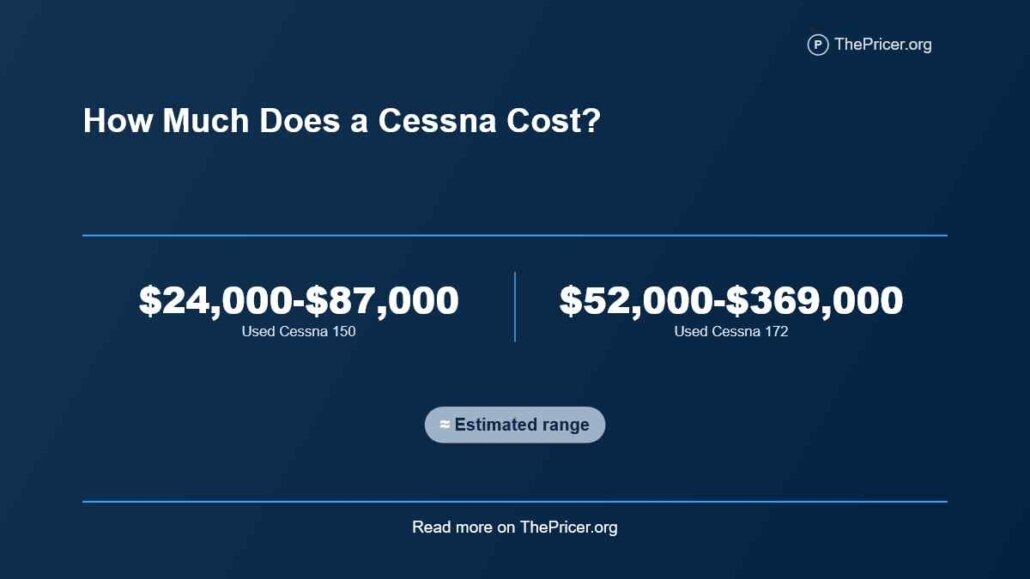
- Used Cessna 150s currently list from about $24,000 to $87,000, while 152s run roughly $44,000 to $95,000.
- Current Cessna 172 Skyhawk listings span approximately $52,000 to $369,000.
- Cessna 182 Skylanes currently range from about $80,000 to $650,000.
- Older high-performance Cessnas can cost far more than their age suggests. Some exceptional Cessna 210 variants now ask several hundred thousand dollars or more.
- A Citation M2 Gen2 currently costs roughly $5.5 million to $7.5 million on the used and nearly-new market.
- Nearly new Citation Latitudes are being advertised around $22.5 million, while recent Longitude values can reach roughly $30 million.
- At the current nationwide average of approximately $7.41 per gallon for 100LL avgas, fuel alone can easily cost a piston Cessna $60 to $100+ per flight hour.
How Much Does a Cessna Cost?
The answer depends almost entirely on which Cessna you mean. The brand stretches from two-seat trainers built decades ago to turboprop utility aircraft and long-range business jets.
| Aircraft | Current price range | Typical use |
|---|---|---|
| Cessna 150 | $24,000-$87,000 | Training and recreational flying |
| Cessna 152 | $44,000-$95,000 | Training and economical personal flying |
| Cessna 172 Skyhawk | $52,000-$369,000 | Training and personal travel |
| Cessna 182 Skylane | $80,000-$650,000 | Personal and family cross-country travel |
| Cessna 210 | $65,000 to several hundred thousand+ | High-performance personal travel |
| Cessna 310 | $77,000-$397,000 | Piston-twin ownership |
| Cessna 340 | $129,000-$580,000 | Pressurized piston-twin travel |
| Grand Caravan EX | Roughly $2 million-$3 million+ used | Utility, charter, cargo and commercial operations |
| Citation M2 Gen2 | $5.5 million-$7.5 million | Entry-level business jet |
| Citation Latitude | About $12.9 million-$22.5 million | Midsize business jet |
| Citation Longitude | Roughly $22 million-$30 million | Super-midsize business jet |
These are market ranges, not appraisals. Advertised prices can move quickly, and unusually upgraded, low-time, or collectible aircraft may sit far outside what most buyers pay.
Current listings from Controller, for example, put Cessna 150 asking prices between $24,279 and $86,712. That spread illustrates why model name alone is not enough to value an airplane.
Entry-Level Cessnas
The lowest-cost Cessnas are usually older 150s and 152s. They remain attractive to student pilots, time builders, flight schools, and recreational owners because they are relatively simple two-seat airplanes.
Current Cessna 150 listings run from approximately $24,000 to $87,000. The Cessna 152 market currently starts around $44,000 and reaches approximately $95,000.
The large difference between two otherwise similar aircraft can come from engine hours, corrosion, avionics, damage history, logbook completeness, paint, interior condition, propeller time, and recent maintenance.
This creates an important pricing trap. A $40,000 airplane is not necessarily $30,000 cheaper than a $70,000 airplane if the cheaper one soon needs an engine, major avionics work, and corrosion repairs.
Cessna 172 Prices
The Cessna 172 Skyhawk has one of the widest price ranges because buyers are comparing aircraft produced across many decades.
Current listings run from roughly $52,000 to $369,000. Older airplanes with conventional panels occupy the lower end, while recent aircraft with glass cockpits, modern autopilots, low hours, and strong maintenance histories can cost several times as much.
The Skyhawk remains a current-production model. Textron Aviation’s current Skyhawk uses modern Garmin avionics, and the manufacturer announced another piston-fleet upgrade in 2026. New-production Skyhawks, Skylanes, Turbo Skylanes, and Turbo Stationair HDs are receiving Garmin G1000 NXi System Release 7 and dual electronic ignition, with upgraded aircraft entering service from late 2026 into 2027.
A buyer considering ownership primarily for training should compare the aircraft’s total annual cost with rental and the broader cost to become a pilot. Low annual utilization can make ownership surprisingly expensive on a per-hour basis.
Cessna 182 Prices
The Cessna 182 Skylane provides more power, useful load, and cross-country capability than a 150, 152, or 172, and prices reflect that step up.
Current advertised Skylanes range from approximately $80,000 to $649,900. Older airframes occupy the lower end while newer glass-panel airplanes can approach $650,000.
The current factory Cessna Skylane uses a 230-horsepower Lycoming engine and modern Garmin G1000 NXi avionics.
Independent 2026 ownership analysis from GlobalAir also emphasizes that purchase price is only one component of Skylane ownership, with fuel, maintenance, storage, insurance, and reserves materially increasing the annual budget.
Six-Seat Cessnas
Buyers wanting more payload can move into aircraft such as the Turbo Stationair HD.
A useful real-world price reference comes from a 2026 South Carolina procurement document, which lists the commercial aircraft base price for a Turbo Stationair HD T206 at $1,069,000. Published options in that procurement pushed the configured list price to $1,142,940. The government pricing document is available through the South Carolina State Fiscal Accountability Authority.
This shows how misleading it can be to say that a “new Cessna” costs only a few hundred thousand dollars. Once buyers move into today’s larger piston models, factory pricing can cross $1 million.
Older Performance Models
Age does not necessarily make a Cessna cheap.
The current Cessna 210 market is a good example. Advertised prices begin around $65,000, but exceptional turbocharged, pressurized, heavily restored, or extensively upgraded variants can reach several hundred thousand dollars, with current listing data even containing outliers above $1 million.
Cessna 310 twin-engine aircraft currently run approximately $77,000 to $397,000, while Cessna 340s range from roughly $129,000 to $580,000.
The acquisition price can actually obscure the financial risk here. An inexpensive twin may carry two engines, two propellers, retractable landing gear, turbocharging, pressurization, and substantially more complex systems. Buying the airplane cheaply does not make those components cheap to maintain.
Caravan Prices
The Caravan family moves Cessna into commercial turboprop territory.
Textron’s current Grand Caravan EX uses an 867-shaft-horsepower Pratt & Whitney Canada PT6A-140 and offers a useful load of 3,532 pounds in its standard land configuration.
Used examples commonly cost several million dollars, depending on year, time, maintenance status, configuration, and mission equipment.
A commercial Caravan buyer also has expenses that do not resemble those of a recreational Cessna 150 owner: turbine maintenance, commercial insurance, crew expenses, inspections, airport charges, training, and potentially much higher annual utilization.
Citation Jet Prices
 Cessna’s Citation family pushes the price range into another financial category entirely.
Current Citation M2 Gen2 asking prices run from approximately $5.5 million to $7.5 million. A 2026 aircraft with only 14 hours was recently offered at $7.495 million, while 2022 examples sit closer to $5.5 million.
The next M2 generation is already on the way. Textron has announced the M2 Gen3, with entry into service planned for 2027. The company’s Gen3 announcement includes Garmin Emergency Autoland as a major new feature.
The Citation Latitude market is substantially higher. Current listings range from approximately $12.85 million for an older example to $22.5 million for nearly new 2026 aircraft.
Our separate guide goes deeper into the cost of a Citation Latitude.
The Citation Longitude sits higher again. Current market data from AvBuyer places recent pre-owned Longitudes at roughly $22 million for a 2020 aircraft, $25 million for a 2022, $28 million for a 2023, and approximately $30 million for a 2024 example.
What We Verified
We checked current October 2026 aircraft listings, manufacturer specifications, Textron’s current model lineup and 2026 product announcements, current aviation-fuel data, independent ownership guidance, aircraft pre-purchase guidance, engine overhaul pricing, and recent business-jet market information.
We also removed several model errors from the older version rather than carrying them forward. Discontinued aircraft are now clearly treated as used-market airplanes, current-production models are separated from legacy models, and asking prices are identified as market listings rather than completed transaction prices.
Most importantly, we did not reuse the old article’s blanket operating-cost figures. According to the Aircraft Owners and Pilots Association, true aircraft costs should be divided among direct expenses, fixed expenses, reserves, and variable expenses. The number of hours flown each year materially changes the apparent hourly cost.
Fuel Costs
Fuel is the easiest ownership expense to see immediately.
AirNav’s current nationwide survey of thousands of FBOs shows an average 100LL avgas price of approximately $7.41 per gallon and average Jet A of approximately $7.66 per gallon.
Using the current AirNav fuel average, an airplane burning 8.5 gallons per hour would spend:
8.5 × $7.41 = $62.99 per flight hour
At 100 hours per year:
$62.99 × 100 = $6,299 per year
A larger piston Cessna burning 12.5 gallons per hour would instead consume:
12.5 × $7.41 = $92.63 per hour
At 100 hours:
$92.63 × 100 = $9,263 per year in fuel alone
This is before maintenance, insurance, hangar space, engine reserves, inspections, oil, avionics subscriptions, or financing.
Ownership Math
Flying more can actually reduce the apparent hourly cost because fixed expenses are distributed over more hours.
Suppose an owner has $12,000 in annual fixed costs before fuel and flight-hour-dependent maintenance.
| Hours flown | Fixed cost per hour |
|---|---|
| 50 hours | $240 |
| 100 hours | $120 |
| 200 hours | $60 |
The airplane did not become cheaper. The same annual bills were simply spread across four times as many flight hours.
This is why an advertised claim that a Cessna “costs $150 per hour” is almost meaningless unless it specifies what expenses are included and how many hours per year the owner flies.
A $110,000 Skyhawk
Consider someone buying a $110,000 Cessna 172 and flying 100 hours per year.
| Expense | Illustrative annual amount |
|---|---|
| Fuel, 8.5 gph at $7.41 | $6,299 |
| Hangar, $500/month | $6,000 |
| Insurance | $1,800 |
| Annual inspection and routine maintenance allowance | $4,000 |
| Engine reserve, $35/hour | $3,500 |
| Oil, databases and miscellaneous costs | $1,200 |
| Illustrative annual total | $22,799 |
That works out to approximately $228 per flight hour, before financing, depreciation, taxes, major repairs, or upgrades.
The example is not intended as a universal 172 ownership quote. It demonstrates how quickly a relatively affordable aircraft becomes a five-figure annual expense.
Engine Risk
The engine can dramatically change whether an aircraft is a bargain.
Current published overhaul pricing from AirWorx Aviation, effective September 2026, starts around $32,500 for a Continental O-200, $39,500 for a Lycoming O-320, $41,500 for a 180-hp O-360, and $53,500 for a Continental O-470. Accessories, installation labor, shipping, and additional repairs can push the final bill considerably higher.
That means a $50,000 aircraft facing a $40,000-$50,000 engine event can effectively become a $90,000-$100,000 aircraft surprisingly quickly.
Hidden Costs
Deferred maintenance is one of the largest hidden costs. A cheap airplane can require expensive corrosion repairs, cylinders, exhaust work, avionics repairs, landing-gear work, or an engine shortly after purchase.
Avionics matter. A modern GPS, ADS-B equipment, autopilot, engine monitor, and glass-panel upgrade can represent tens of thousands of dollars of installed value.
Hangar space is recurring. Even an airplane that barely flies still needs to be stored somewhere. See our guide to aircraft hangar costs.
Financing magnifies the sticker price. Interest paid over a long aircraft loan can add tens of thousands of dollars to a piston airplane and much more to a turbine aircraft.
A prebuy can save far more than it costs. Aircraft-maintenance specialist Savvy Aviation recommends using an independent mechanic familiar with the particular make and model and focusing first on expensive potential show-stoppers, including engine condition and aircraft records.
Cheap vs Expensive
Imagine two Cessna 150s:
Aircraft A costs $42,000 but is close to engine overhaul and has old avionics.
Aircraft B costs $70,000 but has a relatively fresh engine, useful modern avionics, clean records, and no immediate major maintenance requirement.
If Aircraft A needs a $32,500 engine overhaul plus $10,000 in avionics and other work, its effective cost becomes approximately:
$42,000 + $32,500 + $10,000 = $84,500
The nominally $28,000-cheaper airplane has now cost $14,500 more than Aircraft B.
That is why engine time, maintenance history, corrosion, avionics, damage history, and logs can matter more than the number in the advertisement.
Answers to Common Questions
What is the cheapest Cessna?
Older Cessna 150s are among the cheapest widely available Cessna airplanes. Current listings start around $24,000, although unusually inexpensive aircraft may have high engine time, limited avionics, or maintenance needs.
How much does a Cessna 172 cost?
Current Cessna 172 Skyhawk asking prices range from roughly $52,000 to $369,000. Most of the difference comes from age, engine time, avionics, condition, equipment, and maintenance history.
How much does a new Cessna cost?
Current-production Cessnas range from piston aircraft costing hundreds of thousands to more than $1 million, through multimillion-dollar Caravans and Citation business jets. A configured Turbo Stationair HD exceeded $1.14 million in one documented 2026 government purchase-price schedule.
How much does a Cessna cost per hour?
There is no single honest hourly number. Fuel alone can run approximately $60-$100+ per hour for many piston Cessnas at current avgas prices. The actual ownership cost rises once maintenance, inspection, insurance, hangar, engine reserve, and other fixed expenses are included.
Is a Cessna 150 cheaper than a 172?
Usually. The 150 generally costs less to buy and burns less fuel, but the condition of an individual airplane can outweigh the model difference.
Should I buy the cheapest used Cessna I can find?
Usually not based on price alone. A properly maintained airplane with a stronger engine, better records, and useful avionics can be much cheaper over several years than a bargain aircraft requiring immediate major work.
Disclosure: Educational content, not financial advice. Prices reflect public information as of the dates cited and can change. Confirm current rates, fees, taxes, and terms with official sources before purchasing. See our methodology and corrections policy.