
How Much Does Childcare Cost Per Month?
Published on | Written by Alec Pow
This article was researched using 14 sources. See our methodology and corrections policy.
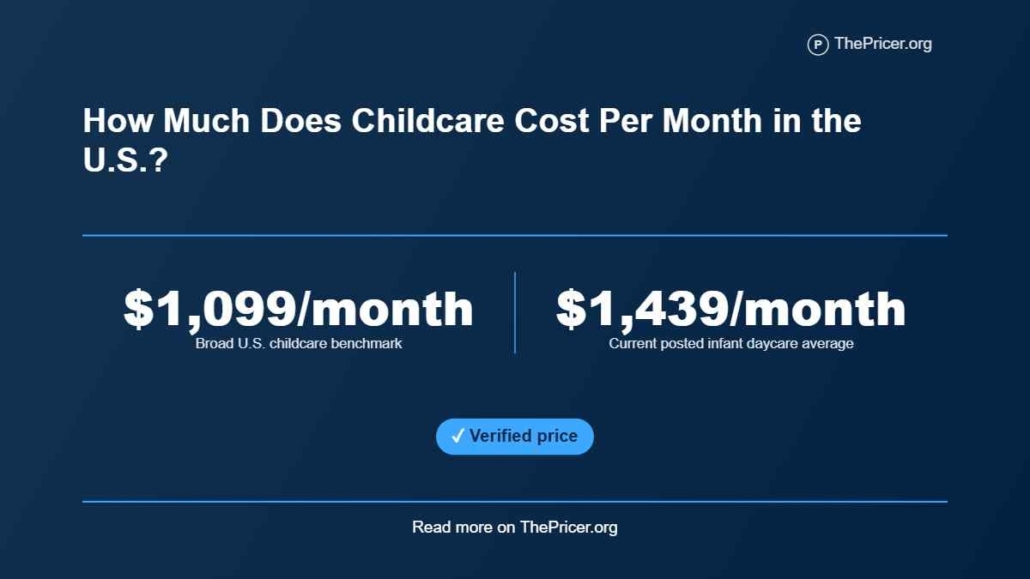
Childcare costs about $1,099 per month on the latest broad U.S. national benchmark, based on Child Care Aware of America’s 2025 annual average of $13,184. Child Care Aware published its latest national price release in May 2026. That benchmark is a starting point rather than a quote for every family. Current posted rates put infant daycare near $1,439 per month, family child care near $1,400 per month, and a full-time infant nanny near $3,770 per month.
U.S. childcare spans center-based daycare, family child care, nanny care, and limited-hours sitter care. Child Care Aware of America supplies national price benchmarks, Care.com supplies posted marketplace rates, the U.S. Department of Labor tracks geographic price patterns, and the IRS governs federal tax rules that can change a household’s net cost.
The monthly budget depends on the child’s age, location, weekly schedule, number of children, provider fees, paid closures, and any tax or assistance programs that apply. Keeping those cost structures separate makes the national benchmark useful without mistaking it for a local provider quote.
Article Highlights
Jump to sections
- The latest broad U.S. childcare benchmark works out to about $1,099 (at $30 per hour, earning that amount would take about 4.6 full-time workdays, before taxes) per month.
- Current posted infant daycare rates average about $1,439 per month after converting the weekly figure across a full year.
- A full-time infant nanny in the same posted-rate dataset works out to about $3,770 per month before household-employer costs that may apply.
- Two-child pricing changes the comparison sharply because adding a second child raises center care much more than nanny wages in the cited marketplace data.
How Much Does Childcare Cost Per Month?
Two current datasets answer different parts of the question. Child Care Aware reports a national average annual price of $13,184 (about 11 full-time workweeks at $30 per hour) across three calculation methods and 47 states with price data. Its 2025 price and supply report also lists a space-weighted center price of $15,015 per year for infants and $12,165 per year for 4-year-olds. Those figures equal about $1,251 and $1,014 per month.
Care.com reports posted marketplace rates rather than the same state-based measure. Its 2026 report lists weekly rates across care types, including daycare, family care, nannies, after-school sitters, and babysitters. The monthly figures below use weekly rate times 52 divided by 12. That method avoids the common four-weeks-per-month shortcut, which leaves roughly four weeks of annual cost out of the budget.
| Care type or benchmark | Published unit | Approximate monthly cost | Scope |
|---|---|---|---|
| Broad U.S. childcare benchmark | $13,184 per year | $1,099 | Blended national benchmark |
| Center care for an infant | $15,015 per year | $1,251 | Child Care Aware Method 2 |
| Center care for a 4-year-old | $12,165 per year | $1,014 | Child Care Aware Method 2 |
| Infant daycare | $332 per week | $1,439 | Care.com posted rates |
| Infant family care | $323 per week | $1,400 | Care.com posted rates |
| Full-time infant nanny | $870 per week | $3,770 | 40-hour week |
| After-school sitter | $328 per week | $1,421 | 15 hours per week |
| Babysitter | $175 per week | $758 | 8 hours per week |
What Childcare Includes
Regular childcare can mean several different products. A child care center usually provides group care in classrooms organized by age. Family child care is typically provided in a caregiver’s home to a smaller mixed-age group. A nanny works in the family’s home and is usually paid for a defined weekly schedule. After-school sitters and babysitters cover fewer hours and should not be compared with full-time center care as though the services were identical.
The monthly price also depends on what the arrangement covers. Full-day center tuition may include meals, snacks, classroom supplies, or diapers at some providers, while another center may require families to bring them. Nanny pay may cover the caregiver’s wages but leave payroll taxes, overtime, paid leave, mileage, activities, and other employment costs outside the headline rate. Parents comparing center care can use the separate daycare cost guide, while families weighing in-home care can compare the structure in the nanny cost guide.
The care model matters. A lower monthly quote is only cheaper when the hours, child count, included services, and required payments match the family’s actual need.
Age Changes the Monthly Bill
Infant care carries a higher price than care for older children in the cited center data. The figures show the size of that premium without treating it as a rule for every provider. Under Child Care Aware’s space-weighted method, infant center care is $15,015 (about 12.5 full-time workweeks at $30 per hour) per year, while center care for a 4-year-old is $12,165 per year.
The difference is $2,850 per year. Dividing that gap by 12 gives an infant premium of about $237.50 per month, and the infant figure is about 23% above the 4-year-old figure. That calculation is useful for families planning ahead because a childcare budget can fall as a child moves into an older classroom even when the provider stays the same. The exact timing and reduction still depend on the center’s classroom definitions and tuition schedule.
Age can also affect the comparison between care models. A family child care home may price age groups differently from a center, and a nanny may quote one hourly rate for a schedule rather than publishing separate infant and preschool tuition. That makes age-specific provider quotes more useful than applying one national monthly number to every child.
Location Can Shift the Price
Location can move a monthly childcare bill far away from the national benchmark. The U.S. Department of Labor tracks county-level childcare prices by provider type and child age. Its public price series currently runs through 2022, so it is better used to study geographic patterns than as a current 2026 quote.
Current direct provider pages show how large the local spread can be even within one brand. Primrose School at Avalon Park in Orlando posts infant tuition of $345 per week, or about $1,495 per month when normalized across 52 weeks, for its Orlando location. Primrose School of Midtown at Colony Square in Atlanta posts $2,660 per month for infant care for its Midtown Atlanta location.
Those two same-brand examples differ by about $1,165 per month, with the Atlanta figure roughly 78% above the normalized Orlando figure. They are examples, not a national Primrose range. Families comparing that brand can see more location and classroom context in the Primrose tuition guide. The practical comparison is local price against local price, using the same child age and attendance schedule.
The Two-Child Cost Jump
Adding a second child changes the economics of each care model. Care.com’s current toddler figures place a nanny at $936 per week for one child and $952 per week for two children. The added child raises the posted nanny rate by only $16 per week, which is about $69 per month or 1.7%. The same dataset puts daycare at $308 per week for one toddler and $585 per week for two children.
That daycare increase is $277 per week, or about $1,200 per month. It is close to a 90% increase because a second center seat consumes another large block of capacity. Care.com states that its two-child daycare and family-care figures include a national average sibling discount of 10%, so the published two-child rate already reflects that assumption.
ThePricer’s calculated comparison shows why one-child price gaps can mislead a growing family. For one toddler, the nanny-minus-daycare gap is $628 per week. With two children, it falls to $367 per week. The gap shrinks by about 42%, even though the nanny remains more expensive in this dataset. A family expecting another child should compare the added cost of child two, not reuse the one-child ranking.
Fees and Billing Surprises
Tuition is not always the full amount needed to start or keep care. A current La Petite Academy offer, checked September 17, 2026, advertises up to $500 in tuition credits but requires families to pay a registration fee and advance tuition before the offer applies. Its published sibling-discount terms say qualifying families with more than one enrolled child may receive a 10% discount for the oldest child.
That discount wording shows another comparison trap. A 10% sibling discount is not a 10% reduction on the full two-child bill when it applies to only one child. If two children had equal tuition before the discount, taking 10% off one child would cut the combined tuition by 5%. Actual savings will differ when classroom rates differ.
Billing cadence can distort monthly budgeting too. A weekly price multiplied by four understates a full 52-week year. A family paying $332 per week for 52 billed weeks spends $17,264 per year, not $15,936. The difference is $1,328 per year. Families should also ask how holidays, illness, vacations, late pickup, schedule extensions, meals, diapers, supplies, and deposits are handled before treating two tuition quotes as equal.
Tax Benefits and Assistance
 Tax treatment can reduce the effective household cost without changing the provider’s tuition. For 2026, IRS Publication 15-B raises the annual dependent-care assistance exclusion to $7,500, or $3,750 for a married employee filing separately. The IRS sets the current exclusion rules and states that qualifying excluded benefits are not subject to federal income tax withholding, Social Security tax, or Medicare tax within the applicable rules.
The Child and Dependent Care Credit has separate limits. IRS Publication 505 says the eligible expense ceiling remains $3,000 for one qualifying person or $6,000 for two or more, while the maximum credit rate rises to 50% for 2026. Families should apply the current 2026 credit guidance to filing status, income, work-related care expenses, and any employer dependent-care benefits rather than treating every maximum as stackable cash.
Families may also qualify for programs that reduce the provider bill directly. Federal guidance on childcare financial assistance options explains that states and territories operate subsidy programs with their own eligibility rules. It also points families to Head Start, Early Head Start, state-funded prekindergarten, tribal programs, and some college-based care. A monthly budget should use the family’s expected copayment only after eligibility and provider participation are confirmed.
Three Monthly Budget Scenarios
These scenarios use the published rates cited above and stated assumptions. They are budgeting models, not invoices.
One infant in daycare
At $332 per week for 52 billed weeks, annual tuition is $17,264. Dividing by 12 gives an average monthly budget of about $1,439. It excludes enrollment charges, optional services, and tax benefits.
Two children with a dependent-care FSA
At the cited two-child daycare rate of $585 per week, assume an eligible employee routes $7,500 through a dependent-care FSA, is in a 22% federal marginal income-tax bracket, stays below the Social Security wage base, and has no state-tax savings. The IRS lists current employee payroll rates of 6.2% for Social Security and 1.45% for Medicare.
- Weekly tuition is $585.
- Annual tuition is $30,420.
- Monthly tuition before tax effects is $2,535.
- Modeled FSA tax savings are about $2,224 per year.
- Modeled after-tax-equivalent cost is about $28,196 per year, or $2,350 per month.
The tax calculation uses 29.65%, which is the chosen 22% federal rate plus 7.65% employee Social Security and Medicare. Multiplying $7,500 by 29.65% gives $2,223.75, rounded to $2,224. The family still pays the provider, and the model does not include state-tax effects.
Two-child daycare against a nanny
Two-child daycare at $585 per week equals $30,420 per year. The two-child nanny figure of $952 per week equals $49,504 per year. The gap is $19,084 per year, or about $1,590 per month, before nanny payroll or employment costs. It narrows versus the one-child comparison but does not reverse in the cited data.
Makes sense if
- The selected care model covers the hours the household really needs.
- The family has compared the marginal cost of adding another child.
- The quote includes the recurring services that matter to the household.
- Available tax benefits or subsidies have been modeled using current eligibility rules.
Does not make sense if
- A weekly quote was converted to a monthly budget by multiplying by four.
- A one-child comparison is being used to plan for two children.
- Registration, paid closures, schedule extensions, or employment costs are missing from the comparison.
- A tax maximum is being treated as cash back without checking the household’s eligibility.
Answers to Common Questions
How much should I budget for childcare each month?
The latest broad U.S. benchmark is about $1,099 per month. Current posted infant daycare averages about $1,439 per month, while a full-time infant nanny works out to about $3,770 per month.
How much does childcare cost for two children?
Current marketplace data puts two-child daycare near $2,535 per month and a two-child nanny near $4,125 per month before household-employer costs.
Why does infant childcare cost more?
In the cited space-weighted center data, infant care is about $237.50 per month above care for a 4-year-old.
Can tax benefits lower my childcare cost?
They can for eligible households. The 2026 dependent-care assistance exclusion can reach $7,500, and the Child and Dependent Care Credit has separate expense limits and eligibility rules. Those benefits change net household cost, not posted tuition.
Disclosure: Educational content, not financial advice. Prices reflect public information as of the dates cited and can change. Confirm current rates, fees, taxes, and terms with official sources before purchasing. See our methodology and corrections policy.