
How Much Does Claude Opus 5.5 Cost?
Published on | Written by Alec Pow
This article was researched using 12 sources. See our methodology and corrections policy.
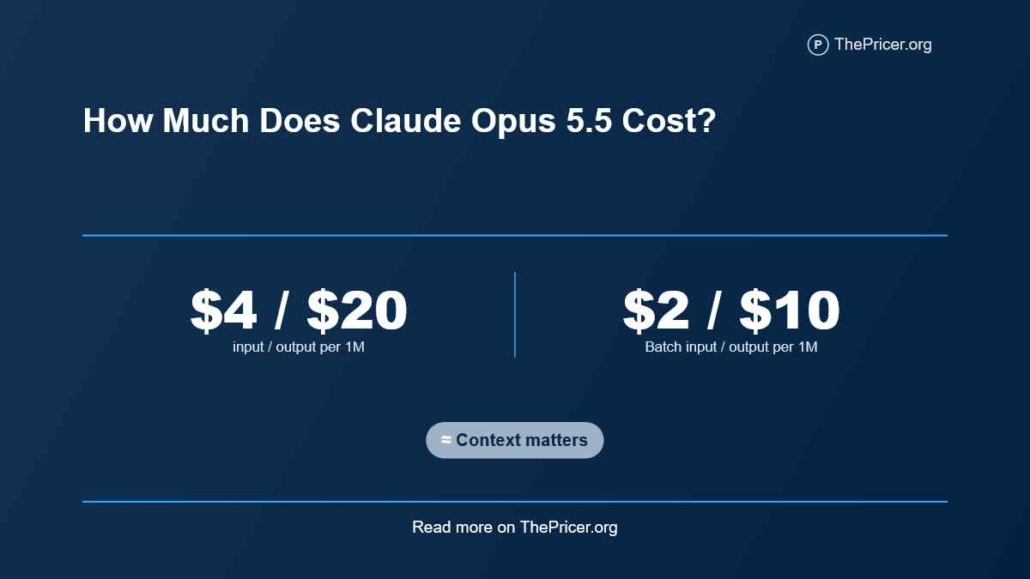
Claude Opus 5.5 costs $4 per 1 million input tokens and $20 per 1 million output tokens through the standard Claude API. Prompt-cache reads cost just $0.20 per million tokens, while a five-minute cache write costs $5 and a one-hour cache write costs $8 per million. Anthropic also offers Batch processing at $2 input and $10 output per million tokens and a faster mode at $8 input and $40 output.
Anthropic released Claude Opus 5.5 on September 22, 2026. The official Opus 5.5 announcement says its base token prices are 20% lower than Claude Opus 5, while typical workloads can cost about 40% less because the newer model also uses fewer tokens to finish tasks. Opus 5.5 is available through the Claude API, Claude apps, Claude Code, AWS, Google Cloud, and Microsoft Foundry.
Article Highlights
Jump to sections
- Claude Opus 5.5 costs $4 per million input tokens and $20 (at $30 per hour, earning that amount would take about 40 minutes, before taxes) per million output tokens.
- Cache reads cost only $0.20 per million tokens, 60% below the $0.50 rate for Opus 5.
- Batch processing cuts the standard rates in half to $2 input and $10 output.
- Fast mode doubles the standard rates to $8 input and $40 output.
- A Claude subscription and Claude API usage are separate purchases. Claude Pro starts at $20 per month, while Max costs $100 or $200 per month.
How Much Does Claude Opus 5.5 API Cost?
Anthropic’s Opus 5.5 model documentation lists five main token charges. The model supports a 1-million-token context window and up to 128,000 output tokens in ordinary requests.
| Opus 5.5 billing item | Price per 1 million tokens | What it covers |
|---|---|---|
| Standard input | $4.00 | New prompt and context tokens |
| Standard output | $20.00 (about 40 minutes at $30 per hour) | Generated responses, code, and other output |
| 5-minute cache write | $5.00 | Creating reusable cached context |
| 1-hour cache write | $8.00 | Creating longer-lived cached context |
| Cache read | $0.20 | Reusing context already stored in the cache |
| Batch input | $2.00 | Asynchronous batch requests |
| Batch output | $10.00 | Output generated through Batch |
| Fast input | $8.00 | Higher-speed processing |
| Fast output | $40.00 | Higher-speed generated output |
The output rate is five times the ordinary input rate. This means long answers, generated code, reports, and agent output can become a larger part of the bill than the prompt itself.
For example, a request containing 100,000 input tokens and generating 20,000 output tokens costs $0.80. The input costs 0.1 × $4, or $0.40. The output costs 0.02 × $20, which is another $0.40.
What Does Opus 5.5 Cost for Real Workloads?
A few cents per request can turn into hundreds or thousands of dollars when an application runs repeatedly. The useful number is therefore not just the per-million-token rate but the number of tasks and the amount of context each task consumes.
Small professional task
A request using 10,000 input tokens and generating 2,000 output tokens costs approximately $0.08. One thousand identical requests would cost about $80 (about 2.7 hours of work at $30 per hour) at standard API rates.
Large coding or document task
A 100,000-input-token request with 20,000 output tokens costs about $0.80. Run the same workload 1,000 times and the token bill reaches approximately $800.
Very large context job
A task that feeds Claude 750,000 input tokens and generates 50,000 output tokens costs about $4. The input costs $3 and the output costs $1. Running that job 100 times would produce about $400 in model charges before any tool fees or platform-specific charges.
At a $30 hourly wage, earning $800 represents about 26 hours and 40 minutes of gross work. This is why token optimization becomes much more important in repeated agent workflows than it does for occasional API calls.
Prompt Caching
 Opus 5.5 has unusually aggressive cache-read pricing. Anthropic cut cache reads from $0.50 per million tokens on Opus 5 to $0.20 per million on Opus 5.5. That is a 60% reduction and only 5% of the normal $4 input rate.
The tradeoff is that creating the cache costs more than ordinary input. A five-minute cache write costs $5 per million tokens, while a one-hour write costs $8 per million. Caching therefore works best when the same long system prompt, codebase, document set, or tool definition will be reused multiple times.
Consider a workflow that repeatedly uses 500,000 tokens of shared context, adds 20,000 new input tokens, and generates 20,000 output tokens. Without caching, one run costs about $2.48. With the 500,000 shared tokens already cached, the cache read costs $0.10, the 20,000 fresh input tokens cost $0.08, and the output costs $0.40. The repeat run falls to about $0.58.
That saves approximately $1.90 per repeat request, or about 76.6%. The first cache write still costs money, so a workload that uses a large prompt only once may not benefit. Long-lived coding agents and repetitive document-analysis systems are where the math becomes much more favorable.
Batch Mode
Anthropic’s Opus 5.5 documentation says the Batch API receives a 50% discount on input and output. The effective prices are therefore $2 per million input tokens and $10 per million output tokens.
The 100K-input plus 20K-output workload that costs $0.80 under normal pricing costs only $0.40 through Batch. Across 1,000 such jobs, the bill falls from $800 to $400.
Batch is meant for work that can be processed asynchronously rather than returned immediately. Anthropic’s broader Claude pricing page describes Batch as the lower-cost service tier for grouped asynchronous requests. For a large nightly classification job, report generation run, or document queue, the 50% discount can outweigh the delay.
Fast Mode Costs
Opus 5.5 also has a Fast mode in Claude Code and on the Claude Platform. Anthropic says it can deliver up to 2.5 times faster speed, but the price doubles to $8 per million input tokens and $40 per million output tokens.
Our 100K-input plus 20K-output example therefore rises from $0.80 in Standard mode to $1.60 in Fast mode. Across 1,000 runs, the difference is $800.
Fast mode makes the strongest economic case when human waiting time or machine idle time costs more than the extra API charge. For overnight processing, Batch may be the better price. For an interactive coding session where response latency blocks paid engineering work, Fast mode may justify the premium.
US-Only Processing
Anthropic’s current Opus product page says US-only inference is available at 1.1 times normal input and output pricing. That would move the ordinary Opus 5.5 rates from $4 and $20 to approximately $4.40 per million input tokens and $22 per million output tokens.
This premium matters mostly to businesses with a specific data-location requirement. A company running $10,000 per month of otherwise identical input and output usage would add roughly $1,000 if all of that usage qualified for the 10% US-only premium.
Opus 5.5 Is Cheaper Than Opus 5
The previous Claude Opus 5 costs $5 per million input tokens and $25 per million output tokens. Opus 5.5 cuts both prices by 20%. Cache writes also drop from $6.25 to $5 for the standard five-minute cache, while cache reads fall much more sharply from $0.50 to $0.20.
Anthropic goes further than the sticker-price comparison. It says typical Opus 5.5 workloads cost about 40% less to run than Opus 5 because the new model both costs less per token and tends to use fewer tokens to complete a task. Independent launch coverage from TechCrunch confirmed the $4 input and $20 output pricing and the reduction from the previous generation.
VentureBeat’s launch coverage also confirmed the 20% base-token reduction and noted that the larger practical savings come from reduced token consumption and cheaper cache reads.
Opus 5.5 vs Fable 5.1 and Sonnet 5
The more surprising comparison is with Claude Fable 5.1. Anthropic prices Fable 5.1 at $10 input and $50 output per million tokens, compared with $4 and $20 for Opus 5.5. Opus therefore costs 60% less per ordinary input and output token even though Anthropic says Opus 5.5 performs at roughly Fable 5.1’s level on much of its work.
Sonnet 5 sits below Opus on price. Anthropic’s current model comparison lists Sonnet 5 at $2 input and $10 output per million tokens. That makes Opus 5.5 exactly twice the base token price of Sonnet 5.
The resulting ladder is unusual. Sonnet 5 is the lower-cost choice, Opus 5.5 doubles its token rate, while Fable 5.1 costs 2.5 times as much as Opus 5.5 on both standard input and output. Readers comparing other premium AI models can also see our GPT-6 Astra cost guide and Claude Fable 5 pricing guide.
Claude Subscription Prices
You do not have to pay API rates simply to use Opus 5.5 in the Claude app. Anthropic says Opus 5.5 is available to Pro, Max, Team, and Enterprise users. Those plans use subscription limits instead of billing each normal Claude chat directly at the $4 and $20 API rates.
Claude Pro costs $20 per month in the United States. Anthropic also offers an annual option at $200, equivalent to about $16.67 per month. The public pricing page rounds that discounted monthly equivalent to $17.
The current Claude plan comparison lists Max 5x at $100 per month and Max 20x at $200 per month. Team costs $25 per person per month with annual billing or $30 monthly, with a five-member minimum.
A five-person Team account therefore starts at an effective $125 per month on annual pricing or $150 per month when billed monthly. Anthropic’s Team billing explanation confirms the per-member structure and notes that taxes can vary by region.
The critical distinction is that a Claude subscription does not include ordinary Anthropic API usage. Anthropic’s Pro documentation explicitly separates Claude app subscriptions from Console API billing. A developer can therefore pay $20 for Claude Pro and still receive a separate API bill for an application using claude-opus-5-5.
For a wider business comparison, our Claude AI business pricing guide covers seat-based plans, enterprise use, and token-heavy company deployments. Readers comparing consumer subscriptions can also review our ChatGPT cost guide.
Hidden Costs
The $4 and $20 figures are not always the complete API bill. Agentic applications may invoke paid tools in addition to generating tokens. Anthropic’s pricing page currently lists web search at $10 per 1,000 searches, with the input and output tokens used around those searches billed separately.
Code execution can also add usage charges once the included organization allowance is exhausted. These costs can be small compared with long Opus sessions, but an autonomous research agent making hundreds or thousands of searches can produce a meaningful tool line on top of its model charges.
Cloud marketplaces introduce another layer. Opus 5.5 is available through Amazon Bedrock, Google Cloud, Microsoft Foundry, and Claude Platform on AWS. The Opus 5.5 migration documentation confirms availability across those routes. Buyers should check their chosen cloud’s billing terms rather than assume every marketplace invoice will look exactly like a direct Claude Platform bill.
Who This Makes Sense For
Opus 5.5 is priced for long-running coding agents, complicated document work, computer use, and professional tasks where model quality can affect how many retries, corrections, or hours of human review are required. Anthropic’s own description positions it as the Opus model for demanding coding and knowledge work.
The weaker economic case is straightforward classification, data cleanup, simple extraction, routine summaries, and other jobs where Sonnet or a lower-cost model can reach the required quality reliably. Paying twice Sonnet 5’s base token price for a task that gets no measurable benefit from Opus raises cost without improving the finished result.
The API price should therefore be compared on cost per successful task, not only cost per million tokens. A $0.40 cheaper run that repeatedly needs correction can cost more in the end than a stronger first pass. The opposite is also true for easy high-volume work, where even a few cents of unnecessary Opus usage can become thousands of dollars at scale.
What We Verified
Base pricing: Anthropic’s current model documentation lists Opus 5.5 at $4 per million input tokens and $20 per million output tokens, with $5 five-minute cache writes, $8 one-hour cache writes, and $0.20 cache reads.
Batch and Fast pricing: Anthropic lists a 50% Batch discount, bringing the effective rates to $2 and $10. Fast mode is $8 input and $40 output and can run up to 2.5 times faster.
Model limits: Opus 5.5 has a 1-million-token context window, a 128,000-token normal output limit, and a beta Batch output limit of up to 300,000 tokens.
Independent confirmation: The Verge’s launch report independently confirmed the September 22 release and Anthropic’s claim that typical Opus 5.5 workloads are about 40% cheaper than Opus 5.
Answers to Common Questions
How much does 1 million tokens cost with Claude Opus 5.5?
Standard API pricing is $4 per 1 million input tokens and $20 per 1 million output tokens. The exact request cost depends on the mix of input, output, cached context, and paid tools.
How much does Claude Opus 5.5 cost with Batch processing?
Batch processing costs $2 per million input tokens and $10 per million output tokens, a 50% discount from Standard pricing.
How much is Claude Opus 5.5 Fast mode?
Fast mode costs $8 per million input tokens and $40 per million output tokens. Anthropic says it can provide up to 2.5 times faster generation.
Can I use Claude Opus 5.5 with Claude Pro?
Yes. Anthropic lists Opus 5.5 for Pro, Max, Team, and Enterprise users. Claude Pro costs $20 monthly in the U.S., or $200 when paid annually. API usage remains separately billed.
Bottom line: Claude Opus 5.5 starts at $4 per million input tokens and $20 per million output tokens. Batch can cut that to $2 and $10, while Fast mode doubles it to $8 and $40. The largest savings for long-running agents may come from the $0.20 cache-read price. For ordinary Claude app users, the relevant starting point is instead the $20-per-month Pro subscription, with API charges kept separate.
Disclosure: Educational content, not financial advice. Prices reflect public information as of the dates cited and can change. Confirm current rates, fees, taxes, and terms with official sources before purchasing. See our methodology and corrections policy.