
How Much Does College Cost Per Year?
Published on | Written by Alec Pow
This article was researched using 14 sources. See our methodology and corrections policy.
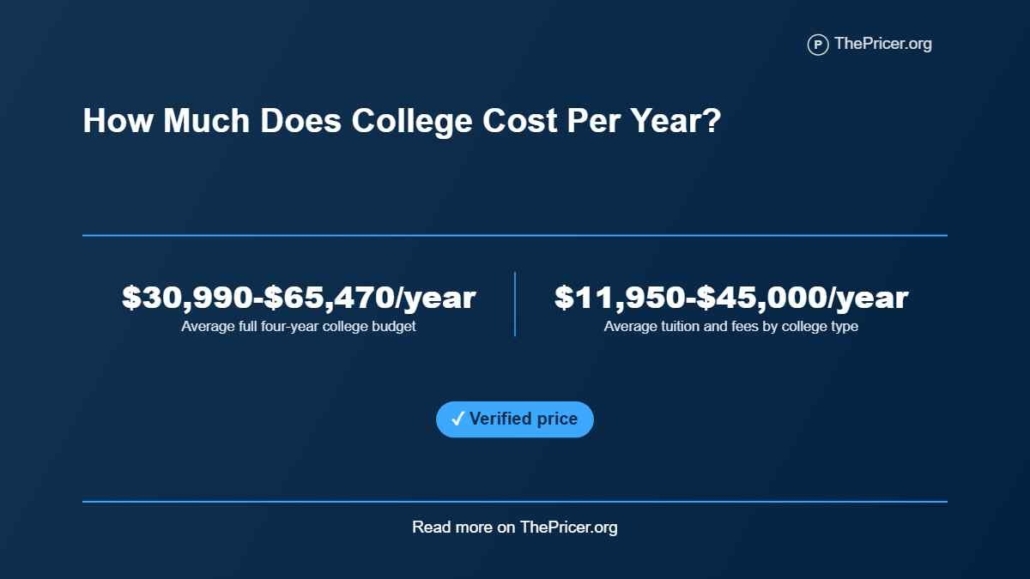
College costs for one undergraduate academic year depend heavily on whether the school is public or private and, at public universities, whether the student qualifies for in-state tuition. For 2025-26, average tuition and fees are $11,950 for public four-year in-state students, $31,880 for public four-year out-of-state students, and $45,000 at private nonprofit four-year colleges. Tuition is only part of the yearly bill.
Average full student budgets reach $30,990, $50,920, and $65,470 for those same groups. Those budgets include common living and education expenses before grants and scholarships reduce what a particular student may need to pay.
College Board supplies the national public and private pricing benchmarks, while Federal Student Aid distinguishes tuition, cost of attendance, grants, loans, and net price. Public universities such as the University of Florida, UCLA, and the University of Michigan show how resident and nonresident charges can diverge at individual schools, while private nonprofit institutions such as Harvard illustrate how tuition, housing, food, insurance, and institutional aid combine into a different annual cost structure.
WICHE’s Western Undergraduate Exchange adds another variable for eligible nonresident students because participating public colleges can offer a reduced nonresident rate. The useful comparison is not simply public versus private. It is resident status, published tuition, full annual budget, and aid measured on the same basis.
Article Highlights
Jump to sections
- Public four-year in-state tuition and fees average $11,950 (at $30 per hour, earning that amount would take about 10 full-time workweeks, before taxes) for 2025-26.
- Public four-year out-of-state tuition and fees average $31,880, a national gap of $19,930 from the in-state figure.
- Private nonprofit four-year tuition and fees average $45,000, while the average full student budget reaches $65,470.
- At the public in-state average, $19,040 of the annual budget sits outside tuition and fees.
- Aid can change the comparison enough that sticker price alone is a poor way to choose between two offers.
How Much Does College Cost Per Year?
The national figures show two separate comparisons. College Board splits public four-year pricing into resident and nonresident categories, while its private nonprofit figure appears as one national category. The table keeps tuition and the full student budget separate because the two answer different questions. Tuition is the instructional sticker charge plus required fees. The full budget adds categories such as housing, food, books, supplies, transportation, and personal expenses.
| Four-year college category | 2025-26 tuition and fees | 2025-26 full budget | Budget outside tuition | Share outside tuition |
|---|---|---|---|---|
| Public in-state | $11,950 (about 10 full-time workweeks at $30 per hour) | $30,990 | $19,040 | 61.4% |
| Public out-of-state | $31,880 | $50,920 | $19,040 | 37.4% |
| Private nonprofit | $45,000 | $65,470 | $20,470 | 31.3% |
ThePricer calculation subtracts tuition and fees from each full budget, then divides the remainder by the full budget. For a public in-state student, $30,990 minus $11,950 leaves $19,040. That is 61.4% of the published student budget. This finding matters because a family focusing only on the tuition line can miss most of the planning amount at the public in-state benchmark. The same subtraction leaves $19,040 for public out-of-state students and $20,470 at private nonprofit colleges.
What Counts as College Cost?
College pricing uses several labels that should not be treated as synonyms. Federal Student Aid defines cost of attendance as the total school-year cost for a student and says it can include tuition, fees, books, supplies, food, and housing. Its guidance also distinguishes cost of attendance from net price. Net price is the amount left after grants and scholarships are subtracted from the cost of attendance. A loan may help finance that amount, but borrowed money does not reduce the price.
Cost of attendance also mixes billed and estimated expenses. Tuition, required fees, campus housing, and a meal plan may appear directly on the college bill. Transportation and personal spending can be allowances that the school uses for financial-aid planning rather than checks a student writes to the school. Books may sit in either category depending on how they are purchased. This is why two colleges with similar tuition can produce very different annual budgets. It also explains why a student living at home can have a lower budget than a student renting near campus even when both pay the same tuition.
The same distinction matters for two-year schools. A student comparing a four-year offer with a transfer path can use the separate community college cost guide for that question. The four-year figures on this page should not be applied to community colleges because tuition structure, housing patterns, and residency rules differ.
The Residency Premium
The average public four-year out-of-state tuition figure is $19,930 (about 3.8 months of full-time work at $30 per hour) above the public in-state figure. That result comes from $31,880 minus $11,950. If those 2025-26 prices stayed unchanged for four academic years, the tuition-only difference would be $79,720. That is a constant-price illustration, not a forecast. Colleges can change rates each year, and a student’s residency classification can also change only under the rules set by the state or institution.
State averages differ before the nonresident premium is even added. The national 2025-26 data place average public four-year in-state tuition and fees from $6,360 in Florida to $18,090 in Vermont. A family comparing public universities should identify the resident status the school will assign, then compare the actual tuition schedule rather than treating the national average as a quote. Residency standards differ by state and school, so use the classification shown in the institution’s official records.
Regional agreements can reduce nonresident tuition for eligible students. The Western Undergraduate Exchange lets students from participating WICHE states and territories attend more than 170 participating public colleges and universities at no more than 150% of the enrolling school’s resident tuition, under current WUE tuition rules. Participation, majors, deadlines, and eligibility can vary by campus, so the WUE rate should be checked against the college’s own offer before it is counted as savings.
Living Costs and Fees
Housing can move the annual total by thousands of dollars without changing tuition. UCLA’s 2026-27 budget for a new California resident is $45,500 on campus, $47,786 off campus, and $36,707 for a commuter or remote learner. Its published budget includes housing and food, books and supplies, transportation, personal expenses, and $3,885 for health insurance. UCLA says that insurance can be waived for students who have their own qualifying coverage, and it warns that its 2026-27 tuition and fee figures may change when final rates are approved.
Private colleges can show the same billed-versus-unbilled split. Harvard lists 2026-27 tuition of $62,226, fees of $6,216, housing of $14,250, and food of $8,942. Its published student budget reaches $95,134 to $100,134 after estimated personal expenses, books, and transportation. Required health insurance adds $4,954 unless qualifying family coverage applies. A student researching a private school can also compare school-specific pages for Providence College costs or Stevens Institute costs, then verify the current school source before making a budget.
These budget lines show why a lower tuition number does not automatically produce the lower annual cost. Housing choice, transportation, health coverage, course materials, and personal spending can move independently from tuition. They also explain why cost-of-attendance totals are planning figures rather than promises of exactly what every student will spend.
What Students Actually Pay
Sticker tuition is useful for comparing published prices, but it is not the final price for a student who receives grants or scholarships. The 2025 net price estimates put net tuition and fees at $2,300 for first-time full-time in-state students at public four-year colleges and $16,910 for first-time full-time students at private nonprofit four-year colleges. Those figures are net tuition and fees, not complete living budgets. A family still has to account for housing, food, books, transportation, and personal expenses that remain after grant aid.
Private nonprofit colleges can fund large institutional grants. NACUBO’s 2025 Tuition Discounting Study, covering 258 participating private nonprofit colleges and universities, estimated a 57.1% institutional tuition discount rate for first-time full-time undergraduates in 2025-26. The published results describe an institutional aggregate, not a guaranteed percentage off any applicant’s tuition. A student’s award can be higher, lower, or absent.
The practical comparison is the student’s own net price from each aid offer. Add the school-related costs the student expects to face, subtract grants and scholarships, and compare what remains. Keep loans in a separate financing column because borrowed money must be repaid. This prevents a package with a large loan component from looking like a larger price reduction than it really is.
Current School Examples
Three public universities show how far the resident gap can move around the national average. The University of Florida’s 2026-27 undergraduate budget is $25,830 for an in-state student living on or off campus and $54,010 for an out-of-state student. UF labels tuition and fees for incoming freshmen as projected estimates based on 30 fall and spring credit hours. The budget difference between resident and nonresident students is $28,180.
At UCLA, the comparable on-campus totals are $45,500 for a California resident and $84,770 for a nonresident, a gap of $39,270. At the University of Michigan, lower-division 2026-27 budgets are $40,194 for a Michigan resident and $88,394 for a nonresident. Michigan’s approved estimates put that gap at $48,200. Across these three selected examples, the largest nonresident premium exceeds the smallest by $20,020. That is a ThePricer comparison of these schools, not a national market range.
UF also supplies a useful itemized resident case. Its $25,830 annual budget contains $6,440 tuition and fees, $1,220 books and course materials, $1,700 transportation, $14,190 living expenses, $2,224 personal expenses, and a $56 federal student loan-fee allowance. The six lines add to $25,830. The loan-fee allowance belongs to the planning budget and is not a universal cash charge for a student who does not borrow.
Aid and Tuition Breaks
 Federal grants can lower the amount a qualifying student has to cover. For the 2026-27 award year, the maximum Federal Pell Grant is $7,395, with the maximum Pell Grant set at that amount. The maximum should not be treated as a standard award because eligibility and award size depend on the student’s federal aid calculation and enrollment circumstances. Some eligible students attending an added term may qualify for year-round Pell under federal rules.
Institutional grants and regional tuition programs can change the public-versus-private comparison. A private college with a higher sticker price may offer a larger institutional grant to a particular applicant. A public university may offer a merit award or a regional tuition rate to an eligible nonresident. The WUE rule described above is one route for qualifying Western students, but a campus can limit participation by major, enrollment term, or other eligibility rules. Use the rate and conditions in the student’s actual offer rather than assuming a regional agreement applies automatically.
The useful figure is the aid that applies to the individual offer, not the largest award named on a website. Read each award letter for grants and scholarships that do not require repayment, then list work-study and loans separately. Also check renewal conditions. A first-year merit grant can lose much of its value if it requires a GPA, credit load, program, or enrollment status that the student later fails to maintain.
Comparing Your Options
Put every college on the same annual template before comparing offers. Start with tuition and required fees, then add the housing choice the student is likely to use, food, books, transportation, health coverage, and a realistic personal-expense amount. Subtract grants and scholarships that apply to that student. Keep loans outside the discount calculation. That approach turns a sticker-price comparison into a cash-planning comparison and makes resident versus nonresident pricing visible rather than burying it inside a total.
A public in-state school often begins with the lowest published tuition of the three four-year categories covered here, but the final choice can change once living arrangements and grants are applied. A private college may close part of the sticker gap with institutional aid. An out-of-state public college can become less expensive through a qualifying tuition exchange or scholarship. The calculation should be repeated for each year if renewal terms or housing plans change.
Makes sense if
- You compare the same cost categories across every school.
- You use the residency classification shown by each public college.
- You subtract grants and scholarships before comparing family payment needs.
- You check whether insurance or another listed charge can be waived.
Does not make sense if
- You compare one school’s tuition with another school’s full cost of attendance.
- You count loans as if they reduce the price.
- You assume every nonresident pays the same public-college premium.
- You use a national average as the amount a particular college will bill.
Answers to Common Questions
How much is one year of public college?
For 2025-26, average public four-year tuition and fees are $11,950 for in-state students and $31,880 for out-of-state students. Average full budgets are $30,990 and $50,920.
How much is one year of private college?
Average 2025-26 tuition and fees at private nonprofit four-year colleges are $45,000. The average full student budget is $65,470 before subtracting grants and scholarships.
Why is out-of-state college more expensive?
Public colleges can charge residents and nonresidents different tuition rates. The national 2025-26 public four-year tuition figures differ by $19,930, but the actual premium depends on the school and any reciprocity or scholarship rules.
Should I compare colleges by tuition or net price?
Use tuition to compare published instructional charges, then use each school’s full cost and your own grants and scholarships to estimate net price. Keep loans separate because they finance the cost rather than reduce it.
Disclosure: Educational content, not financial advice. Prices reflect public information as of the dates cited and can change. Confirm current rates, fees, taxes, and terms with official sources before purchasing. See our methodology and corrections policy.