
How Much Does Credit Repair Cost?
Published on | Written by Alec Pow
This article was researched using 14 sources. See our methodology and corrections policy.
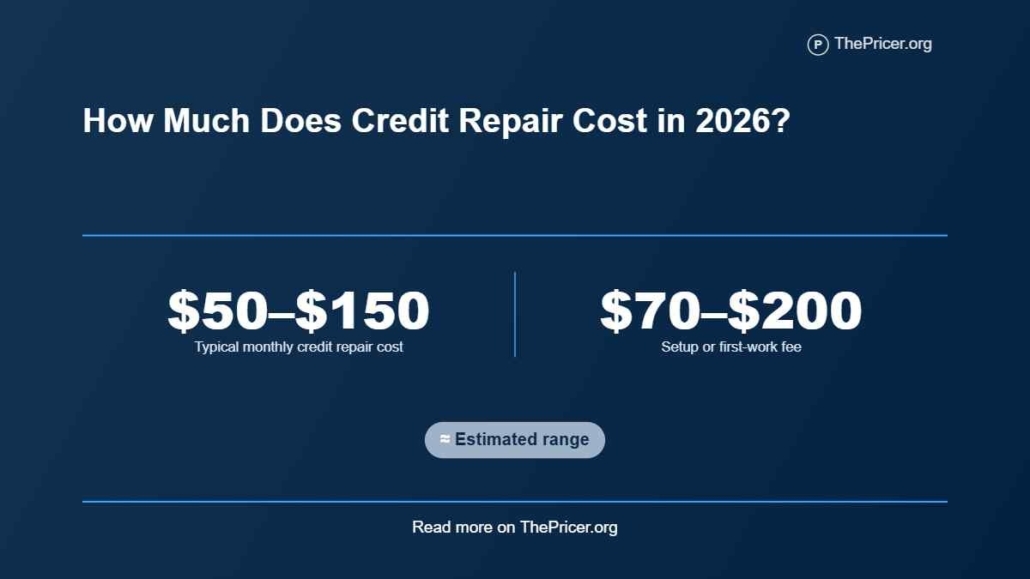
Credit repair in the U.S. commonly costs $50 to $150 per month, and some companies add a setup or first-work charge around $70 to $200. A May 2026 published U.S. cost review reports those ranges for professional services. The fee buys help reviewing credit reports, preparing disputes, tracking responses, and handling related paperwork. It does not buy a lawful shortcut for deleting accurate negative information.
Current U.S. pricing also needs to be read by entity and service model. Credit Saint, Sky Blue Credit, and The Credit Pros sell recurring professional repair plans, while Dovly Premium is a lower-cost software option. Experian, Equifax, and TransUnion are the three nationwide credit bureaus involved in report disputes, while the Consumer Financial Protection Bureau and Federal Trade Commission set or enforce federal consumer protections that shape dispute rights, billing, contracts, and cancellation.
The quoted cost changes with setup or first-work fees, three-bureau versus single-bureau coverage, credit monitoring, individual versus couples pricing, and the number of billing cycles a customer remains enrolled. A lower monthly price can reflect narrower service rather than a better deal, so the useful comparison is the complete fee structure and the work included at that price.
Article Highlights
Jump to sections
- Published market guidance places professional service near $50 to $150 (at $30 per hour, earning that amount would take about 1.7 to 5 hours of work, before taxes) per month, with setup or first-work charges around $70 to $200.
- Current full-service plans reviewed for this article run from $79 to $149 per month before any initial-work charge.
- Credit Saint lists initial working fees from $99 to $195, which can raise short-term effective monthly spending sharply.
- Dovly Premium lists $39.99 monthly or $99.99 annually, but its disputes currently go to TransUnion only.
- Consumers can dispute inaccurate credit-report information themselves for $0 in service fees.
How Much Does Credit Repair Cost?
The current offers below show why one national average misses useful detail. Credit Saint’s three current service tiers run from $79.99 to $139.99 (about 2.7 to 4.7 hours of work at $30 per hour) per month plus initial working fees, while Sky Blue publishes individual and couples rates from $79 to $179 per month. The Credit Pros lists two recurring repair plans at $129 and $149 per month, and Dovly posts monthly and annual Premium pricing below those full-service rates.
The full-service companies differ on initial work, household pricing, bureau coverage, and included tools. Dovly is cheaper, but its dispute function is limited to TransUnion, so its price is not directly comparable with three-bureau repair.
| Service | Current advertised price | Initial charge | Scope note |
|---|---|---|---|
| Credit Saint | $79.99 to $139.99 per month | $99 to $195 initial working fee | Three-bureau challenges, with added features on higher tiers |
| Sky Blue Credit | $79 to $119 per month individual, $119 to $179 per month couples | Shown separately during enrollment | Three-bureau reports and disputes, with broader creditor work on higher tiers |
| The Credit Pros | $129 to $149 per month for repair plans | $129 to $149 standard first-work fee | Three-bureau disputes and creditor interventions |
| Dovly Premium | $0 free, $39.99 per month, or $99.99 per year | No separate setup charge shown | Dispute tools currently work with TransUnion only |
Within the three full-service companies in that sample, recurring individual repair plans span $79 to $149 per month. That is a researched provider sample, not an industry average. Couples pricing at Sky Blue also changes the household unit, so comparing one couples membership with two unrelated individual subscriptions can distort the result.
What Credit Repair Buys
Credit repair is a paid service built around credit-report review and dispute administration. A company may examine reports, flag entries the client believes are inaccurate or incomplete, prepare bureau disputes, send creditor intervention letters, track responses, and provide score or report monitoring. Higher tiers can add inquiry work, identity monitoring, budgeting tools, or credit-building features. The customer is paying for labor, organization, and follow-up rather than access to a special legal process.
Scope matters because two plans with similar monthly prices can perform different work. One may submit disputes to all three nationwide bureaus, while another may focus on a single bureau. Some plans limit dispute volume or update frequency. Others bundle credit reports, scores, identity protection, or creditor letters. Those differences explain why a low monthly number can be a poor comparison with a broader service.
The work is also separate from score guarantees. A service can prepare and track disputes, but a bureau, data furnisher, or creditor controls whether information changes after investigation. A buyer should judge the fee against the tasks being outsourced, not against a promised score increase. That distinction keeps the price question tied to a deliverable the company can actually perform.
Upfront Work
Initial charges deserve separate treatment from the monthly fee. Credit Saint states that enrollment costs $0 today, the first-work fee is due on day six, and the recurring monthly payment starts one month after that fee. Its enrollment page states cancellation before day six will not trigger a charge. This sequence matters because the initial fee is not simply another monthly payment.
Sky Blue uses a similar two-step display in its current Premium enrollment flow. It shows $0 at signup, a $119 (about 4 hours of work at $30 per hour) review and setup fee six days later, then a recurring $119 monthly charge while membership remains active. The enrollment flow shows that initial charge separately even though the main member-pricing page focuses on recurring rates.
Federal payment rules add another layer. The Consumer Financial Protection Bureau says a credit-repair company enrolled through telemarketing faces stricter timing rules before it can bill or receive payment, including a required consumer report showing promised results after the stated service period. The CFPB explains those telemarketing payment limits, which is a reason to ask how enrollment occurred and what work a first charge covers.
Time Can Cost More
A monthly quote becomes expensive when the service remains active across several billing cycles. Credit Saint supplies a useful illustration because its package page separates the monthly charge from the initial working fee. Using the already cited prices, three paid cycles of Credit Polish equal $99 plus three payments of $79.99, for $338.97. Spread across those three cycles, the effective outlay is $112.99 per month, about 41 percent above the recurring sticker price.
ThePricer calculated scenario. The same three-cycle method puts Credit Remodel at $142.99 per month after allocating its $99 initial fee, about 30 percent above its $109.99 recurring charge. Clean Slate reaches $204.99 per month after allocating its $195 initial fee, about 46 percent above its $139.99 recurring charge. Over 12 paid cycles, those initial-fee uplifts fall to about 10, 8, and 12 percent.
The calculation does not predict how long a specific file will need paid help. It shows why a buyer planning only a few billing cycles should compare the initial charge with the recurring fee as one combined budget. The first-work fee has its largest effect on short engagements, while the recurring fee dominates a longer one.
Three Budget Scenarios
A lower-priced professional case can still cross $300 quickly. Assume a Credit Saint Credit Polish customer stays through three paid monthly cycles at the advertised rates already cited. The itemized total is a $99 initial working fee plus $239.97 for three monthly payments, producing $338.97. This scenario includes only the advertised fee lines and does not assume three cycles are enough to resolve every dispute.
A household case looks different. Sky Blue Premium lists couples pricing at $179 per month, while one Premium membership is $119 per month. Three recurring couple payments equal $537. Two separate individual Premium subscriptions would total $714 across the same three cycles, so the advertised couples rate saves $177 in recurring charges over that period. This comparison excludes initial charges because the public enrollment display does not state a separate couples setup amount.
The software case has a different break point. Dovly Premium costs $39.99 per month on the web or $99.99 per year. Dividing the annual price by the web monthly price gives 2.5 monthly payments, so annual billing becomes cheaper once a third monthly payment would otherwise occur. Dovly’s support documentation lists a mobile Premium rate of $19.99 per month. At that channel price, annual billing becomes cheaper starting around the sixth monthly payment.
Paid Repair vs Free Disputes
Paid credit repair competes with a free legal right. The CFPB says consumers can dispute inaccurate information directly with credit reporting companies and information furnishers at no service fee, says mistakes are usually investigated within 30 days, and warns that accurate current negative information cannot normally be removed just because a consumer pays a repair company. Its September 2026 guidance states those dispute and removal limits.
That boundary changes the spending decision. A person with one obvious reporting error may prefer to send a free dispute. Someone with several reports, repeated correspondence, identity-theft records, or limited time may place a higher value on outsourcing the paperwork even though the legal dispute right itself costs $0. The price pays for administration, not a different legal standard.
That difference matters. The fair comparison is paid administrative help against the time and effort of doing the same lawful dispute work personally. It is not paid repair against a guaranteed score result. Consumers should also be wary of any fee framed as payment for deleting accurate, current negative information.
Repair Is Not Debt Counseling
 Credit repair addresses reporting accuracy and dispute work. Credit counseling addresses budgeting, repayment, and debt management. Mixing those services can lead someone to buy the wrong kind of help. The National Foundation for Credit Counseling says most member agencies offer free counseling and education, while some specialized services carry fees that vary by agency and state law.
A consumer who is current on debts but sees reporting errors has a different problem from someone who cannot afford minimum payments. The second person may need a budget review, creditor payment plan, or legal debt-relief information rather than a monthly dispute subscription. If debt has become unmanageable, the cost of filing for personal bankruptcy is a separate decision with court and legal costs that should not be folded into a credit-repair budget.
The price comparison should match the job. A $0 counseling session can help diagnose a repayment problem, while a $129 monthly repair plan can outsource report disputes. Neither price proves the other service is unnecessary. The relevant question is whether the consumer needs report correction, debt-payment help, or both.
When Paying Makes Sense
Paid repair has the strongest case when the consumer has legitimate reporting errors, wants help organizing evidence and correspondence, and understands the complete fee schedule before enrolling. The value comes from transferred workload. A plan is harder to justify when the customer expects accurate negative information to disappear, has only one simple error, or has a debt-affordability problem that dispute letters cannot fix.
Makes sense if
- You have several disputed entries across one or more reports and want someone else to manage the paperwork.
- The plan covers the bureaus and tasks you actually need.
- You have priced the initial charge and the expected number of monthly cycles together.
- You value monitoring, creditor letters, or follow-up enough to pay for those included tasks.
Does not make sense if
- The negative information is accurate and current.
- You are comfortable filing a simple dispute yourself at $0 in service fees.
- The main problem is unaffordable debt rather than inaccurate reporting.
- The company promises a certain score increase or asks you to pay for a result it cannot control.
Before enrollment, write down the recurring rate, every initial charge, the billing date, cancellation method, bureau coverage, and any limit on disputes or updates. Then compare that list with the work you would actually outsource. A lower price with narrower bureau coverage may cost less because it is a smaller service, not because it offers the same work at a discount.
Answers to Common Questions
How much is credit repair per month?
Published U.S. market guidance places professional plans around $50 to $150 per month. The current full-service plans reviewed here run from $79 to $149 per month before initial-work charges.
How much can setup or first-work fees add?
Published guides place common setup charges around $70 to $200. Current examples reviewed here include initial or first-work fees from $99 to $195 before promotional discounts.
Can I repair my credit for free?
Yes. You can dispute inaccurate information yourself for $0 in service fees. Paid companies charge for handling review, paperwork, tracking, and related tasks on your behalf.
Can a credit repair company remove accurate negative information?
Usually no. Accurate and current negative information is not made removable simply because a consumer pays a repair service.
Is credit counseling the same as credit repair?
No. Credit repair centers on report accuracy and disputes. Credit counseling centers on budgeting, debt repayment, and financial planning, and many nonprofit counseling sessions are free.
Disclosure: Educational content, not financial advice. Prices reflect public information as of the dates cited and can change. Confirm current rates, fees, taxes, and terms with official sources before purchasing. See our methodology and corrections policy.