
How Much Does Cryonic Preservation Cost?
Published on | Written by Alec Pow
This article was researched using 12 sources. See our methodology and corrections policy.
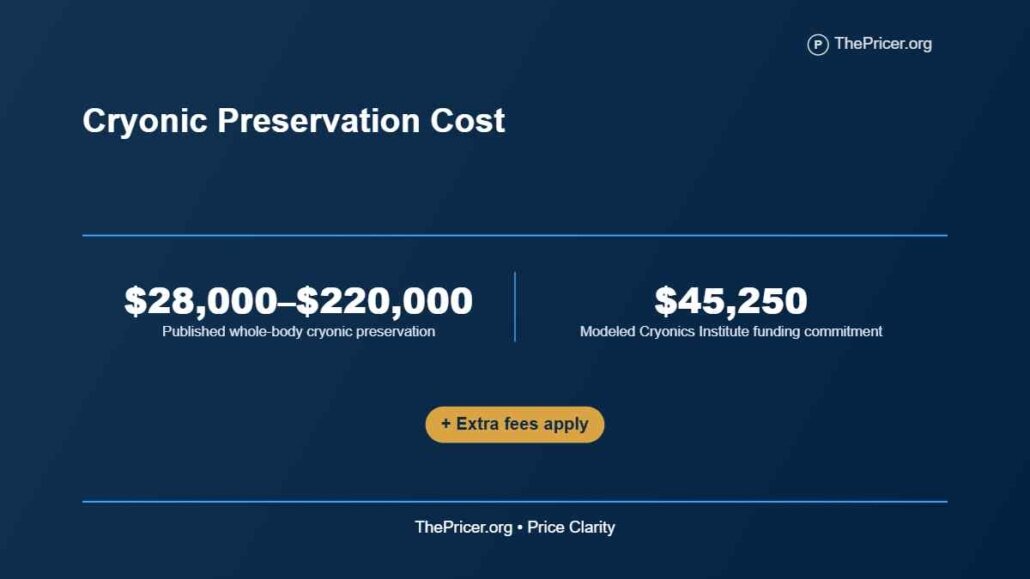
Cryonic preservation costs $28,000 to $220,000 for whole-body preservation at two established U.S. providers, before any separately charged membership, transportation, or standby services.
The Cryonics Institute lists $28,000 for lifetime members and $35,000 for annual members, while Alcor lists $220,000 for whole-body preservation and $80,000 for neuropreservation, which preserves the brain.
These amounts represent a highly experimental preservation service performed after legal death, not a medical treatment proven to restore life. No human has been revived after whole-body cryonic preservation. The possibility of future revival remains speculative.
Most customers arrange funding while alive, often through life insurance. The actual financial commitment combines the preservation amount, membership dues, insurance premiums or savings, and any charges for emergency response and transportation.
Article Highlights
Jump to sections
- Cryonics Institute lifetime members can arrange whole-body preservation for $28,000, plus a $1,250 lifetime membership and separately charged assistance.
- Alcor lists $220,000 for whole-body preservation and $80,000 for brain-only preservation.
- Cryonics Institute annual members pay $120 yearly plus a $200 initiation charge, with preservation priced at $35,000.
- Professional standby, local funeral-director services, and transportation can materially increase the total.
- Life insurance can fund the eventual preservation fee but does not eliminate its cost or guarantee eligibility.
- Cryonics offers no demonstrated likelihood of successful human revival.
How Much Does Cryonic Preservation Cost?
Cryonics is the preservation of legally deceased people at very low temperatures, generally using cryoprotective solutions and liquid-nitrogen storage. Providers differ in the procedures and logistical services included in their advertised prices.
The following published prices were checked in October 2026. They are provider-specific charges, not an industry average.
| Provider and arrangement | Preservation price | Other requirements |
|---|---|---|
| Cryonics Institute, lifetime member | $28,000 | $1,250 one-time membership, local services extra |
| Cryonics Institute, annual member | $35,000 | $200 initiation and $120 annually, local services extra |
| Cryonics Institute, post-mortem nonmember | $45,000 | Acceptance required, other fees possible |
| Alcor, neuropreservation | $80,000 | Age-based dues and applicable surcharges |
| Alcor, whole-body preservation | $220,000 | Age-based dues and applicable surcharges |
| Tomorrow.bio, U.S. whole-body member rate | $220,000 | Separate membership and eligibility terms |
The Cryonics Institute membership schedule excludes local funeral-director assistance, transportation, and optional professional standby from its basic preservation fee.
Alcor’s published preservation pricing includes comprehensive member standby within its quoted cryopreservation arrangements, subject to additional charges in specified circumstances.
Tomorrow.bio’s funding calculator and pricing information gives U.S. member figures of $220,000 for whole-body preservation and $80,000 for brain-only preservation. Its international service model involves transportation to long-term storage in Switzerland. Confirm current U.S. availability and service scope directly rather than assuming coverage nationwide.
Whole-Body vs Brain Preservation
 Whole-body cryopreservation attempts to preserve the body and brain. Neuropreservation focuses on the brain or head, based on the speculative proposition that future technology might recover information and restore or reconstruct the person.
Neither procedure has demonstrated successful human revival. Neuropreservation is not an established way to preserve consciousness or guarantee recovery of memories.
At Alcor, choosing neuropreservation instead of whole-body preservation reduces the published service price from $220,000 to $80,000, a difference of $140,000. This is a price comparison between two materially different services, not evidence that either will be successful.
Tomorrow.bio’s European membership and preservation offers show member prices of €75,000 for brain-only preservation and €200,000 for whole-body preservation. These euro prices describe European arrangements and should not be converted into U.S. fees without checking the applicable contract and exchange rate.
The Cryonics Institute focuses on whole-body preservation for its standard human service. A buyer seeking neuropreservation should not treat the Institute’s whole-body quotation as a comparable brain-only offer.
Membership and Recurring Dues
Joining a cryonics organization does not necessarily mean the eventual preservation procedure has been funded. Membership often covers administrative services, preparation support, and eligibility to arrange a preservation contract.
Cryonics Institute offers lifetime membership for $1,250. Its annual membership costs $120 per year after a $200 one-time initiation payment.
Alcor uses age-based membership dues. Its published schedule for adults joining at age 19 or older calculates annual dues at $15 multiplied by joining age, under the stated age-locking arrangement. Someone joining at age 30 would therefore pay $450 annually, subject to the current membership agreement.
Members should not assume these dues pay down the ultimate preservation obligation. Unless a contract explicitly provides a credit, recurring membership payments purchase ongoing membership services rather than accumulate toward the preservation fee.
Membership also does not guarantee preservation can be performed in every circumstance. A provider must receive legal authorization, sufficient funding, timely notification, and the ability to accept and transport the remains.
Standby and Transportation Charges
Emergency response is one of the largest hidden price differences between cryonics providers. Preservation organizations generally aim to begin cooling and stabilization soon after legal death, before transporting the person to the storage facility.
Cryonics Institute states in its local assistance and transportation guidance that funeral-director and shipment costs can be negligible for someone near its Michigan facility but may reach approximately $3,000 on the U.S. West Coast and more for overseas cases.
Professional standby is a separate service. The Institute’s funding and standby information explains that response expenses depend on distance, staffing, transport arrangements, and whether an outside organization is engaged.
The published Suspended Animation arrangements include a prepaid standby option at $13,000 for one deployment lasting up to 72 hours, and a broader prepaid standby arrangement at $27,500. Additional procedures and completion charges may apply.
These are not universal mandatory charges for all Cryonics Institute members. Some people organize local assistance differently, while urgent or complex cases can be considerably more expensive.
Alcor’s comprehensive standby arrangements make its quoted package broader than the Cryonics Institute’s basic storage-and-procedure price. A direct comparison of their headline prices alone therefore overstates the difference between equivalent service packages.
Hidden Cost of Urgent Arrangements
Planning shortly before death can introduce fees and operational limitations that do not arise with a funded membership arranged years earlier.
Alcor lists a $20,000 surcharge if services are needed within the first 180 days of membership. Its schedule also identifies a $10,000 surcharge for cases outside the United States and Canada, along with certain third-party arrangement charges.
Those additional costs appear in the provider’s published pricing terms. They do not mean every international or urgent case can actually be accepted.
Cryonics Institute lists $45,000 for an accepted post-mortem nonmember case, before applicable local assistance. Acceptance is discretionary, and the member price cannot automatically be obtained after legal death.
Legal documentation matters as much as funding. The Alcor membership and authorization requirements describe documentation, signatures, and proof of approved funding needed for a complete arrangement.
Unexpected death, autopsy requirements, delayed notification, or disputes among relatives can prevent the intended preservation procedure or reduce the quality of the preservation attempt. Paying more cannot always overcome those obstacles.
Life Insurance Funding Costs
Many cryonics customers use conventional life insurance, naming the preservation organization as a beneficiary for sufficient funds. The policy is still life insurance, not a guarantee of cryonic preservation or future revival.
The Cryonics Institute’s life insurance funding instructions recommend enough coverage for the base preservation price and additional costs. It identifies $50,000 as a reasonable minimum planning amount for many Cryonics Institute arrangements, while acknowledging that more may be necessary.
An insurance policy’s premium depends on age, health, coverage amount, policy structure, and underwriting. An inexpensive term policy can expire or become expensive to renew before death, leaving insufficient funding at the time it is needed.
The Institute’s frequently asked funding questions mention approximately $30 per month as an example for some healthy middle-aged applicants seeking minimum-level coverage. It is an illustrative reported figure, not an available quote for every applicant.
At that assumed premium, twenty years of coverage would require $7,200 in payments. The death benefit would be paid only if the policy’s conditions were satisfied and coverage remained active.
Compare term and permanent coverage carefully. A life insurance cost comparison can help identify the wider differences between premiums, policy duration, and funding needs.
Worked Cryonics Budget
Consider a U.S. adult arranging whole-body cryopreservation through the Cryonics Institute’s lifetime membership. The person lives outside Michigan and chooses a defined allowance for transport and local assistance.
The following is an illustrative funding calculation rather than a case-specific quote.
- Cryonics Institute lifetime membership: $1,250
- Whole-body preservation commitment: $28,000
- Assumed local assistance and transport: $3,000
- Assumed prepaid standby arrangement: $13,000
- Total modeled funding commitment: $45,250
This total excludes further stabilization services, possible incremental provider charges, insurance premiums, legal work, and unexpected complications. The standby amount is an optional third-party arrangement, not an unavoidable Cryonics Institute charge.
If the customer instead funds the preservation and transport components through a policy, the insurance benefit must be sufficient for the covered obligations. The membership payment and any prepaid standby deposit also require separate consideration.
A $50,000 funding target would leave $4,750 above this modeled $45,250 commitment. That surplus could be inadequate if substantial additional stabilization or transportation charges arise.
When Lifetime Membership Saves Money
Cryonics Institute charges both a lower preservation fee and a different membership structure for lifetime members than for annual members.
Compare someone who remains an annual member for 20 years before cryopreservation with someone purchasing lifetime membership at the outset.
The annual membership path costs $200 initially, plus twenty annual payments of $120, totaling $2,600 in membership charges. Adding $35,000 for preservation produces $37,600 before local services.
Lifetime membership costs $1,250 plus $28,000 for the preservation procedure, totaling $29,250.
The calculated difference is $8,350 in favor of lifetime membership under unchanged published prices and otherwise comparable circumstances.
This does not reflect inflation, investment returns, changed contract terms, or the timing of death. The two arrangements also differ in upfront payment and flexibility.
One useful finding is that the lifetime arrangement starts with a lower combined membership-and-preservation obligation even before decades of annual dues are counted. At current listed prices, the higher annual-member preservation rate alone is $7,000 above the lifetime-member rate.
What Does Long-Term Storage Include?
Cryonics organizations use low-temperature storage equipment and long-term funding arrangements intended to maintain preserved remains indefinitely.
Alcor’s patient-care trust explanation describes dedicated resources intended to support long-term storage and care. Cryonics Institute likewise describes its preservation fee as including ongoing liquid-nitrogen storage without a separate standard annual patient-storage bill.
However, a provider’s promise or intention to store remains indefinitely is not a guarantee that the organization, funding arrangement, or storage infrastructure will survive forever.
The Cryogenic Society of America distinguishes cryonics from established cryogenic engineering and states that it does not endorse human cryonics as part of the scientific discipline.
The Society for Cryobiology’s position statements also address cryonics as a separate topic from established biological cryopreservation research.
Preserving human cells, embryos, and certain tissues for defined uses does not demonstrate the feasibility of restoring an entire legally deceased human. Cryoprotectant toxicity, tissue damage, and the absence of a workable revival procedure remain fundamental scientific obstacles.
Cryonics vs Conventional Arrangements
Cryonic preservation and conventional funeral services accomplish different things. Cremation or burial provides final disposition, while cryonics seeks long-term preservation in the hope of hypothetical future restoration.
The cost of cremation is ordinarily far below whole-body cryonics. Families may nevertheless need a separate memorial service, death certificates, or legal assistance even when cryopreservation is arranged.
Other end-of-life costs also vary independently. A cemetery plot purchase is not a prerequisite for cryonics, although relatives may make separate arrangements for remembrance.
Makes sense if
- You understand that revival is unproven and want to fund a speculative preservation arrangement.
- You can maintain sufficient funding and keep documentation current.
- You have confirmed realistic standby, transport, and local legal arrangements.
- You have considered the financial effect on beneficiaries and dependents.
Does not make sense if
- You expect a medically proven life-extension treatment.
- Funding preservation would jeopardize essential needs or dependents’ financial security.
- The required emergency response cannot realistically operate in your circumstances.
- You are unwilling to accept the possibility that preservation will never lead to revival.
Anyone evaluating a contract should request a complete written price schedule, document what insurance or assets fund each obligation, and obtain independent legal and financial advice about the arrangement.
Answers to Common Questions
What is the cheapest published whole-body cryonics price?
The Cryonics Institute lists $28,000 for lifetime members, excluding membership, local assistance, transportation, and optional standby.
Can you pay for cryonics with life insurance?
Yes. Providers may accept qualifying life insurance arrangements that designate the organization as beneficiary. Premiums depend on underwriting and the policy must remain active with sufficient coverage.
How much does brain-only cryopreservation cost?
Alcor currently lists neuropreservation at $80,000, plus applicable dues and any surcharges. This is not the same service as whole-body preservation.
Has anyone been revived after cryonic preservation?
No verified human revival from whole-body cryonic preservation has occurred. Future revival remains speculative, and the service should not be understood as proven medical treatment.
Is long-term storage paid for separately every year?
Major providers typically include intended long-term patient storage in their preservation funding arrangements. Membership dues while alive and any other contractual payments are separate.
Disclosure: Educational content, not medical advice. Pricing varies by provider, location, and insurance. Confirm eligibility, coverage, and out-of-pocket costs with a licensed clinician and your insurer. See our methodology and corrections policy.