
How Much Does Dale Carnegie Training Cost?
Updated on | Researched and reviewed by Alec Pow, Founder & Pricing Investigator
Prices, claims, and calculations checked against 18 cited sources. See our research methodology and corrections policy.
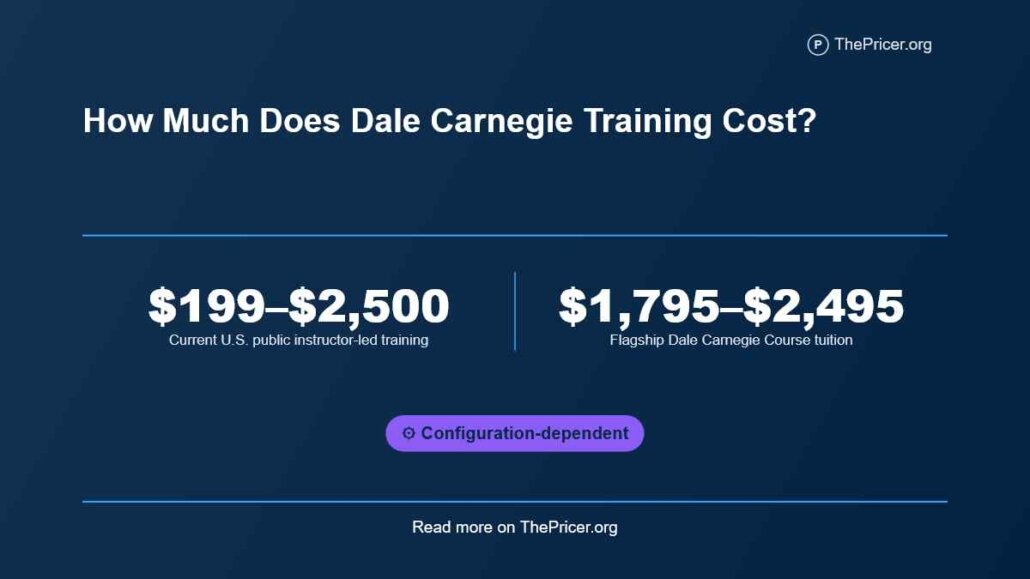
Dale Carnegie training costs from $199 to about $2,500 for many current U.S. public instructor-led courses. Free previews, modular programs, subscriptions, coaching bundles, development paths, and private company workshops sit outside that band.
A three-hour live-online public-speaking class is $399, the modular Foundation section is $595, and current flagship Dale Carnegie Course sessions run from $1,795 to $2,495 depending on location and schedule. Corporate training can cost much more, with a customized workshop listed at $8,500 for a half day or $14,000 for a full day for up to 25 participants. Format, course scope, location, and buyer type determine the useful comparison.
Article Highlights
Jump to sections
- Many public instructor-led courses currently cost about $199 to $2,500.
- The flagship Dale Carnegie Course ranges from $1,795 to $2,495 across current U.S. listings.
- A modular Foundation section costs $595, while a three-hour live-online public-speaking class costs $399.
- The Dale Carnegie Leadership Academy is currently listed at $350 for one year of access.
- A four-phase leadership pathway costs $7,500 when purchased as the full package.
- Custom company workshops can reach $8,500 to $14,000 for up to 25 participants.
How Much Does Dale Carnegie Training Cost?
Dale Carnegie no longer fits one simple national tuition table. Its current professional training catalog separates in-person, live-online, on-demand, online-subscription, and learning-development-path products. Prices also change by local franchise, schedule, and program design. A buyer comparing courses should match the learning format and content rather than assume two programs with similar titles include the same hours or support.
The table below uses current official U.S. listings as representative price points. It is a catalog snapshot, not a promise that every location will quote the same amount. Some offerings are national live-online products, while others are sold by regional Dale Carnegie operators.
| Current training option | Published price | Scope |
|---|---|---|
| Live Online kickoff session | $0 | 30-minute interactive preview |
| Successful Public Speaking | $399 | 3-hour live-online session |
| Dale Carnegie Foundation module | $595 | Three 3-hour live-online sessions |
| Dale Carnegie Leadership Academy | $350 | One-year online subscription at the current displayed price |
| Dale Carnegie Course | $1,795 to $2,495 | Current U.S. in-person sessions at several locations |
| Short live-online courses | $199 | Current one-hour presentation courses in a regional schedule |
| Diplomacy course with coaching | $4,500 | Two-day course plus one-on-one virtual coaching package |
| Leadership Pathway | $2,495 to $7,500 | Regional one-through-four-phase pathway |
| Custom company workshop | $8,500 or $14,000 | Half day or full day for up to 25 participants |
The public-course band helps an individual budget for instructor-led training. A free preview and a private company workshop solve different problems, so their prices should stay separate.
Same Course With Different Prices
Location is a real pricing variable. The current flagship Dale Carnegie Course page shows sessions at $1,795 in parts of Florida and Mississippi, $2,195 in Michigan, $2,295 in Virginia, $2,395 in Tennessee, and $2,495 in Iowa and Nebraska. The course name remains the same while the local operator, schedule, session count, and market change.
The lowest and highest current U.S. examples differ by $700. Dividing that difference by the $1,795 low price gives about 39%. That means geography and scheduling can move the tuition by almost two-fifths of the lower published price before travel is considered. A learner with flexibility may save money by checking nearby locations or live-online dates rather than treating the first listing as a national rate.
The price difference does not prove that the higher-priced class has better instruction. Some listings use eight sessions, others use nine weeks, and local franchise economics differ. Compare the exact course, delivery method, hours, included support, travel requirement, and tuition. A lower price can stop being cheaper if it requires airfare, hotels, or repeated long-distance travel.
This local variation also explains why an old static table ages poorly. A current course finder is more useful for exact enrollment pricing, while a cost article should explain the recurring price bands and the variables that move them.
Online, In Person
Dale Carnegie now gives buyers several ways to reduce the upfront commitment. Short live-online classes can cost a few hundred dollars, the Foundation module costs $595, and the Leadership Academy is currently displayed at $350 for one year. Those products are different from a full flagship course, but they let a learner buy a narrower skill set or spread professional development across formats.
A mixed-format scenario shows the budget difference. A learner could combine the $595 Foundation module, the $399 Successful Public Speaking session, and the $350 Leadership Academy subscription. The itemized total is $1,344. That is $451 below the current $1,795 low-end flagship price, but the curriculum and learning experience are not equivalent. The calculation is useful for someone who wants several targeted experiences rather than the complete Dale Carnegie Course.
Shorter courses reduce schedule risk. A three-hour class asks for less time away from work than an eight-session program. The tradeoff is depth, repetition, peer interaction, and trainer feedback. Compare live hours and delivery model before choosing by price alone.
Readers comparing professional-development programs can also look at the structure and cost of Scrum Master certification. Certification training and Dale Carnegie skills training have different outcomes, so price alone does not make them substitutes.
Flagship and Leadership Programs
The flagship Dale Carnegie Course sits near the center of the current public-course market at $1,795 to $2,495. Leadership-focused public programs can occupy a similar band, while packages that add coaching move higher. The current diplomacy-and-coaching package at $4,500 shows how one-on-one support can raise the price well above a standard public classroom seat.
Development paths create another pricing structure. One current regional Leadership Pathway listing sets one phase at $2,495, two at $4,725, three at $6,700, and all four at $7,500. Buying four phases separately at the one-phase price would equal $9,980. The four-phase package is $2,480 lower, a reduction of about 25% from that simple four-times-one-phase comparison.
That calculation does not mean every learner should buy four phases. It shows the financial effect of committing to the larger package. Someone who needs only one phase spends less in total by stopping after the first. Someone already expecting to complete all four receives a lower effective cost per phase, about $1,875 when $7,500 is divided by four.
Leadership development also competes with certification, coaching, university extension programs, and employer-sponsored training. A reader comparing leadership credentials can review the John Maxwell certification cost. Certification rights and workplace-skills training are different purchases.
Corporate and Group Training
Company training should be budgeted separately from individual enrollment. The current custom workshop listing prices a half-day program at $8,500 and a full-day program at $14,000, each customized for up to 25 participants. At a full group of 25, those totals equal $340 per person for the half day and $560 per person for the full day.
Per-person math can make the company option look inexpensive beside a $1,795 public flagship seat, but the comparison is not like-for-like. The private workshop is a shorter team event with customized objectives. The public flagship course runs across multiple sessions and follows a broader established curriculum. Employers should compare desired hours, subject depth, customization, and participant count rather than divide every quote by headcount and choose the smallest number.
Local group policies can also matter. One current regional leadership package says group pricing is available for five or more people. That policy belongs to the listed regional program and should not be treated as one nationwide discount rule.
For an employer with a larger group, staff time also matters. Sending 25 people to separate multi-session public courses can consume more work hours than one private day. The organization has to decide whether depth or concentrated delivery better matches the training objective.
What Tuition Includes
Course inclusions vary enough that tuition should not be compared by title alone. Some products are a single live session. Others add coaching, online access, books, recorded practice, or follow-on resources. The company does not use one identical materials package across every program, so the old claim that all tuition includes the same training materials is too broad.
One current Leadership Experience package illustrates the richer end of the catalog. It lists three Dale Carnegie books, a knowledge center with digital resources, and more than 25 hours of live-online follow-on resources. Its current package price is $6,000. That does not mean a $399 short course carries those same extras.
The included experience also changes with format. In-person courses may create travel and lodging expenses that never appear on the tuition line. Live-online courses remove most travel expense but still require scheduled attendance. On-demand products give more scheduling freedom and usually involve less live trainer contact.
That distinction matters when comparing Dale Carnegie with a higher-priced intensive program such as Zero to Dangerous training. The buyer should match live hours, coaching, access period, materials, travel, and intended outcome instead of treating both as generic courses.
Refunds, Credits, and Certificates
Cancellation terms can change the real financial risk. Dale Carnegie Digital says a live-online registrant can receive a complete refund when cancelling up to two weeks before the program begins. A cancellation inside the two-week window may carry a service charge. A confirmed participant who does not attend forfeits the refund, although the policy allows a limited transfer path based on availability. Those rules are documented in the current live-online cancellation policy.
Attendance also affects course credit. The U.S. training terms and conditions set participation thresholds based on program length, including eight of nine sessions for a nine-session course and full attendance for a one-day or two-day program. The same terms state that Dale Carnegie is not responsible for cancellation costs such as airline tickets or hotel reservations if it cancels a class.
Certificates and payment rules can vary by region. One current regional training FAQ says a Certificate of Achievement is awarded after program requirements are met, with physical certificates for in-person programs and digital certificates for Live Online programs. The same region says it does not currently offer payment plans. A certificate should not be assumed merely from paying tuition if the attendance standard is not met.
Some programs also carry CEUs, Education Credits, or professional accreditation links. Credit eligibility belongs to the individual course and the learner’s professional body. Confirm the exact credit type before paying if reimbursement or credential maintenance depends on it.
Which Price Level Fits Your Use Case?
The cheapest option is useful when the goal is narrow. A free preview can test the training style. A $399 public-speaking class can address one skill. A $595 module gives more live contact without committing to a multi-thousand-dollar program. The full flagship course makes more sense when the learner wants the broader Dale Carnegie curriculum and can attend the required sessions.
A company has a different calculation. The $14,000 full-day custom workshop becomes $560 per participant at 25 attendees, while a development pathway asks for a much larger per-person commitment over time. Neither is automatically cheaper in the useful sense because the amount of training and intended outcome differ.
Makes sense if
- You have a defined communication, leadership, presentation, or people-skills goal.
- Your employer will reimburse part or all of the tuition.
- You can attend enough sessions to satisfy the program requirements.
- You have compared nearby, online, and modular versions of the skill you want.
Does not make sense if
- You are choosing a high-priced pathway before knowing which skill gap you need to address.
- Travel costs make a cheaper distant class more expensive than a local or online option.
- You need a formal occupational certification that the selected Dale Carnegie course does not provide.
- Your schedule makes the attendance requirement unrealistic.
Verification checks
- Checked a current live-online course schedule to confirm instructor-led virtual training remains a separate active format.
- Confirmed the current on-demand training catalog remains distinct from scheduled live-online classes.
- Cross-referenced the current online subscription catalog to confirm subscription-based training remains an active delivery option.
Answers to Common Questions
How much is the Dale Carnegie Course?
Current U.S. flagship listings run from about $1,795 to $2,495, depending on location, schedule, and local operator.
Does Dale Carnegie offer cheaper online training?
Yes. Current examples include a $399 three-hour live-online public-speaking course, a $595 modular Foundation program, and a Leadership Academy subscription displayed at $350 for one year.
Does Dale Carnegie have free classes?
Yes. Dale Carnegie currently lists free preview and kickoff sessions, including a free 30-minute interactive live-online experience.
How much does Dale Carnegie corporate training cost?
One current custom-workshop offer is $8,500 for a half day or $14,000 for a full day for up to 25 participants. Other corporate quotes can differ by scope and location.
Can Dale Carnegie training be refunded?
Refund rules depend on format and timing. Current Live Online policy allows a full refund when cancellation occurs at least two weeks before the program, while later cancellations may face a service charge.
Disclosure: Educational content, not financial advice. Prices reflect public information as of the dates cited and can change. Confirm current rates, fees, taxes, and terms with official sources before purchasing. See our methodology and corrections policy.