
How Much Does Diesel Cost per Gallon?
Updated on | Written by Alec Pow
This article was researched using 14 sources. See our methodology and corrections policy.
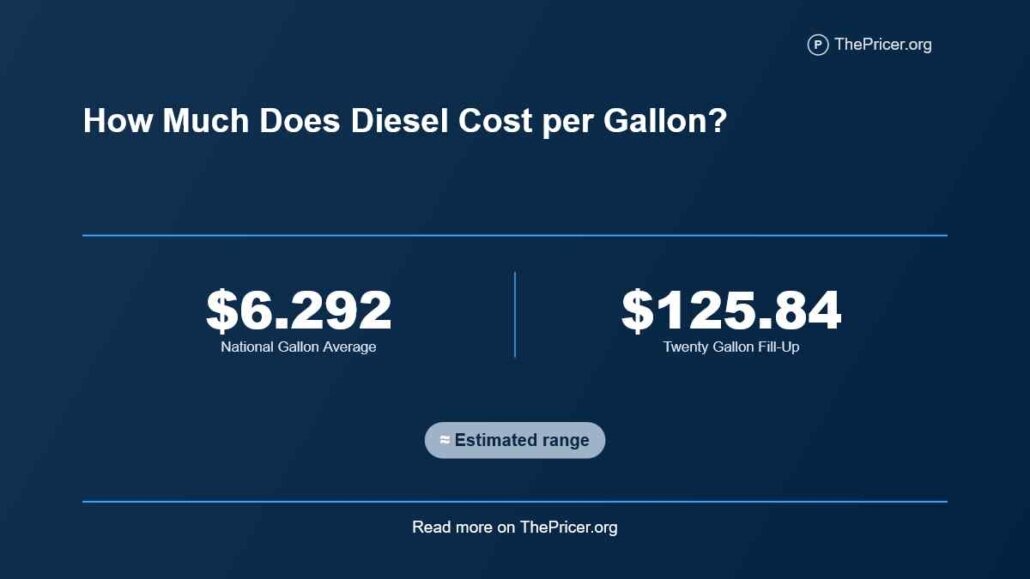
Diesel costs an average of $6.292 per gallon in the United States, according to the latest U.S. Energy Information Administration (EIA) weekly survey dated November 2, 2026. The regional average ranges from $5.814 in the Lower Atlantic to $8.076 in California. These are tax-inclusive retail on-highway prices, not quotes for a particular filling station.
At the national benchmark, a 25-gallon purchase costs about $157.30, while 150 gallons for a large truck costs $943.80. The average dropped 6 cents from October 26 but remained $2.539 per gallon higher than a year earlier. A business buying 10,000 gallons annually would spend $25,390 more if that year-over-year gap persisted across its purchases.
Fuel prices can change sharply from week to week. A driver’s actual bill also depends on diesel grade, location, fleet pricing, gallons purchased, and whether the fuel is intended for highway or qualifying off-road use.
Article Highlights
Jump to sections
- The EIA’s November 2 national average is $6.292 per gallon, down from $6.352 one week earlier.
- The cheapest EIA region is the Lower Atlantic at $5.814; California averages $8.076.
- Twenty gallons cost about $125.84 at the national benchmark; 100 gallons cost $629.20.
- A driver averaging 25 mpg pays about 25.2 cents per mile for diesel alone.
- Ordinary federal on-highway diesel taxes total 24.4 cents per gallon; temporary dyed-diesel federal relief is in effect through December 2026.
How Much Does Diesel Cost?
The EIA’s current weekly fuel survey is the most consistent national comparison for on-highway diesel. The November 2 observations were released November 3. Most diesel areas are petroleum districts rather than individual states; California is separately reported.
| Region | Price per gallon |
|---|---|
| United States | $6.292 |
| East Coast | $6.025 |
| New England | $6.416 |
| Central Atlantic | $6.486 |
| Lower Atlantic | $5.814 |
| Midwest | $6.402 |
| Gulf Coast | $5.912 |
| Rocky Mountain | $6.445 |
| West Coast | $7.272 |
| West Coast excluding California | $6.575 |
| California | $8.076 |
These values are corroborated by HaulBench’s regional weekly comparison and the Federal Reserve’s EIA-derived diesel price series. Regional averages include all taxes but cannot show a specific truck stop’s cash or card price.
California’s diesel costs $2.262 per gallon more than the Lower Atlantic average. That spread equals $226.20 on 100 gallons and $4,524 on 2,000 gallons. The difference is useful for budgeting a regional operation, but driving hundreds of extra miles to access another region’s average could erase the apparent savings.
Tank and Truck Fill-Up Costs
The total at the pump is gallons purchased multiplied by the station price. Using the national $6.292 per gallon benchmark, these are illustrative full purchases, not assumptions that every vehicle arrives with an empty tank.
| Gallons purchased | Estimated cost |
|---|---|
| 10 gallons | $62.92 |
| 15 gallons | $94.38 |
| 20 gallons | $125.84 |
| 25 gallons | $157.30 |
| 35 gallons | $220.22 |
| 50 gallons | $314.60 |
| 100 gallons | $629.20 |
| 150 gallons | $943.80 |
A pickup driver adding 18 gallons spends about $113.26, regardless of whether the tank holds 25 or 35 gallons. A commercial truck consuming 1,500 gallons during a month would spend approximately $9,438 at the national benchmark. Freight operators may have negotiated fuel-card discounts, network limitations or surcharges that change their effective price.
Fuel is only one line in the cost of owning a semi truck. Equipment financing, insurance, tires, repairs, downtime and driver compensation continue even if diesel prices fall.
Why Is Diesel Expensive?
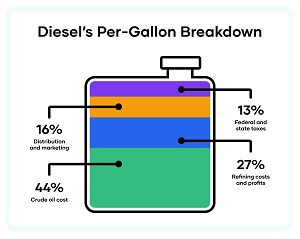
According to the EIA’s diesel price and outlook explanation, retail prices reflect crude oil, refinery processing, transport, retail costs and taxes. Diesel competes with heating oil and other distillate fuels for refinery output and shipping capacity.
The agency’s analysis of price drivers also explains why California and the West Coast can remain expensive when refinery production or deliveries are disrupted. The western fuel market has weaker connections to some other U.S. supply networks, so replacement shipments may take longer and cost more.
High crude supply does not guarantee abundant diesel. Refineries make multiple products, and disruptions to refining, pipelines, shipping or imports can raise the diesel price even while crude prices soften. In 2026, the U.S. war involving Iran, disruptions to Russian refining and tight global distillate inventories have contributed to an unusually expensive market.
The government has pursued supply measures, including proposed imports of Russian diesel. But a November 5 Associated Press investigation found no confirmed U.S. delivery under the announced arrangement, while two tankers initially headed toward the United States had changed course amid sanctions and legal concerns. Announcements about potential supply should not be treated as barrels already delivered to American retail markets.
Different refined products face different markets. The price of jet fuel is relevant to refinery economics but cannot be substituted for the retail cost of on-highway diesel.
How Much Is Diesel Tax?
The ordinary federal on-highway diesel levy is 24.4 cents per gallon, comprising a 24.3-cent excise tax and a 0.1-cent underground storage tank fee. The EIA’s January 2026 fuel tax comparison puts average state diesel taxes and fees at another 35.5 cents per gallon, excluding some additional local charges.
Together these ordinary benchmarks total 59.9 cents per gallon, or about $59.90 per 100 gallons. They are already included in the posted on-highway retail price, so adding them again to an EIA pump-price estimate would double count taxes. Actual state and local amounts vary.
There is a temporary exception concerning dyed diesel. President Trump’s October 5 executive order directed federal penalty relief and consideration of tax-payment deferral for specified highway uses of dyed fuel. The IRS subsequently announced that it would suspend ordinary federal dyed-diesel highway-use penalties and related collection procedures for the designated relief period. This does not erase taxes on ordinary clear highway diesel or change every state’s law.
Because tax treatment can depend on the fuel and transaction, the federal fuel tax should not be subtracted from every pump price as if all diesel customers automatically receive a discount.
Diesel Versus Gasoline
Diesel is typically more expensive per gallon than regular gasoline. The EIA’s gasoline-versus-diesel explanation identifies distillate demand, low-sulfur refining requirements and higher federal fuel taxes as contributing factors.
The November 2 EIA survey reports regular gasoline at $4.153 per gallon, compared with $6.292 for diesel. The gap is $2.139 per gallon, but fuel economy determines which vehicle actually spends less over a given distance.
The Department of Energy’s fuel energy comparison shows diesel contains more energy per gallon than typical gasoline. Vehicle efficiency, weight, gearing and driving cycle determine whether an individual diesel car converts that advantage into lower running costs.
| Illustrative comparison | Diesel car | Gasoline car |
|---|---|---|
| Fuel price | $6.292/gal | $4.153/gal |
| Assumed economy | 35 mpg | 28 mpg |
| Cost per 100 miles | $17.98 | $14.83 |
| 12,000-mile fuel cost | $2,157.26 | $1,779.86 |
Although the hypothetical diesel car travels 25% farther per gallon, it spends about $377.40 more each year on 12,000 miles under these price assumptions. At 35 mpg, its diesel price would have to fall to about $5.19 per gallon to match the gasoline car’s fuel expense at 28 mpg and $4.153 gas. This is a fuel-only calculation, not a vehicle ownership comparison.
The Cost of Price Changes
A commuter driving 15,000 miles per year at 25 mpg buys about 600 gallons annually. At $6.292 per gallon, that is $3,775.20. Each additional 50 cents per gallon raises annual spending by $300, assuming consumption stays unchanged.
For an illustrative commercial truck covering 100,000 miles at 7 mpg, annual consumption reaches approximately 14,286 gallons. A 50-cent change in diesel costs about $7,143 per year on that usage. A fleet of ten similar trucks faces a roughly $71,430 annual sensitivity to the same price movement.
These numbers help explain the attention paid to electric freight alternatives such as the Tesla Semi. Comparing trucks requires electricity or fuel spending alongside the vehicle price, charging facilities, payload, downtime and maintenance.
For a shorter lookback, the EIA average declined from $6.352 on October 26 to $6.292 on November 2. That 6-cent movement saves an operator $600 over 10,000 gallons, if all gallons are bought at the lower benchmark. The saving is a volume calculation; it is not proof that any fleet received those exact prices.
Does Red Diesel Cost Less?
Red-dyed diesel is ordinarily sold for qualifying off-highway purposes, including many farm and construction applications. It may cost less because of different federal and state fuel taxes, but there is no single national dyed-diesel retail benchmark. Supplier-specific evidence and fuel-type differences are covered in the red diesel cost comparison.
Under ordinary law, IRS excise-tax rules distinguish taxable highway diesel from certain qualifying dyed-fuel uses. However, temporary federal relief announced in October 2026 changes enforcement for highway use of dyed fuel through year-end.
The IRS’s temporary relief announcement says federal highway-use penalties are suspended retroactively to October 1 and through December 31, 2026. Its subsequent October 23 guidance says affected dyed-diesel transactions need not be reported for the specified federal excise tax on Form 720 during the relief period and that the IRS will not require those records to be reconstructed later solely for that tax.
The relief concerns federal dyed-diesel excise tax, not every federal tax or state regulation. Some states have taken corresponding actions and others have not. Interstate operators need to verify rules for each state on the route, especially when carrying dyed fuel across state lines. The rules are temporary, and separate treatment may apply to fuel left in tanks after the relief period.
Will Diesel Prices Fall?
Prices may ease when refineries increase output, shipping constraints relax or demand weakens, but a weekly decline does not establish a sustained trend. Recent California and national observations show the U.S. average moving up and down around $6.20 to $6.35 during October before reaching $6.292 on November 2.
International supply remains a major uncertainty. The possibility of new refined-fuel shipments can influence expectations, but as the November reporting on Russian diesel showed, planned import volumes can be delayed by sanctions, ports, payment arrangements and political disputes. Forecasts should be treated as planning scenarios rather than future pump prices.
A driver expecting to consume 800 gallons over the next year would spend $4,400 at $5.50 per gallon, $5,033.60 at $6.292, or $5,600 at $7.00. That is a $1,200 range between the low and high scenarios, a more useful budget allowance than assuming today’s price will remain unchanged all year.
How to Spend Less
Comparing nearby stations on a route, reducing unnecessary idling, maintaining proper tire pressure and avoiding fuel-wasting detours can reduce diesel spending. A lower price several miles out of the way is not always a saving.
On a 100-gallon purchase, a 15-cent-per-gallon discount saves $15 before detour costs. A vehicle at 25 mpg burns 0.8 gallons on an extra 20-mile round trip. At the national benchmark, that detour consumes about $5.03 in diesel, leaving only $9.97 in fuel savings, before accounting for the driver’s time and vehicle wear.
Fleet cards may offer negotiated discounts or administrative convenience, but network restrictions, fees and purchase requirements can change their net value. The same principle applies to bulk deliveries, where the per-gallon quote must be compared after delivery, storage and applicable tax costs.
Vehicle maintenance also belongs in a full comparison. An oil change, diesel exhaust fluid, tires and engine or emissions-system repairs remain separate expenses. The cost of a Walmart oil change illustrates how even basic service pricing varies with the engine and oil quantity.
What We Verified
Answers to Common Questions
How much is diesel per gallon in the United States?
The EIA national average is $6.292 per gallon for November 2, 2026. It changes weekly, and individual pumps can be higher or lower.
How much does 20 gallons of diesel cost?
At that national average, 20 gallons costs approximately $125.84. At a station charging $7 per gallon, the same purchase costs $140.
Where is diesel cheapest?
Among the EIA regions, the Lower Atlantic averaged $5.814 per gallon on November 2. That does not identify the cheapest individual state or truck stop.
Why does diesel cost more than regular gas?
Diesel prices reflect distillate demand, refinery and shipping constraints, fuel standards and different tax treatment. On November 2, the national diesel benchmark exceeded regular gasoline by $2.139 per gallon.
Can red-dyed diesel be used on highways in 2026?
Federal relief currently suspends specified penalties and reporting obligations for highway use of dyed diesel during the temporary 2026 relief period. State rules remain separate, so legal eligibility depends on the route and jurisdiction.
Disclosure: Educational content, not financial advice. Prices reflect public information as of the dates cited and can change. Confirm current rates, fees, taxes, and terms with official sources before purchasing. See our methodology and corrections policy.