
How Much Does Dinner at a Michelin-Starred Restaurant Cost?
Published on | Written by Alec Pow
This article was researched using 9 sources. See our methodology and corrections policy.
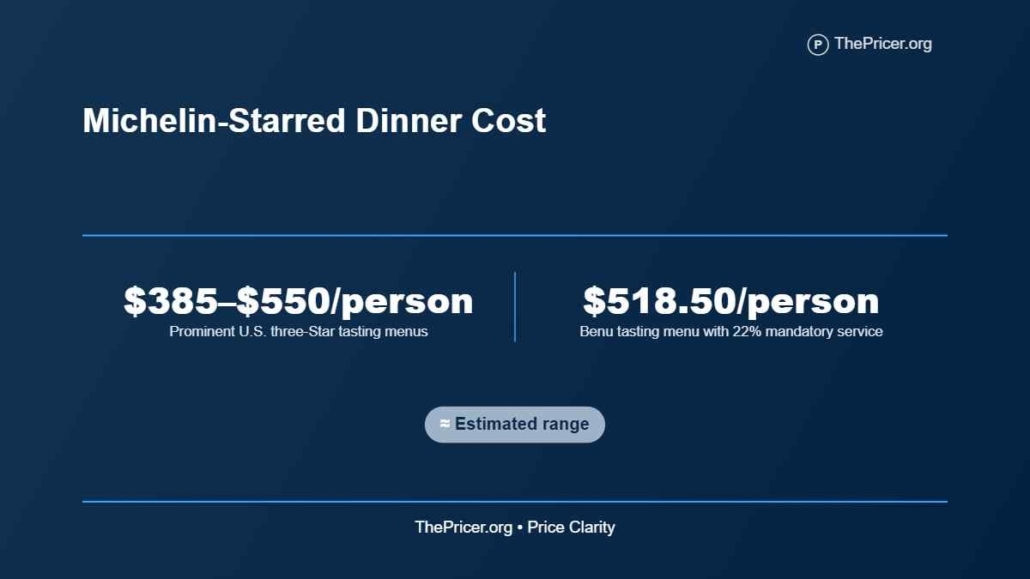
Dinner at a Michelin-starred restaurant in the United States can cost well under $300 per person for a shorter tasting experience, while prominent luxury tasting menus currently reach $385 to $550 per person before drinks and other additions. Eleven Madison Park lists a $225 bar tasting and $385 full tasting menu, Smyth lists tasting menus at $420 and $550, and Benu charges $425 before its mandatory service charge.
A couple choosing a high-end tasting menu, wine pairing, and required service can therefore spend more than $1,000 on dinner before every possible extra is counted. These are current restaurant examples for budgeting, not a national average for all Michelin-starred restaurants.
The Star itself does not set the price. The diner pays for the restaurant’s chosen menu format and extras, while Michelin evaluates the cooking. Menu structure, beverage choices, mandatory charges, location, and optional upgrades usually have a more direct effect on the final bill than Star count alone.
At Benu, the published $425 tasting menu plus its 22% service charge reaches $518.50 per person before applicable tax, beverages, or other extras. The most useful dinner budget separates the base food price from every additional layer instead of treating the menu price as the final check.
Article Highlights
Jump to sections
- Current prominent U.S. three-Star tasting-menu examples include prices from $385 to $550 per person before various additions.
- Eleven Madison Park charges $385 for its full tasting menu and $225 for its shorter bar tasting experience.
- Benu’s $425 tasting menu becomes $518.50 after its mandatory 22% service charge, before applicable tax and optional extras.
- Smyth lists a $420 tasting menu and a $550 Chef’s Menu, with beverage pairings costing hundreds more per person.
- Two Benu tasting menus plus mandatory service total $1,037 before applicable tax, drinks, supplements, or parking.
- A Michelin Star measures Michelin’s assessment of the cuisine; it does not prescribe what a restaurant must charge.
How Much Does Dinner at a Michelin-Starred Restaurant Cost?
The most useful way to budget is to examine actual restaurant menus rather than assign an unsupported average to every Michelin-starred establishment. Michelin-starred restaurants range from à la carte dining rooms to elaborate tasting-menu destinations, and even restaurants holding the same number of Stars can charge very different prices.
At the luxury tasting-menu end, current published prices provide several strong U.S. reference points. Eleven Madison Park in New York lists a $385 full tasting menu and a shorter $225 bar tasting menu. Its current dining information states that wine pairings begin at $125 per person and gratuity is not included. A diner choosing the full menu and starting wine pairing therefore reaches $510 before tax and gratuity.
Chicago’s Smyth lists a $420 tasting menu and an upgraded $550 Chef’s Menu. Its current beverage program includes pairings at $245 and $475 per person. In San Francisco, Benu publishes a $425 tasting menu. These prices illustrate the upper end of current Michelin dining rather than the minimum price of getting into a starred restaurant.
| Restaurant or experience | Published base price | Selected extra |
|---|---|---|
| Eleven Madison Park full tasting | $385 | Wine pairing from $125 |
| Eleven Madison Park bar tasting | $225 | Wine pairing from $125 |
| Benu tasting menu | $425 | 22% mandatory service charge |
| Smyth tasting menu | $420 | Pairing from $245 |
| Smyth Chef’s Menu | $550 | Premium menu before drinks |
The table should not be read as a nationwide Michelin price range. It is a comparison of documented current luxury tasting experiences. One-Star restaurants can operate with different formats and substantially different check sizes, while special menus, holidays, private dining, and limited events can carry other prices.
Stars Do Not Set the Price
 The number beside a restaurant’s Michelin listing does not work like a hotel classification with a fixed set of amenities or rates. Michelin’s published criteria explain that inspectors judge restaurants using ingredient quality, harmony of flavors, technical mastery, the personality expressed through the cuisine, and consistency. Price is not the formula that determines whether a restaurant receives one, two, or three Stars.
Michelin describes One Star as high-quality cooking worth a stop, Two Stars as refined and inspired cooking worth a detour, and Three Stars as exceptional cuisine worth a special journey. Those distinctions explain culinary recognition, but they do not establish a dollar value for dinner. A diner should not calculate the expected price by multiplying a hypothetical one-Star price by two or three.
Restaurant format matters much more to the immediate budget. An à la carte restaurant lets diners control spending through individual dishes, while a tasting-menu restaurant can require every guest to purchase the full menu. A restaurant may also offer a shorter bar menu, prix fixe option, lunch menu, or another experience alongside its flagship dinner.
A national “average cost per Michelin Star” would create false precision. A more defensible budget starts with the restaurant, menu format, mandatory charges, and desired drinks or supplements, then calculates the expected check from those components.
What the Menu Price Includes
A tasting-menu price generally buys the restaurant’s defined sequence of courses, but it does not automatically include beverages, premium supplements, tax, gratuity, or mandatory service. Reservations can also have cancellation terms or prepayment requirements that affect when the customer pays even when they do not change the underlying menu price.
At Benu, current dining information states that the $425 tasting menu carries a mandatory 22% service charge, while corkage costs $100 per 750 ml bottle and valet parking costs $30. A diner comparing only the $425 headline menu with another restaurant’s final bill would therefore be comparing different cost layers.
Prix fixe menus work somewhat differently because the diner may choose among dishes within a set number of courses. À la carte dining gives still more control over how many dishes are ordered. Tasting menus generally provide less control over the food subtotal because the menu itself is the experience being purchased.
A practical budget treats the base menu as layer one. Layer two consists of food supplements or extra courses. Beverages form another layer. Mandatory service charges and surcharges follow according to the restaurant’s policy, with applicable tax and any genuinely discretionary gratuity considered separately. Transportation and parking sit outside the restaurant check but still affect the night’s total cost.
Service, Tax, and Gratuity
Service policies can make two identically priced menus produce different final checks. Some restaurants build service into menu pricing, some impose a mandatory percentage, and others leave gratuity to the guest. Diners should read the restaurant’s current policy instead of automatically adding 20% to every Michelin menu or assuming a listed service charge replaces every possible addition.
Benu provides a clear calculation. Its $425 menu carries a 22% service charge:
$425 × 22% = $93.50
The menu plus mandatory service therefore costs $518.50 per person. For two people, the same calculation becomes $850 for food plus $187 in service, producing $1,037 before applicable tax and optional additions.
Atelier Crenn uses another structure. Its current restaurant policies state that a 20% service charge and a separate 3% San Francisco Health Care Mandate surcharge apply, while corkage is $125 per bottle. This shows why diners need the complete fee policy rather than the tasting-menu price alone.
Sales tax is another location-dependent layer. A San Francisco dinner, a Chicago dinner, and a New York dinner should not be given one artificial tax percentage. The worked totals therefore stop before tax unless a calculation is tied to a particular documented tax treatment. This keeps menu and service comparisons reproducible without disguising a local tax assumption as a national rule.
Wine Can Double the Budget
Beverages are one of the largest discretionary variables in Michelin dining. A guest drinking water or ordering one modest beverage can stay much closer to the food price than a guest choosing the restaurant’s premium wine pairing. At luxury tasting restaurants, the pairing itself can cost several hundred dollars.
Smyth provides a striking example. Its current dining options show that the $420 tasting menu can be paired with beverage options priced at $245 or $475 per person. Two regular tasting menus cost $840. Adding two $245 pairings costs another $490, bringing food and pairings to $1,330 before tax and gratuity.
The premium pairing changes the calculation much more sharply. Two $475 pairings cost $950. Combined with two $420 tasting menus, the food-and-pairing total becomes $1,790. The pairings alone cost $110 more than the two tasting menus.
Alinea shows a similar spread in beverage choices. Its current restaurant policies list wine pairings at $195, $285, and $475 per person, with those prices excluding service charge and tax, while valet starts at $19. A couple choosing the highest pairing spends $950 on pairings before the associated service and tax are considered.
This is why “How much is the tasting menu?” and “How much should we budget for dinner?” can have very different answers. Beverage choice can move a dinner for two by several hundred dollars without changing a single food course.
A Dinner for Two
Benu offers a useful worked example because its published information provides the tasting-menu price, mandatory service percentage, corkage, and parking cost. Start with two $425 tasting menus, producing an $850 food subtotal.
The mandatory service charge is 22%. Applied to the two-person food subtotal, that equals $187:
$850 × 0.22 = $187
| Dinner component | Two-person cost |
|---|---|
| Two tasting menus at $425 | $850.00 |
| 22% mandatory service charge | $187.00 |
| Food plus mandatory service | $1,037.00 |
| Optional corkage for one bottle | $100.00 |
| Optional valet | $30.00 |
| Modeled total with those extras, before applicable tax | $1,167.00 |
The required menu and service portion already exceeds $1,000 for two. Adding one corkage fee and valet raises the modeled amount to $1,167 before applicable tax. The wine brought by the diners is not included in that total, so its purchase price would be another personal expense.
Eleven Madison Park provides a second comparison. Two $385 full tasting menus plus two starting $125 wine pairings total $1,020 before tax and gratuity. Choosing the $225 bar tasting instead reduces the two-person food portion by $320. With the same starting pairings, two bar experiences total $700 before tax and gratuity.
Supplements and Other Extras
Luxury ingredients can increase the check without changing the restaurant’s base menu. Caviar, truffles, Wagyu, premium seafood, cheese courses, and other upgrades may appear as optional supplements. Their cost should be treated separately because two diners purchasing the same tasting menu can finish with very different totals depending on upgrades.
Le Bernardin provides a clear illustration of the scale such additions can reach. Current menu material lists Royal Osetra caviar at $145 per ounce and a bluefin tuna and caviar supplement at $50. These are restaurant-specific menu examples rather than a claim that every Michelin restaurant charges similar supplement prices.
Corkage can also be substantial. A diner who brings a bottle may avoid restaurant wine-list pricing but still pay $100 or more for the restaurant to serve it. Bottle limits, prohibited labels, and corkage policies differ by restaurant. The cost of purchasing the bottle remains separate from the corkage charge.
Transportation deserves a line in a special-occasion budget as well. Valet charges such as Benu’s $30 or Alinea’s starting $19 are small relative to a four-figure dinner but still affect the total evening cost. Rideshare fares, parking garages, babysitting, hotels, and travel are personal trip expenses rather than restaurant-menu costs and should remain outside claims about the dinner price itself.
Lower-Cost Ways In
A Michelin-starred meal does not always require buying the restaurant’s longest tasting menu with wine pairing. Shorter menus, bar experiences, lunch service, and à la carte ordering can provide lower entry prices when a restaurant offers them. Availability varies, and the less expensive option may provide fewer courses or a materially different experience.
Eleven Madison Park demonstrates the difference clearly. Its full tasting menu costs $385, while its bar tasting costs $225. The difference is $160 per person, or $320 for two. A couple choosing the shorter experience preserves several hundred dollars of the budget before tax and gratuity.
Skipping a pairing can have an even larger effect at restaurants with premium beverage programs. At Smyth, declining the $475 pairing saves a couple $950. At Eleven Madison Park, skipping two starting $125 pairings saves at least $250. Diners can instead examine the restaurant’s by-the-glass, cocktail, nonalcoholic, or bottle options where available.
For comparison with a premium restaurant experience outside the Michelin-star system, ThePricer’s Hell’s Kitchen dining cost guide shows how prix fixe food, wine pairing, tax, and gratuity build a final restaurant budget. Hell’s Kitchen Las Vegas does not hold a Michelin Star, so its pricing should be treated as a luxury-restaurant comparison rather than Michelin pricing.
Budget for the full tasting experience if
- The flagship menu is the main reason for choosing the restaurant.
- The budget comfortably accommodates mandatory service and applicable tax beyond the menu price.
- Wine pairing or premium supplements are part of the desired experience.
- The reservation is being treated as a major special-occasion expense rather than an ordinary dinner.
Check for a lower-cost format if
- The restaurant offers a shorter bar, lunch, or prix fixe menu.
- Beverage pairings would push the dinner beyond the intended budget.
- The group prefers à la carte control over a fixed multi-course tasting.
- The advertised menu price is already near the maximum planned spend before service, tax, and extras.
Answers to Common Questions
How much should two people budget for a Michelin-starred dinner?
The amount depends heavily on the restaurant and menu. At the luxury three-Star end, two tasting menus alone can approach or exceed $800 to $1,100 in the documented examples above. Mandatory service, tax, drinks, supplements, and gratuity can push the final expense higher. One-Star and à la carte restaurants can cost materially less.
Does a three-Michelin-Star restaurant always cost more than a one-Star restaurant?
No. Michelin Stars assess the cooking rather than setting prices. Many famous three-Star restaurants use expensive tasting menus, but the Star definitions do not require a restaurant to charge a particular amount.
Is wine included in a Michelin tasting-menu price?
Often it is not. At the restaurants examined here, beverage pairings are separately priced and can add from $125 to several hundred dollars per person. Check the restaurant’s reservation and menu terms before assuming drinks are included.
Are tax and tip included in Michelin restaurant prices?
Policies differ. Some restaurants impose mandatory service charges, some exclude gratuity, and local tax treatment varies. Benu, as one documented example, adds a 22% service charge to its $425 tasting menu.
Can I eat at a Michelin-starred restaurant for less than the flagship tasting-menu price?
Sometimes. Restaurants may offer shorter bar menus, lunch, prix fixe options, or à la carte dining. Eleven Madison Park currently lists a $225 bar tasting compared with its $385 full tasting menu, a difference of $160 per person.
Disclosure: Educational content, not financial advice. Prices reflect public information as of the dates cited and can change. Confirm current rates, fees, taxes, and terms with official sources before purchasing. See our methodology and corrections policy.