
How Much Does Driving School Cost?
Updated on | Written by Alec Pow
This article was researched using 14 sources. See our methodology and corrections policy.
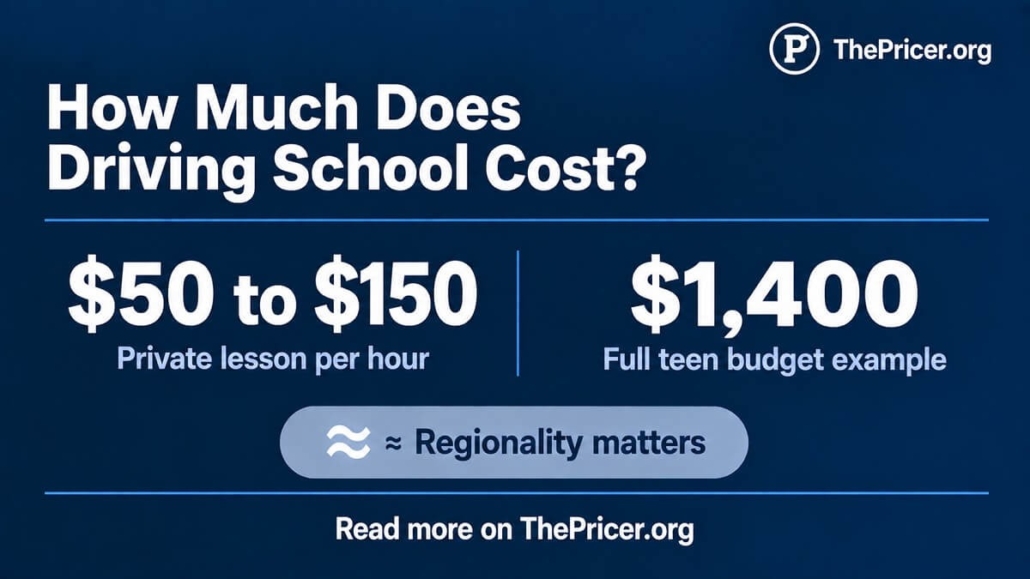
Driving school in the United States commonly costs about $50 to $150 per hour for private behind-the-wheel instruction and about $400 to $800 for a course combining classroom and road training, according to published driving school cost data. Direct school prices checked September 8, 2026 show that the actual bill depends heavily on lesson length, state licensing rules, test-day service, and how much classroom work is bundled. Across five current road-training packages used below, normalized instruction runs from about $45 to $91.67 per hour.
Driving school pricing can cover private driving lessons, teen driver education, adult instruction, behind-the-wheel training, online or classroom coursework, supervised practice requirements, road-test preparation, a training vehicle, pickup service, completion certificates, and permit or license charges.
The buyer may be a parent purchasing a state-approved teen course or an adult learner buying only a few road lessons. Those services use different units and satisfy different licensing needs, so the article separates per-hour instruction, full courses, mandatory training, optional test-day services, and government fees rather than treating them as one national package.
Article Highlights
Jump to sections
- Private behind-the-wheel instruction often budgets around $50 to $150 (at $30 per hour, earning that amount would take about 1.7 to 5 hours of work, before taxes) per hour, though the five direct packages sampled here normalize to about $45 to $91.67 per hour.
- A California AAA member can buy a state-minimum teen package for $469, while one Massachusetts school posts a full teen program at $1,150.
- California requires six professional road-training hours for many under-18 applicants, while Massachusetts requires 12 behind-the-wheel hours plus six observation hours.
- An AAA package upgrade adds four road hours for $145, equal to $36.25 per added hour.
- A Massachusetts school-based licensing scenario built from posted school and RMV charges totals $1,400.
How Much Does Driving School Cost?
The table uses advertised prices visible on September 8, 2026. The five road-rate rows were selected because the schools publish a clear driving-hour count or lesson duration. They span Texas, New York, Massachusetts, Washington, and California, so they show real price variation rather than a single local market. The sample is handpicked for comparable units and is not a representative national survey.
| School and market | Advertised road-training offer | Normalized road rate | Other posted charges or scope |
|---|---|---|---|
| US-BD, Garland, Texas | Six adult driving hours for $270 (about 1.1 full-time workdays at $30 per hour) | $45 per hour | Road test with car is posted at $100 |
| Golden Star, New York City | Ten 45-minute lessons for $500, equal to 7.5 road hours | $66.67 per hour | Pickup and drop-off are included with that ten-lesson offer |
| Weston School of Driving, Massachusetts | Twelve road-training hours for $985 | $82.08 per hour | Full teen package is $1,150, certificate $35, road-test sponsorship $100 |
| 911 Driving School, Camas, Washington | Three one-hour adult lessons for $270 | $90 per hour | School-vehicle road test is posted at $65 |
| Teen Driving Academy, California | Six behind-the-wheel training hours for $550 | $91.67 per hour | Four-hour test service is $350, while six hours plus test service costs $750 |
The rate column is a ThePricer calculation, not a quoted industry rate. It divides each posted training price by the stated road hours. That treatment is most useful for lesson-only offers. A full teen program can include classroom work or observation that has real value but disappears if every dollar is assigned to road time. The package total still matters, but it answers a different question.
What Driving School Covers
A driving school purchase may contain several different services. Behind-the-wheel instruction puts the learner in a training vehicle with an instructor. Driver education covers rules, signs, risk, and licensing material in a classroom or online course. A teen program may combine those pieces with observation hours, parent instruction, pickup, a completion certificate, or use of a school car for the road test. Adult learners often buy only road instruction because their state and age may not require a teen education package.
That scope matters because the same word, lesson, does not identify the same unit. One school may schedule 45-minute lessons, another may sell 60-minute hours, and another may bundle several road sessions with a fixed online course. A buyer comparing only the package total can miss the amount of paid driving time inside it. Readers focused only on classroom or online education can compare that narrower service in the driver’s ed cost guide.
The useful comparison is the price for the training the learner actually needs under the applicable state rules. That means matching lesson duration, total road hours, course approval, test-day service, pickup, and cancellation terms. A cheap classroom course does not replace required road instruction. A large road package also does not become necessary merely because a school sells it. State rules and the learner’s skill gap set the buying problem.
Price Per Road Hour
Normalizing the five offers above changes the comparison. The lowest package works out to $45 (about 1.5 hours of work at $30 per hour) per road hour, while the highest is about $91.67 per road hour. Dividing the high rate by the low rate gives 2.04. In this defined five-school sample, the highest normalized rate is a little more than twice the lowest. That does not establish a national market ratio. It shows how far posted prices can move even before classroom work, test service, or state licensing fees are added.
Lesson duration can create an equally large reading error. Golden Star sells ten 45-minute lessons for $500. Ten lessons sounds larger than a five-session package, but those ten lessons are delivered as five 90-minute sessions and total 7.5 hours. The implied rate is about $66.67 per road hour. Comparing its sticker price with a ten-hour package would overstate how much driving time the learner receives.
Packages can still beat single-hour purchasing when the learner needs several sessions. The relevant number is not merely the advertised discount. Compare total paid road minutes and ask whether fixed extras, such as online driver education or test scheduling, are useful to that learner. A short refresher buyer may pay a higher hourly price yet spend less in total because fewer road hours are needed.
State Rules Drive Tuition
State requirements can change the minimum amount of professional training a teen must buy. California’s under-18 license requirements call for six hours of professional driver training. The same page requires 50 hours of supervised practice for the provisional path, including 10 hours at night. Paid school time covers only part of that practice burden, which is why a six-hour school package can satisfy the professional component without replacing home-supervised practice.
Massachusetts sets a larger professional education requirement. Its Junior Operator License rules require 30 classroom hours and 18 hours in a training vehicle, made up of at least 12 behind-the-wheel hours and six observation hours. A Massachusetts teen course that includes all required pieces is selling much more school time than a California package built around six paid road hours.
This is why state-minimum packages should be compared by compliance scope before price. A lower-priced offer in one state may be perfectly adequate for that state’s licensing path and still be incomplete in another. Adult rules can differ from teen rules in the same state. Parents who are planning the next major ownership expense can also compare teen car insurance costs separately because insurance is not part of driving-school tuition.
Test-Day and Extra Charges
The advertised lesson price may leave out services that become useful near the road test. A school can charge for a test vehicle, warm-up lesson, appointment handling, pickup, missed lessons, or payment processing. City Xpress in Illinois posts a teen basic program at $575, an optional pickup and drop-off add-on of $25, and a $2 processing charge for each Zelle transaction. Those amounts are small beside tuition, but they matter when two packages have similar base prices.
Cancellation rules can cost more than a small processing fee. The schools in the price table publish different notice and refund terms, including forfeiture risks tied to missed lessons or uncompleted packages. Read those rules before buying a large block of sessions. The risk is greatest when the learner’s schedule is uncertain, because an unused discounted package can cost more than several flexible single lessons.
Government fees sit outside school tuition too. Permit applications, road tests, license issuance, and retests are paid to the licensing agency, not the instructor, unless a school collects them as part of an authorized service. Keep those charges separate when comparing schools. Commercial driver training is also a different purchase with different licensing economics, covered in the CDL cost article.
Some Courses Cost More
Paid road hours are the largest visible driver of tuition, but the structure around those hours changes the bill. A full teen course can carry fixed classroom content, observation, parent instruction, or administrative work before another road hour is added. That fixed content makes simple package division misleading. A ten-hour package may have a lower marginal road-hour cost than its average package cost because the classroom component was already included in the smaller tier.
Location also affects what the school has to provide. Dense urban practice can require more instructor travel between pickups, while a broad service area can make complimentary pickup valuable. Schools may charge separately for home pickup or limit it to certain packages. Weekend or evening availability can change which sessions a learner can actually use, even when the posted tuition is unchanged. The economic question is usable training, not just booked training.
Student experience changes quantity too. A brand-new driver may need more paid practice than someone who already has supervised family driving available. Test preparation can be another narrow need that does not justify a full course. When comparing two schools, match the amount of road time, lesson duration, included education, pickup area, cancellation policy, and test-day service before deciding that the lower package price is the cheaper choice.
A Full Teen Budget
 A Massachusetts teen using Weston’s full program gives a clear worked example because the school posts both tuition and school-specific licensing services. Using the prices cited in the table, the full driver-education package is $1,150, the school certificate charge is $35, and road-test sponsorship is $100. The Massachusetts RMV lists permit and license charges of $30 for the permit application, $35 for the license application and road test, and $50 for a Class D license.
The itemized total is $1,150 plus $35 plus $100 plus $30 plus $35 plus $50, which equals $1,400. This is an illustrative school-based licensing path, not a Massachusetts statewide average. It assumes the learner uses the posted Weston package, buys the certificate and sponsorship services, passes without extra paid instruction, and owes the standard RMV charges shown above. It excludes insurance, family practice costs, missed-lesson charges, and any retest.
The calculation also shows why tuition and licensing cost should not be merged into one unexplained range. In this scenario, $250 of the $1,400 total sits outside the base course tuition. A family that compares only the $1,150 course price would understate this defined path by about 21.7% relative to tuition alone. The same arithmetic will differ at another school because sponsorship and certificate charges are provider-specific.
Package or Individual Lessons
Package math becomes useful when the same school sells a fixed education component with different amounts of road time. AAA’s Corona program posts two driver education packages, with an online course plus six behind-the-wheel hours at $469 for an existing member and the same online course plus ten road hours at $614. Both tiers include 30 hours of approved online education. The upgrade costs $145 and adds four road hours, so each added road hour costs $36.25. That is much lower than dividing either full package by its road hours because the fixed online course is already paid for.
A second package calculation uses the Teen Driving Academy figures cited in the table. Six road hours are posted at $550, standalone test service at $350, and the six-hour plus test bundle at $750. Buying the listed pieces separately would total $900. The bundle is $150 lower, equal to a 16.7% reduction against the separate-component total.
Makes sense if
- The learner needs most of the included road hours.
- The fixed classroom or online component is required for the licensing path.
- Test-day vehicle service solves a real vehicle or scheduling need.
- The package’s cancellation and expiration rules fit the learner’s schedule.
Does not make sense if
- The learner needs only one or two targeted refresher sessions.
- Several bundled hours are likely to go unused.
- The included education does not satisfy the learner’s state requirement.
- A family car and permitted supervised practice already cover most practice needs.
Answers to Common Questions
How much is one driving lesson?
A private road lesson often falls around $50 to $150 per hour, though lesson duration varies. Convert 45-minute and 90-minute sessions to an hourly rate before comparing them.
How much does a full teen driving course cost?
Published packages vary by state and scope. Current examples reviewed for this article run from $469 for a California AAA member package to $1,150 for a Massachusetts full teen program.
Are road-test charges included in driving school tuition?
Sometimes. Some schools bundle a test vehicle or test service, while others sell it separately. Check the package description rather than assuming tuition covers test day.
Is a driving-school package cheaper than individual lessons?
It can be when the learner will use the included hours. In the AAA example above, four added road hours cost $145, or $36.25 per added hour, because the fixed online course is already included in both tiers.
Disclosure: Educational content, not financial advice. Prices reflect public information as of the dates cited and can change. Confirm current rates, fees, taxes, and terms with official sources before purchasing. See our methodology and corrections policy.