
How Much Does Drone Ownership Cost Per Year?
Published on | Written by Alec Pow
This article was researched using 13 sources. See our methodology and corrections policy.
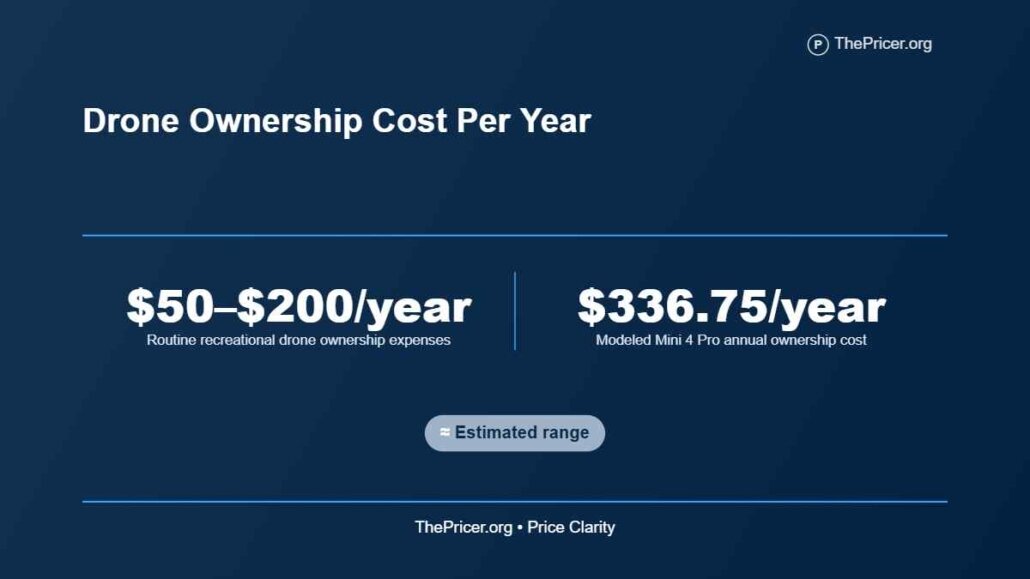
Owning a consumer camera drone in the United States costs an estimated $50 to $200 per year in routine out-of-pocket expenses for many recreational pilots, excluding the original purchase and major accidents.
Owners buying extra batteries, optional damage protection, and accessories can spend $200 to $500 or more annually. Professional operators face additional certification, insurance, and business costs.
Including the purchase price over the drone’s useful life changes the answer. A $600 drone kept for four years contributes $150 per year in annualized equipment cost, before maintenance or insurance. The same drone replaced after two years contributes $300 annually.
These are planning estimates rather than measured national averages. Battery requirements, accident risk, registration rules, and the type of flying determine what an owner actually spends.
Article Highlights
Jump to sections
- Recreational operating expenses can stay below $200 annually without optional protection or major repairs.
- FAA drone registration costs $5 for three years, while qualifying recreational drones under 250 grams are exempt.
- DJI replacement batteries provide price benchmarks from $55 to $245 across selected camera-drone models.
- Accident protection plans and liability insurance serve different purposes and should not be confused.
- Commercial drone pilots generally need Part 107 certification, with the initial knowledge test costing approximately $175.
- The annualized purchase price can outweigh electricity and routine replacement parts combined.
How Much Does Drone Ownership Cost Per Year?
Drone ownership has two distinct costs. Cash expenses include replacement parts, registration, optional protection, and repairs. Economic ownership cost also includes the initial purchase spread over the period the aircraft remains useful.
The table shows illustrative annual allowances for a U.S. recreational camera drone. It is not a statistical survey of owner spending.
| Expense | Illustrative annual budget | Frequency or condition |
|---|---|---|
| FAA registration | $0–$1.67 annual equivalent | Exemption or three-year registration |
| Propellers and minor supplies | $0–$40 | Damage and wear |
| Battery replacement reserve | $0–$125 | Model, battery condition, usage |
| Electricity | $1–$10 | Illustrative charging allowance |
| Optional damage protection | $0–$200+ | Model and coverage selection |
| Major repairs | Variable | Accidental damage or failure |
| Annualized purchase cost | $75–$750+ | Purchase price and useful life |
These categories are not all mandatory. Someone flying a lightweight drone occasionally may spend almost nothing in a given year after buying it. A heavily used aircraft can require multiple batteries and replacement components.
The purchase-price difference is substantial. DJI’s published Mini 4K Fly More package was listed at $449, with additional batteries and a charging hub included. The product was marked out of stock when checked, so this is a published price benchmark rather than a currently guaranteed purchase offer.
A more capable DJI Mini 4 Pro package was listed at $759 for the standard controller version. Its higher equipment cost directly increases annualized ownership expense if both drones are kept for the same number of years.
FAA Registration and Licensing
Registration is relatively inexpensive, but recreational and non-recreational operations follow different rules.
According to the FAA’s drone registration requirements, a recreational registration costs $5 and lasts three years. It covers the owner’s recreational drone inventory. Under Part 107, the fee is also $5 for three years, but registration applies separately to each aircraft.
A drone weighing less than 250 grams is generally exempt from registration when flown exclusively under the recreational exception. Commercial Part 107 operations do not receive that exemption simply because the drone is lightweight.
The annual equivalent of a three-year registration is approximately $1.67. That is a budgeting allocation, not an annual FAA payment.
Recreational pilots must also complete the FAA recreational TRUST test. The approved test is free, and the pilot must retain proof of completion. Paying a third-party provider for recreational test access is unnecessary.
Commercial operations are different. The FAA’s remote pilot certification guidance reports approximately $175 for the initial aeronautical knowledge test at an approved testing center. Optional training materials and examination retakes can increase first-year expenses.
Replacement Battery Expenses
Batteries are among the most consequential drone ownership expenses because they affect flight duration and eventually wear out.
DJI publishes different battery prices across its aircraft families. Its official battery product listings include the Mini 2 battery at $55, Mini 3-series battery at $65, Mini 4 Pro battery at $99, and Air 3 battery at $159.
The larger Air 3S intelligent flight battery carries a published price of $245. Its manufacturer-rated maximum flight time is 45 minutes under controlled test conditions, not a promise of 45 minutes in every real flight.
Battery life depends on charging cycles, storage conditions, temperature, discharge behavior, and age. No fixed annual replacement requirement applies to all consumer drone batteries.
For budgeting, an owner planning to replace one $99 battery every three years could reserve $33 annually. Buying another battery for longer flying sessions is a separate equipment purchase rather than maintenance caused by wear.
Bundle contents deserve attention. DJI’s Mini 4 Pro Fly More Combo includes three flight batteries, a charging hub, controller, carrying bag, and spare propellers at a published package price of $1,099. Buyers comparing that package with a basic aircraft should not add the included batteries a second time.
Propellers and Minor Repairs
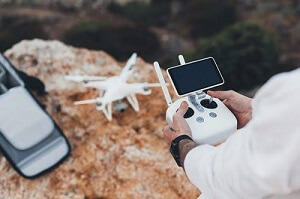 Propellers are inexpensive relative to batteries, cameras, and motors. They can still create unexpected expenses when an aircraft strikes a branch or lands on an unsuitable surface.
DJI’s Mini 4 Pro propeller package is listed at $9 for two pairs with installation screws. The manufacturer instructs users to fit matching propellers correctly rather than mix parts from different packages.
Replacing damaged propellers promptly is a safety expense, not merely cosmetic maintenance. Cracked or deformed blades can affect flight stability.
A $20 to $40 annual reserve can cover occasional minor accessories on a small consumer drone, although an aircraft that never damages a component may spend nothing. The allowance should not be mistaken for a predictable manufacturer service charge.
Camera gimbals, folding arms, motors, and controllers can be far more expensive to repair. Those failures need model-specific quotes. An owner deciding whether to repair a crash-damaged aircraft should compare the complete repair price with the cost of a compatible replacement, including any equipment that can be reused.
Accident Protection and Insurance
Drone protection products have different purposes. Manufacturer replacement programs help with eligible aircraft damage or loss. Liability insurance addresses potential claims involving other people or property, subject to the policy’s terms.
For a specific benchmark, DJI listed its Mini 4 Pro Care Refresh plan at $89 for one year or $149 for two years in a USD-denominated listing. Prices, eligibility, and market availability must be checked before purchasing.
Care Refresh is not unlimited free replacement coverage. DJI’s U.S. protection program explanation describes replacement benefits for qualifying damage, with service conditions and replacement charges depending on the product and plan.
That distinction produces an important hidden cost. A pilot paying $89 for protection may still owe a replacement fee after an eligible incident. A protected drone is not necessarily inexpensive to crash.
Commercial operators should request quotes for third-party liability and physical damage coverage separately. Premiums depend on aircraft value, activities, limits, deductibles, and operating history. There is no defensible universal yearly premium that applies to every commercial drone business.
Do not substitute manufacturer protection for commercial liability insurance without confirming the actual policy coverage. Also check whether local clients, venues, or contracts require proof of insurance.
Commercial Drone Operating Costs
A drone used for paid photography, inspection, mapping, or other non-recreational work has a different cost structure from a recreational aircraft.
The FAA’s Part 107 certification instructions require operators to maintain their aviation knowledge currency. The FAA provides qualifying recurrent online training at no cost, with a 24-calendar-month training requirement.
Certification expenses belong in the first-year budget if the operator is not already qualified. A detailed Part 107 drone license cost analysis provides the broader distinction between examination, study, and optional preparation expenses.
Commercial pilots may also need editing software, storage, additional batteries, replacement aircraft, liability coverage, and travel allowances. Those are business expenses rather than mandatory annual FAA fees.
An illustrative small-business budget might allocate $300 annually for liability protection, $150 for accessories and maintenance, $100 for data storage and software, and $200 for equipment replacement reserves. This totals $750 annually before assigning any share of the drone’s initial purchase.
The figures are scenario assumptions, not insurer quotations or measured industry averages. A mapping contractor with expensive sensors can spend substantially more than a part-time real-estate photographer.
Example of Yearly Ownership
Consider a recreational pilot purchasing a DJI Mini 4 Pro with the published standard-package price of $759. The owner already has a suitable phone and does not need to buy additional batteries immediately.
For an illustrative four-year ownership period, the annual budget consists of the following:
- Purchase price allocation, $759 divided by four: $189.75
- One $99 battery replacement allowance spread over three years: $33.00
- Annual propeller and small-accessory allowance: $20.00
- Estimated annual charging electricity: $5.00
- Optional Care Refresh one-year protection: $89.00
The modeled annual ownership expense is $336.75, including the allocated original purchase price and the optional annual protection plan.
Without protection, that falls to $247.75 annually. The difference is precisely the protection-plan premium, assuming no accidents, replacement claims, or other costs.
These results do not include sales tax, major repair charges, insurance liability premiums, or resale value. Actual protection eligibility and renewals may not allow the same plan to continue unchanged for all four years. The four-year model assumes the annual cost remains available solely to illustrate the financial difference.
The most important finding is that the drone’s annualized equipment cost of $189.75 represents about 56% of the modeled $336.75 ownership total. Focusing only on battery charging and FAA registration misses most of the ownership expense.
Annual Cost Per Flight
The number of flights changes the effective cost of each outing even when annual ownership spending remains unchanged.
Using the worked example’s $336.75 modeled annual cost, flying 12 times a year produces an allocated cost of approximately $28.06 per outing. At 52 outings, the figure falls to $6.48.
This is a cost-allocation comparison rather than a literal per-flight fee. It assumes identical annual spending in both scenarios and ignores extra component wear from frequent flying.
The difference matters when deciding whether ownership is sensible. An aircraft used once or twice during a vacation may have a surprisingly high effective cost per flight, while someone filming weekly can distribute the equipment expense across many more sessions.
The model also shows why buying a second battery is a capacity decision. Its value comes from longer sessions and fewer charging interruptions, not necessarily lower annual ownership costs.
Depreciation and Replacement
Annual operating expenses do not fully reflect the money tied up in a drone. Aircraft can lose value as newer cameras, flight controls, and safety systems enter the market.
For a simple ownership model, divide the purchase price minus an estimated resale value by the number of years of use. A $1,200 aircraft that could be sold for an assumed $300 after four years has lost $900 in value, equivalent to $225 annually.
If the same aircraft becomes unusable after only two years and has no resale value, the allocated purchase cost rises to $600 annually. This is one reason accident risk and repairability matter.
Resale values are assumptions until supported by actual comparable secondhand sales. Owners should not count a hypothetical sale price as guaranteed recovery.
Budget for the possibility that spare batteries, remote controllers, or proprietary parts become difficult to replace as a model ages. Before buying used equipment, verify battery health, serial-number status, software compatibility, and that the aircraft can be registered and operated legally.
Hidden Cost of Compliance
Registration is cheap. Buying incompatible hardware can be expensive.
The FAA requires registered drones to meet applicable Remote ID requirements unless an authorized exception applies. Its Remote ID compliance guidance explains the role of Standard Remote ID equipment and external broadcast modules.
A newer compliant aircraft may already include the necessary broadcasting functionality. An older or modified aircraft might need additional equipment to fly outside permitted exceptions.
That can affect the total cost of a seemingly inexpensive used drone. The buyer should confirm the exact model’s compliance status before purchase, rather than assume a low advertised aircraft price represents a legal ready-to-fly setup.
Commercial use creates another distinction. A drone may be exempt from recreational registration because of its weight but still require registration and compliance when flown under Part 107.
The $175 initial knowledge test is also not an annual renewal charge. Treating it as yearly operating overhead would overstate ordinary continuing certification expenses.
When Drone Ownership Makes Sense
Drone ownership is attractive when a pilot regularly needs aerial images or genuinely enjoys the flying itself. It can be a poor financial choice for occasional users who repeatedly purchase expensive equipment but rarely take it out.
Makes sense if
- You expect to fly regularly and have lawful, practical places to operate.
- Your chosen aircraft has readily available replacement batteries and propellers.
- You want direct control over filming schedules and camera settings.
- You can maintain and store batteries safely between flights.
Does not make sense if
- You need aerial imagery only once or twice annually.
- Local airspace or site restrictions make the planned flights impractical.
- You cannot comfortably absorb an uninsured crash or loss.
- Professional software, insurance, and training would exceed your expected business income.
Business users should distinguish the expense of owning a drone from the market cost of performing a paid aerial job. Photography, mapping, inspection, and military aircraft occupy different equipment categories. The cost of military FPV drones illustrates why specialized unmanned aircraft procurement should not be used to estimate ordinary consumer ownership spending.
Answers to Common Questions
Is it expensive to maintain a drone?
Routine maintenance can be inexpensive if the aircraft avoids damage and its batteries remain healthy. Larger repairs or replacement batteries can raise annual expenses significantly.
Do I have to pay FAA drone registration every year?
No. Applicable FAA registration costs $5 for three years. Qualifying recreational drones weighing less than 250 grams are exempt from registration.
Does a drone need insurance?
There is no universal federal requirement for every recreational drone owner to purchase liability insurance. Commercial contracts, locations, and particular operations may impose their own coverage requirements.
How much does it cost to charge a drone?
Charging a typical small camera drone generally uses little electricity compared with household appliances. Annual cost depends on battery capacity, charging efficiency, number of charges, and local electricity rates.
How much should a beginner budget for the first year?
A beginner purchasing a $449 drone package could budget approximately $500 to $650 in first-year cash spending with modest accessories and no major damage. This is an illustrative budget, not a guaranteed retail total.
Disclosure: Educational content, not financial advice. Prices reflect public information as of the dates cited and can change. Confirm current rates, fees, taxes, and terms with official sources before purchasing. See our methodology and corrections policy.