
How Much Does Dumpster Rental Cost?
Updated on | Researched and reviewed by Alec Pow, Founder & Pricing Investigator
Prices, claims, and calculations checked against 7 cited sources. See our research methodology and corrections policy.
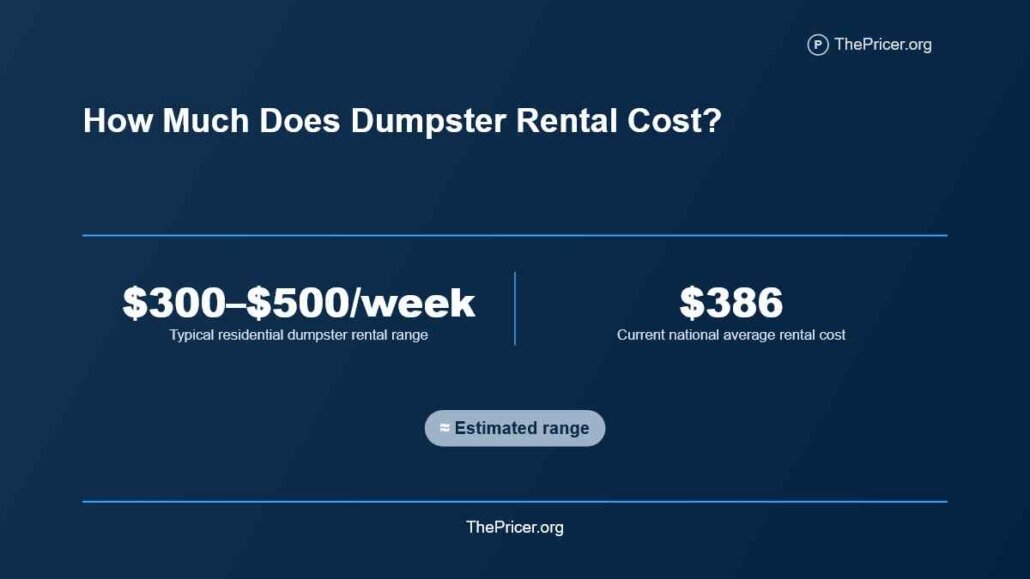
Dumpster rental costs about $300 to $500 per week for a typical residential cleanup or remodeling project in 2026. The current national average is approximately $386, with most rentals falling between $294 and $480. A full-size roll-off dumpster can cost roughly $300 to $800+, while expensive markets, long rental periods, heavy debris, permits, and weight overages can push the final bill above $1,000.
Size makes a large difference. A 10-yard dumpster typically costs about $225 to $575 per week, a 20-yard container costs $275 to $700, a 30-yard dumpster runs $300 to $725, and a 40-yard container costs roughly $350 to $800.
The price advertised for the container is not always the amount you pay at pickup. Check how much debris weight is included, how many rental days are covered, and whether delivery, pickup, landfill charges, permits, mattresses, appliances, or extra tons carry separate fees.
Article Highlights
Jump to sections
- A typical dumpster rental costs about $300 to $500 per week.
- The 2026 national average is approximately $386.
- A 10-yard dumpster commonly costs $225 to $575.
- A 20-yard dumpster runs about $275 to $700 and is one of the most frequently rented sizes.
- A 40-yard dumpster can cost $350 to $800+.
- Extra weight can add roughly $40 to $200 per ton.
- Extra rental days commonly cost another $5 to $10 per day.
- A street or public-property permit can add about $10 to $150+, depending on the city and provider.
- Heavy materials such as concrete, brick, dirt, and roofing debris can reach the weight allowance long before the dumpster looks full.
How Much Does Dumpster Rental Cost?
Current 2026 dumpster rental data puts the national average at $386 and the usual homeowner range at $294 to $480. Larger roll-off containers span a wider price range.
| Dumpster size | Typical weekly cost | Common projects |
|---|---|---|
| 10-yard | $225 to $575 | Small cleanouts, bathroom work, light renovation debris |
| 20-yard | $275 to $700 | Garage cleanouts, flooring, roofing, medium remodels |
| 30-yard | $300 to $725 | Large renovations, additions, construction cleanup |
| 40-yard | $350 to $800 | Whole-house cleanouts, major remodeling, commercial projects |
Those are broad national weekly ranges rather than fixed rates. Angi’s separate roll-off dumpster data puts the average full-size roll-off rental around $650 and shows that some 40-yard rentals can run around $920. This is why a realistic planning ceiling should extend past $800 for large containers.
A 20-yard dumpster is a common residential choice because it can handle many cleanouts and remodeling jobs while still fitting on many driveways.
What a Rental Quote Includes

Many dumpster companies use a flat-rate quote that bundles several parts of the job into one price.
A standard quote may include:
- Delivery of the empty dumpster
- Pickup when the rental is finished
- A set rental period
- A specified amount of disposal weight
- Transport to a landfill or processing facility
- Disposal charges up to the included limit
Budget Dumpster’s current rental pricing policy says its flat-rate quotes bundle delivery, pickup, and the rental period. A set weight allowance is also included and can range from 1 to 10 tons depending on the container and debris.
Its standard rental periods commonly run about 5 to 10 days. Other companies may provide seven days, 14 days, or another period.
Do not assume that every quote includes two tons or two weeks. Those numbers vary too much between providers and projects to use as a national rule.
What Changes the Quote
Dumpster pricing depends on more than container capacity.
Location: Local landfill charges, fuel costs, wages, taxes, disposal rules, and haul distance can move the same dumpster by hundreds of dollars between cities.
Debris type: Household junk, yard debris, roofing shingles, concrete, dirt, and mixed construction waste can be priced differently because they may be taken to different facilities.
Weight: A dumpster that looks half empty can still exceed its paid tonnage allowance if it contains concrete, tile, dirt, brick, shingles, or other dense material.
Rental time: Keeping the container beyond the included period can trigger daily extension fees.
Placement: A dumpster on your own driveway may not need the same permits as one placed in a street, parking lane, alley, or other public right-of-way.
Special items: Mattresses, tires, appliances, electronics, and other materials may carry extra disposal charges or may not be accepted.
Weight Can Cost More
Dumpster capacity is measured in cubic yards, but disposal facilities often charge by weight.
Angi lists physical capacity ranges around 2 to 3 tons for many 10- and 20-yard containers, 3 to 5 tons for 30-yard dumpsters, and 5 to 6 tons for 40-yard dumpsters. That does not mean every rental company includes that entire amount in your quoted price.
The paid allowance can be smaller.
Current market quotes show this clearly. Cedar Rapids rental listings updated in August 2026 show 10- to 11-yard dumpsters around $404 to $453 with only 1 to 1.5 tons included, while 14- to 20-yard containers around $480 to $534 include roughly 1.5 to 2 tons.
Exceeding the paid allowance can add approximately $40 to $200 per extra ton.
Worked example: Suppose a 20-yard rental costs $500 and includes two tons. If the debris weighs three tons and the provider charges $150 for the additional ton, the final rental becomes $650.
That one extra ton increases the bill by 30%.
Concrete and Dirt
Dense materials create a different sizing problem from furniture and household junk.
A large roll-off filled completely with concrete could become too heavy for safe transport. Companies may restrict heavy debris to a smaller container, require a dedicated concrete dumpster, or tell the customer to fill a larger container only partway.
Budget Dumpster, for example, warns that containers carrying heavy debris such as brick or concrete may need to be filled only halfway.
If you have roofing shingles, concrete, soil, tile, brick, asphalt, or similar material, tell the provider what you are throwing away before choosing the dumpster size.
A smaller heavy-debris container can cost less and reduce the risk of a large overage charge.
Extra Fees
A $450 quote can move upward quickly when the job does not stay within its original limits.
Current national price data show common charges around:
- Weight overage: $40 to $200 per extra ton
- Extra rental time: $5 to $10 per additional day
- Landfill charges when not included: roughly $20 to $50 per ton
- Remote delivery: roughly $0.50 to $0.65 per mile in some pricing models
- Dumpster permit: roughly $10 to $100 in broad national data
- Right-of-way permit: often $20 to $150+ depending on the city
- Mattress, appliance, tire, or electronics fees: provider and landfill dependent
- Blocked pickup or failed-trip fee: provider dependent
Budget Dumpster notes that a blocked pickup can also produce a trip fee. A parked car, snow pile, overloaded container, or debris extending above the walls can stop the driver from safely removing the dumpster.
A $500 Rental Can Become $705
Here is a realistic scenario showing how extras change the final price.
- Base 20-yard dumpster: $500
- One extra ton at $150: $150
- Three additional days at $10 each: $30
- Street permit: $25
Total:
$500 + $150 + $30 + $25 = $705
The customer started with a $500 quote but finished $205 higher, a 41% increase.
The largest risk in this example is not the size of the dumpster. It is exceeding the included disposal weight.
Location Can Change the Price
National averages hide large local differences.
Hometown Dumpster Rental publishes recent market quotes showing the spread. In Cedar Rapids, Iowa, 10- to 11-yard rentals currently run around $404 to $453.
In Flemington, New Jersey, current local dumpster quotes put a 10-yard container around $593 to $691, a 20-yard around $701 to $764, and a 30-yard around $858 to $935.
Using the top of each 10-yard range, Flemington’s $691 is $238 more than Cedar Rapids’ $453.
That is a 52.5% difference for a similarly sized dumpster.
Local disposal prices and included rental terms matter enough that national averages should be used as budgeting figures rather than guaranteed quotes.
Hazardous Waste
Paints, solvents, pesticides, automotive chemicals, certain batteries, and other hazardous materials should not simply be added to a normal roll-off and treated as a surcharge.
The U.S. Environmental Protection Agency says products that are toxic, corrosive, flammable, or reactive can require special disposal. EPA recommends checking with the local environmental or solid-waste agency for household hazardous-waste collection programs.
Many standard dumpster providers prohibit hazardous or flammable materials entirely.
Asbestos also requires its own disposal rules and should never be treated like ordinary demolition waste without checking applicable requirements and the waste provider’s acceptance rules.
Dumpster vs Junk Removal vs Bagster
A full roll-off is not always the cheapest way to remove debris.
Junk removal: Full-service junk hauling makes more sense when you have furniture, appliances, or household clutter and do not want to load a container yourself. Current 1-800-GOT-JUNK pricing data puts smaller volume jobs around $107 to $396, medium jobs around $396 to $600, and larger loads around $600 to $1,099. The labor is included.
Bagster: For a much smaller job, WM’s Bagster holds up to 3 cubic yards and 3,300 pounds. The Bagster bag itself currently costs $29.95 online before shipping, but the collection charge is separate and varies by ZIP code.
For example, one current Georgia Bagster market lists a $250 first-bag collection charge. That means a Bagster is not simply a $30 disposal option once pickup is included.
DIY hauling: A pickup or trailer can cost less when the debris volume is very small and your local landfill accepts it, but you pay fuel, landfill fees, vehicle rental if needed, and your own loading time.
For more material, the fixed capacity of a roll-off often becomes easier to budget.
How to Keep the Bill Down
The cheapest quote is not always the cheapest finished rental.
- Ask for the exact included tonnage before comparing prices.
- Compare at least three local quotes using the same dumpster size and debris description.
- Ask whether delivery, pickup, disposal, taxes, and fuel charges are included.
- Confirm the included rental days and the extra-day price.
- Tell the provider about concrete, dirt, roofing shingles, tile, or brick before ordering.
- Keep prohibited materials out of the container.
- Have the dumpster picked up as soon as the project is finished.
- Keep the pickup path clear and debris below the top edge.
- Use a Bagster or full-service junk removal when the load is too small to justify a roll-off.
Do not automatically order the smallest dumpster. Renting a container that is too small can force a second rental or trigger overflow problems. The cheapest size is the smallest one that can safely handle both the volume and weight of the debris.
What We Verified
- Checked: current national dumpster rental data puts the average around $386, with most homeowner rentals around $294 to $480.
- Confirmed: current weekly size ranges run about $225 to $575 for 10 yards, $275 to $700 for 20 yards, $300 to $725 for 30 yards, and $350 to $800 for 40 yards.
- Cross-referenced: overweight charges can reach roughly $40 to $200 per extra ton.
- Verified: flat-rate providers can include delivery, pickup, a rental period, and a specified disposal-weight allowance, but the allowance is not universally two tons.
- Checked: current local quotes show hundreds of dollars of geographic variation for similarly sized dumpsters.
- Confirmed: hazardous household materials can require specialized local disposal rather than a normal roll-off dumpster.
Related Waste Removal Costs
For a smaller renovation or household cleanup, compare the price of a roll-off with our guide to Bagster pickup costs, where the bag purchase and collection fee are separate.
If you need a permanent container instead of a temporary roll-off, see how much a recycling bin costs.
Commercial properties planning a permanent waste area may also need to budget for the cost of building a dumpster enclosure.
Answers to Common Questions
How much does it cost to rent a dumpster for a week?
A typical weekly dumpster rental costs roughly $300 to $500, with current national data placing the average around $386. Large roll-off containers and expensive markets can reach $800 to $1,000+.
How much is a 10-yard dumpster?
A 10-yard dumpster commonly costs about $225 to $575 per week. Local prices can fall outside this range.
How much is a 20-yard dumpster?
Plan on roughly $275 to $700 per week. The 20-yard size is widely used for garage cleanouts, remodeling debris, roofing, and medium construction projects.
How much is a 30-yard dumpster?
A 30-yard dumpster typically costs around $300 to $725 per week, although current local markets can exceed $800.
How much is a 40-yard dumpster?
A broad national range is about $350 to $800. Roll-off-specific price data show some large 40-yard rentals around $900+.
How much do dumpster weight overages cost?
Current national pricing data put overweight charges around $40 to $200 per additional ton. Your provider should tell you how many tons are included before the rental begins.
How long can you keep a rental dumpster?
Many flat-rate rentals include about 5 to 10 days, while other providers offer one or two weeks. Extra time commonly adds approximately $5 to $10 per day, although provider rates differ.
Do you need a permit for a dumpster?
A dumpster placed entirely on private property may not require the same permit as one placed in a street or public right-of-way. Permit costs can range from roughly $10 to $150+. Check the local municipality before delivery.
What size dumpster do most homeowners rent?
A 20-yard dumpster is one of the most common choices because it works for many cleanouts and remodeling jobs without taking up as much space as a 30- or 40-yard container.
Can you put hazardous waste in a rental dumpster?
Do not assume so. Many providers prohibit hazardous and flammable materials. Paint, solvents, chemicals, pesticides, certain batteries, and similar waste may require a local household hazardous-waste program or specialized disposal service.
Disclosure: Educational content, not financial advice. Prices reflect public information as of the dates cited and can change. Confirm current rates, fees, taxes, and terms with official sources before purchasing. See our methodology and corrections policy.