
How Much Does Epoxy Garage Floor Cost?
Updated on | Written by Alec Pow
This article was researched using 10 sources. See our methodology and corrections policy.
An epoxy garage floor costs approximately $4 to $10 per square foot professionally installed in the United States in 2026. That works out to $1,600 to $5,800 for a typical two-car garage, depending on its size, coating system, concrete condition, and preparation requirements. DIY epoxy kits can cost approximately $100 to $300 for basic retail products, but tools, repairs, and additional coating materials increase the completed project budget.
The biggest distinction is between a basic two-part DIY epoxy coating, a professionally applied high-solids epoxy system, and a garage floor finished with polyurea or polyaspartic materials. Those products are frequently advertised under the same general garage-floor-coating label, despite their different prices and specifications.
Concrete grinding, moisture problems, cracks, decorative finishes, and curing time can change the bill substantially. A quote should identify the entire coating system and what preparation is included, rather than offering only a price per square foot.
Article Highlights
Jump to sections
- Professional epoxy installation typically costs $4–$10 per square foot.
- A two-car garage generally costs $1,600–$5,800 professionally coated.
- A 500-square-foot Rust-Oleum DIY kit has been advertised at approximately $185.
- Professional polyaspartic systems generally cost $5–$12 per square foot.
- Concrete preparation and moisture problems can substantially increase the completed price.
- Kit coverage can fall below the advertised maximum on rough or porous concrete.
How Much Does an Epoxy Garage Floor Cost?
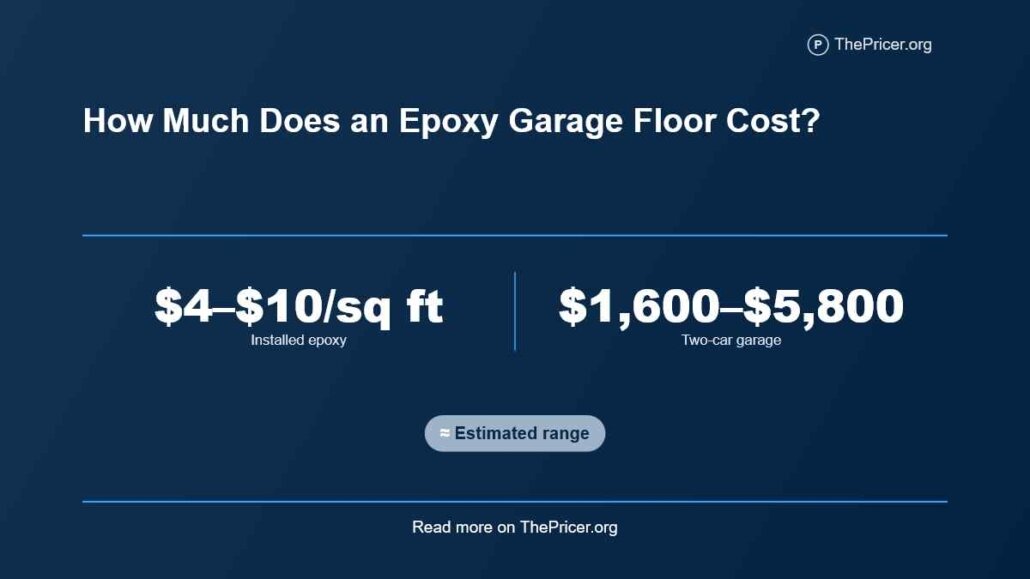
HomeGuide’s February 2026 epoxy flooring research reports average installed prices of $4 to $10 per square foot. Its data puts a two-car garage at $1,600 to $5,800, with larger areas and difficult concrete preparation raising the total.
Angi’s August 2026 flooring cost estimates give a broader $2 to $12 per square foot range. The wider spread reflects differences in resin type, installation conditions, and job scope rather than a contradiction about the cost of identical work.
| Garage Size | Typical Area | Professional Epoxy Cost |
|---|---|---|
| One-car | 288–392 sq ft | $1,200–$3,900 |
| Two-car | 400–576 sq ft | $1,600–$5,800 |
| Three-car | 576–864 sq ft | $2,300–$8,600 |
| Oversized, 1,000 sq ft | 1,000 sq ft | $4,000–$10,000 |
The first three rows reflect HomeGuide’s published garage-size estimates. The final row is calculated from its per-square-foot range, not a documented price for an actual oversized garage.
For comparison, a 500-square-foot garage costs approximately $2,000 to $5,000 at HomeGuide’s rate. A small floor with difficult access or heavy damage may cost more per square foot than a larger, unobstructed garage.
Regional contractor prices illustrate the difference between systems. Everclad Coatings advertises a complete hybrid coating installation at $8 per square foot, including grinding, repairs, decorative flakes, and a polyaspartic topcoat.
That is a published contractor offer for a particular system, not a national average for ordinary epoxy.
Epoxy, Polyurea, or Polyaspartic?
Epoxy is a resin-and-hardener coating that bonds to properly prepared concrete. Different formulations produce different thicknesses, working times, chemical resistance, and durability.
Water-based epoxy products are often used in homeowner kits. High-solids and 100%-solids epoxy systems can create thicker protective films but may require more demanding installation procedures.
Polyurea and polyaspartic systems use different chemistry. They are often selected for their rapid return-to-service characteristics and performance in sunlight-exposed garage entrances.
HomeGuide’s garage coating comparison distinguishes the installed prices:
- Epoxy coatings: $4–$10 per square foot.
- Polyurea coatings: $5–$10 per square foot.
- Polyaspartic coatings: $5–$12 per square foot.
Some contractors combine an epoxy base coat with decorative flakes and a polyaspartic topcoat. A customer may receive a quote described simply as an epoxy floor even though the finished system contains several materials.
At a selected 500-square-foot garage size, the published upper installed rates differ by $1,000: $5,000 for epoxy at $10 per square foot versus $6,000 for polyaspartic at $12 per square foot.
Those are range-end comparisons, not evidence that a polyaspartic installation always costs exactly 20% more. Actual estimates must cover the same preparation, thickness, decorative treatment, and warranty terms.
A separate polyurea garage floor cost comparison explores that alternative in greater detail.
How Much Do DIY Epoxy Kits Cost?
Basic retail epoxy kits can be much cheaper than hiring a contractor, provided the concrete is suitable and the homeowner can perform the preparation correctly.
Home Depot’s Rust-Oleum EpoxyShield garage kit was listed at approximately $185 for a 2.5-car package advertised to cover up to 500 square feet.
A smaller one-car EpoxyShield package has also been advertised at approximately $109 to $129, with stated coverage of up to 250 square feet on suitable concrete.
The manufacturer’s EpoxyShield product information confirms that the basic kit contains two-part epoxy, decorative color chips, concrete etch, and instructions.
That package is not equivalent to a professional installation including mechanical grinding, repairs, multiple coats, and a separate protective topcoat.
A DIY buyer may also need cleaning products, application tools, personal protective equipment, crack repair material, and a grinding-machine rental. Requirements depend on the slab and the coating manufacturer’s instructions.
The important hidden cost is insufficient coverage. The manufacturer’s instructions distinguish the maximum coverage on smooth concrete from lower coverage on rough or porous surfaces.
For a 500-square-foot garage, one kit advertised for 500 square feet leaves no allowance for reduced coverage. If the actual coverage were only 400 square feet, the homeowner would need another compatible kit or sufficient additional material.
That changes the purchase from one $185 kit to two, or $370, before any preparation expenses. The second-kit calculation is illustrative and assumes identical package pricing and no suitable smaller refill option.
It explains why buying exactly the advertised maximum coverage can create an unexpected expense.
Concrete Preparation and Moisture Costs
Preparation is often the decisive factor in whether an epoxy installation performs as intended. Oil, existing sealers, loose paint, dirt, moisture, and deteriorated concrete can interfere with adhesion.
Sherwin-Williams’ concrete surface preparation requirements explain the need to remove contaminants, assess moisture, and use a properly cured substrate. Its guidance includes a plastic-sheet moisture screening method and warns against coating unsuitable concrete.
Professional contractors may diamond-grind the slab, repair cracks, remove failed coatings, and evaluate moisture before applying the new system.
HomeGuide places extensive concrete resurfacing around $3 to $7 per square foot. That is a separate treatment for a more significantly damaged surface, not a compulsory charge on every epoxy job.
For a 500-square-foot garage, full resurfacing at those rates would cost $1,500 to $3,500. Adding it to a straightforward epoxy budget could substantially change the project.
The distinction between surface repair and underlying structural repair is important. A coating does not correct a moving slab, continuing settlement, or significant structural cracking.
For a slab with extensive deterioration, concrete repair and resurfacing costs provide useful context about surface treatments, although patio work and indoor garage coating are not identical projects.
A quote should specify whether ordinary grinding is included and identify any separately priced repairs. Charging for standard grinding twice would artificially inflate the project budget.
Flakes, Clear Coats, and Other Extras
Plain epoxy usually costs less than a decorative system with a full broadcast of colored flakes, multiple layers, and a protective clear topcoat.
The value of decorative flakes extends beyond appearance. They can help conceal minor visual imperfections, while the coating texture and optional traction additives can influence slip resistance.
Rust-Oleum’s Premium Clear Top Coating instructions describe an additional protective product suitable for coated concrete, including specific recoat conditions and a separate curing schedule.
A clear topcoat is not automatically included in a basic DIY color kit. Professional packages may include one as standard, making direct kit-to-contractor price comparisons misleading.
A Kissimmee, Florida contractor publishes installed flake-system pricing of approximately $6 to $10 per square foot for a system using a moisture-tolerant base and UV-stable polyaspartic topcoat.
That regional example shows why a quote advertised as epoxy may be a hybrid coating system. It also illustrates the importance of identifying the topcoat, rather than assuming all glossy finishes use the same chemistry.
Metallic effects, logos, multiple colors, moisture remediation, and extensive crack repairs can increase project costs. Their prices should come from the actual contractor’s itemized proposal, not a universal surcharge added to every floor.
A Complete Two-Car Garage Budget
Consider an illustrative 500-square-foot two-car garage with sound concrete that needs ordinary preparation, a basic epoxy coating, and minor crack repairs.
Assume the contractor quotes $6 per square foot for coating and ordinary grinding, within HomeGuide’s installed range. The written proposal excludes several localized repairs and a small allowance for moving heavy storage equipment.
- 500-square-foot epoxy installation at $6 per square foot: $3,000.
- Additional minor crack repairs, assumed: $180.
- Garage clearing and temporary storage allowance, assumed: $120.
- Illustrative completed project: $3,300.
The last two charges are planning assumptions, not published average fees. The base coating price is assumed to include normal surface preparation, materials, and labor, so those items are not charged again.
The exclusions add $300 to the $3,000 quote, increasing the project by 10%.
Suppose another contractor offers the same coating specification, repairs, and ordinary preparation for $3,200 with all the necessary work included. That higher-looking package would actually save $100 compared with the modeled itemized project.
The better comparison is therefore the completed scope, not the first advertised coating price.
The same garage might also receive a polyaspartic quote. At an illustrative installed rate of $8 per square foot, the coating price becomes $4,000. Whether the additional cost is justified depends on documented product performance, return-to-service time, and warranty coverage.
Epoxy Versus Other Garage Floors
Epoxy is not the only way to finish an existing garage slab. Polyurea, polyaspartic coatings, concrete sealers, polishing, and interlocking floor tiles provide different levels of protection and visual finish.
An independent 2026 coating price comparison reports installed epoxy around $3 to $8 per square foot and polyaspartic systems around $5 to $12 per square foot, reinforcing the importance of comparing like-for-like coating specifications.
HomeGuide’s published estimates place polished concrete at approximately $3 to $15 or more per square foot, depending on finishing complexity. Polishing changes the appearance of the concrete itself and is not the same as installing a resin coating.
Interlocking tiles avoid some liquid-coating preparation requirements and may be replaced individually, but their installation, expansion gaps, load rating, and cleaning requirements differ from epoxy.
A severely damaged slab might require replacement rather than decoration. The cost of garage demolition and concrete removal becomes relevant only if the concrete must actually be removed.
People choosing between a decorative garage floor and a new concrete surface should also compare the cost of concrete resurfacing, while recognizing that outdoor driveway work has different installation requirements.
Curing, Lifespan, and Maintenance

An epoxy floor needs sufficient curing time before it is subjected to vehicle traffic. The schedule changes according to product formulation, temperature, humidity, and the number of coating layers.
Rust-Oleum states that its EpoxyShield garage coating can generally handle walking after one to two days and vehicle traffic after three days under suitable conditions.
That instruction is product-specific. A high-solids professional system, an epoxy-plus-clearcoat installation, or a polyaspartic coating may require a different schedule.
HomeGuide describes service lives of approximately three to five years for some water-based epoxy products and ten to twenty years for properly installed solid epoxy, depending on traffic and exposure.
Those are estimates rather than guarantees. Preparation quality, moisture, ultraviolet exposure, tire traffic, spills, and cleaning practices affect the actual result.
The original article’s universal two-to-three-year resealing schedule is not supported across every coating system. Homeowners should follow the specific manufacturer and installer recommendations instead of routinely buying another topcoat.
Routine sweeping, appropriate cleaning, and prompt attention to damaged areas can help maintain appearance. Avoid strong chemicals not approved for the selected coating.
Makes sense if
- The existing concrete is structurally sound and can be prepared properly.
- Oil resistance, easier cleaning, and an improved finish are priorities.
- The chosen coating specification matches vehicle use and sunlight exposure.
- The quote includes appropriate preparation and documented return-to-service requirements.
Does not make sense if
- The slab has unresolved moisture problems or significant structural movement.
- The homeowner cannot keep the garage unused for the required curing period.
- The apparent low price excludes necessary repairs and preparation.
- A removable tile system or simpler concrete finish better serves the intended use.
What We Verified
- Compared current HomeGuide and Angi professional epoxy price ranges.
- Inspected Rust-Oleum product specifications, kit coverage, and curing instructions.
- Reviewed Sherwin-Williams guidance concerning concrete moisture and preparation.
- Compared published contractor prices for hybrid polyaspartic systems.
- Checked related ThePricer floor-coating, concrete, and garage articles.
- Separated actual advertised prices from assumptions in the worked budget.
Answers to Common Questions
How much does it cost to epoxy a two-car garage?
Professional epoxy coating generally costs $1,600 to $5,800 for a typical two-car garage, depending on size, concrete condition, and coating specification.
How much does a DIY epoxy garage kit cost?
Basic kits are available around $100 to $300, but actual costs rise when extra material, preparation tools, repairs, or a clear topcoat are needed.
Is epoxy cheaper than polyaspartic coating?
Usually upfront. Published professional epoxy ranges are approximately $4 to $10 per square foot, compared with $5 to $12 per square foot for polyaspartic systems. Matching the included work is essential.
How soon can a car park on a new epoxy floor?
Rust-Oleum recommends waiting three days for vehicle traffic on its EpoxyShield garage coating. Other systems have different curing instructions, and environmental conditions can affect the schedule.
Will epoxy fix cracks in a concrete garage floor?
No. Cracks and substrate defects need appropriate assessment and preparation. A surface coating does not correct structural movement, continuing settlement, or unresolved moisture problems.
Disclosure: Educational content, not financial advice. Prices reflect public information as of the dates cited and can change. Confirm current rates, fees, taxes, and terms with official sources before purchasing. See our methodology and corrections policy.