
How Much Does EV Home Charger Installation Cost?
Published on | Written by Alec Pow
This article was researched using 14 sources. See our methodology and corrections policy.
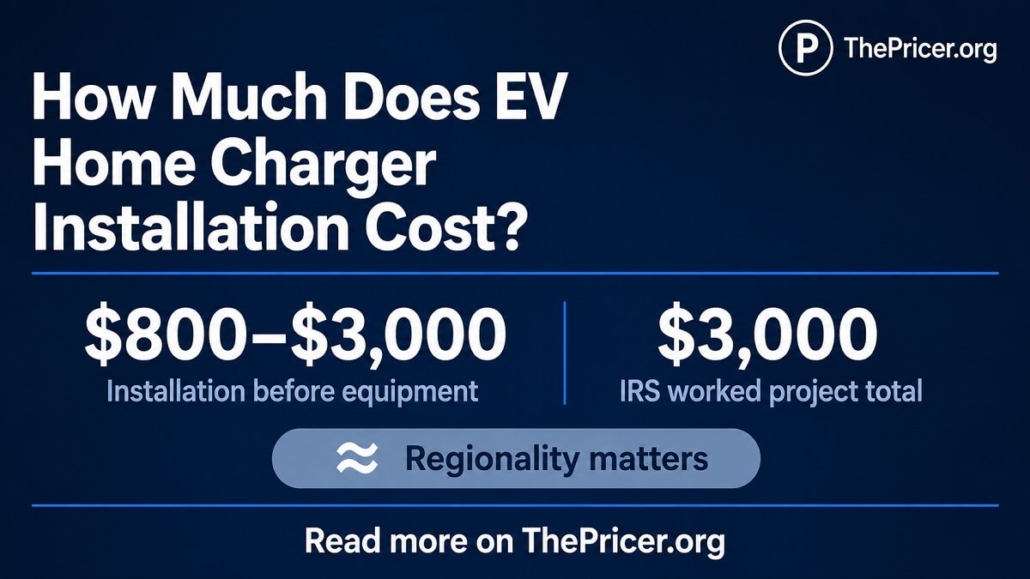
A residential Level 2 charging setup combines EVSE hardware such as the Tesla Wall Connector or ChargePoint Home Flex with a dedicated circuit, breaker, conductors, conduit, and a parking-space connection tied to the service panel. Qmerit, the U.S. Department of Energy Alternative Fuels Data Center, IRS Section 30C rules, NEMA receptacles, and NEC Article 625 each cover part of the job. In the U.S., installation before equipment runs $800 to $3,000, with the charger adding $100 to $800, according to EnergySage’s June 2026 U.S. installation figures.
The project total can include EVSE, breaker, wiring, conduit, mounting, permits, inspection, commissioning, and electrician labor. An exact quote needs the panel rating, circuit route, parking location, and wall or trench access because short garage and detached-garage jobs have different scopes.
EV home charger installation is priced per project, with labor and materials tied to panel capacity and the route from service equipment to parking. Hardwired equipment, plug-in equipment, trenching, and electrical upgrades change the scope even when the vehicle stays the same.
How Much Does EV Home Charger Installation Cost?
Jump to sections
- Installation before equipment can run $800 to $3,000 (at $30 per hour, earning that amount would take about 0.7 to 2.5 full-time workweeks, before taxes).
- Charger equipment can add $100 to $800.
- Home charging can run about $35 to $90 per month for many Tesla-driving scenarios.
What you’re buying
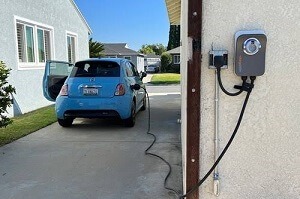
A home EV charger installation is the electrical work that connects charging equipment to the home’s distribution system and parking location. The electrician plans the branch circuit, selects conductors and overcurrent protection, mounts or connects the EVSE, and tests the finished setup. A purpose-built unit such as the Tesla Wall Connector is one version of that equipment, with published hardware specifications covering its charging hardware and installation, while a plug-in charger uses a compatible receptacle instead of a direct hardwired connection.
Level 1 charging is different because it can use an existing household outlet when the circuit and parking arrangement fit the vehicle’s needs. Public DC fast charging is different again because it relies on commercial-scale equipment away from the residence.
For a homeowner, the purchase is a permanent electrical connection plus charging hardware, not merely a cable hung on the garage wall. The equipment choice matters because connector style, charging output, indoor or outdoor placement, and plug-in versus hardwired installation shape the electrician’s scope. Tesla and ChargePoint publish installation instructions, but the home’s panel, circuit route, local code, and parking layout decide how much electrical work sits behind the charger.
Electrician labor, charger hardware
Qmerit’s March 2026 component figures list Level 2 hardware at $300 to $900 (about 1.3 to 3.8 full-time workdays at $30 per hour), electrician labor and permitting at $500 to $1,200, and conduit, wire, and breaker materials at $200 to $500 in its March 2026 component figures. Adding the published low ends gives $300 + $500 + $200 = $1,000. Adding the high ends gives $900 + $1,200 + $500 = $2,600 before added electrical-system work.
That split helps explain why buying a lower-priced charger does not guarantee a lower project bill. Copper conductors, conduit, a breaker, wall penetration, routing time, and permit handling remain even when the homeowner supplies the EVSE.
Plug-in installations can add a heavy-duty receptacle and related protection, while hardwired work takes the circuit directly into the charger. A separate look at 240V outlet installation pricing puts straightforward 2024-2025 projects around $250 to $800, with difficult runs and service work reaching $900 to $1,500+. A quote that looks expensive can be driven by cable routing and panel work rather than by the visible charging unit mounted near the car.
Short garage runs, long circuits
Distance changes the bill. A charger mounted near an accessible panel can keep conductor length, conduit, drilling, and electrician time relatively contained. Move the parking spot across a finished basement or to the far side of a garage and the electrician may need a longer feeder path, more fittings, wall access, surface raceway, or additional repair work after the circuit is installed. A detached garage creates another layer because the path may leave the house, cross soil or pavement, enter a second structure, and meet outdoor or underground wiring rules.
That can turn a charger project into a small electrical-construction job. The visible distance between the car and panel is not the full measurement either. Cable must follow a legal route through the building, and that route may need to avoid structural members, plumbing, ducts, finished ceilings, or locations where conduit cannot be protected. The cheapest charger location can be the one that shortens this electrical path, even if it is not the wall a driver first had in mind.
Quote comparisons become clearer when each contractor describes the route rather than giving one lump sum.
| Job condition | Electrical work that changes | Quote item to check |
|---|---|---|
| Panel beside parking | Short conductor and conduit path | Basic circuit labor |
| Finished interior route | More routing and wall access | Labor and restoration |
| Detached parking | Exterior or underground pathway | Trenching and raceway |
Three installation cases
Budget case. A close-panel garage with usable electrical capacity represents the lower-scope end of the market. The August 2026 installation range published by Angi places home EV charging-station installation around $550 to $1,400 (about 0.5 to 1.2 full-time workweeks at $30 per hour). The primary driver in this case is limited electrical work rather than charger features.
Mid-range case. A longer circuit route adds wire and labor even when the service panel can carry the load. A May 2026 electrician cost review from Angi reports an installation average of $963 and cites wiring distance as a major quote driver. The added expense comes from getting power to the parking spot.
High case. A home with inadequate panel capacity can move into another spending tier before the charger circuit is finished. Qmerit’s May 2026 installation scope puts replacement of an older panel at $1,300 to $3,000 in its May 2026 panel replacement figures. That panel work sits alongside the EV circuit and charging equipment, so electrical capacity becomes the primary driver.
Line items
The first quote may cover the dedicated circuit and charger mounting but leave other work outside its base scope. Angi’s July 2026 pricing lists panel upgrades at $800 to $2,000, added wiring at $500 to $1,500, permits around $100 to $200, weather protection around $50 to $200, and free-standing pedestals starting at $300 in a July 2026 installation price table.
Ask whether the written quote includes permit handling, inspection coordination, charger hardware, trenching, drywall repair, exterior sealing, and final commissioning. Those items are easy to miss when one contractor prices only the electrical circuit and another submits an all-in project figure. Restoration deserves its own line because an electrician may open a wall or ceiling without providing finish carpentry or paint. The same applies to concrete cutting and trench restoration. Separating these tasks keeps an apparent low bid from becoming expensive through change orders after work starts.
An itemized EV charger quote
In a worked residential charging example, the IRS says qualifying home property had to be placed in service by June 30, 2026 and itemizes $1,500 for EVSE including labor, $500 for a wall mount, and $1,000 for charger-dedicated panel, conduit, and wiring work, so $1,500 + $500 + $1,000 = $3,000, and 30% of $3,000 = $900.
That itemization is useful even for a project with no federal credit. It separates the charging equipment and labor from mounting hardware and electrical infrastructure, which makes competing bids easier to compare.
A homeowner can ask each electrician to identify the charger, branch-circuit materials, panel work, permit handling, and site preparation instead of accepting one bundled figure. It also exposes which part of the quote can disappear.
A house with adequate panel capacity does not need the charger-specific panel line from that example, and a homeowner who already owns compatible equipment does not need to purchase the EVSE through the electrician. The arithmetic also shows why a single headline installation figure can hide very different scopes.
Panel capacity, amperage
Panel space is not capacity. An empty breaker position does not by itself show that the electrical service can carry another sustained vehicle-charging load. The electrician needs to examine the service rating and household demand before selecting the charger circuit. Higher charging output can require a larger branch circuit, which raises conductor size and may expose a capacity problem that was not visible when the charger was purchased.
Panel work can become the dominant expense. A separate review of electrical panel upgrade pricing places many residential upgrades around $1,200 to $3,000 in 2025, with larger or more involved service changes going higher. That is why charger output should be matched to the vehicle, driving pattern, and electrical system rather than selected from the maximum number printed on the charger box. Load-management equipment can also be part of the electrician’s design when household capacity is constrained. It coordinates charging with other large loads instead of treating the EV as an isolated appliance. The quote should state whether the proposed solution changes the panel, changes the service, reduces charger output, or manages competing loads.
Permit rules, access
 Local rules change the administrative part of the job. The U.S. Department of Energy’s Alternative Fuels Data Center directs installers and property owners to account for permitting, site preparation, utility coordination, and electrical construction through its infrastructure planning guidance. A contractor familiar with the local authority can state which permit is required, who files it, and whether inspection is included in the quoted fee.
Physical access changes labor too. Open garage framing gives an electrician a different job from a finished basement route, masonry wall, exterior raceway, or detached structure. Quote requests should identify the charger model, parking location, panel location, planned charging output, route distance, wall conditions, and any trenching. That gives competing electricians the same scope and makes change-order differences easier to spot.
Who this cost makes sense for
A permanent charger is easier to justify when the vehicle returns to the same parking space each night and ordinary household charging cannot restore enough driving range before the next trip. Daily mileage matters. So does access to workplace charging. A driver with reliable charging at work may get less value from a new garage circuit than someone who depends on the home as the main charging location.
Running costs also shape the decision. A current look at Tesla home charging costs places many home-charging months around $35 to $90 as of July 2026, so the installation should be judged against how often the owner expects to use that home electricity rather than against charger hardware alone.
Makes sense if
- The EV is parked at the residence on a regular basis.
- Level 1 charging does not replace the driver’s normal mileage.
- The parking spot has a workable path back to the service panel.
- The owner expects to keep charging at the property for several years.
Doesn’t make sense if
- Existing Level 1 charging already covers daily driving.
- Workplace charging handles the bulk of charging needs.
- The residence is temporary and permanent electrical work is restricted.
- Remote parking would require major construction for limited charging use.
Answers to Common Questions
Do I need a Level 2 charger at home?
Not in every case. Level 1 can suit lower daily mileage, especially when the vehicle remains parked long enough between trips.
Is hardwiring cheaper than installing an outlet?
Either approach can cost less depending on the existing circuit, local code, charger design, receptacle requirements, and electrician labor.
Can an EV charger require a new electrical panel?
Yes. A charger can expose a household capacity constraint, but the electrician’s load calculation determines whether panel or service work is needed.
Why do two charger installation quotes differ so much?
Compare circuit length, conductor size, panel work, permit handling, trenching, restoration, charger hardware, and final testing line by line.
Disclosure: Educational content, not financial advice. Prices reflect public information as of the dates cited and can change. Confirm current rates, fees, taxes, and terms with official sources before purchasing. See our methodology and corrections policy.