
How Much Does Event Barricade Rental Cost?
Published on | Written by Alec Pow
This article was researched using 13 sources. See our methodology and corrections policy.
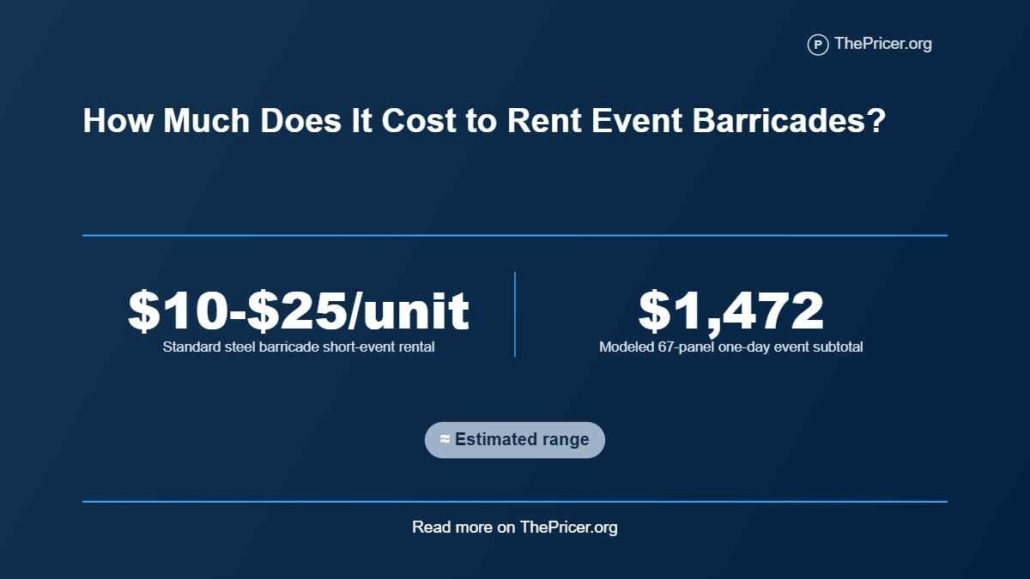
Renting a standard steel event barricade in the U.S. usually costs about $10 to $25 per unit for a short event before delivery, setup, pickup, taxes, damage waivers, and special scheduling. An August 2026 pricing guide places crowd-control barricades at that level per rental, while current commercial listings reviewed below sit near the middle of the range. For a small private event, the barricades alone may cost a few hundred dollars, but transport and service charges can materially raise the delivered total.
Event barricade pricing depends on barrier type, panel length, quantity, rental period, delivery radius, setup labor, and event scope. Steel pedestrian barricades, crowd-control barriers, bike-rack barricades, temporary chain-link fencing, stanchions, and water-filled traffic barriers are separate rental categories.
Published figures from Kelly Rentals, Arrogantly Shabby Event Rentals, Pink Gorilla Events, Epic Crowd Control, Cal Expo, the City of Bellevue, and San Francisco Public Works show why an organizer should compare the same equipment and service package rather than treat every barricade quote as interchangeable.
A staffed street closure or parade can move into the thousands because the quote may cover transport, traffic-control equipment, staging windows, and a much larger route. This article focuses on movable steel pedestrian barricades and uses public-event figures only to show how route-scale work differs from an equipment-only order.
Article Highlights
Jump to sections
- Standard steel pedestrian barricades often rent for about $10 to $25 (at $30 per hour, earning that amount would take about 20 to 50 minutes, before taxes) each for a short event.
- Current commercial listings reviewed for this guide include $18 and $18.50 daily rates.
- Delivery can rival the equipment charge on a very small order.
- Multi-day pricing may be far cheaper than multiplying the first-day rate.
- Street-closure barricade budgets can reach several thousand dollars because they cover a different scope.
How Much Does Event Barricade Rental Cost?
Current published offers show a fairly tight band for basic steel barricades, while venue-controlled inventory and public-event estimates can sit far outside that band. The table keeps unlike quote types separate rather than blending them into one national average.
| Provider or schedule | Published price | What the figure covers |
|---|---|---|
| Kelly Rentals | $18.50 (about 37 minutes at $30 per hour) per day per item | 7-foot galvanized steel barricade. The current listing excludes tax, delivery, damage waiver, and other fees. |
| Arrogantly Shabby Event Rentals | $18 per day per item | 8.5-foot steel barricade. Its current listing shows a standard $170 delivery fee, a mandatory damage waiver, and a 20% labor fee for loading, unloading, and transportation. |
| Pink Gorilla Events | $16 per panel | 9.5-foot crowd-control fence. The equipment sheet lists a $1,000 minimum and $2.50 per panel for each added day without moving. |
| City of Bellevue, Main Street | $1,550 to $2,570 | The city’s 2026 plan gives this starting barricade-rental range for a Main Street festival or street closure. |
The table shows why a quote must carry its unit and scope. The first three entries describe equipment rental structures. Bellevue’s figure is a route-level event estimate tied to a planned street closure. Dividing that municipal total by a retail panel rate would create a false unit comparison.
What Counts as an Event Barricade?
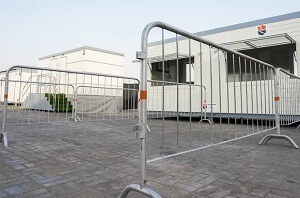
The central product here is an interlocking steel pedestrian barricade, often called a crowd-control or bike-rack barricade. Common event models are about 7 to 9.5 feet long and roughly 3.5 to 4 feet high. They create queue lanes, spectator lines, parade edges, entry channels, and temporary separations around event spaces. The units connect in sequence and are built for repeated setup and removal.
That product is not the same as a temporary chain-link perimeter, a retractable stanchion, or a water-filled traffic barrier. A chain-link rental is often quoted by linear foot and month, while a steel event barricade is commonly quoted per item and per day or event. Readers who need a secure temporary perimeter should compare temporary fence rental costs instead of treating the two products as interchangeable.
The distinction matters because a short crowd line can use movable steel rails with little site work, while a street closure may require traffic-control devices, police coordination, route plans, and timed deployment. A low per-panel rate is useful only after the organizer confirms which barrier is allowed for the intended use.
Delivery and Service Charges
Delivery is the first place a cheap unit rate can lose its advantage. Kelly states that normal delivery starts at $110 (about 3.7 hours of work at $30 per hour) for locations within 20 miles of one of its nearest locations. Because its base barricade rate is $18.50, six barricades cost $111 before delivery. Adding the starting delivery charge creates a known subtotal of $221. Delivery is about 49.8% of that subtotal.
The same calculation changes at 20 barricades. Equipment is $370, and the same starting delivery charge produces $480 before tax, damage waiver, and any other unpriced charges. Delivery then accounts for about 22.9% of the known subtotal. This is a ThePricer calculation from Kelly’s published rate and delivery minimum, not a national market average. The break-even quantity is about six barricades because $110 divided by $18.50 is 5.95.
Other suppliers use different structures. A labor percentage, mandatory damage waiver, parking charge, early-morning delivery, or fixed setup and teardown price can move the total without changing the barricade rate. Small orders should be compared by delivered subtotal rather than the cheapest panel number. Ask each vendor to state equipment, transport, setup, strike, pickup, waiver, tax, and after-hours charges separately.
How Quantity Changes Cost
Quantity starts with the length of the barricade line, not the guest count alone. Epic Crowd Control says common steel units are 7 or 8.5 feet long and recommends dividing the required footage by barricade length, then adding 10% to 15% for corners, gate openings, and adjustments. The same page gives a steel rental range of $8 to $25 per unit per day.
Using that method, a straight 200-foot line built with 8.5-foot barricades starts at about 24 units before the adjustment. Adding three units for layout changes brings the working quantity to 27. At a planning rate of $10 to $25 each, the equipment-only range would be $270 to $675. That scenario uses the article’s planning range, not a quoted bid, and it excludes delivery and service charges.
Curves, separate entry lanes, gaps for access, stage pits, and route intersections can all increase the count. A venue may also specify its own layout or product. Measure every independent run on the site plan, then request the same quantity and same rental dates from each bidder. That makes a unit-price comparison far more useful.
One-Day vs Multi-Day Rentals
Daily pricing does not always scale by simple multiplication. Pink Gorilla’s sheet lists $16 per panel, an extra-day charge of $2.50 per panel when the fence is not moved, and fixed delivery, setup, and teardown charges of $400 for a one-day weekend or $500 for a two-day weekend. The sheet also pairs its $1,000 minimum with 67 panels, even though 67 times $16 equals $1,072. A buyer should ask which figure controls the quote.
Using the posted per-panel rate for a reproducible 67-panel scenario, one weekend day costs $1,472 before any mileage or hotel charge. The math is 67 times $16, plus the $400 service fee. Two days cost $1,739.50 after adding 67 times $2.50 and using the $500 two-day service fee. The second day raises the known subtotal by only $267.50, or about 18.2%.
That two-day result equals about $12.98 per panel-day. Duration can work in your favor. A weekend event should ask for the actual extension rate instead of multiplying a one-day quote by two. The saving can be substantial when transport and placement are already covered on the first day.
Real Event Cost Examples
 A small local order can be delivery-heavy. Using Kelly’s published figures, six barricades create a known subtotal of $221 before tax, damage waiver, and any other charge. At 20 units, the known subtotal rises to $480. The item price barely changes, but the fixed delivery component becomes less dominant as the order grows.
A medium festival can look very different. The 67-panel Pink Gorilla scenario produces a one-day weekend subtotal of $1,472. The itemized total is $1,072 for 67 panels at $16 each plus $400 for delivery, setup, and teardown. Mileage beyond 50 miles, hotel charges if needed, and any unlisted taxes remain outside that number. This is an illustrative calculation using published rates, not a customer invoice.
Large public events occupy another pricing class. Bellevue’s 2026 Crossroads parade plan gives a barricade-rental range of $2,000 to $3,350 for the route. San Francisco Public Works budgeted $297,000 for barricade rental across an estimated 33 police events, and its budget submission states an average rental cost of $9,000 per event. Those are public-event program figures, not evidence that a standard steel barricade costs thousands of dollars.
How to Compare Quotes
Start with one written scope that every bidder receives. State the barricade type, panel length if known, quantity, event date, delivery address, setup window, strike window, and whether staff must place or move the units. Ask whether the quoted rental period ends at a fixed time or covers the entire event day. A quote that omits those details may look cheaper while covering less work.
Then separate the invoice into equipment and logistics. Check delivery, pickup, labor, damage waiver, deposit, tax, parking, mileage, minimum order, and after-hours service. A current temporary-fence checklist calls for matched scope and dates alongside delivery, installation, and liability terms. The method transfers cleanly to steel barricade bids.
That difference matters on small orders. If one vendor charges a lower panel rate but has a large fixed truck fee, another supplier can be cheaper at ten units and more expensive at fifty. The quote should also identify replacement or damage terms. If the venue or municipality supplies inventory, compare that schedule with commercial delivered pricing before renting from outside.
Rent or Use Another Barrier?
Steel pedestrian barricades fit events that need movable crowd lines, queue control, spectator separation, or short route segments. They are less suitable when the real need is a secure overnight perimeter or vehicle traffic control. Temporary chain-link fencing, stanchions, and traffic-control devices solve different problems and should be priced as separate systems.
Events with security staffing may also need a broader budget. A campus event security plan can include guards, screening equipment, medical coverage, insurance, and other items beyond barricades. Keeping those costs separate prevents a crowd-control rental line from being mistaken for the full event-security budget.
Makes sense if
- You need steel barricades for one event or a few dates each year.
- Your quantity changes from one venue or route to another.
- You do not want to store, transport, inspect, and inventory the equipment.
- A rental vendor can meet the event’s load-in and strike windows.
Does not make sense if
- The venue already supplies enough compatible barricades.
- You actually need a locked or taller perimeter.
- The traffic plan requires a different approved device.
- Frequent reuse plus owned transport and storage makes purchase worth pricing separately.
Answers to Common Questions
How much is one event barricade to rent?
A standard steel pedestrian barricade often costs about $10 to $25 for a short event rental before delivery and service charges.
How much would 20 barricades cost?
At $10 to $25 each, 20 barricades produce an equipment-only planning range of $200 to $500. Delivery, setup, pickup, waiver, and tax can raise the total.
Is delivery included in the barricade rate?
Often it is separate. Published suppliers reviewed here use fixed delivery charges, labor percentages, or combined delivery and setup fees, so the quote should state the service scope.
Are two-day rentals twice the one-day price?
Not always. Some suppliers use a much lower extra-day rate, which can make a two-day event cost only modestly more than a one-day rental.
Are street-closure barricades priced the same way?
No. A street-closure estimate can include a larger route and traffic-control scope, so a municipal event total should not be treated as a per-panel retail rate.
Disclosure: Educational content, not financial advice. Prices reflect public information as of the dates cited and can change. Confirm current rates, fees, taxes, and terms with official sources before purchasing. See our methodology and corrections policy.