
How Much Does FARXIGA Cost?
Published on | Written by Alec Pow
This article was researched using 13 sources. See our methodology and corrections policy.
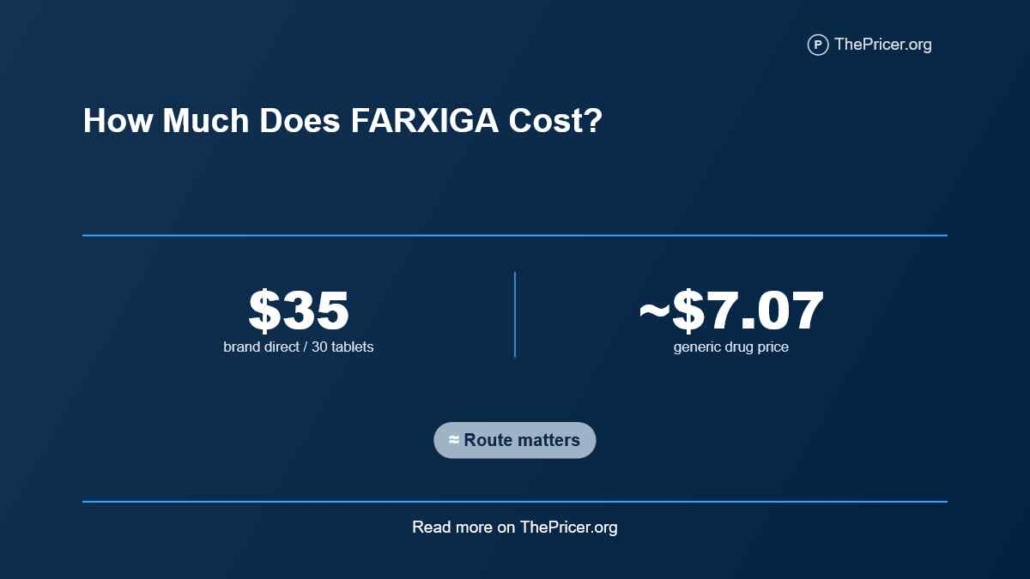
FARXIGA can cost anywhere from $0 to about $377 for 30 tablets in the United States in 2026, depending on how the prescription is paid for. AstraZeneca now offers eligible patients brand-name FARXIGA for $35 per 30 tablets through its direct program.
Medicare’s negotiated 2026 price is $178.50 per 30-day supply, while FDA-approved generic dapagliflozin entered the market in April and one current cash channel lists the drug itself at about $7.07 before shipping or other checkout charges.
The price gap is unusually wide because several things changed in the same year. FARXIGA’s U.S. list price was cut, Medicare’s negotiated price took effect, multiple generics were approved, and AstraZeneca expanded direct-to-patient pricing. A cash-paying patient who goes to the wrong channel can still see a bill near $377, while another patient filling the same active ingredient can spend a tiny fraction of that amount.
Article Highlights
Jump to sections
- Brand-name FARXIGA sells for about $377 (at $30 per hour, earning that amount would take about 1.6 full-time workdays, before taxes) for 30 tablets at some cash pharmacies.
- AstraZeneca Direct lists brand-name FARXIGA at $35 per 30 tablets for eligible patients.
- Medicare’s negotiated 2026 price is $178.50 per 30-day supply, although that is not automatically the patient’s copay.
- FDA approved multiple generic dapagliflozin products in April 2026.
- One current generic cash channel lists dapagliflozin at about $7.07 for the drug before checkout extras.
- AstraZeneca’s savings card can reduce eligible commercial-insurance fills to as little as $0, but the monthly benefit has a $175 ceiling.
How Much Does FARXIGA Cost?
The most useful price answer is a range by payment route rather than one national average. Drugs.com currently lists both 5 mg and 10 mg brand-name FARXIGA from about $376.95 (about 1.6 full-time workdays at $30 per hour) for 30 tablets for cash-paying customers. The current retail cash listing also shows about $1,115.06 for 90 tablets. Pharmacy prices can change, and insurance claims use a different set of negotiated rates.
AstraZeneca has created a far lower direct route. Its FARXIGA home-delivery program says eligible patients may buy 30 tablets for $35. That is about $342 below the current $376.95 cash benchmark, a reduction of roughly 90.7%. Twelve monthly fills at $35 total $420 per year, compared with about $4,523.40 if someone repeatedly paid $376.95 for 30 tablets.
| FARXIGA payment route | Current price signal | What it means |
|---|---|---|
| Retail cash, brand | About $376.95 / 30 tablets | Cash pharmacy benchmark |
| AstraZeneca Direct, brand | $35 / 30 tablets | Eligible direct-purchase patients |
| Commercial savings card | As low as $0 | Maximum monthly savings applies |
| Medicare negotiated price | $178.50 / 30-day supply | 2026 Maximum Fair Price, not a guaranteed copay |
| Generic dapagliflozin | About $7.07 drug price | Current Cost Plus listing before checkout extras |
Generic Dapagliflozin
The biggest 2026 price change came from generic entry. On April 6, the FDA approved multiple dapagliflozin tablets referencing FARXIGA, with several manufacturers receiving approvals for 5 mg and 10 mg strengths. The FDA generic approval notice confirms that generic competition entered the U.S. market this year.
Cash pricing can now be dramatically lower than the brand. Mark Cuban Cost Plus Drugs currently lists dapagliflozin propanediol, generic for FARXIGA, at a $7.07 drug price on its heart-failure medication page. Shipping, taxes, and checkout charges can raise the final amount, so $7.07 should not be treated as a universal delivered price.
The difference is still striking. Compared with the $376.95 (about 1.6 full-time workdays at $30 per hour) brand cash benchmark, a $7.07 generic drug price is about 98.1% lower. Twelve fills at that drug price total only $84.84 before shipping and taxes. That is roughly $4,438.56 less per year than twelve brand cash fills at $376.95.
Generic substitution depends on the prescription, pharmacy stock, insurance formulary, and the patient’s clinical situation. A pharmacist or prescriber can confirm whether a specific generic product can be dispensed for a given prescription. The price comparison is financial, not a recommendation to change treatment on your own.
Medicare Pricing in 2026
FARXIGA was one of the first drugs selected for Medicare price negotiation. CMS set the 2026 Maximum Fair Price at $178.50 for a 30-day equivalent supply, compared with a 2023 list-price benchmark of $556. The CMS negotiated-price table describes that as a 68% reduction from the older list-price benchmark and lists Jardiance at $197 for a 30-day equivalent supply.
The $178.50 number is not a promise that every Medicare beneficiary pays $178.50 at the pharmacy. Part D plans apply their own benefit design, deductible rules, copays, and coinsurance subject to federal requirements. Under the defined standard 2026 Part D benefit, covered drug costs can include a deductible of up to $615 and 25% cost sharing in the initial coverage stage. The 2026 Part D cost rules also cap annual out-of-pocket spending on covered Part D drugs at $2,100.
Twenty-five percent of the $178.50 negotiated price is about $44.63. That is a useful standard-benefit illustration after the deductible, but an actual FARXIGA copay can be different. Plan formularies, Extra Help, deductible status, and enhanced benefits can all change the amount collected at the pharmacy.
The Medicare price also now sits above some cash routes. $178.50 is about 5.1 times the $35 AstraZeneca Direct price and more than 25 times the $7.07 generic drug-price listing. Those channels have different eligibility and billing rules, so they should not be treated as interchangeable offers for the same person.
How the Savings Card Works
AstraZeneca advertises brand-name FARXIGA for as little as $0 per month for eligible commercially insured patients. The current savings-card terms set a maximum benefit of $175 per 30-day supply. The offer is not available to patients enrolled in Medicare Part D, Medicaid, VA, Department of Defense programs, TRICARE, and several other government-funded coverage arrangements.
The monthly ceiling matters. A commercially insured patient whose plan leaves a $250 responsibility would not automatically pay $0. Applying the maximum $175 card benefit leaves $75. Someone with a $100 eligible responsibility could potentially reach $0, subject to the program terms.
If a patient could use the full $175 benefit on every monthly fill for a year, the theoretical maximum card assistance would be $2,100. That is a program ceiling calculation, not a promised annual payment. Actual savings depend on the patient’s eligible responsibility at each fill and on the program remaining available under its terms.
The cash-pay rule is different. AstraZeneca says it will pay up to the first $150 for an eligible cash prescription, with the patient responsible for the balance. Applied to the current $376.95 retail benchmark, that would leave about $226.95. That is far above the $35 direct-purchase route, which shows why the phrase “use a coupon” is not enough. The payment channel itself can change the bill by hundreds of dollars.
Brand Cash Prices
 Generic entry and direct pricing did not erase high retail cash prices overnight. Drugs.com still shows brand-name FARXIGA at about $376.95 for 30 tablets. That matters because a patient who pays the ordinary cash counter price can spend more than ten times AstraZeneca Direct’s $35 rate without changing the active ingredient or monthly quantity. The spread is a distribution and eligibility problem as much as a drug-price problem.
FARXIGA’s brand economics changed before generic launch as well. AstraZeneca told Maryland’s Prescription Drug Affordability Board that the product’s U.S. wholesale acquisition cost was reduced by 37% effective January 1, 2026. The company’s pricing submission argued that generic competition would create further price erosion during 2026.
This is why older articles that still quote a $500 to $600 monthly list price can be badly misleading in late 2026. Some retail cash channels remain expensive, but the current market also contains a $35 brand direct route and low-cost generic channels.
FARXIGA vs Jardiance
Jardiance is another SGLT2 inhibitor used across diabetes, heart failure, and chronic kidney disease, although indications and individual suitability are not identical. Medicare’s 2026 negotiated prices put FARXIGA at $178.50 per 30-day equivalent supply and Jardiance at $197. On that narrow benchmark, FARXIGA is $18.50, or about 9.4%, lower.
That comparison changes once the payment channel changes. FARXIGA’s $35 direct price is much lower than either Medicare negotiated benchmark, and generic dapagliflozin can be cheaper again. A person with strong insurance coverage for Jardiance may face the opposite result at the pharmacy. Coverage tier, prior authorization, copay structure, and generic preference can outweigh the headline difference.
Readers comparing the class can use the separate Jardiance cost breakdown for its own payment routes and assistance rules. Insulin is another diabetes cost category with different federal caps and dosing economics, covered in the current insulin cost guide. A clinician still has to decide whether two drugs are reasonable alternatives for the condition being treated. A cheaper number does not establish medical equivalence or the same coverage rules for every patient.
Three Realistic Monthly Budgets
Direct brand scenario. An eligible patient uses AstraZeneca Direct and pays $35 for 30 tablets. Twelve identical fills would total $420 for the year before any outside medical costs. This is the cleanest low-cost brand scenario found in the current market.
Generic cash scenario. A patient with a prescription that can be filled as generic dapagliflozin uses a cash channel listing the drug at $7.07. Twelve drug-price fills total $84.84. Shipping, taxes, and order fees can raise the delivered total, so this is a medication-price calculation rather than a guaranteed annual checkout bill.
Retail brand scenario. A cash-paying patient fills brand FARXIGA at $376.95 and uses AstraZeneca’s cash savings benefit of up to $150. The modeled balance is $226.95 for that month. Twelve identical fills would equal $2,723.40. The same person may find the $35 direct route far cheaper if eligible.
Worked annual comparison. Twelve retail brand fills at $376.95 total $4,523.40. Twelve AstraZeneca Direct fills at $35 total $420. The difference is $4,103.40 per year. Against the $7.07 generic drug price, the annual difference reaches $4,438.56 before generic shipping and checkout charges.
What Changes The Bill
The prescription strength does not necessarily create the biggest price swing. Current brand cash listings put both 5 mg and 10 mg tablets near $376.95 for 30 tablets. Payment route matters much more. Commercial insurance, Medicare Part D, direct cash purchase, a discount pharmacy, and generic substitution can produce radically different totals for a once-daily medicine.
Quantity can move the unit price a little even when the monthly route stays the same. The same cash listing shows $1,115.06 for 90 brand tablets, or about $12.39 per tablet, compared with roughly $12.57 per tablet in the 30-count fill. That 90-day discount is modest beside the gap created by direct or generic purchasing.
Insurance can also create non-price barriers. A plan may require prior authorization, impose quantity limits, or prefer generic dapagliflozin. A prescription written explicitly for brand FARXIGA can be handled differently from one that permits generic substitution. The FARXIGA brand-use guidance tells patients who want the brand to discuss “Dispense as Written” with their prescriber now that multiple generics exist.
FARXIGA is used for several conditions, which can affect coverage rules. The current FDA-approved prescribing information includes uses involving type 2 diabetes, chronic kidney disease, and heart failure. It also carries warnings involving ketoacidosis, volume depletion, and genitourinary infections. A price difference is not a reason to start, stop, split, or switch a prescription without the clinician managing the treatment.
Compare the Cheapest Route
The lowest displayed number is not automatically the lowest usable number. Match the exact drug, strength, quantity, prescription wording, and insurance status before comparing offers. Someone with commercial coverage may get a very low brand copay through the savings card. An uninsured person may be better served by the $35 direct brand route or a low-cost generic. A Medicare beneficiary has different rules because the manufacturer savings card is not available for Part D fills.
Makes sense to check
- Whether the prescription permits generic dapagliflozin.
- Whether AstraZeneca Direct accepts the patient’s payment and eligibility route.
- Whether a commercial savings card beats the normal insurance copay.
- Whether a Part D plan prefers the brand or generic and applies prior authorization.
Does not make sense
- Assuming the Medicare $178.50 negotiated price is the patient’s exact copay.
- Assuming an advertised $0 card has no monthly benefit limit.
- Paying a $376.95 cash benchmark without checking direct and generic channels.
- Changing therapy based only on price without confirming clinical suitability.
Patients dealing with kidney disease may also face much larger treatment expenses outside the prescription itself. The cost difference is visible in current dialysis treatment pricing, where recurring medical services operate on a completely different scale from a monthly tablet prescription.
What we verified
- Checked the FDA first-generic list and confirmed multiple dapagliflozin approvals dated April 6, 2026.
- Confirmed through the current CMS drug list that FARXIGA remains subject to its 2026 negotiated price and is not among the listed deselection determinations.
- Cross-referenced AstraZeneca’s 2026 financial filing, which says multiple U.S. generics launched in the second quarter and U.S. FARXIGA revenue fell 17% in the first half of 2026.
Answers to Common Questions
How much does FARXIGA cost without insurance?
Brand-name FARXIGA is currently listed around $376.95 for 30 tablets at some cash pharmacies. Eligible direct-purchase patients may pay $35, and generic dapagliflozin can be much cheaper.
Is there a generic for FARXIGA?
Yes. The FDA approved multiple generic dapagliflozin tablets in April 2026, and generic products are now appearing in U.S. cash channels.
How much is FARXIGA with Medicare in 2026?
CMS set a negotiated price of $178.50 per 30-day equivalent supply. A beneficiary’s actual out-of-pocket amount depends on the Part D plan, deductible status, copay or coinsurance, and other assistance.
Can FARXIGA really cost $0?
Eligible commercially insured patients may pay as little as $0 with AstraZeneca’s savings card. The current benefit is capped at $175 per 30-day supply, so some patients can still owe a balance.
How much is FARXIGA through AstraZeneca Direct?
The current direct-purchase page lists brand-name FARXIGA at $35 per 30 tablets for eligible patients.
Disclosure: Educational content, not medical advice. Pricing varies by provider, location, and insurance. Confirm eligibility, coverage, and out-of-pocket costs with a licensed clinician and your insurer. See our methodology and corrections policy.