
How Much Does Foundation Repair Cost?
Updated on | Researched and reviewed by Alec Pow, Founder & Pricing Investigator
Prices, claims, and calculations checked against 12 cited sources. See our research methodology and corrections policy.
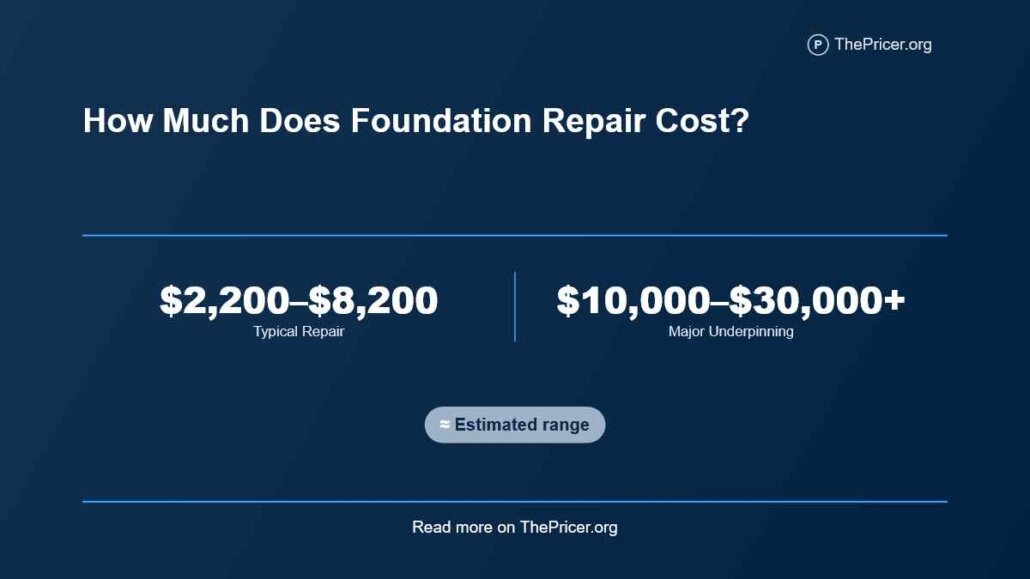
Foundation repair typically costs about $2,200 to $8,200 for a residential project in the United States, with national cost guides reporting averages around $5,000 to $5,200. A localized crack may cost $250 to $800 to repair, while stabilizing a sinking foundation with multiple piers can cost $10,000 to $30,000 or more. Extensive lifting or foundation replacement can exceed $50,000.
The repair method matters more than the home’s square footage alone. A damp basement, a bowed wall and a sinking foundation can produce similar warning signs but require substantially different work. The most useful estimate identifies the cause of movement, the portion of the structure affected and the repair needed to restore stability.
Article Highlights
Jump to sections
- Current national cost guides place many foundation repairs around $2,200 to $8,200, with averages near $5,200.
- Crack injection commonly costs $250 to $800 per crack when the repair is suitable for the damage.
- Foundation piers commonly cost $1,000 to $3,000 each, making the required number of supports a major budget variable.
- A structural engineer’s foundation inspection typically costs approximately $300 to $750.
- Waterproofing, drainage, excavation and restoration may be separate from the structural repair quote.
- Water stains, wall bowing and settlement require different diagnoses. Sealing a crack does not necessarily correct the underlying problem.
How Much Does Foundation Repair Cost?
Recent Angi foundation repair pricing reports an average of approximately $5,175, with many projects falling between $2,225 and $8,133. These figures describe broad residential repair costs, not a quote for a specific method.
The following price ranges show why identifying the work is more useful than relying on a national average.
| Repair method | Planning cost | Typical application |
|---|---|---|
| Epoxy injection or crack stitching | $250–$800 per crack | Selected concrete cracks |
| Localized slab leveling | $500–$1,300 for some small jobs | Limited concrete settlement |
| Foundation leveling | $1,000–$10,000 | Level correction, depending on method |
| Steel or helical piers | $1,000–$3,000 per pier | Supporting a settling foundation |
| Structural wall reinforcement | $4,000–$12,000 | Selected bowed or weakened walls |
| Foundation underpinning | $10,000–$30,000+ | Multiple supports beneath a structure |
| House lifting and foundation replacement | $20,000–$100,000 | Major structural reconstruction |
These are published planning ranges, primarily drawn from HomeGuide’s 2026 repair-method comparisons. They are not interchangeable treatments. For example, a low-cost slab-lifting project does not establish the price of lifting an entire house.
There is also a difference between leveling a detached concrete surface and stabilizing a load-bearing foundation. Although both may involve lifting settled concrete, the required engineering, equipment and structural responsibilities differ.
Foundation replacement is generally considered when deterioration or instability cannot reasonably be addressed with localized repairs. It is not the normal outcome for a small crack.
Cracks, Settlement and Bowing
The visible symptom often determines which investigation comes first. A narrow, stable crack is not automatically evidence of structural failure. Conversely, a crack that continues to widen, separates building materials or accompanies significant movement should not simply be covered with sealant.
Crack repair. Epoxy injection may bond suitable concrete cracks, while polyurethane injection is often selected for certain water-sealing applications. A contractor must establish whether the crack is active and whether the wall is structurally sound. The 2026 Fixr foundation repair guide distinguishes minor sealing work from stabilization that may reach tens of thousands of dollars.
Settlement. When sections of a foundation move downward because supporting soil no longer provides adequate support, underpinning may be recommended. Push piers and helical piers transfer structural loads to suitable supporting soil or bearing layers. Their design and suitability depend on load requirements and site conditions.
Bowing walls. A basement wall moving inward may need anchors, steel bracing, carbon fiber reinforcement or more substantial reconstruction. Current Angi bowing-wall estimates place many such repairs between $500 and $10,000, with an approximate $4,500 average. More complex repairs can exceed that band.
Carbon fiber straps typically restrain further movement rather than restore a severely displaced wall to its original position. Where straightening is feasible, it can require additional excavation and work.
Homeowners with concrete block basement walls should also compare the methods described in our block foundation repair cost article. Mortar-joint cracking, wall movement and water infiltration may require different combinations of repair methods.
What Pier Installation Costs
Piers are one of the largest sources of variation in foundation repair bids. The old assumption that a steel push pier can generally be installed for only a few hundred dollars is too low for many current projects.
Current published estimates commonly place foundation piers around $1,000 to $3,000 each, depending on the system and project. The per-pier figure may be different from a complete underpinning quotation, which also accounts for the site’s conditions and the overall work.
The number of piers is important. A foundation requiring four supports is a different project from one requiring twelve. The spacing and locations should follow the structural design rather than a homeowner’s preferred spending limit.
Consider a house that requires eight piers at an illustrative installed price of $2,000 each.
- Eight piers: $16,000
- Engineering inspection allowance: $600
- Drainage and grading allowance, if required: $2,000
- Illustrative total: $18,600
The pier rate is within the published market band. The engineering and drainage allowances are scenario inputs, not a contractor’s actual quote. The total excludes any separately charged permits, extensive excavation, finish repairs and unexpected site conditions.
There is a significant quantity effect. If engineering determines that twelve rather than eight piers are necessary, the additional four piers cost another $8,000 at the same assumed rate. That would raise the modeled total to $26,600 before any related changes in excavation or restoration.
For raised foundations, the distinction between repairing individual supports, replacing beams and underpinning the structure is particularly important. HomeGuide’s pier-and-beam repair data discusses these separate tasks and the additional labor involved when support locations are difficult to access. The cost of building an entirely new pier and beam foundation should not be used as a direct estimate of a repair.
Bowed Wall Repair Costs
A bowed basement wall can often be stabilized without replacing the entire foundation, although the appropriate method depends on the wall’s condition and the direction and extent of movement.
For a 20-foot affected section, HomeGuide’s bowed-wall cost comparison lists the following installed planning ranges.
- Wall anchors: $1,600 to $3,000
- Steel or carbon fiber straps: $1,700 to $5,600
- Helical tiebacks: $6,000 to $7,200
- Wall straightening: $6,800 to $11,000
These are different structural methods, not four equivalent bids for one problem. Anchors generally rely on adequate soil and installation space outside the wall. Carbon fiber systems may suit more limited movement when the wall and its connections remain suitable. Tiebacks require a different installation approach and load assessment.
The comparison exposes a common budgeting mistake. Paying to stabilize a wall is not necessarily the same as paying to straighten it. A homeowner should ask whether the proposal is intended to stop additional movement, recover some displacement or restore the wall’s position.
Wall reinforcement can also be ineffective as a complete solution if water pressure and drainage problems remain untreated.
Engineering and Hidden Costs
Structural repairs commonly involve expenses outside the advertised repair method. An inspection, additional engineering, permits, excavation and surface restoration may appear as separate line items.
Engineering. A structural engineer’s foundation inspection commonly costs $300 to $750. A written report or engineered repair design may be included in one proposal and separately priced in another.
On a hypothetical $15,000 repair, a $600 independent assessment represents 4% of the repair budget. That expenditure may be valuable when it establishes which areas are moving and whether a proposed repair addresses the actual cause. It is not a guarantee that an expensive repair can be avoided.
Permits and documentation. Local requirements vary. Some jurisdictions require engineered plans or inspections for underpinning and other structural work. The National Foundation Repair Association advises checking municipal requirements rather than assuming that every project follows the same rules.
Drainage and excavation. Managing runoff may be necessary before or alongside structural work. University of Minnesota Extension guidance explains how gutters, downspouts and grading can resolve many basement moisture problems. Interior waterproofing does not automatically stop water from collecting against the outside of a wall.
Excavation may disturb walkways, planting beds, steps, irrigation systems or other improvements. Ask whether the contractor’s price includes restoring those surfaces. For larger water problems, the separate basement waterproofing cost analysis helps distinguish interior water collection from exterior drainage work.
Warranties. A lifetime warranty is not necessarily a promise to repair every future foundation problem. For example, Granite Foundation Repair’s published warranty limits coverage to specified installed supports and contains exclusions involving conditions such as poor drainage and soil movement. It also sets a deadline for transferring coverage when the property is sold.
Before signing, request the complete warranty document. Confirm whether it covers materials, labor, adjustments, new movement outside the repaired area and transfer to another owner.
Why Local Quotes Vary

Location matters because soil, groundwater, frost conditions, seismic exposure, labor availability and permitting requirements influence both the repair design and price. However, broad regional averages are less useful than identifying the conditions beneath the particular house.
Expansive clay is one example. As soil moisture changes, some clay-rich materials can swell or shrink enough to damage foundations. A U.S. Geological Survey case study documented severe foundation damage associated with expansive geological materials in a Colorado subdivision.
That does not mean all houses in Colorado, Texas or another state require the same repair. Two nearby properties may have different construction, drainage, soil exposure and histories of movement.
Foundation type also changes accessibility. Basement walls may be reached from inside for certain repairs. Slab foundations may require excavation or work through the slab. Crawl spaces can provide access to beams and posts, but restricted working height may increase labor.
Likewise, a quote that includes engineering, drainage correction and restoration cannot be compared fairly with one that prices only the installation of supports. Ask contractors to identify exclusions so the proposals describe substantially the same completed project.
Choosing the Right Repair
Cracks, sticking doors, uneven floors and recurring water infiltration can justify further investigation, especially when several symptoms appear together or worsen over time. None of these observations alone establishes how much foundation repair is needed.
When a wall is severely displaced, structural components appear unstable or damage is progressing rapidly, avoid disturbing the affected area and obtain prompt professional assessment.
Obtain a written description of the problem before comparing prices. For substantial movement or competing repair recommendations, an independent structural engineer can help establish the repair objective.
Makes sense if
- The repair recommendation identifies the cause and affected structural area.
- The proposed method is consistent with a documented assessment.
- The quote includes the number and type of supports or the length of wall to be treated.
- Drainage, permits, restoration and warranty responsibilities are clearly assigned.
Does not make sense if
- A contractor proposes extensive pier installation without explaining the evidence of settlement.
- A waterproofing quote is presented as a complete solution to confirmed structural movement.
- The lowest bid excludes important work included in competing quotes.
- A verbal lifetime guarantee replaces a written warranty with clear coverage terms.
One financial consideration involves insurance. Foundation damage is not automatically covered by homeowners or flood insurance. Cause matters, and exclusions vary by policy. In a published National Flood Insurance Program appeal decision, foundation damage associated with earth movement was excluded even though the dispute followed flooding. Homeowners should review their specific policy and obtain a documented cause assessment before assuming a repair is reimbursable.
Answers to Common Questions
How much does a small foundation crack cost to repair?
A suitable localized crack repair may cost around $250 to $800. The price increases when the crack is associated with movement, significant water intrusion or structural damage requiring additional work.
How much does it cost to install foundation piers?
Published estimates commonly range from $1,000 to $3,000 per pier. A project requiring multiple supports may reach $10,000 to $30,000 or more, depending on engineering, access and soil conditions.
Does every foundation crack require structural repair?
No. Some cracks result from relatively minor movement or shrinkage. Widening cracks, wall displacement and related structural symptoms warrant professional assessment before the homeowner selects a repair method.
How long does foundation repair last?
There is no universal lifespan. Durability depends on the cause of damage, the chosen system, installation quality, soil movement and drainage conditions. Review the contractor’s written warranty for the exact components covered and the circumstances that can void coverage.
Should I hire an engineer before a foundation repair contractor?
For suspected significant structural movement, conflicting recommendations or an expensive underpinning proposal, an independent structural engineer can provide valuable diagnostic information. A typical foundation inspection costs approximately $300 to $750, with more extensive investigation or design work potentially costing extra.
Disclosure: Educational content, not financial advice. Prices reflect public information as of the dates cited and can change. Confirm current rates, fees, taxes, and terms with official sources before purchasing. See our methodology and corrections policy.