
How Much Does Garage Door Repair Cost?
Published on | Written by Alec Pow
This article was researched using 14 sources. See our methodology and corrections policy.
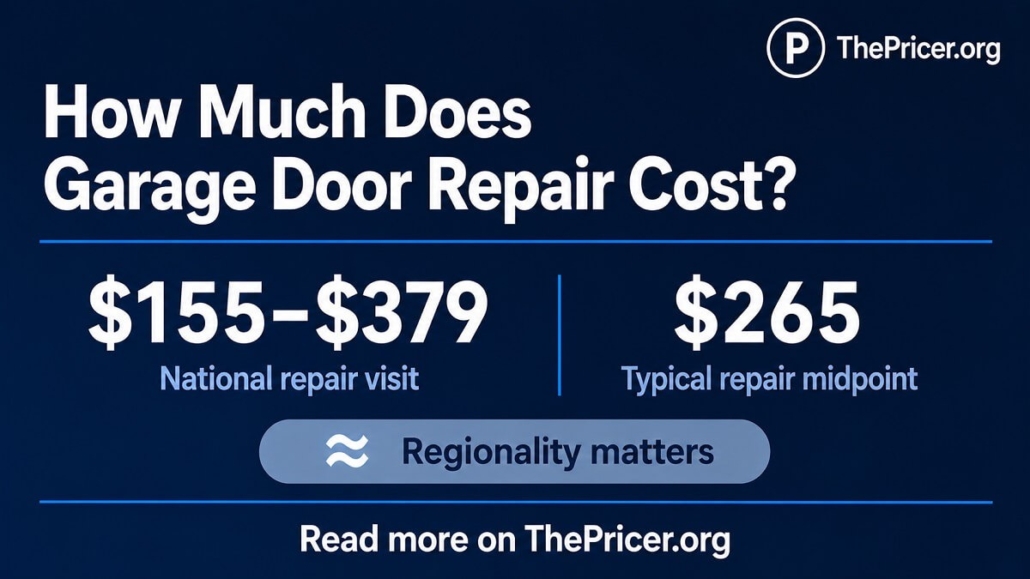
A garage door may stop lifting, hang crooked, grind along a track, or refuse to close after a spring, cable, roller, sensor, panel, or opener failure. HomeAdvisor’s June 2026 figures place repair visits between $155 and $379, with a midpoint near $265.
The invoice can combine a service visit, diagnosis, technician labor, replacement parts, adjustments, and added work found after inspection. January 2026 HomeGuide data puts spring and cable repairs at $150 to $350 each.
Garage door repair connects the sectional door, torsion or extension springs, lift cables, cable drums, rollers, hinges, tracks, bottom brackets, safety sensors, and motorized opener. Clopay, Amarr, and Wayne Dalton sell door systems, while LiftMaster, Chamberlain, and Genie are established opener brands with drive, sensor, rail, and control components that may enter the repair scope.
Repair is billed per visit or project. Labor versus materials, the failed component, door weight, local labor rates, access, and urgent scheduling shape the final charge.
How Much Does Garage Door Repair Cost?
Jump to sections
- $155 to $379 (at $30 per hour, earning that amount would take about 0.6 to 1.6 full-time workdays, before taxes) is a current national repair band.
- $265 is a useful midpoint for a standard repair visit.
- $150 to $350 covers many spring or cable jobs in current published data.
What you’re buying
Garage door repair restores an existing door system rather than replacing the complete assembly. The technician may work on torsion or extension springs, lift cables, rollers, hinges, tracks, panels, safety sensors, or the motorized opener. Some failures stop the door from moving. Others leave it crooked, noisy, difficult to lift, or unable to reverse correctly. The diagnosis determines whether the visit stays focused on one component or expands to several related parts.
A tune-up is narrower because it centers on inspection, lubrication, tightening, testing, and adjustment rather than a failed component. A new garage door opener installation is also a separate project when the door, springs, tracks, and panels remain usable.
Cosmetic work sits outside many mechanical repair calls as well. A homeowner looking at garage door surface skins, paint, or other appearance changes is solving a different problem from a broken cable or spring.
Repairing vs replacing the door
The first decision is which system actually failed. A motor that runs without lifting the door does not automatically mean the opener needs replacement. A broken counterbalance spring can leave the opener trying to move far more weight than it was designed to handle.
A technician should separate opener faults from spring, cable, track, roller, and panel faults before parts are approved. That distinction can prevent a homeowner from buying a motorized operator when the mechanical door system is the source of the failure.
Full door replacement becomes more relevant when several panels have structural damage, compatible sections cannot be sourced, or repeated mechanical failures are arriving together. A1 Garage Door Service states in its March 2026 guidance that isolated spring, roller, and opener problems can support repair, while sagging panels and repeated service needs can shift the decision toward replacement. That is a condition-based decision, not a rule that every older door should be removed.
Labor, parts, and the service call
A garage door invoice can look simple even when the technician performs several separate tasks. The service-call or diagnostic line covers the trip and initial inspection. Labor pays for disassembly, spring tension work, cable routing, alignment, opener testing, rebalancing, and final safety checks. Materials cover the failed parts plus hardware needed to fit them. Some contractors quote one project figure instead of listing technician hours.
Others separate the visit fee from parts and labor. Door size, spring configuration, damaged hardware, and whether another component failed at the same time can change the balance between those categories. A broken cable may involve inexpensive material but skilled tension-system work, while a damaged panel can place a larger share of the invoice in the physical part. The diagnosis matters. A written quote should identify the component being replaced, the labor included, whether the service fee is credited, and which added repairs require approval before work continues.
Current U.S. pricing records show how the main repair categories divide the bill.
| Quote category | Published 2025-2026 figures | What the figure covers |
|---|---|---|
| Labor, parts, and visit fee | Angi’s August 2026 data lists labor at $150 to $450 per job, parts at $5 to $200 (about 0.2 to 6.7 hours of work at $30 per hour), and service calls at $50 to $75. | Broad repair work across component types |
| Cable work | Angi’s July 2026 data puts cable repair around $100 to $350, with technician labor at $75 to $150 per hour. | Cable realignment or replacement |
| Spring systems | HomeGuide’s October 2025 figures list torsion replacement at $150 to $350 and extension springs at $120 to $200. | Parts and replacement labor |
Three repair cases
 Published repair cases help show why two doors with similar symptoms can produce different invoices. This Old House’s May 2026 examples list a spring job at $360, a multi-part job at $485 (about 2 full-time workdays at $30 per hour), and a spring-cable-opener job at $639, with the middle case showing $145 in parts + $265 labor + $75 service = $485.
The first case centers on one failed torsion spring, so diagnosis and rebalancing dominate the visit after the replacement part is selected. The second combines extension springs, cables, and rollers, creating more removal, installation, and adjustment work during one appointment.
The third adds opener replacement to mechanical door work, which changes the repair from a narrow component job into a mixed hardware and motorized-operator project. Those cases also show why a symptom alone cannot set a reliable quote. A door that will not open may have one failed spring, several worn lifting parts, or an opener problem layered on top of door hardware.
Quote line items
Added charges often come from work discovered after the door is secured and inspected. A broken spring can expose worn cables or bearings. A cable problem can reveal a damaged drum, roller, or track. Panel work may change when the matching section is discontinued. A technician may write those items as a revised quote or change order rather than silently adding them to the original figure. Ask which repairs are required to restore operation and which are optional replacements for worn but functioning components.
Urgent scheduling can add another line because the visit itself may carry a special trip charge. Fee structures differ by company, so a useful phone question is whether nights, weekends, and emergency dispatch create one stated fee or several separate charges. The repair price should be approved before additional parts are installed.
What an itemized quote looks like
An itemized quote should separate the repair itself from charges tied to the visit. That makes it easier to compare two contractors that package the same work differently. CostInspector’s August 2026 figures put torsion springs at $250 to $550 installed and a service or trip fee at $50 to $100. Using the low ends, $250 + $50 = $300. Using the high ends, $550 + $100 = $650.
That worked total is a budgeting model, not a contractor promise. A real estimate should state the spring type, quantity, included hardware, service fee, labor scope, disposal terms, warranty, and any additional work needed for balance or alignment.
If the quote changes after inspection, the revised document should identify the newly found component rather than replacing the original figure with an unexplained total. This matters with paired parts such as springs or cables because the technician may recommend servicing related hardware during the same visit. A written line-item quote makes that recommendation easier to evaluate.
Regional labor and hard-to-reach hardware
Location affects technician labor, but physical access can matter just as much. A standard residential door with open ceiling space gives the technician direct access to springs, drums, tracks, and the opener rail. High-lift tracks, tight overhead storage, finished ceilings around hardware, heavier door sections, or an off-track door can make the same component harder to remove and align.
The contractor may also need different spring sizing or cable specifications for a heavier door. Access changes labor time.
HomeGuide’s October 2025 figures put cable replacement at $150 to $250 and emergency cable service at $250 to $350. The same data identifies door size, cable strength, labor market, additional component damage, service timing, and spring-system type as price drivers. This is why a phone estimate based only on “broken cable” may change after the technician sees the door. Door width, weight, counterbalance design, cable routing, and access all define the actual job.
Who this cost makes sense for
Repair makes the strongest case when the failed component is isolated and the rest of the door remains serviceable. Paying for a spring, cable, roller, track correction, sensor, or opener component can restore the system without replacing panels and framing that still function. Replacement deserves a fresh comparison when several major parts are failing together, structural sections are damaged, or compatible panels cannot be obtained. The choice should follow the inspected condition of the door rather than a sales rule tied only to age.
Makes sense if
- A spring or lift cable failed and the panels and tracks remain usable.
- A roller or track problem is isolated to repairable hardware.
- The opener has a defined fault and the counterbalance system tests correctly.
- A damaged panel can be matched without rebuilding several sections.
Doesn’t make sense if
- Several panels have structural damage.
- Repeated failures are affecting springs, cables, tracks, and opener hardware together.
- Compatible sections or proprietary hardware cannot be sourced.
- The proposed repair leaves another major known failure unresolved.
What we verified
- Checked August 2026 Modernize data, which places common repairs around $150 to $350.
- Confirmed January 2025 Fixr data, which reports a national band of $150 to $350.
- Cross-referenced June 2026 Smarfle figures, which place common repairs around $150 to $400.
- Verified older historical context against April 2024 Forbes Home data, which reported $150 to $375.
Answers to Common Questions
How much should I budget for a basic garage door repair?
A working budget in the low hundreds fits many single-component repairs. Current 2026 national references cluster many standard jobs around the ranges shown above, but the failed part and local labor market control the final quote.
Is a broken garage door spring expensive to repair?
Spring work can sit within the same broad band as many cable repairs, but spring type, door weight, spring quantity, and related hardware change the invoice. Torsion and extension systems also carry different published ranges.
Can I repair garage door springs or cables myself?
Spring and cable work involves stored tension and a heavy moving door. Professional service is the safer route for counterbalance-system repairs. Owner-level tasks are better limited to observation, cleaning, remote batteries, and other work that does not release spring tension.
When should I replace the door instead of repairing it?
Replacement becomes easier to justify when several structural sections are damaged, matching panels are unavailable, or multiple major systems need work at the same time. An isolated spring, cable, roller, sensor, or opener fault can still support repair when the remaining door is serviceable.
Disclosure: Educational content, not financial advice. Prices reflect public information as of the dates cited and can change. Confirm current rates, fees, taxes, and terms with official sources before purchasing. See our methodology and corrections policy.