
How Much Does Gemini 4 Argon Cost?
Published on | Written by Alec Pow
This article was researched using 7 sources. See our methodology and corrections policy.
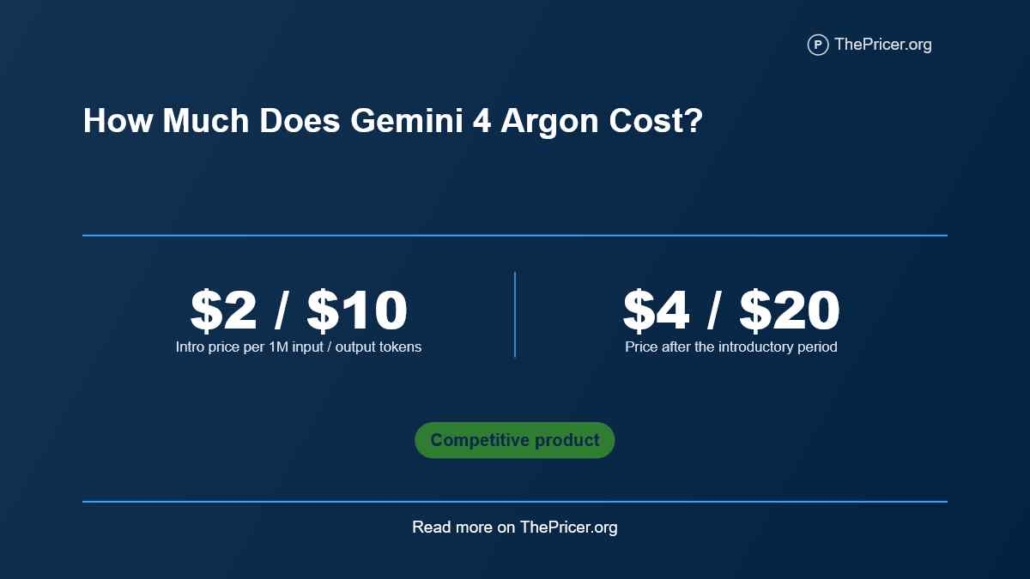
Google Gemini 4 Argon will launch at $2 per 1 million input tokens and $10 per 1 million output tokens, with cached input priced at a 95% discount. That puts cached reads at an effective $0.10 per million tokens during the introductory period.
The cheaper price is temporary. Google says that after the introductory period, Gemini 4 Argon will cost $4 per million input tokens and $20 per million output tokens. Google has not announced when the introductory pricing ends, so developers building a long-term budget should treat the higher $4/$20 rates as the safer planning figure.
Argon was announced on September 30, 2026, but most people cannot buy API usage yet. Google is initially giving the model to selected cybersecurity defenders through its Fairwind Program while it evaluates safety controls. Broader access is expected to begin with paid API customers and Google AI Ultra subscribers.
The most interesting price question is therefore not merely whether Argon costs $2 or $4 per million input tokens. A short chat can cost pennies, while a long-running coding or research agent repeatedly reading millions of tokens can generate a substantial bill. Caching, output length, agent loops and eventual tool charges can matter more than the headline input rate.
Article Highlights
Jump to sections
- Gemini 4 Argon’s introductory API price is $2 per million input tokens and $10 (at $30 per hour, earning that amount would take about 20 minutes, before taxes) per million output tokens.
- Cached input receives a 95% discount, reducing the introductory cached-input rate to about $0.10 per million tokens.
- After the introductory period, Google says prices rise to $4 input and $20 output per million tokens.
- A job using 100,000 input tokens and generating 20,000 output tokens would cost about $0.40 during the introductory period and $0.80 afterward.
- A much larger 10-million-input, 2-million-output workload costs about $40 initially and $80 at the eventual standard rate.
- The output token price is five times the input price, making long generated reports, code and agent traces a major cost driver.
- Argon’s introductory rates match GPT-6.1 Sol’s $2/$10 standard pricing and are half Claude Opus 5.5’s $4/$20 rates.
- Argon’s eventual $4/$20 rates match Claude Opus 5.5 and cost twice GPT-6.1 Sol at equal token volumes.
- Argon is not yet broadly available through the public Gemini API, so these are announced launch prices rather than a bill most developers can incur today.
How Much Does Gemini 4 Argon Cost?
Google announced Gemini 4 Argon with an unusually straightforward introductory rate. Its official Gemini 4 announcement lists $2 per million new input tokens and $10 (about 20 minutes at $30 per hour) per million output tokens. Cached input receives a 95% discount from the ordinary input price.
| Gemini 4 Argon charge | Introductory price | After introductory period |
|---|---|---|
| Input | $2 / 1M tokens | $4 / 1M tokens |
| Output | $10 / 1M tokens | $20 / 1M tokens |
| Cached input | About $0.10 / 1M | Google has not separately published the post-promotion cache rate in its launch announcement |
The $2/$10 price applies to tokens rather than individual questions. Google explains in its token-counting documentation that a Gemini token represents roughly four characters on average, with 100 tokens corresponding to approximately 60 to 80 English words. Images and other supported input types are also converted into billable tokens.
That means “how much does one Gemini 4 Argon prompt cost?” has no fixed answer. A short question with a short response can use a tiny fraction of one million tokens. Feeding an agent an entire repository, a long legal record or a large research corpus can move the request into millions of billable tokens before the model generates its answer.
What One Request Costs
A practical way to understand Argon pricing is to model actual token volumes rather than divide $2 by an arbitrary number of prompts.
Consider a substantial professional task containing 100,000 input tokens and producing 20,000 output tokens. During the introductory period:
100,000 input tokens = 0.1 × $2 = $0.20
20,000 output tokens = 0.02 × $10 (about 20 minutes at $30 per hour) = $0.20
Total = $0.40.
After Google’s introductory pricing expires, the same request becomes:
0.1 × $4 + 0.02 × $20 = $0.80.
The task itself has not changed, but the price doubles.
Take a far larger workload that processes 10 million input tokens and generates 2 million output tokens. Introductory pricing produces:
10 × $2 + 2 × $10 = $40.
At the announced post-introductory rates:
10 × $4 + 2 × $20 = $80.
A company processing that workload every business day for 22 days would move from about $880 per month during the promotion to roughly $1,760 per month afterward, assuming identical token usage and no caching or extra tool charges.
The Output Cost
Argon’s generated tokens cost five times as much as new input tokens under both announced price levels. That ratio makes output one of the easiest places for an application to overspend.
A workload with one million input tokens and only 100,000 output tokens costs $3 during the promotion: $2 for input plus $1 for output. Increase the generated content to one million output tokens and the same input now produces a $12 bill.
That distinction matters because Google is positioning Argon for long-horizon coding, financial research, legal work and cybersecurity. Its launch material describes agents working across large codebases and complex multi-step tasks rather than short consumer questions. Google also says Argon supports an unusually large one-million-token maximum output, making extremely long generations technically possible even though most requests will be far smaller.
At the introductory output rate, generating the full one-million-token maximum would cost $10 for output alone. After the introductory period it would cost $20, before counting a single input token.
This is why developers comparing Argon with cheaper Gemini models should focus on task economics rather than the model name. The existing Gemini 3.5 Flash cost is aimed at higher-volume work where the cheapest capable model can matter more than frontier-model performance.
Caching Changes the Bill
Google’s 95% cached-input discount is potentially the most valuable part of Argon’s introductory pricing for applications that repeatedly send the same large body of information.
At $2 per million ordinary input tokens, a fresh 10-million-token context costs $20 each time it is processed. If all 10 million tokens qualify as cached input at the effective $0.10 introductory rate, reading that cached context costs only:
10 × $0.10 = $1.
That is a $19 reduction for one reuse compared with sending the same 10 million tokens as uncached input.
If an agent reuses that context 100 times, the simple token comparison becomes $2,000 of uncached input versus $100 of cached reads, a difference of $1,900. That calculation isolates input-token charges and does not include cache creation or storage charges that Google may apply through the final Argon API implementation.
Google’s broader Gemini API price schedule shows why those extra details need to be checked when Argon becomes generally available. Existing Gemini products can separately charge for cache storage, search grounding, file retrieval and other services. Google’s Argon announcement does not yet provide a complete public rate card for every auxiliary feature.
Argon vs GPT and Claude
Google’s introductory pricing puts Argon directly into one of the most competitive parts of the frontier-model market.
| Model | Input / 1M | Cached input / 1M | Output / 1M |
|---|---|---|---|
| Gemini 4 Argon, introductory | $2 | ~$0.10 | $10 |
| Gemini 4 Argon, later standard rate | $4 | Not separately disclosed at launch | $20 |
| GPT-6.1 Sol | $2 | $0.10 | $10 |
| Claude Opus 5.5 | $4 | $0.20 | $20 |
| GPT-6 Astra | $10 | $1 | $50 |
OpenAI currently lists GPT-6.1 Sol at $2 input and $10 output per million tokens, exactly matching Argon’s introductory headline rates. Sol also lists cached input at $0.10 per million. OpenAI charges more for very long prompts above its stated threshold, so identical headline prices do not guarantee identical bills for every workload.
Anthropic lists Claude Opus 5.5 at $4 input and $20 output, with cache reads at $0.20 per million. Argon therefore launches at half Opus’s standard input and output prices, but Google’s announced post-promotional rates move Argon directly to the same $4/$20 level.
The comparison with GPT-6 Astra is larger. OpenAI’s current enterprise rate card prices Astra at $10 input and $50 output per million tokens. Argon’s introductory rates are 80% lower on both ordinary input and output at equal token volumes.
Readers comparing the models in detail can also check current GPT-6 Sol and Luna prices and Claude Opus 5.5 pricing, where caching, Batch modes and long-context rules can materially change the headline comparison.
The Hidden Cost
The API meter is not always the whole AI bill. Google’s current developer documentation says managed-agent workloads can be billed for the underlying model’s input, output and intermediate reasoning tokens, while tools can carry their own charges. That becomes important for Argon because Google is marketing it specifically for complex workflows that can continue working across many steps.
An agent might read a repository, search documentation, call tools, inspect the result, revise its plan, generate code, run another tool and continue iterating. A user may think of that as one task, while the billing system sees many rounds of token processing.
Suppose an agent completes 20 rounds, with each round consuming 250,000 fresh input tokens and generating 25,000 output tokens. Total usage becomes 5 million input tokens and 500,000 output tokens.
At Argon’s introductory prices:
5 × $2 + 0.5 × $10 = $15.
At the later rate:
5 × $4 + 0.5 × $20 = $30.
If large portions of the repository can be cached, the actual input cost could drop substantially. If the agent repeatedly changes context, invokes paid search or other services, or generates much more output, the bill can rise.
That makes cost per completed task a more useful measure for agentic workloads than cost per prompt. A model that charges twice as much per token can still be cheaper if it finishes the job in substantially fewer steps. A lower token rate can also lose its advantage if the model loops repeatedly before reaching a usable result.
Can You Buy Argon Yet?
For most developers, the answer is not yet. Google launched Argon first through its Fairwind Program for selected cybersecurity defenders rather than putting the model immediately into unrestricted public API access.
Google says the phased rollout is connected to Argon’s cyber capabilities and its work with the U.S. government’s voluntary pre-release model-review process. Reuters reported that Google has not supplied a firm date for general public release and is emphasizing Argon’s cost advantage as it returns to the frontier-model race. The initial Argon rollout remains restricted while Google gathers feedback.
Google says broader access will begin with paid API customers and Google AI Ultra subscribers. That does not mean an Ultra subscription converts into an unlimited pool of API tokens. Consumer Gemini access and developer API billing are different purchasing paths unless Google explicitly states otherwise for a feature.
Google has also reorganized its paid AI plans into multiple tiers in some markets. Its current Google AI plan comparison lists Ultra tiers with higher Gemini usage allowances than Pro. Availability, quotas and subscription prices depend on the country and plan, so a U.S. dollar API rate should not be presented as the cost of an Ultra subscription.
Is the Intro Price Misleading?
Google has disclosed the future price prominently enough that the $2/$10 launch rate should be treated as a promotion rather than a permanent baseline.
The change is simple:
$2 → $4 input = 100% increase.
$10 → $20 output = 100% increase.
A developer spending $1,000 per month on an identical mix of standard input and output at the introductory rates would therefore spend approximately $2,000 per month after the pricing change, assuming token usage and every other charge stayed constant.
That is the largest predictable budget risk we can quantify from Google’s launch material. The timing remains unknown. Google says only that higher rates apply after the introductory period expires.
The promotional price still matters competitively. It gives developers a chance to evaluate Argon at the same base token rates as GPT-6.1 Sol and at half the standard rates of Claude Opus 5.5. The long-term purchasing decision changes once Argon reaches $4/$20, because it then has to justify its cost through better task completion, fewer agent iterations, stronger coding performance or another measurable workload advantage rather than simply being cheaper per token.
Answers to Common Questions
How much does Gemini 4 Argon cost?
Google says Gemini 4 Argon will launch at $2 per million input tokens and $10 per million output tokens. After the introductory period, those rates rise to $4 input and $20 output.
How much does cached input cost?
Google says cached input receives a 95% discount during the introductory period. Applied to the $2 input rate, that is approximately $0.10 per million cached tokens.
How much would one Gemini 4 Argon request cost?
A request with 100,000 input tokens and 20,000 output tokens would cost about $0.40 during the introductory period. The same token usage would cost about $0.80 after the announced price increase.
Is Gemini 4 Argon cheaper than Claude Opus 5.5?
During Argon’s introductory period, yes at equal standard token volumes. Argon is $2/$10 while Opus 5.5 is $4/$20. After Google’s promotion expires, their published base input and output prices are the same.
Is Gemini 4 Argon cheaper than GPT-6.1 Sol?
Their headline introductory rates are the same: $2 per million input tokens and $10 per million output tokens, with $0.10 cached reads. Other billing rules and the number of tokens required to complete a task can still make their actual workload costs different.
Can anyone use Gemini 4 Argon now?
No. Google initially restricted access to selected cybersecurity defenders through Fairwind. Paid API customers and Google AI Ultra subscribers are expected to be among the first broader groups to receive access, but Google has not announced a firm general-release date.
When will the introductory price end?
Google has not announced an end date. Developers budgeting for long-lived applications should account for the disclosed future rate of $4 input and $20 output per million tokens.
Disclosure: Educational content, not financial advice. Prices reflect public information as of the dates cited and can change. Confirm current rates, fees, taxes, and terms with official sources before purchasing. See our methodology and corrections policy.