
How Much Does GPT-6 Astra Cost?
Published on | Written by Alec Pow
This article was researched using 13 sources. See our methodology and corrections policy.
OpenAI introduced GPT-6 Astra on September 3, 2026, as its flagship model for demanding reasoning, coding, research, computer use, and professional work. Access is rolling out through the OpenAI API and several ChatGPT plans.
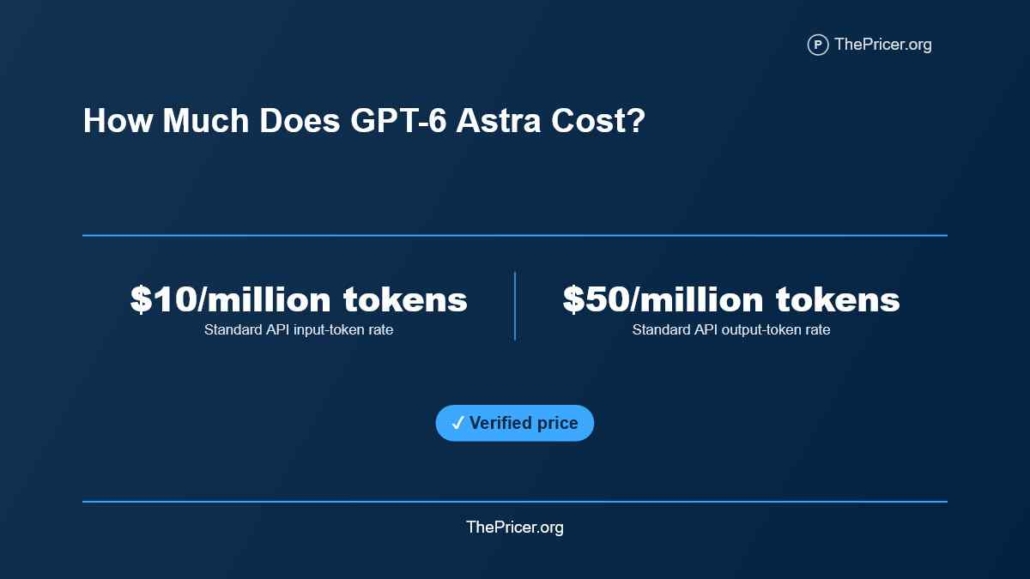
For developers, the clearest benchmark is Standard API usage at $10 per 1 million input tokens and $50 per 1 million output tokens, according to OpenAI’s Astra launch announcement. ChatGPT users pay through subscriptions and usage allowances instead of that direct API meter.
API billing is separate. Context size, caching, processing speed, output volume, tools, and the product used to access Astra can all change the amount charged.
How Much Does GPT-6 Astra Cost?
Jump to sections
GPT-6 Astra starts at $10 (at $30 per hour, earning that amount would take about 20 minutes, before taxes) per million input tokens and $50 per million output tokens through the Standard OpenAI API. ChatGPT access can instead come through paid plans, with Pro tiers at $100 and $200 per month.
Important numbers
- Standard API input is $10 per million tokens.
- Standard API output is $50 per million tokens.
- Cached input can cost $1 per million tokens.
- Long-context requests use higher rates after the published token threshold.
- Batch and Flex processing cost half the corresponding Standard rates.
- Fast mode costs more in return for faster processing.
What GPT-6 Astra is
GPT-6 Astra is OpenAI’s highest-capability model for complex end-to-end tasks. It can be used through several products, and those products do not share one billing method. Direct OpenAI API requests are metered by token consumption and processing tier. ChatGPT uses plan allowances, message limits, or flexible credits. Work and Codex can draw from included plan usage or purchased credits.
OpenAI has announced Astra access through Microsoft Azure and Amazon Bedrock as well, where cloud-provider billing may differ from direct OpenAI charges. A monthly ChatGPT subscription, an API invoice, and a cloud-platform bill are different purchases. Readers comparing the broader product can see the existing ChatGPT subscription costs.
Worked GPT-6 Astra API cost
A basic Standard API calculation needs two inputs, the amount sent to the model and the amount generated in response. Consider an application that processes 1 million uncached input tokens and produces 200,000 output tokens. This model excludes cache writes, tools, long-context pricing, regional processing charges, and Fast mode. The calculation uses the public Standard rates rather than a ChatGPT subscription allowance.
- 1 million input tokens at $10 (about 20 minutes at $30 per hour) per million cost $10.
- 200,000 output tokens equal 0.2 million tokens.
- 0.2 million output tokens at $50 per million cost $10.
- Modeled API total is $10 + $10 = $20.
The result is $20 for that workload before separate tool or processing charges. Output can become a large part of the bill because its per-token rate is five times the Standard input rate. Applications that generate long reports, code, research results, or agent traces may spend more on output than a short-prompt chatbot with similar request counts.
Standard GPT-6 Astra API tokens
OpenAI meters Astra text usage by millions of tokens rather than by API request. The current model comparison page lists Standard uncached input at $10 (about 20 minutes at $30 per hour) per million tokens, cached input at $1 per million, and output at $50 per million. Those are developer charges tied to model consumption, not monthly ChatGPT fees.
Caching can make repeated context much cheaper. If 1 million tokens that would otherwise be billed as ordinary Standard input qualify as cached input, the token charge falls from $10 to $1. The arithmetic difference is $10 – $1 = $9, a 90% reduction for that repeated input portion. Cache eligibility and writes still matter, so a developer should not assume every repeated prompt automatically receives the lower rate. OpenAI bills generated output separately. That pricing structure also differs from competing model families covered in Claude API pricing.
Large-context pricing
Astra supports a very large context window, but requests that cross OpenAI’s published 272,000-input-token threshold move to a higher rate schedule. The current Astra model page lists long-context pricing at $20 per million input tokens, $2 per million cached input tokens, $25 per million cache writes, and $75 per million output tokens. It also lists short-context cache writes at $12.50 per million tokens.
The higher schedule applies to the full qualifying request once the input passes the threshold, not just to tokens after token 272,000. A developer sending a large repository, lengthy document collection, extensive conversation history, or big research packet can cross that boundary with a single request, which can materially change the expected bill even if request count stays constant.
Caching can soften repeated-input expense, but new cache writes carry their own charge and generated output remains separately metered. A cost model should use actual token logs rather than file size alone because tokens and words are not interchangeable units.
Batch, Flex, Standard, and Fast mode
Processing choice can move Astra spending even when input and output volumes stay unchanged. Standard is the base reference. Batch and Flex are priced at 50% of the applicable Standard rates, making them attractive for work that can accept their service characteristics.
Fast mode moves in the opposite direction and charges a premium for higher-speed processing. Context size can still change the applicable tier, so the speed choice should not be evaluated without the prompt size.
This spread means an application built around delayed background jobs can have a different model bill from an interactive product tuned for low latency. Regional data-processing choices can create another adjustment where applicable. Tool use sits outside the plain text-token total, so an agent that repeatedly searches the web, accesses files, or opens computing environments can produce charges beyond its Astra input and output consumption.
ChatGPT Pro, Business, and Enterprise
 ChatGPT does not bill ordinary chat messages at the direct API token rate. Plus currently costs $20 per month, and OpenAI says API usage remains separate on its Plus plan page. Astra is rolling out to Plus for Work and Codex, but the Pro model option in ordinary Chat follows different plan rules. OpenAI’s Pro plan documentation lists Pro at $100 per month and $200 per month, with the higher tier carrying more usage. Neither Pro tier is sold as unlimited access to every model.
In Chat, Astra powers GPT-6 Pro. Current GPT-6 Pro allowance documentation assigns Pro $100 users 50 GPT-6 Pro messages per week and Pro $200 users 200 per week. Business Standard currently receives 15 Pro-model messages per month, while Business Premium receives 50 per week.
Plus does not include the GPT-6 Pro option in ordinary Chat. Rollout status matters too. An eligible plan does not mean Astra has already appeared on every account as of September 4, 2026.
Work, Codex, credits
ChatGPT Work and Codex create another billing path because Astra can draw from a plan’s included agentic allowance rather than a direct API key. OpenAI’s Work and Codex documentation says Pro $100, Pro $200, and Business Premium users can use their existing full allowance with Astra once access reaches their account.
Plus and Business Standard receive limited Astra usage in these products and can buy credits for more usage. Signing into Codex with a ChatGPT account uses the plan’s allowance and billing system, while supplying a personal API key switches the work to API metering.
Task length, model reasoning level, input size, generated output, and Fast mode can make Astra consume an included allowance more rapidly than a lower-cost model. These usage pools should not be converted into a fixed number of tasks because two coding or research jobs can consume very different amounts of model work.
For credit-based Business and Enterprise usage, OpenAI’s current rate card lists Astra at 250 credits per million input tokens, 25 credits per million cached input tokens, and 1,250 credits per million output tokens. Those credits are a workspace billing unit rather than API dollars. AI-agent users comparing consumption models can also review AI agent usage costs.
Three GPT-6 Astra cost cases
Light API case. The workload used in the worked calculation processes 1 million input tokens and 200,000 output tokens under Standard short-context pricing. Its modeled model-only charge is $20. This case fits a developer who wants direct metering and whose request remains below the large-context threshold.
Heavy API case. A workload processing 10 million Standard input tokens and generating 2 million Standard output tokens over many qualifying short-context requests reaches $200. The arithmetic is 10 times $10 for input plus 2 times $50 for output. Caching, tools, and other processing tiers would change that model.
ChatGPT case. A user who wants GPT-6 Pro in ordinary Chat can choose an eligible Pro subscription rather than pay for each message by raw API tokens. The two individual Pro tiers have different included allowances and monthly charges, so the better choice depends on actual Pro-model use. A developer embedding Astra into a product should not substitute a ChatGPT subscription for API billing because ChatGPT accounts are not a resale route for powering third-party applications.
Which GPT-6 Astra price should you use
The right figure follows the product surface. Use direct token rates for software sending requests through an OpenAI API key. Use the monthly subscription amount and current model allowance for Astra or GPT-6 Pro inside ChatGPT.
Use Work and Codex allowances when those products are running under a signed-in ChatGPT plan. Managed workspaces using flexible billing should follow their applicable credit or USD rate card. Microsoft Azure and Amazon Bedrock customers should check the cloud provider’s own bill rather than assume direct OpenAI rates transfer unchanged.
| Access route | Billing basis | What to check |
|---|---|---|
| OpenAI API | Token and tool usage | Context, cache, processing tier, tools |
| ChatGPT | Subscription and model allowance | Plan, weekly or monthly limit, rollout |
| Work and Codex | Included usage or credits | Plan allowance, task consumption, extra credits |
| Managed workspace | Credits or contracted USD billing | Workspace rate card and admin settings |
Makes sense if
- You match the rate to the product actually running Astra.
- You separate input, output, cached input, and tool usage.
- You check the context threshold before forecasting large requests.
- You treat ChatGPT message allowances separately from API tokens.
Doesn’t make sense if
- You treat a ChatGPT monthly fee as an API allowance.
- You use Standard pricing for a Fast request.
- You ignore the higher schedule on a qualifying long-context prompt.
- You assume staged rollout guarantees immediate account access.
What we verified
- Checked the September 3 Reuters launch report against OpenAI’s announcement of Astra and its staged release.
- Confirmed the September 4 rollout report, which documents that some paying users were still waiting for access after launch.
- Cross-referenced the ChatGPT release notes, which describe Astra as rolling out rather than already active for every eligible account.
- Verified the OpenAI API changelog, which records the September 3, 2026 GPT-6 Astra release.
Answers to Common Questions
How much does GPT-6 Astra API access cost?
Standard short-context pricing is $10 per million input tokens and $50 per million output tokens. Cached input, cache writes, long contexts, processing tier, and tools can change the final bill.
Can I use GPT-6 Astra with ChatGPT Plus?
OpenAI is rolling Astra out to Plus for Work and Codex with limited included usage. The GPT-6 Pro option in ordinary Chat is currently reserved for eligible Pro, Business, and Enterprise plans.
Does ChatGPT Pro include unlimited GPT-6 Astra use?
No. GPT-6 Pro has separate usage allowances. The amount available depends on the Pro tier and resets according to the published model limit.
Does a ChatGPT subscription include API usage?
No. API usage is billed separately. Signing into ChatGPT, Work, or Codex under a subscription uses the rules for that product, while applications using an API key follow API metering.
Disclosure: Educational content, not financial advice. Prices reflect public information as of the dates cited and can change. Confirm current rates, fees, taxes, and terms with official sources before purchasing. See our methodology and corrections policy.