
How Much Does Halloween Candy Cost?
Published on | Written by Alec Pow
This article was researched using 8 sources. See our methodology and corrections policy.
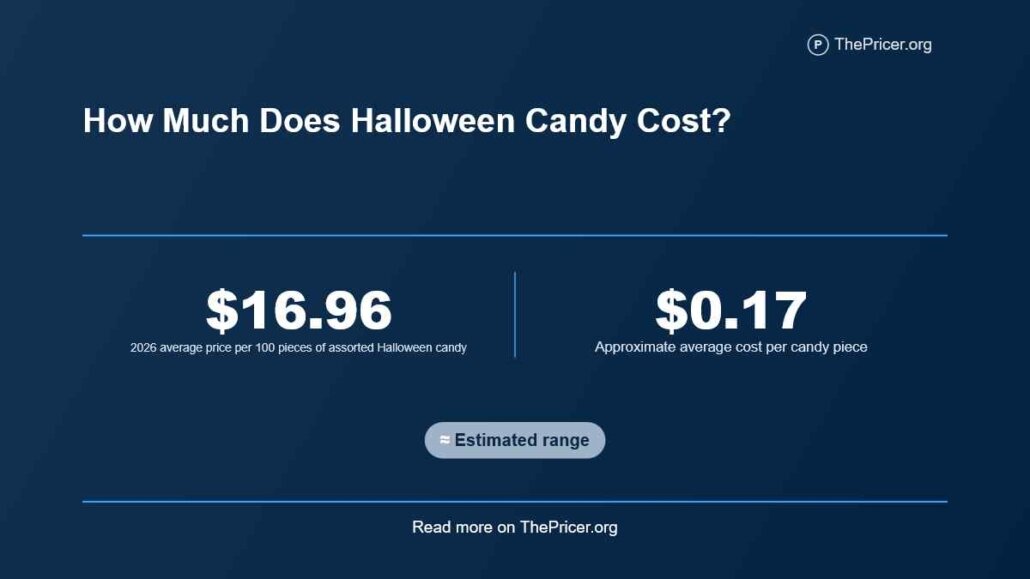
Halloween candy costs an average of $16.96 per 100 pieces in the United States in 2026, or about 17 cents per piece, according to a September retail-price study. Actual prices vary considerably. Large bags of inexpensive chewy candy can cost under 5 cents per piece, while certain name-brand chocolates and individually wrapped treats cost 20 to 35 cents or more each.
A household expecting 100 trick-or-treaters can budget approximately $17 for one piece per child at the study average, or $34 for two. A busier neighborhood expecting 300 children may require about $51 to $102. Those estimates exclude sales tax and assume every piece costs the reported average. Buying particular brands, shopping during promotions, and selecting different candy sizes can change the bill substantially.
Article Highlights
Jump to sections
- The average 100-piece assortment costs $16.96 in 2026, compared with $9.91 in 2021.
- Halloween candy prices rose 71% over five years, but only 3.5% between 2025 and 2026.
- Selected 2026 Target listings ranged from $9.99 for 400 small candies to $25.99 for 200 assorted chocolates.
- Giving two pieces instead of one doubles the candy quantity and potentially the spending.
- Americans are projected to spend $4.1 billion on Halloween candy in 2026.
- Price per piece matters, but the size and weight of each treat matter too.
How Much Does Halloween Candy Cost?
The most useful national comparison comes from FinanceBuzz’s Halloween candy price study, updated September 30, 2026.
Researchers examined full-price bulk candy assortments at Walmart, Target, Kroger, and Albertsons. The study included at least 25 bags each year, ranging from 28 to 500 pieces. Historical prices came from archived store advertisements, while September 2026 figures came from retailer websites.
The reported $16.96 figure is a normalized average for 100 candies, not the price of a particular bag available at every store. Different candy mixtures and package sizes affect what shoppers actually pay.
Current Target Halloween candy listings show how much the price changes with brand, weight, and assortment. The following selected offers were listed in October 2026. They are illustrative retail examples rather than a representative sample of all U.S. stores.
| Candy assortment | Bag price | Pieces | Cost per piece |
|---|---|---|---|
| Frooties assorted chewy candy | $9.99 | 400 | 2.5¢ |
| HARIBO Halloween assortment | $14.99 | 150 | 10.0¢ |
| Sour Patch Kids variety pack | $19.99 | 190 | 10.5¢ |
| Mars chocolate minis | $19.99 | 150 | 13.3¢ |
| Mars chocolate assortment | $25.99 | 200 | 13.0¢ |
| Ring Pop Halloween assortment | $6.29 | 22 | 28.6¢ |
| Nerds Gummy Clusters | $9.99 | 28 | 35.7¢ |
These were advertised online prices before applicable taxes, shipping, and promotions. Store availability and pricing can change before October 31.
Not every piece is equivalent. A small chew contains much less candy than a fun-size chocolate bar or individually packaged snack. Comparing price per ounce alongside price per piece avoids treating unequal portions as identical products.
How Much Candy for Trick-or-Treaters?
The number of children visiting a home is the most important quantity to estimate. A household on a quiet street might need fewer than 50 pieces, while one in a popular trick-or-treating neighborhood may distribute hundreds.
At the national study benchmark of approximately 17 cents per piece, a household expecting 50 children needs about $8.50 for one treat each. For 100 children, the cost becomes $17. At 200 children, it becomes $34.
Those amounts assume exact quantities. In practice, shoppers often buy complete bags and may want a reserve for unexpected visitors.
Consider a household expecting 150 children and planning to give two candies per child. That requires 300 pieces before a safety margin. Adding 10% increases the quantity to 330 pieces.
At the rounded national benchmark, the candy consumed would represent approximately $56.10. Buying four full 100-piece bags at the study’s normalized average would instead cost approximately $67.84, leaving 70 pieces unused. The calculation illustrates the difference between candy consumption value and actual package spending.
A family expecting a busy night should also examine the distribution method. Allowing each child to grab a handful makes consumption less predictable than handing out a fixed number of treats.
Chocolate Versus Cheaper Candy
Chocolate assortments frequently cost more than small chewy sweets, although branded chocolate can still provide reasonable value when purchased in large bags.
The difference is apparent in current retail examples. A 400-piece chewy-candy package listed at $9.99 costs roughly 2.5 cents per small piece, while a 150-piece chocolate assortment at $19.99 costs roughly 13.3 cents per piece.
At those prices, giving 200 children one chewy candy would consume roughly $5 of candy, compared with about $26.67 for 200 chocolate minis. However, shoppers must still purchase the necessary package quantities.
The two types are not equivalent servings. A homeowner could reasonably decide to hand out two or three tiny chews instead of one chocolate mini, substantially narrowing the difference.
In Scripps News’ October 2026 pricing coverage, shopping specialists identified small Tootsie Roll Minis around 2 to 3 cents, Dum-Dums around 6 cents, and Smarties rolls around 7 cents per item as budget alternatives. These are reported price benchmarks rather than guaranteed offers.
Households serving children with allergies should consider ingredient labels, including nuts, dairy, soy, and other allergens. A mixed bowl does not guarantee that every item is appropriate for every visitor.
Why Halloween Candy Costs More
Halloween candy prices have risen sharply since 2021. FinanceBuzz found its standardized 100-piece price increased from $9.91 in 2021 to $16.96 in 2026, a rise of approximately 71%.
The increase was not evenly distributed. The study recorded $14.06 in 2024, $16.39 in 2025, and $16.96 in 2026. The latest annual increase was approximately 3.5%, considerably slower than the preceding two years.
Cocoa is an important driver of chocolate prices. Supply disruptions, crop conditions, manufacturing, packaging, and transportation costs all affect the final retail price. Candy containing relatively little cocoa can face a different cost structure.
The Bureau of Labor Statistics consumer price data tracks candy and chewing gum as part of its broader food-price measures. That official index covers a different product basket and measurement method from the FinanceBuzz Halloween assortments, so the two inflation figures should not be treated as interchangeable.
There is also a difference between falling ingredient prices and falling shelf prices. Manufacturers may have purchased ingredients under earlier contracts, while distribution expenses, packaging changes, and retailer pricing decisions can delay or offset the effects of lower commodity prices.
How Much Are Americans Spending?
Halloween candy is an unusually large seasonal market. The National Retail Federation’s September 2026 survey projects $4.1 billion in candy purchases, within $13.5 billion in total Halloween spending.
The survey covered 7,889 consumers from September 1 through 9. NRF reported that 96% of Halloween shoppers planned to purchase candy and 61% of consumers planned to hand out treats.
The broader Halloween spending forecast includes costumes, decorations, and greeting cards. Its average of $115.14 per person covers all those categories rather than candy alone.
The 2026 candy projection is approximately $200 million above the $3.9 billion forecast in the NRF’s 2025 survey. That represents about a 5.1% increase in projected aggregate spending, not necessarily an identical increase in prices.
More shoppers, larger quantities, changes in product choice, and higher prices can all contribute to a larger market total.
The Hidden Price of Bulk Bags
 The least expensive candy per piece is not always the least expensive purchase for an individual household.
Suppose someone expects 40 trick-or-treaters and wants to give one item each. A 400-piece package of small sweets at $9.99 has a low unit price, but leaves 360 pieces after the planned distribution.
An 80-piece bag at $9.99 would cost the same total and leave only 40 pieces. Its per-piece price is higher, but the homeowner avoids purchasing far more candy than expected to use.
That distinction matters more when buying premium chocolate in large quantities. Unsold or uneaten candy reduces the practical savings from volume discounts, especially when it is unlikely to be used later.
Retailer promotions can complicate the comparison. A buy-one-get-one percentage discount may require purchasing two bags. Delivery fees and minimum-order requirements can also eliminate savings offered by a lower online price.
The Walmart Hershey Miniatures listing displayed a 100-piece package at $29.99, but showed it as out of stock. That is a documented listing, not an available purchase recommendation. Stock status needs to be checked before using any posted price as a realistic shopping option.
A Worked Halloween Candy Budget
Consider a neighborhood expecting 200 trick-or-treaters. The homeowner wants to offer one chocolate candy and one smaller chewy candy per child, with a modest reserve.
The following scenario uses the advertised Target package prices already described and assumes no taxes or delivery expenses.
- One 200-piece Mars chocolate assortment: $25.99
- One 400-piece Frooties chewy-candy package: $9.99
- Total checkout cost before taxes: $35.98
- Planned distribution of 400 candies, two per child
- Remaining inventory after 200 visitors: 200 small chewy candies
The checkout cost is approximately 18 cents per child for the intended two-piece combination, with additional candy left over. This makes the amount spent per visitor different from the average cost of each candy in the purchased packages.
A different household wanting two chocolates per visitor would need 400 chocolates. At two bags of $25.99, its checkout cost would be $51.98. The mixed assortment therefore reduces spending by $16, or about 31%, while giving each child the same number of items.
The calculation is an illustrative purchasing model, not a documented customer transaction. The result depends on the availability of those exact assortments at their advertised prices.
When and Where to Buy Candy
Price comparisons are useful throughout October because retailer promotions can change weekly. Discount stores, supermarkets, warehouse clubs, and online sellers may have different package counts and promotional restrictions.
NRF’s 2026 Halloween shopping analysis reported that 31% of consumers planned to comparison-shop if prices were higher than expected, while 26% intended to use coupons or sales more often.
Buying earlier may provide a better selection, but does not guarantee a lower price. Waiting for late promotions might save money, although desirable assortments can sell out.
For households hosting a larger event, the total cost should include other refreshments rather than assuming trick-or-treat candy covers every guest. Specialty sweets such as handmade fudge are priced very differently from individually wrapped bulk candy.
There is a similar distinction with seasonal treats such as candy canes. Their package prices and serving sizes are not equivalent to a standard Halloween assortment, even though they can sometimes be purchased inexpensively.
Makes sense if
- Buying larger bags when past experience suggests several hundred visitors.
- Choosing individually wrapped inexpensive sweets to serve a larger crowd.
- Comparing price per piece and portion size before committing to a brand.
- Using a sale when the purchase quantity matches the expected need.
Does not make sense if
- Buying 400 candies for a street that typically receives fewer than 50 visitors.
- Purchasing a discounted package only because its unit price looks low.
- Counting smaller chews as equal portions to larger chocolate bars.
- Choosing an online offer without accounting for shipping, quantity limits, and stock status.
What We Verified
- Reviewed FinanceBuzz’s September 2026 retail-price study, including its four-retailer sample and historical method.
- Checked current Target listings for advertised prices, package counts, and differences among candy types.
- Compared the original FinanceBuzz study with independent reporting on low-cost treat alternatives.
- Checked NRF’s separate forecasts for candy and overall Halloween spending.
- Calculated unit prices, package requirements, and the mixed-candy household budget from stated figures.
- Treated retailer prices as time-sensitive listings rather than guaranteed nationwide offers.
Answers to Common Questions
How much does a 100-piece bag of Halloween candy cost?
The 2026 average was $16.96 per 100 pieces in FinanceBuzz’s standardized retail comparison. A specific 100-count bag can be cheaper or more expensive depending on the assortment and store.
How much should I spend on candy for 100 trick-or-treaters?
At approximately 17 cents per piece, one treat per child costs around $17, while two pieces per child cost around $34 before taxes and excess package quantities.
Is chocolate more expensive than non-chocolate Halloween candy?
It often is when compared with very small chewy sweets or lollipops. However, package size and weight matter, and large chocolate assortments can be competitively priced per serving.
Why is Halloween candy so expensive in 2026?
Higher ingredient, production, and distribution expenses have contributed to price increases over several years. The 2026 study found a 71% rise since 2021, although the most recent annual increase slowed to approximately 3.5%.
Is buying Halloween candy in bulk cheaper?
It can lower the cost per piece, particularly for large households or busy neighborhoods. It is not automatically cheaper overall when a household buys far more candy than it expects to distribute.
Disclosure: Educational content, not financial advice. Prices reflect public information as of the dates cited and can change. Confirm current rates, fees, taxes, and terms with official sources before purchasing. See our methodology and corrections policy.