
How Much Does High Point University Cost?
Updated on | Written by Alec Pow
This article was researched using 15 sources. See our methodology and corrections policy.
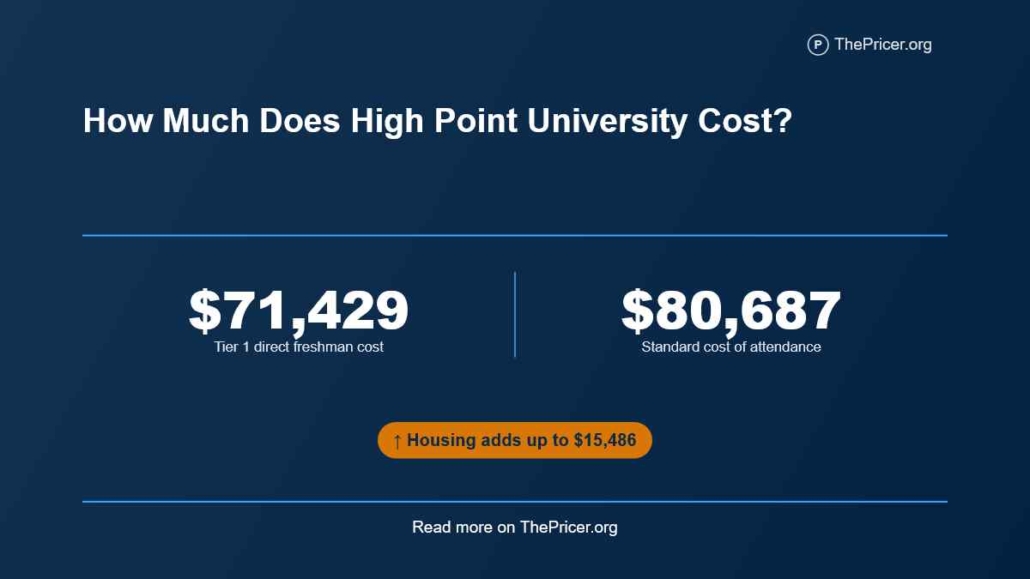
High Point University costs about $71,429 per year in 2026–27 for tuition, fees, Tier 1 housing, food, and North Carolina dining tax before financial aid. HPU’s official average cost of attendance rises to about $80,687 after using Tier 2 housing and adding books, transportation, personal spending, and estimated federal loan fees.
The final amount can move sharply in either direction. Incoming freshmen choosing upgraded housing can add as much as $15,486 to the Tier 1 residential price, while HPU reports an average scholarship and aid package above $23,000 for incoming freshmen. Health insurance and tuition protection can add another $3,650 if neither charge is waived.
Article Highlights
Jump to sections
- HPU tuition and required fees total $50,628 (at $30 per hour, earning that amount would take about 9.7 months of full-time work, before taxes) for 2026–27.
- Tier 1 housing, food, and dining tax cost about $20,800.
- The basic direct freshman price is about $71,429 before aid.
- HPU’s official average cost of attendance is about $80,687.
- Incoming-freshman housing upgrades can add $4,890 to $15,486 per year.
- Merit scholarships currently range from $5,000 per year to full tuition.
- HPU student health insurance costs $3,226 in 2026–27 when it cannot be waived.
How Much Does High Point University Cost?
High Point University’s 2026–27 freshman pricing lists $50,628 (about 9.7 months of full-time work at $30 per hour) for tuition and required fees. Tier 1 housing, the standard meal plan, and North Carolina dining tax add about $20,801. The direct academic-year investment is $71,429 before scholarships, grants, loans, or housing upgrades.
For federal financial-aid purposes, HPU uses a larger budget. Tier 2 housing is used in its standard cost-of-attendance calculation, lifting direct charges to $76,318. HPU then adds $1,500 for books and course materials, $1,600 for transportation, $1,200 for personal costs, and $68 for estimated loan fees. That produces an official annual budget of about $80,687.
| 2026–27 HPU cost | Annual amount |
|---|---|
| Tuition | $44,682 |
| Required fees | $5,946 |
| Tier 1 housing, food, dining tax | $20,800.14 |
| Tier 1 direct total | about $71,429 |
| Tier 2 housing upgrade | +$4,890 |
| Indirect-cost allowance | $4,368 |
| Official average cost of attendance | about $80,687 |
Full-time tuition covers 12 to 18 semester credits. Students taking more than 18 credits pay another $1,055 per excess credit. Part-time students taking 1 to 11 credits pay $1,405 per credit plus $2,973 in fees per semester.
Housing Tiers
Housing is one of HPU’s largest price variables. The 2026–27 incoming-student schedule prices Tier 1 housing, food, and dining tax at $20,800.14 (about 4 months of full-time work at $30 per hour) for fall and spring combined. Tier 1 includes double rooms in several traditional residence halls.
Tier 2 adds $4,890 per year and includes options such as selected single rooms, doubles in several newer buildings, and multi-bedroom suites. Tier 3 adds $6,840. Tier 4 adds $9,900. Tier 5 adds $15,486 and includes selected single rooms.
That means a Tier 5 freshman can face about $86,915 in direct tuition, fees, housing, food, and dining tax before aid. The calculation takes the basic $71,429 direct cost and adds the $15,486 Tier 5 premium.
Housing choice matters too. HPU says 98% of freshmen live in Tier 1 or Tier 2 housing, so the most expensive option is not representative of most first-year students. Returning students have even more tiers. Premium returning-student housing can add more than $20,000 above Tier 1 in selected accommodations.
Students also cannot simply assume they can move off campus after freshman year to cut costs. HPU requires students to live on campus until senior status unless they qualify for an exception such as commuting from a parent’s permanent residence.
Merit Scholarships
High Point’s merit-aid structure is broader than the old article suggests. HPU’s Presidential Scholars program currently lists four award levels. High Point Scholarships range from $5,000 to $10,000 per year. Presidential Scholarships range from $10,000 to $17,000, and Presidential Fellowships range from $12,000 to $20,000.
The Presidential Founders Scholarship sits at the top, ranging from $40,000 to full tuition. These awards are renewable for four years when the student meets the applicable renewal requirements. The undergraduate admission application also serves as the scholarship application, although top candidates can be invited to an on-campus scholarship interview weekend.
The four-year value can be large. A renewable $10,000 annual scholarship represents $40,000 across four years if the award remains intact. A $20,000 annual fellowship represents $80,000. A Founders Scholarship at the $40,000 annual floor represents $160,000 over four years before any tuition changes.
HPU also lists additional scholarship programs. Honors Scholars and several Fellows programs carry a $3,000 annual award, while qualifying Eagle Scouts and Girl Scout Gold Award recipients can receive $1,000.
Need-Based Aid
HPU uses the FAFSA to determine eligibility for federal, state, and institutional need-based aid. Its undergraduate financial-assistance program says institutional grants depend on demonstrated need, the student’s academic profile, and other scholarships or grants in the aid package.
The university’s admission pricing page reports an average incoming-freshman aid and scholarship package above $23,000. Applying exactly $23,000 to the basic $71,429 direct freshman cost produces $48,429, the figure HPU itself publishes as its average direct investment after that aid benchmark.
That is not a promised net price for every student. Merit awards differ, need-based grants can change annually, and outside aid can alter institutional need-based funding. HPU’s aid terms state that total gift aid cannot exceed direct educational charges and that institutional need-based grants are reevaluated each year.
The federal Pell Grant can add substantial help for eligible undergraduate students. The 2026–27 maximum Pell Grant is $7,395. A student should not simply add that figure to HPU’s published average aid amount because the university’s average package can already contain federal, state, institutional, and outside aid.
The number that matters is the student’s actual grant and scholarship total after the financial-aid offer arrives.
Hidden Costs
HPU’s headline price includes more campus services than many colleges charge separately for, including parking, campus airport transportation, residence-hall laundry, tutoring, printing, athletic events, and selected student support services. Several other charges still need attention.
Full-time undergraduates who do not have qualifying outside health coverage are automatically billed for the university plan. HPU’s 2026–27 health-insurance premium is $3,226, split between fall and spring. Students with comparable insurance can waive that charge by the university deadline.
HPU also automatically enrolls undergraduates in an optional tuition-protection program costing $424 per academic year. Families can waive it. If neither health insurance nor tuition protection is waived, the combined charge is $3,650.
Add that amount and HPU’s $4,368 indirect-cost allowance to the Tier 5 direct-price scenario of $86,915, and the planning total reaches about $94,933. This is a calculated high-housing scenario rather than HPU’s standard cost of attendance.
International students holding F-1 visas also pay another $1,500 per academic year. Course-specific lab or equipment charges can appear as well.
Financing the Gap
Federal student borrowing does not cover anything close to HPU’s full sticker price for many dependent freshmen. Federal Student Aid sets the standard first-year dependent undergraduate Direct Loan limit at $5,500, of which no more than $3,500 can be subsidized.
Parent borrowing also changed on July 1, 2026. HPU’s 2026 federal-aid update explains that Parent PLUS borrowing for families without the limited grandfathered exception is capped at $20,000 per academic year and $65,000 per dependent student across undergraduate study.
For a new dependent freshman with no scholarships or grants, the standard $5,500 student loan plus the maximum $20,000 Parent PLUS amount equals $25,500. Against HPU’s $80,687 average cost-of-attendance budget, that still leaves $55,187 to cover through grants, scholarships, family funds, payment plans, outside scholarships, work earnings, or other financing.
HPU offers semester payment plans through its Student Accounts office. Each semester balance can be divided into four or five monthly payments. Enrollment costs $55 per semester, or $110 for two semesters if the family uses the plan both times.
A payment plan changes timing, not price.
Graduate Programs
 Graduate and professional study at High Point uses program-specific pricing rather than the undergraduate $50,628 tuition-and-fee amount. HPU’s graduate tuition schedule lists different per-credit or cohort rates for MBA, education, health-profession, law, dental, and other programs.
The Physician Assistant program shows how far prices have moved from older HPU figures. The 2026–27 PA comprehensive fee is estimated at $59,520 for the first year, divided into $19,840 across each of the summer, fall, and spring terms. Its full first-year cost-of-attendance budget totals about $106,200 when housing, food, books, transportation, personal expenses, and loan fees are included.
HPU also charges different per-credit rates in programs that do not use a cohort tuition amount. One current graduate schedule lists tuition rates including $695, $982, and $1,510 per credit depending on the program, with separate fees.
That means the old article’s single examples for an MBA or PA program cannot serve as a general graduate-price benchmark. Prospective graduate students need the cost page for the exact degree, enrollment term, and cohort year.
Four-Year Cost
Holding HPU’s current prices flat provides a useful scale, though actual tuition, housing, and fees can change each year. Four years at the official $80,687 average cost of attendance equal $322,748. Four years of the Tier 1 direct price of $71,429 equal $285,716 before indirect expenses.
Aid can cut that sharply. If a student received exactly HPU’s published $23,000 average aid benchmark each year and the Tier 1 direct cost never changed, the modeled four-year direct total would fall to $193,716. That scenario is not a promise because grants, scholarships, tuition, and housing prices can change from year to year.
Merit scholarships can create an even wider spread. A student receiving a renewable $5,000 High Point Scholarship would reduce four years of tuition charges by $20,000. A renewable $20,000 Presidential Fellowship would reduce them by $80,000. A Founders award can go as high as full tuition.
Makes sense if
- Your scholarship and grant offer brings HPU’s net price into a range your household can fund.
- You value HPU’s residential model and expect to use the campus services built into the price.
- You compare housing tiers before committing to an upgraded residence.
Does not make sense if
- You are budgeting from the old $56,000 annual estimate.
- You need large private loans after federal aid and scholarships are exhausted.
- A lower-cost college produces a similar academic outcome for your intended field.
For comparison, see Boston University costs, Harvard University costs, and Liberty University dual enrollment costs.
Answers to Common Questions
How much does High Point University cost per year?
HPU’s basic 2026–27 freshman direct cost is about $71,429 for tuition, fees, Tier 1 housing, food, and dining tax. Its standard financial-aid cost of attendance is about $80,687.
How much is High Point University tuition?
Undergraduate tuition is $44,682 for 2026–27. Required fees bring tuition and fees together to $50,628.
Does High Point University offer full-tuition scholarships?
Yes. The Presidential Founders Scholarship currently ranges from $40,000 to full tuition. Other Presidential and High Point merit awards range from $5,000 to $20,000 per year.
How expensive is premium housing at HPU?
Incoming-freshman Tier 5 housing adds $15,486 per year above Tier 1. Tier 2, Tier 3, and Tier 4 upgrades add $4,890, $6,840, and $9,900.
Does HPU require health insurance?
Full-time undergraduates must carry qualifying health insurance. Students without comparable coverage are charged $3,226 for HPU’s 2026–27 plan, while students with qualifying insurance can submit a waiver.
Disclosure: Educational content, not financial advice. Prices reflect public information as of the dates cited and can change. Confirm current rates, fees, taxes, and terms with official sources before purchasing. See our methodology and corrections policy.