
How Much Does Hofstra University Cost Per Semester?
Updated on | Written by Alec Pow
This article was researched using 11 sources. See our methodology and corrections policy.
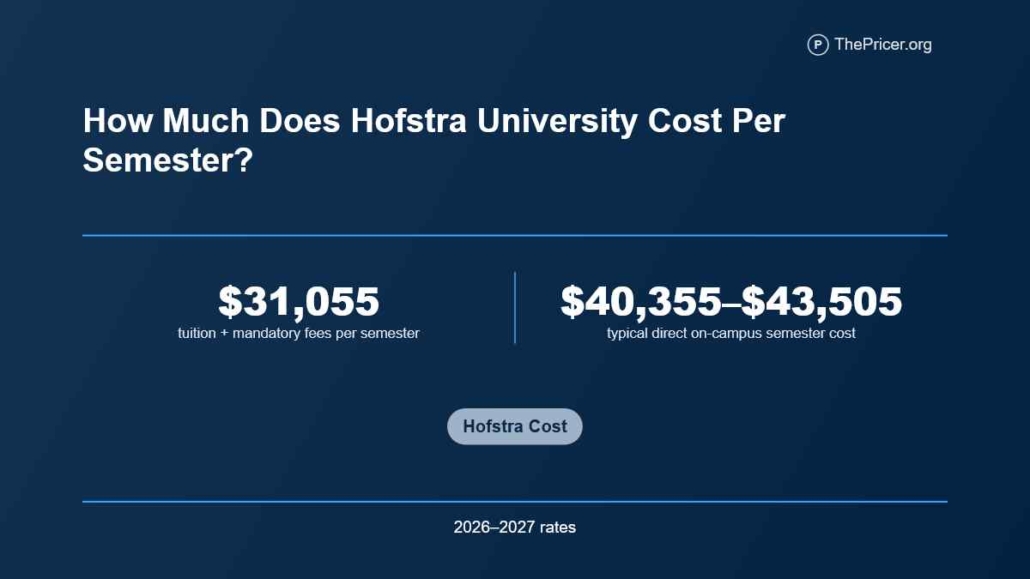
Hofstra University costs $31,055 per semester for full-time undergraduate tuition and mandatory university-wide fees during the 2026-2027 academic year. A student living on campus will usually face a much larger direct bill once housing and dining are added. Depending on the room and dining plan, a realistic billed semester can land around $40,355 to $43,505 before books, transportation, personal spending, optional insurance, special course charges, and financial aid.
Hofstra is a private university in Hempstead, New York, so undergraduate tuition does not change based on New York residency. The price that matters most to a family is also rarely the published sticker price. Housing choices can shift the semester bill by thousands of dollars, and scholarships and grants can reduce what the student actually has to pay by an even larger amount.
Article Highlights
Jump to sections
- Regular full-time undergraduate tuition is $30,468 (at $30 per hour, earning that amount would take about 5.9 months of full-time work, before taxes) per semester for 12 to 17 credits in 2026-2027.
- University, technology, and student activity fees add $587 per semester, bringing regular tuition plus mandatory fees to $31,055.
- On-campus rooms run from about $6,300 to $9,000 per semester for most undergraduate room types listed by Hofstra.
- Resident first-year and sophomore students must choose Dining Plan 5, 6, or 7, costing roughly $2,920 to $3,370 per semester.
- Hofstra estimates a full-time undergraduate living on campus has a total 2026-2027 cost of attendance of $86,924 per year before financial aid.
- The amount a family actually pays can be far below the sticker price because institutional grants and scholarships are common at Hofstra.
How Much Does Hofstra Cost?
Hofstra’s official 2026-2027 tuition schedule lists full-time undergraduate tuition at $30,468 (about 5.9 months of full-time work at $30 per hour) per semester for students taking 12 to 17 credits. Full-time undergraduates are also charged a $392 university fee, $115 technology fee, and $80 activity fee. Combined, those mandatory charges put regular tuition and fees at $31,055 per semester, or $62,110 across two semesters.
That $31,055 figure is the cleanest answer for a full-time commuter whose question is strictly about tuition and standard fees. It does not include housing, dining, books, transportation, loan fees, personal costs, private music instruction, the PALS program, international health insurance, or other situation-specific charges.
| 2026-2027 undergraduate charge | Per semester |
|---|---|
| Full-time tuition, 12-17 credits | $30,468 |
| University fee | $392 |
| Technology fee | $115 |
| Student activity fee | $80 |
| Regular tuition + mandatory fees | $31,055 |
Part-time undergraduate students pay $2,100 per credit for courses numbered 199 and below. Full-time students also pay $2,100 for every credit above 17. An 18-credit semester therefore adds another $2,100 before any course-specific charge. This makes credit load one of the easiest hidden increases to miss when budgeting.
On-Campus Cost
Housing changes the semester total substantially. Hofstra’s 2026-2027 room rates start at $6,300 (about 5.3 full-time workweeks at $30 per hour) per semester for a Towers double. A suite without a lounge costs $6,357, a single costs $7,500, a suite single costs $8,000, and a super single can reach $9,000. Hofstra also charges a $80 residence life fee per semester.
Dining is another mandatory direct expense for undergraduate residents. Current 2026-2027 dining rates run from $1,910 to $3,370 per semester, depending on eligibility and plan. First-year and sophomore residents must select Plan 5, 6, or 7, priced at roughly $2,920, $3,175, or $3,370.
A first-year student taking the lowest applicable dining plan and living in a $6,300 Towers double has a direct semester calculation of:
- Tuition and mandatory fees: $31,055
- Towers double: $6,300
- Residence life fee: $80
- Dining Plan 5: $2,920
- Direct semester total: $40,355
A student choosing a $9,000 super single and the $3,370 dining plan reaches $43,505 per semester using the same tuition and fees. The housing-and-food decision alone creates a difference of $3,150 per semester, or $6,300 over a two-semester year.
Full Cost of Attendance
The billed amount and Hofstra’s financial-aid cost of attendance are not the same thing. Hofstra’s official 2026-2027 cost-of-attendance budget places a full-time undergraduate living on campus at $86,924 for the year. The university includes $62,110 for tuition and fees, $20,850 for housing and food, $1,000 for books and supplies, $1,050 for personal expenses, $1,000 for transportation, and estimated loan fees.
Dividing the annual estimate equally between two semesters gives a budgeting equivalent of about $43,462 per semester. Families should not expect every individual line item to arrive as a bill for exactly half its yearly amount. Books, travel, borrowing costs, and personal spending happen at different times. The calculation is useful because it shows how much larger the economic cost of a semester can be than the $31,055 tuition-and-fee figure.
| Living arrangement | Annual Hofstra COA | Two-semester equivalent |
|---|---|---|
| On campus | $86,924 | $43,462 per semester |
| Off campus, independent student | $93,489 | $46,744.50 per semester |
| Living with parent | $77,834 | $38,917 per semester |
The surprisingly high off-campus figure does not mean Hofstra charges an off-campus student $93,489. It is an estimated financial-aid budget incorporating housing, food, transportation, and other living expenses. Actual off-campus spending depends heavily on rent, roommates, commuting distance, and lifestyle.
Graduate Tuition
Graduate students should not use the undergraduate semester number. Hofstra bills most graduate study by credit. For 2026-2027, most graduate programs charge $1,826 per credit, while Frank G. Zarb School of Business graduate courses cost $1,868 per credit. A student taking nine credits would therefore face base tuition of about $16,434 in a standard graduate program or $16,812 in the Zarb School before applicable university, technology, activity, program, housing, or other charges.
Hofstra’s graduate cost-of-attendance estimates also vary according to program, credit load, and living arrangement. That distinction matters because a graduate student taking six credits and living with family has a very different financial picture from a nine-credit student renting independently on Long Island.
Some programs use entirely different fee structures. The Online MBA is listed at $1,868 per credit, the Executive MBA has its own program pricing, and Audiology has a specialized rate. Law and medical students also have separate tuition schedules. A prospective graduate student should identify the exact program before converting an annual university cost figure into a semester budget.
The old assumption that graduate study simply costs less than undergraduate study can be misleading. A lower per-semester tuition bill may reflect fewer enrolled credits rather than a cheaper degree. Program length and total required credits matter when comparing complete degree costs.
Aid and Net Price
Sticker price does not reveal what most aided students finally pay. Hofstra reports that 98% of full-time first-year students in fall 2024 received financial aid, including grants. Hofstra’s current net price calculator is configured for students entering during the 2026-2027 academic year and is a much better household budgeting tool than subtracting a generic average award from the published tuition.
The university says scholarships and grants cover an average of 58% of tuition costs, with average institutional aid reported at $34,017. Those are averages across recipients and should not be treated as a guaranteed discount. Merit scholarship amounts, demonstrated financial need, federal grants, New York aid, outside scholarships, and family circumstances can produce very different net prices.
Independent data also illustrates why sticker price and net price must be separated. College Board’s Hofstra cost profile reports an average annual net price in the mid-$35,000 range based on the underlying reporting period. That measure represents the average cost after grants and scholarships for the relevant student population, not a current guaranteed quote for every incoming student.
A family offered $25,000 in annual grants would reduce a $62,110 annual tuition-and-fee sticker price to $37,110 before housing, food, and other costs. A family receiving $40,000 in grants would reduce the same tuition-and-fee portion to $22,110. The award letter is therefore more useful than the published sticker price when deciding whether Hofstra is affordable.
Hofstra vs Alternatives
Hofstra’s private-university price is much higher than public in-state tuition before aid. SUNY lists $7,070 in annual tuition for New York residents at state-operated bachelor’s-degree campuses in 2026-2027. Typical annual student fees add $1,830. That puts the published tuition-and-fee difference against Hofstra at more than $53,000 per year before scholarships, housing, and other costs.
That sticker-price comparison is useful but incomplete. A large Hofstra merit or need-based award can narrow the difference considerably, while housing, commuting, academic program, transfer-credit policy, graduation time, and financial-aid renewal conditions can change the four-year result. Families comparing Hofstra with New York University, the University of Michigan, or Arizona State University should compare net price under their own aid offers rather than published tuition alone.
A useful four-year calculation is the remaining annual cost after renewable grants multiplied by four, then adjusted for expected tuition changes, housing, and borrowing. A $10,000 annual difference between two realistic net prices becomes $40,000 over four years before loan interest. A $20,000 annual difference becomes $80,000. Small-looking semester gaps become large degree-level differences.
Community-college transfer can reduce early tuition costs too, but transfer students should confirm which credits Hofstra will accept and how financial aid changes after transfer. Saving on the first two years helps only when credits apply toward the intended degree without extending enrollment.
Hidden Costs
The largest easy-to-miss charge is extra academic load. Tuition covers 12 to 17 undergraduate credits, but each credit above 17 costs $2,100. A student taking 18 credits pays $2,100 extra; 19 credits would add $4,200. Some specialized courses carry further charges, including private music instruction.
Housing also creates financial penalties if plans change. Hofstra lists a $1,500 housing cancellation fee. Students who arrive before the normal residence period can face a $65-per-night early-arrival fee. International students face required health-plan charges of $1,149 in fall and $1,592 in spring under the current fee schedule.
Payment timing creates another risk. Hofstra lists late-payment charges that can rise from $100 to $250 as an unpaid fall or spring balance remains unresolved. Missing a payment while enrolled in a payment plan can add $100 per month. The university offers semester payment plans that can spread the balance across five months, which changes cash flow but does not reduce the underlying tuition.
There is also optional tuition refund insurance. For fall 2026 and spring 2027, Hofstra lists a $219 semester premium for students living off campus and $286 for students living on campus. It can extend certain withdrawal protection beyond the university’s normal refund schedule, but it is an added cost rather than part of required tuition.
Lowering the Cost
 The biggest potential reduction is financial aid, not saving a few hundred dollars on books. Complete the FAFSA and any applicable New York aid paperwork early, compare the grant portion of the award rather than the headline aid total, and separate grants and scholarships from loans. A $30,000 scholarship cuts cost. A $30,000 loan finances cost and creates a later repayment obligation.
Housing selection is another measurable lever. Moving from a $9,000 super single to a $6,300 Towers double saves $2,700 per semester, or $5,400 over two semesters, using current rates. Choosing Dining Plan 5 rather than Plan 7 saves another $450 per semester for an eligible resident. Those two choices together can shift annual direct costs by roughly $6,300.
Hofstra also offers an optional four-year locked tuition-and-fee arrangement for new undergraduate students. The current published locked rate is $32,726 per semester before the student activity fee, compared with the standard 2026-2027 combination of $30,468 tuition + $392 university fee + $115 technology fee.
The locked option starts at a premium in exchange for protection against qualifying tuition-and-fee increases in later years. Families should compare that premium with the increases they would need to avoid for the contract to save money over four years.
Avoiding an unnecessary extra semester can dwarf smaller savings. At today’s regular $31,055 tuition-and-fee level, one additional full-time semester can cost more than many textbook, transportation, and dining economies combined. Degree planning, transfer-credit review, course sequencing, and keeping required classes on schedule can have a larger financial effect than trimming day-to-day spending.
What We Verified: We checked Hofstra’s current 2026-2027 tuition schedule, undergraduate cost-of-attendance budget, housing rates, dining contracts, graduate rates, financial-aid information, payment rules, and refund-related charges. We removed the previous article’s fictionalized student examples, unattributed expert quotations, unsupported student survey percentages, outdated international comparisons, and speculative future cost projections. Where we calculated semester or annual totals, the arithmetic uses the published Hofstra inputs shown above rather than treating the calculation as a separately reported university price.
Answers to Common Questions
How much is Hofstra tuition per semester?
Regular full-time undergraduate tuition is $30,468 per semester for 12 to 17 credits in 2026-2027. Mandatory university, technology, and activity fees bring the standard tuition-and-fee total to $31,055 per semester.
How much is Hofstra with room and board?
A typical on-campus student’s direct semester charges can reach roughly $40,355 to $43,505 using current undergraduate tuition, mandatory fees, published room rates, the residence life fee, and common resident dining plans. Specific room and dining choices change the total.
How much does Hofstra cost per year?
Hofstra’s official 2026-2027 full-time undergraduate cost-of-attendance estimate is $86,924 per year for an on-campus student before scholarships and grants. Tuition and mandatory fees alone total $62,110 per year.
Is Hofstra the same price for in-state and out-of-state students?
Yes. Hofstra is a private university, so its standard undergraduate tuition does not use separate New York resident and nonresident tuition schedules.
How much is Hofstra after financial aid?
There is no single after-aid price. Scholarships, grants, family income, academic credentials, federal and state eligibility, and housing choices can change the amount substantially. Hofstra reports widespread institutional aid, so prospective students should compare their individual financial-aid award and net-price estimate with the published sticker price.
Does Hofstra have a payment plan?
Yes. Hofstra offers semester-based payment plans that can spread the amount due across five months. A payment plan changes when the family pays the balance rather than reducing the underlying cost.
Disclosure: Educational content, not financial advice. Prices reflect public information as of the dates cited and can change. Confirm current rates, fees, taxes, and terms with official sources before purchasing. See our methodology and corrections policy.