
How Much Does Home Heating Oil Cost?
Published on | Written by Alec Pow
This article was researched using 13 sources. See our methodology and corrections policy.
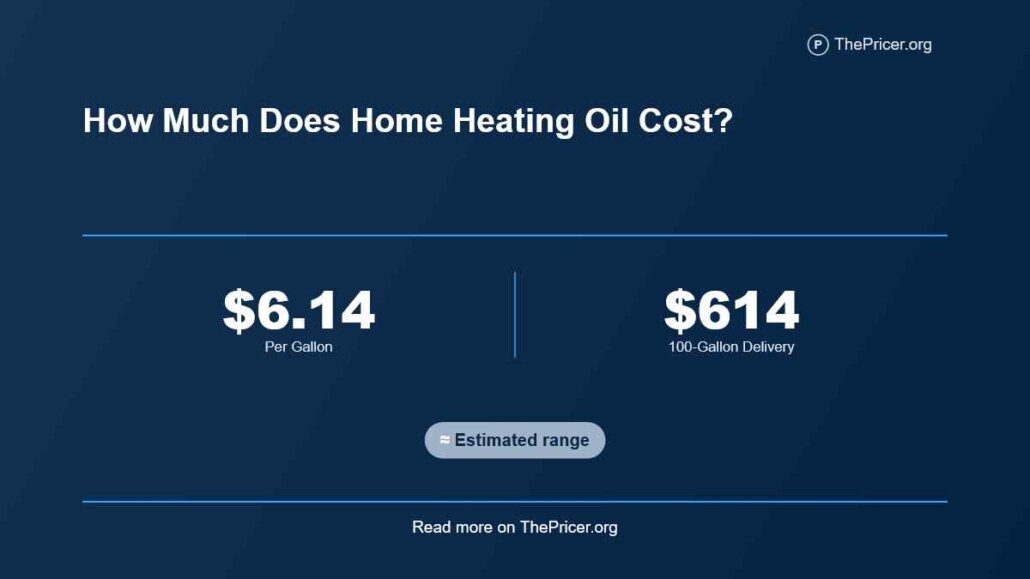
Home heating oil costs approximately $6.14 per gallon in the United States as of October 12, 2026, according to the Energy Information Administration’s residential price survey. A 100-gallon delivery costs about $614, while 150 gallons costs approximately $921, before applicable taxes or additional delivery charges. The actual price varies by state, dealer, order size, and delivery arrangement.
Heating oil has become much more expensive ahead of winter 2026–27. The national surveyed price is approximately 73% higher than a year earlier, while EIA forecasts that households primarily using heating oil will spend 21% more on the fuel this winter. The difference reflects expected changes in consumption and seasonal prices. For homeowners, the total heating bill depends on gallons burned, the efficiency of their furnace or boiler, and whether they receive scheduled or emergency deliveries.
Article Highlights
Jump to sections
- The U.S. residential heating-oil average reached $6.138 per gallon on October 12, 2026, excluding taxes.
- A 100-gallon delivery costs approximately $614, while 200 gallons costs approximately $1,228 at that benchmark.
- State averages ranged from $5.47 in Nebraska to $6.34 in New York among surveyed states.
- EIA forecasts average winter heating-oil expenditures of approximately $2,115 per household, up 21% from last winter.
- Some dealers require 100–150 gallons per delivery and charge $45 to $75 extra for smaller orders.
- Same-day, after-hours, and burner-restart charges can add $40 to $350 or more, depending on the dealer and service.
How Much Does Home Heating Oil Cost?
The U.S. Energy Information Administration publishes weekly residential heating-oil prices during the October-to-March heating season.
Its October 12 heating-oil survey reported a national average of $6.138 per gallon. This was up from $6.050 the previous week and approximately $3.543 one year earlier.
The published prices exclude taxes. They represent surveyed residential prices rather than a guarantee that every homeowner can order fuel at exactly the reported rate.
The following table uses EIA’s October 12 state and regional observations, rounded to cents.
| State or region | Price per gallon | 150-gallon cost |
|---|---|---|
| United States | $6.14 | $921 |
| New England | $6.08 | $912 |
| Connecticut | $6.09 | $914 |
| Maine | $5.97 | $895 |
| Massachusetts | $6.12 | $917 |
| New Hampshire | $6.03 | $904 |
| New Jersey | $6.31 | $947 |
| New York | $6.34 | $950 |
| Pennsylvania | $6.01 | $902 |
| Ohio | $6.04 | $905 |
| Nebraska | $5.47 | $821 |
Delivery totals are calculated from the underlying unrounded EIA prices, so they may differ slightly from multiplying the displayed rounded price. They exclude taxes and extra services.
The concentration of oil-heated households in the Northeast makes regional conditions especially influential. More than 80% of U.S. homes primarily heated by oil are in that region.
Heating Oil Costs This Winter
EIA’s 2026–27 Winter Fuels Outlook forecasts an approximately 21% increase in household heating-oil spending compared with last winter.
Its base-case forecast puts average expenditures around $2,115 over the winter heating season. This is a modeled household average, not a promised annual bill or the cost of filling a particular tank.
EIA expects higher fuel prices to be partly offset by milder Northeast temperatures, which would reduce the quantity of heating oil consumed.
A household’s actual total can differ substantially depending on square footage, insulation, local climate, thermostat settings, equipment efficiency, and whether heating oil also provides domestic hot water.
Consider three illustrative seasonal fuel quantities priced at the October 12 national benchmark of $6.138 per gallon.
- 300 gallons cost approximately $1,841.
- 500 gallons cost approximately $3,069.
- 800 gallons cost approximately $4,910.
These calculations hold the current price constant and are not EIA forecasts for homes with those consumption levels. Winter prices can change between deliveries.
Someone using 800 gallons would pay approximately $3,069 more than a household using 300 gallons at the same price. Reducing consumption may therefore matter as much as finding a slightly cheaper dealer.
Prices by State and Dealer
Heating oil is a petroleum distillate closely connected to diesel fuel markets. Its price reflects crude oil, refinery output, distribution, inventories, and local retail costs.
EIA’s October 6 winter forecast announcement reported that East Coast distillate inventories were 32% below their five-year seasonal average in September.
The agency expects inventories to remain below normal through the winter, increasing sensitivity to supply disruptions and changes in demand.
The Maine Department of Energy Resources surveys delivered cash prices by region. Its October 5 survey reported a statewide average of $5.97 per gallon, with observed offers between $5.45 and $6.81.
Massachusetts’ October 13 state survey reported an average of $6.18 per gallon, with the surveyed 10th and 90th percentile prices at $5.70 and $6.62.
Those state results are gathered through different survey methods and dates. They should not be combined into a new national average.
A separate October 1 dealer-listing analysis examined 268 advertised offers across 11 states. Its dealer medians were generally below the EIA full-service retail averages, reflecting different samples, timing, and purchase conditions.
This helps explain why an advertised cash-delivery price may be lower than a government survey average. The lower price may also come with fewer included services.
How Much Is a Typical Oil Delivery?
Heating oil is usually delivered into a storage tank at the home. A homeowner typically orders a set number of gallons or arranges for the dealer to refill the tank on an automatic schedule.
A 150-gallon delivery at the national October 12 benchmark costs approximately $920.70 before taxes and extra charges.
At that rate, buying 250 gallons would cost approximately $1,534.50. A larger order therefore requires more money upfront, although some dealers offer volume discounts.
Order size also affects whether delivery is available at the advertised rate.
Sherman Oil’s published delivery terms specify a 150-gallon minimum for regular delivery, with smaller orders subject to restrictions. Deliveries under 100 gallons carry an additional $75 charge.
Another Massachusetts supplier, Charlton Oil, lists a 100-gallon minimum and a $50 fee for deliveries below that quantity.
Consequently, someone needing only 75 gallons may face a surcharge even when the advertised price per gallon appears competitive.
The Hidden Price of Running Out
Emergency deliveries can be significantly more expensive than scheduled orders, particularly outside normal business hours.
Squier & Company publishes a $50 same-day charge, a $50 burner prime or restart charge, and a $350 after-hours emergency service charge that includes priming.
These are documented dealer-specific fees, not national averages. The after-hours package should not be added to a separate priming charge when that service is already included.
To see how charges compound, consider a hypothetical 75-gallon order from a supplier using the national benchmark price and a published-style small-order fee.
- 75 gallons at $6.138: $460.35
- Assumed small-delivery fee: $50
- Assumed same-day delivery charge: $40
- Assumed burner restart charge: $50
- Illustrative total: $600.35
The fees in this model are representative amounts from published dealer schedules, not a single supplier’s bundled quotation. They are assumed to apply separately for illustration.
The resulting effective cost is approximately $8.00 per delivered gallon, compared with the underlying $6.14 fuel benchmark.
This is why ordering before the tank is nearly empty can save more than searching for a difference of a few cents per gallon.
Another dealer, Bridgewater Fuel, publishes a $45 sub-100-gallon delivery fee and a separate $60 priming fee. Its example shows that these expenses are common contract variables, although not every customer incurs them.
Fixed-Price Contracts vs Cash Delivery
 Heating-oil companies offer different purchasing arrangements, including will-call delivery, automatic delivery, fixed-price contracts, capped-price contracts, and budget payment plans.
Under will-call service, homeowners monitor the tank and request deliveries when needed. This provides control over timing but increases the risk of running low.
Automatic delivery uses supplier estimates of consumption and weather to schedule refills. It can reduce runout risk, although customers should verify how prices are established.
A fixed-price agreement gives budgeting certainty but may prevent the customer from benefiting if market prices decline.
A capped plan limits the price paid under its terms, but the supplier may charge a program fee. The Massachusetts heating-oil contracts guide advises consumers to check upfront charges, termination penalties, service coverage, refunds, and whether the customer receives the lower market price when prices fall.
Suppose a contract charges $100 to provide price protection on 500 gallons. That fee effectively adds 20 cents per gallon if the entire quantity is purchased.
The cap would need to produce enough savings or budgeting value to justify the fee. A cap is not automatically cheaper than buying oil as needed.
How Much Heat Does a Gallon Provide?
The price per gallon alone does not establish the cost of usable home heat. The efficiency of the furnace or boiler determines how much of the fuel’s energy reaches the home.
The EIA energy conversion reference lists approximately 138,500 British thermal units, or Btu, in one gallon of heating oil.
At $6.138 per gallon, that is approximately $44.32 per million Btu of fuel energy before heating-system losses.
If a system delivers 85% of that energy as useful heat, the effective fuel cost becomes approximately $52.14 per million usable Btu.
At 70% efficiency, it becomes approximately $63.31 per million usable Btu.
For an illustrative 500-gallon season, an 85%-efficient system delivers approximately 58.9 million usable Btu. A 70%-efficient system would require about 607 gallons to deliver the same usable heat.
At the current benchmark, the extra 107 gallons would cost approximately $657. This is a simplified comparison of seasonal efficiencies, not a guaranteed saving from replacing a furnace.
Upgrading old equipment may reduce consumption, but the cost of furnace replacement must be weighed against actual fuel savings and the remaining life of the existing system.
Other Costs of Oil Heating
A household’s total heating expense can include more than delivered fuel. Furnace or boiler servicing, burner repairs, filtration, chimney or vent work, and tank maintenance may require separate spending.
An aging storage tank is a particularly substantial financial risk. ThePricer’s oil tank replacement guide documents a broad range of approximately $1,200 to $4,600 for many residential projects, with difficult underground removals costing more.
That is a capital replacement expense, not an annual fuel charge. Homeowners should not add it to every winter bill unless the tank actually needs replacement.
Those considering switching from oil can compare the installed heat pump cost and the expenses involved in gas boiler replacement.
Any conversion analysis should account for heating capacity, local energy prices, equipment installation, and whether existing radiators or ductwork can be retained.
The EIA’s winter comparison is particularly sensitive to the types of homes using each fuel. A lower national average heating bill for natural gas does not prove that converting a particular oil-heated house will save money.
How Can Homeowners Pay Less?
The largest opportunities usually involve buying under favorable delivery terms and reducing the gallons of fuel consumed.
Compare quotes using the same delivery quantity and payment method. A cash price for 200 gallons should not be compared directly with a full-service automatic-delivery price that includes additional maintenance coverage.
Check tank levels well before a delivery becomes urgent. Ask each dealer about minimum orders, runout fees, emergency charges, cash discounts, and cancellation terms.
For households facing difficulty paying heating bills, the federal Low Income Home Energy Assistance Program may help through state-administered benefits. The Indiana 2026–27 assistance program illustrates how application periods, eligibility rules, and benefits vary by location.
Homeowners should consult their own state program rather than assuming eligibility or a nationwide payment amount.
Makes sense if
- Comparing multiple dealers for the same volume and delivery terms.
- Ordering before the tank reaches an emergency level.
- Choosing automatic delivery when avoiding runouts is a priority.
- Improving heating-system efficiency and reducing unnecessary heat loss.
Does not make sense if
- Choosing the lowest advertised per-gallon price without checking fees.
- Paying for a capped-price contract without understanding the premium.
- Ordering repeated small deliveries that attract surcharges.
- Comparing different heating fuels without accounting for equipment efficiency and conversion costs.
Answers to Common Questions
How much is home heating oil per gallon right now?
The U.S. residential average was approximately $6.14 per gallon on October 12, 2026, excluding taxes. Local quotes vary by state, supplier, order quantity, and payment terms.
How much does a 100-gallon heating oil delivery cost?
At the current national benchmark, approximately $614 before taxes or additional charges. Some suppliers impose higher prices or fees on deliveries below their minimum order size.
How much does it cost to fill a 275-gallon oil tank?
A nominal 275-gallon tank is not normally filled to its entire stated capacity. A hypothetical delivery of 200 gallons costs approximately $1,228 at the October 12 national benchmark. The actual delivery quantity depends on the tank’s starting level and safe fill capacity.
How much will heating oil cost during winter 2026–27?
EIA forecasts average household heating-oil expenditures of approximately $2,115 for the season, about 21% more than last winter. Actual spending depends on consumption, weather, fuel prices, and heating equipment.
Is automatic heating oil delivery cheaper?
Not necessarily. Automatic delivery can reduce the risk of running out, while will-call delivery offers more control over purchase timing. The cheaper choice depends on prices, discounts, contract terms, and potential fees.
Disclosure: Educational content, not financial advice. Prices reflect public information as of the dates cited and can change. Confirm current rates, fees, taxes, and terms with official sources before purchasing. See our methodology and corrections policy.