
How Much Does Home Maintenance Cost Per Year?
Published on | Written by Alec Pow
This article was researched using 13 sources. See our methodology and corrections policy.
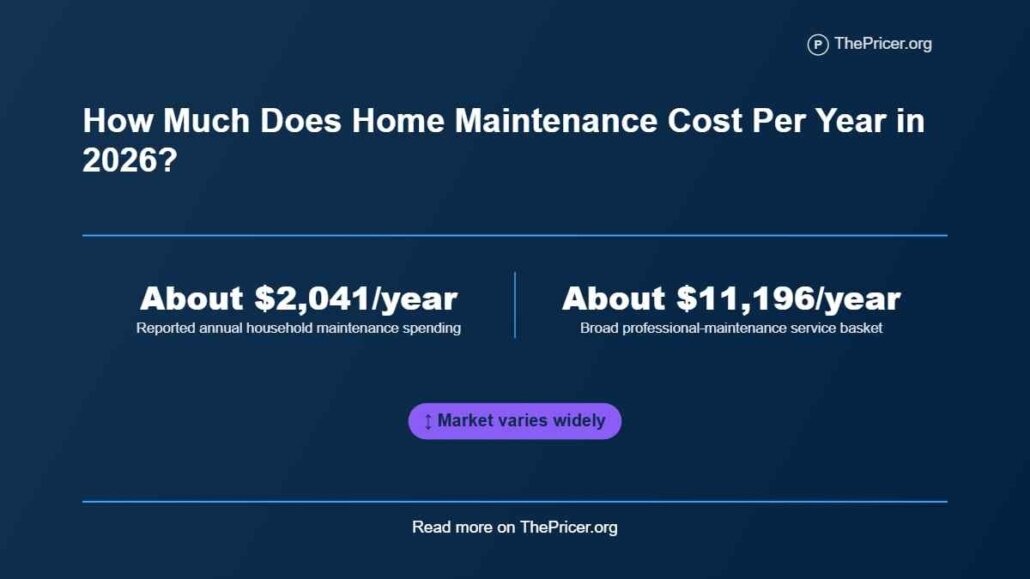
Home maintenance can cost about $2,041 per year in reported household spending, while a broad professional-service approach can reach $11,196 per year. Angi reported the lower figure for 2025 household maintenance spending. The higher figure comes from recommended professional maintenance work priced in Thumbtack’s July 2026 index.
Those figures answer different questions. A homeowner who does some work personally may spend far less cash than someone who hires out every recurring task. A sound annual budget also needs room for repairs and eventual replacements that are not part of routine service. The practical annual target depends on the home’s age, systems, location, service level, and condition.
For a U.S. single-family home, the annual home maintenance budget is shaped by house age, home value, square footage, climate, local labor rates, and the amount of work hired out. Recurring costs may include HVAC service, gutter cleaning, pest control, chimney sweeping, water-heater care, lawn work, roof checks, plumbing upkeep, drainage work, and exterior sealing. Routine maintenance, emergency repairs, and major replacements belong in separate cost buckets, so any yearly estimate needs to state which costs it includes.
Article Highlights
Jump to sections
- Reported maintenance spending averaged $2,041 per household for 2025.
- A broad hired-professional maintenance basket reached $11,196 per year in July 2026.
- The gap between those two figures is about 5.5 times, mainly because their scope and methods differ.
- Home value rules are better treated as reserve targets than as predictions of this year’s invoice.
- Recurring service frequency can turn a modest per-visit charge into a much larger annual total.
How Much Does Home Maintenance Cost Per Year?
The gap between $2,041 and $11,196 is too large to explain as ordinary price variation. It comes from measurement. Angi’s cited figure is reported household spending on maintenance during 2025. Thumbtack’s cited figure is a weighted index built from professional projects that the company classifies as essential annual home care, adjusted for recommended frequency.
A homeowner who paints, cleans, changes filters, handles yard work, or performs small upkeep without paid labor can have real maintenance activity that never appears as a professional-service bill.
ThePricer’s calculation makes the scope gap concrete. Dividing $11,196 by $2,041 gives 5.49, so the professional-service index is about 5.5 times the observed household maintenance spending figure. The difference is $9,155 per year. This does not prove that households are neglecting $9,155 of work. The two data sets measure different baskets with different methods.
Bankrate provides another useful warning about headline averages. Its 2025 analysis assigns a maintenance budget equal to 2% of the median single-family sale price, producing a national figure of $8,808 per year. That is a modeled budget tied to home value. It is not a survey showing that the average household wrote checks totaling $8,808 for maintenance.
What Counts as Home Maintenance?
Home maintenance is recurring work that keeps a house and its systems functioning as intended. Cleaning gutters, servicing heating and cooling equipment, flushing a water heater, inspecting a chimney, controlling ordinary household pests, sealing small exterior gaps, and caring for drainage are maintenance tasks. The common thread is preservation. The work addresses wear, debris, adjustment, inspection, and minor deterioration before a larger failure develops.
Repairs sit next to maintenance but should not be merged with it. Replacing a failed circulation pump, fixing a roof leak, repairing damaged siding, or restoring a broken garage-door spring is corrective work. Replacement goes one level farther. A new furnace, roof, water heater, or major appliance may be needed after the old component reaches the end of its useful service life. Remodeling is different again because it changes or upgrades the home rather than preserving the existing asset.
This distinction changes the annual number. A household can have a low-maintenance year and still face a costly failure. Another household may pay for many scheduled services yet avoid any large repair during the same period. Mortgage payments, property tax, utilities, HOA dues, and home insurance premiums belong to the wider cost of ownership, not the routine-maintenance total used here.
Budget by Value and Age
A reserve formula answers a different question from a service-price list. Fannie Mae suggests budgeting 1% to 4% of home value per year for maintenance, repairs, and replacements. Its worked examples put a newer $350,000 home at a $3,500 yearly savings target and a home more than 30 years old at $14,000 yearly. The age adjustment matters because older systems and materials are more likely to need corrective work or replacement.
That percentage is best used as a funding target rather than a forecast of this year’s maintenance invoice. Market value can reflect land scarcity, school districts, neighborhood demand, and local housing supply. A high-value home is not automatically four times harder to maintain than an identical structure in a cheaper market. House age, roof condition, heating and cooling equipment, plumbing materials, exterior finishes, drainage, and the owner’s service choices give the percentage rule needed context.
A second ThePricer calculation connects observed spending with reserve planning. Angi reported $2,041 in maintenance spending and $1,143 in emergency-repair spending for 2025. Added together, that is $3,184 per year, or about $265 per month. Against Fannie Mae’s illustrative $350,000 home, the combined figure equals about 0.91% of home value. It still does not create a full replacement reserve for an aging roof, HVAC system, or major appliance.
Routine Service Prices
Task prices show how a household can move from a few hundred dollars to several thousand dollars a year. The table uses current national pricing pages and keeps each service in its own billing unit. Not every home needs every task. A house without a chimney has no chimney-cleaning bill, while a property with heavy tree cover may need gutter work more often than an open-lot home.
| Routine service | Current U.S. price | Scope and annual effect |
|---|---|---|
| HVAC maintenance | $150 to $350 per visit, about $275 average | Current 2026 pricing also lists annual HVAC service contracts at $150 to $500 per year. |
| Gutter cleaning | $119 to $234 per visit, about $168 average | Current pricing shows that downspout flushing or minor repair can add $50 to $100. |
| Water-heater flush | $110 to $200 per service, about $160 average | Current flushing prices vary with tank size and heater type, along with local labor. |
| Chimney sweeping | $129 to $381 per service, about $254 average | Current sweeping prices vary with chimney condition and fireplace type. |
| Recurring pest control | $300 to $900 per year | Recurring plan prices vary with visit frequency and treatment scope, as well as pest type. |
Frequency is the hidden multiplier. Two gutter cleanings at the reported $168 average cost $336 per year before add-ons. A homeowner comparing local bids can use the detailed gutter cleaning cost discussion to match visit scope, access, and downspout work. Recurring pest plans have a similar scope problem, so comparing a one-time extermination with a scheduled monthly pest control plan can distort the annual budget.
What Pushes Costs Higher?
 House size matters, but it is only one driver. More roof edge can mean more gutter footage. A larger yard adds mowing and trimming time. Multiple HVAC zones create more equipment to inspect. Two water heaters create two maintenance points. A steep roof, three-story access, crawlspace, finished basement, narrow side yard, mature trees, or difficult mechanical-room access can also increase labor without changing the home’s square footage.
Climate changes the service calendar. Hot regions put long seasonal loads on cooling equipment. Cold regions can create freeze-related checks and more heating-system use. Areas with heavy tree cover can produce more gutter debris. Wet conditions can raise the importance of drainage, exterior sealing, and pest control. Local labor prices and contractor travel time then affect what the same physical task costs in different markets.
Service choices also move the annual total. A homeowner who handles mowing, filter changes, simple cleaning, and minor sealing may pay mainly for licensed or equipment-heavy work. A pro-heavy household pays for repeated labor, scheduling, travel, equipment, and business overhead. The monthly lawn service figures show how recurring visits can become one of the larger discretionary maintenance lines. The important comparison is the same task list and frequency, not two quotes with different service bundles.
A Worked Annual Budget
Take an illustrative single-family home with central HVAC, gutters, a tank water heater, an active chimney, and a recurring general pest plan. The scenario uses published averages where available and chooses the midpoint of the cited annual pest-plan range. It is a calculation, not a claim that this is the national household average.
One HVAC maintenance visit at $275 plus two gutter cleanings at $168 each comes to $611. Add one water-heater flush at $160 and one chimney sweep at $254, bringing the subtotal to $1,025. A chosen pest-plan midpoint of $600 raises the illustrated annual service total to $1,625. Spread evenly across the year, that is about $135 per month.
The scenario excludes lawn care, house cleaning, roof work, painting, appliance service, supplies for DIY tasks, unexpected repairs, and replacement of worn-out equipment. It also assumes one routine visit for HVAC, water-heater, and chimney work. A property that needs two seasonal HVAC visits, more frequent gutter cleaning, or specialty pest treatment can exceed the modeled total. A home without a chimney or without recurring pest service can fall below it.
This itemized result also shows why one percentage rule cannot describe every household. The modeled $1,625 service calendar is far below a broad professional-maintenance index because it covers only five selected services. It is also below a repair-and-replacement reserve because no capital failure is included. The calculation is useful only when its exclusions travel with the number.
Repairs, Replacements
A maintenance budget should not be expected to absorb every ownership shock. The National Association of Insurance Commissioners explains that a homeowners policy does not cover ordinary wear as a maintenance contract would. That boundary matters when a roof, water heater, furnace, deck component, or other system reaches the end of service life through age and ordinary deterioration.
One practical setup uses separate mental buckets. Routine maintenance covers scheduled work. A repair reserve covers failures that can happen before replacement is planned. A replacement fund handles expensive assets that have finite lives. Those buckets can sit in the same savings account, but the budget should track them separately so a low-service year does not create false confidence about long-term ownership cost.
Replacement also changes the value of maintenance decisions. Paying for a water-heater flush is not equivalent to saving for a new unit. Homeowners facing an aging tank can compare current water heater replacement costs with the remaining expected service period rather than treating routine flushing as protection against every failure. The same logic applies to roofs and HVAC equipment. Maintenance can preserve condition. It cannot make a finite-life component permanent.
DIY and Professional Work
DIY work can reduce cash spending when the homeowner already has the time, tools, access, and skill for the task. Filter replacement, basic cleaning, visible caulk touch-ups, simple yard work, and routine visual checks often have low labor complexity. Paid service becomes more attractive when a job requires diagnostic instruments, specialty equipment, difficult access, formal inspection, or work on systems where an error can create a larger repair.
The decision should compare the same scope. A low DIY cash figure leaves out the homeowner’s time and any tools or materials already owned. A contractor price includes labor, travel, equipment, scheduling, and business costs. Neither approach is automatically cheaper in every house. Repetition matters too. A task completed twice a year may justify buying simple equipment, while an occasional specialized job may not.
Makes sense if
- You raise the reserve for an older home with several systems near replacement age.
- You budget recurring professional labor for difficult access or equipment-heavy tasks.
- You track per-visit services by annual frequency before accepting a quote.
- You separate scheduled upkeep from emergency repairs and capital replacements.
Does not make sense if
- You treat 4% of home value as a required cash expense for every newer home.
- You compare a professional-service index with DIY-heavy household spending as identical measures.
- You count renovations, taxes, utilities, and insurance premiums as routine maintenance.
- You assume a low-maintenance year means no replacement reserve is needed.
Answers to Common Questions
How much should I save monthly for home maintenance?
The right monthly amount depends on whether the fund covers routine service only or also repairs and replacements. The observed maintenance-plus-emergency spending calculation above equals about $265 per month, while older homes can justify a much larger reserve.
Is 1% of home value enough for maintenance?
It can be a starting reserve target for a newer home, but it is not a promise that the year’s bills will equal that amount. Older systems, difficult access, local labor prices, and pending replacement needs can push the prudent savings target higher.
Does home insurance pay for maintenance?
No. Home insurance covers specified losses under the policy. Ordinary upkeep and wear remain the homeowner’s responsibility, so insurance should not replace a maintenance and repair fund.
What maintenance costs are easiest to underestimate?
Recurring per-visit services are easy to undercount because frequency changes the annual total. Gutter cleaning, lawn work, pest service, and HVAC visits can each look modest until every scheduled visit and add-on is included.
Disclosure: Educational content, not financial advice. Prices reflect public information as of the dates cited and can change. Confirm current rates, fees, taxes, and terms with official sources before purchasing. See our methodology and corrections policy.