
How Much Does Homeschooling Cost Per Year in the U.S.?
Published on | Written by Alec Pow
This article was researched using 14 sources. See our methodology and corrections policy.
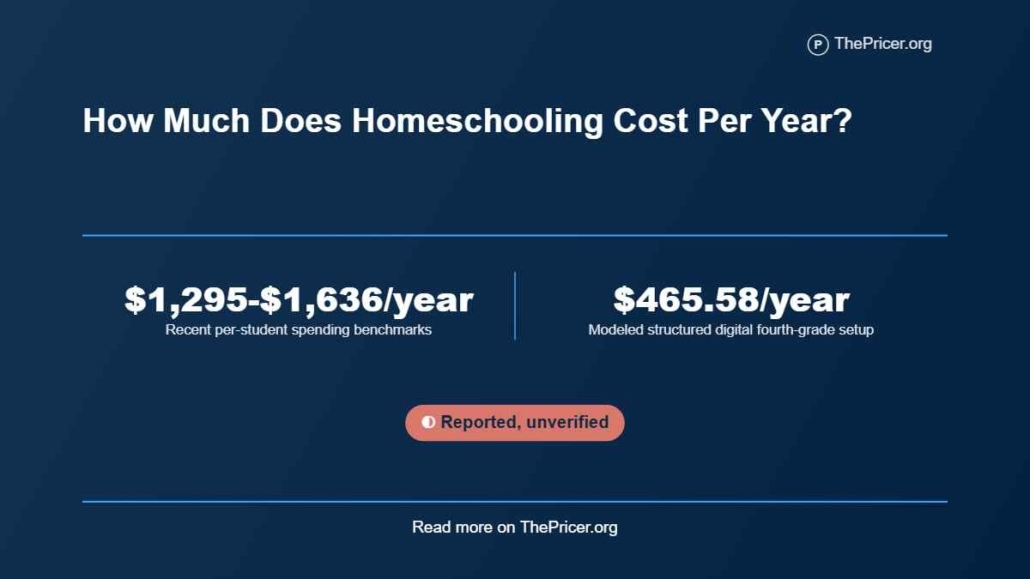
Homeschooling in the United States can cost almost nothing for curriculum alone, while direct family spending can rise into four figures per student once materials, classes, testing, activities, and tutoring enter the budget. A useful recent benchmark is $1,295 per elementary student per year and $1,636 per middle or high school student per year, based on figures from a 2024 HSLDA family survey that were reported again in July 2026.
Families building a homeschool budget may compare Easy Peasy, Time4Learning, Power Homeschool, Abeka, Homeschool Boss, and Classical Conversations, but those names do not represent the same purchase. They span free online curriculum, paid digital subscriptions, boxed grade-level materials, assessments, and community instruction. Comparing annual cash outlay by category keeps curriculum cost, per-student software, testing, reusable books, consumable workbooks, and outside classes from being collapsed into one misleading figure.
The right annual budget depends on what the family counts. Direct spending can include books, printing, tests, co-op charges, online classes, transportation, music, art, sports, and tutoring. Parent work time can carry a much larger economic cost, but it is separate from the cash figures used here. This cost estimate keeps curriculum price, family spending, and lost paid-work income as separate layers.
Article Highlights
Jump to sections
- A recent full-spending benchmark is $1,295 (at $30 per hour, earning that amount would take about 1.1 full-time workweeks, before taxes) per elementary student and $1,636 per middle or high school student each year.
- A complete online curriculum can cost $0, while a parent-led boxed curriculum can exceed $1,000 before activities and outside instruction.
- Power Homeschool currently lists $99 per month per student, far above its documented $25 per month 2024 listing.
- A one-time MAP Growth Math and Reading assessment currently costs $60 for the first student.
- Sibling costs can rise unevenly because books may be reusable while software and testing are often priced per student.
How Much Does Homeschooling Cost Per Year in the U.S.?
A recent national benchmark for direct family spending comes from HSLDA’s summer 2024 survey. More than 4,000 homeschooling families from all 50 states, Washington, DC, and Puerto Rico responded. The HSLDA summer 2024 survey methodology says families were asked to count curriculum, supplies, printing, annual co-op or organization fees, online class tuition, transportation, music lessons, art classes, sports, and tutoring. That makes the reported averages broader than a curriculum quote.
This distinction explains why two honest answers can look far apart. A family using free digital lessons and a library may spend only on printing, supplies, and chosen activities. Another family can buy an all-subject package, pay for a weekly co-op, add outside math instruction, and register for standardized testing. Both are homeschooling, but they are buying different bundles of education. The annual cash total should be built from the family’s actual plan rather than from one advertised curriculum price.
Parent time belongs in a separate column. A parent who reduces paid work can face a real household income effect, yet there is no sound single national figure that applies to every family. Mixing that opportunity cost into the direct-spending benchmark would make the headline less useful. Cash spending and lost earnings answer different questions.
Curriculum Prices by Format
The low end is genuinely low. Easy Peasy All-in-One Homeschool says its online curriculum is $0, with books unnecessary for online use. Families can choose paid books or workbooks when they want offline materials, while donations are optional. The provider’s current cost explanation makes free curriculum a documented option rather than a hypothetical budget trick.
Paid digital programs sit above that floor. Time4Learning currently lists $39.95 (about 1.3 hours of work at $30 per hour) per month for preschool through grade 12 and says its annual plan saves 30%. Applying that published discount gives a calculated monthly equivalent of about $27.97. Using the unrounded discount across 12 months gives an annual curriculum cost of $335.58 for one student before outside testing, books, activities, or devices.
Boxed programs can move much closer to the full annual benchmark. Abeka’s 2026-2027 Grade 3 worksheet lists its Child Kit at $528.95 and its Essential Parent Kit at $565.10. Those current prices create a parent-led base of $1,094.05 before optional add-ons. That single curriculum setup equals about 84.5% of the $1,295 elementary full-spending benchmark.
Extras That Raise the Total
Testing can be a small line item or a recurring one. Homeschool Boss currently charges $60 for one season of MAP Growth Math and Reading for the first student and $162 (about 5.4 hours of work at $30 per hour) for a three-season yearly subscription. It lists lower per-student prices for additional children, plus optional Language Usage and Science assessments. A family should only add testing that fits state requirements or its own academic goals.
Community programs can be much larger than testing. Classical Conversations publishes program-cost examples of $600+ for Foundations, $600+ for Essentials, and $1,600+ for Challenge, with books excluded. The same comparison states that listed amounts can include tuition and charges such as application, registration, administrative, or enrollment fees. A quoted community-program figure is not interchangeable with a stand-alone curriculum price.
Supplies add another layer. Current school supply cost research puts basic elementary supplies around $40 to $100, middle school around $70 to $150, and high school around $100 to $300. Families who already own a printer, laptop, art materials, and reusable binders may land near the low side. A new computer, science equipment, or frequent printing can move the total higher.
Grade Level
The HSLDA benchmark rises from $1,295 for elementary students to $1,636 for middle and high school students. The difference is $341 per year. Dividing that gap by the elementary figure gives a 26.3% increase. This is a calculated comparison of the reported averages, not a claim that every student becomes 26.3% more expensive after elementary school.
Older students can require subject-specific resources that younger students do not. Lab sciences may add materials. Advanced math, foreign language, writing, or test preparation can push a family toward paid outside instruction. High school also creates recordkeeping and course-planning questions that may lead some households to purchase additional services. Those choices can raise the cash budget even when the core curriculum itself stays modest.
Tutoring is one expense capable of overtaking the curriculum. Current Huntington tutoring cost research estimates ordinary academic tutoring at about $45 to $80+ per hour. Two hours each week for a 36-week school year would far exceed the HSLDA middle and high school benchmark. That does not mean homeschoolers normally buy that much tutoring. It shows why a family that outsources one difficult subject should budget from hours of instruction rather than from a curriculum average.
Sibling Costs
 A second child does not always double the bill. Printed teacher guides, reference books, manipulatives, maps, microscopes, and some literature can be reused. Consumable workbooks usually cannot. Digital platforms may price each student separately, while some providers offer family discounts. The result is a household curve that depends on what can be shared and what must be bought again.
Time4Learning’s published family discount structure lists 10% off for two students, 20% off for three to five students, and 25% off for six or more students. That structure shows why multiplying one child’s subscription by the number of children can overstate the digital-curriculum bill. Other purchases may still repeat for each child.
That gap matters. Build a sibling budget in two passes. Put shared assets such as reference books, durable manipulatives, and equipment in a household column, then put consumables and account-based services in a per-child column. Software accounts, workbooks, paid classes, sports registrations, and many tests tend to follow the child. Shelved books and durable equipment can spread their cost across several years and siblings. This makes the added cost of each student visible without pretending the first child’s total simply repeats.
Three Annual Budget Scenarios
These scenarios use current published prices and explicit assumptions. They are not claims about what a typical family spends. The middle example provides an itemized annual total so a parent can see how several modest purchases combine.
| Scenario | Annual direct cost | What is included |
|---|---|---|
| Lean online curriculum | $0 curriculum plus chosen extras | Easy Peasy online curriculum, existing device, family-selected printing and activities |
| Structured digital fourth grade | $465.58 | Time4Learning annual-plan equivalent, one MAP Math and Reading test, assumed $70 basic supplies |
| Parent-led boxed third grade | $1,094.05 before extras | Abeka Grade 3 Child Kit plus Essential Parent Kit |
The structured digital example starts with 12 months at the $39.95 list price, or $479.40, then applies the published 30% annual discount to reach $335.58. Add one $60 MAP Math and Reading assessment and an illustrative $70 supply allowance within the current elementary supply range. The resulting ThePricer scenario is $465.58 for the year. It excludes a new computer, home internet already being paid, co-op participation, tutoring, field trips, sports, and paid music or art instruction.
The premium boxed example reveals a different constraint. Dividing the already cited $1,094.05 curriculum base by the $1,295 elementary spending benchmark gives 84.5%. A family choosing that package could exceed the benchmark quickly after adding activities or outside classes. Free curriculum can be real. So can a four-figure curriculum bill.
False Comparisons
Old homeschool pricing can distort a budget long after the provider changes its offer. Power Homeschool currently lists tuition of $99 per month per student, or $79 per month with the Roger Billings Scholarship, for access to as many as six courses at a time. A full 12 months costs $1,188 on the standard rate or $948 at the scholarship rate if a student remains enrolled for that whole period.
An official Power Homeschool notice dated August 6, 2024 said families enrolling before September 1 could retain the prior $25 per month tuition for that school year. That documented 2024 rate annualizes to $300. The current $99 listing is 296% above that old $25 listing, and a 12-month comparison differs by $888 per student. The 2024 release also tied its pricing change to the Acellus HD upgrade, so this calculation is a stale-price warning rather than a like-for-like historical price index. It does not say the provider made one 296% increase at a single point in time.
The label matters. Tuition-free public online school is another category, because eligible students remain in a publicly funded school rather than independently homeschooling. K12’s May 2026 cost comparison describes public online school as tuition-free for eligible students. A $0 public-school tuition line should not be used as if it were the market price of an independent homeschool curriculum.
When Paying More Changes What You Buy
A higher homeschool bill can buy convenience, structure, physical materials, outside instruction, or community access. It does not automatically buy a better fit for a particular student. A free curriculum asks the parent to take on planning and supervision. A paid self-paced platform can reduce lesson preparation. A boxed program shifts spending toward physical books and teacher materials. A co-op or outside class adds people and scheduled instruction rather than just content.
Before paying for an assessment or recordkeeping service only because another homeschooler uses it, check the requirements in your own jurisdiction. A spending plan works better when required items, academic needs, and optional enrichment sit in separate buckets. That keeps a family from buying a service merely because it appears in someone else’s homeschool budget.
Makes sense if
- You know which subjects the parent will teach and which will be outsourced.
- You can reuse durable materials across siblings or later school years.
- The paid program replaces work or resources you would otherwise buy separately.
- The annual total still leaves room for activities your student values.
Does not make sense if
- You are buying a premium package mainly because its price looks like a quality score.
- A subscription duplicates books, classes, or software already in the household.
- You are using an old price page to build the current school-year budget.
- You are comparing independent homeschool spending with a tuition-free public online school as if both offers have the same scope.
Answers to Common Questions
Can you homeschool for free?
Yes. A family can use a free curriculum such as Easy Peasy and rely on resources it already owns. The cash total can still rise through printing, supplies, activities, testing, transportation, or outside instruction.
How much should I budget for one homeschooled child?
A recent benchmark is $1,295 per year for an elementary student and $1,636 per year for a middle or high school student. A lean family can spend far less, while premium curriculum and paid classes can push the total higher.
Does homeschooling cost more in high school?
The recent HSLDA-based benchmark is higher for middle and high school students than for elementary students. The difference is $341 per year, or 26.3%, across those reported averages.
Do two children cost twice as much to homeschool?
Not always. Reusable books and equipment can be shared, while consumable workbooks, software accounts, tests, and paid classes often create another per-student charge. Provider family discounts can also reduce the second child’s marginal cost.
Disclosure: Educational content, not financial advice. Prices reflect public information as of the dates cited and can change. Confirm current rates, fees, taxes, and terms with official sources before purchasing. See our methodology and corrections policy.