
How Much Does Ibogaine Cost?
Updated on | Researched and reviewed by Alec Pow, Founder & Pricing Investigator
Prices, claims, and calculations checked against 14 cited sources. See our research methodology and corrections policy.
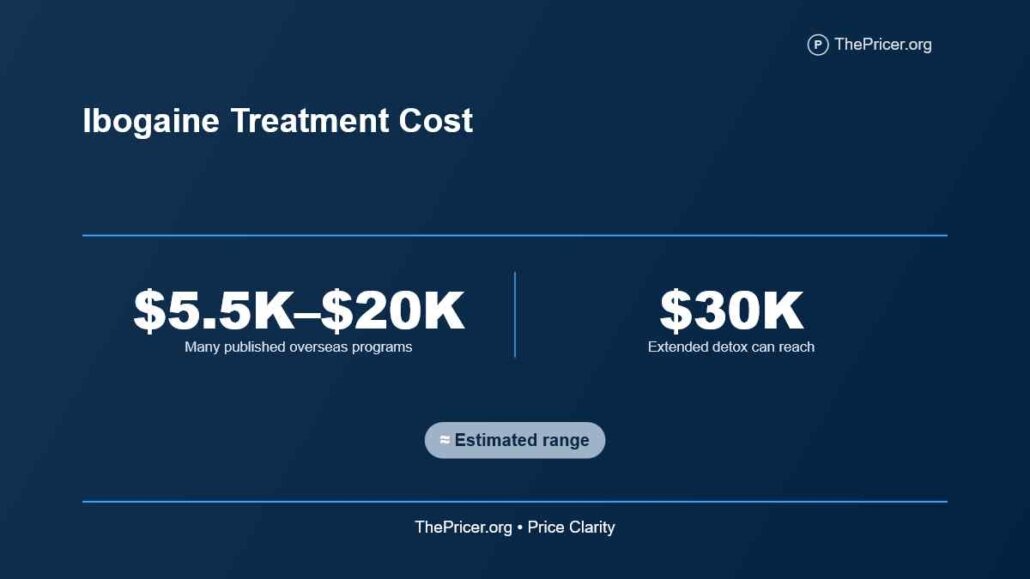
Ibogaine treatment at overseas clinics currently costs about $5,500 to $20,000 for many published programs, a planning band consistent with a 2026 clinic price comparison. Longer detox programs can cost more. The range is not one standardized medical price because stay length, screening, staffing, accommodations, aftercare, and booking terms differ.
For a U.S. reader, published consumer prices largely come from private-pay programs outside the country rather than from a normal domestic retail treatment market. The figures below separate clinic fees from travel, testing, deposits, aftercare, and other costs that can sit outside the advertised package. The U.S. legal and regulatory position is covered separately.
Article Highlights
Jump to sections
- Published overseas clinic prices currently span roughly $5,500 to $20,000 for many programs, with extended detox programs reaching $30,000.
- Experience Ibogaine says facilities commonly charge $5,500 to $10,500.
- Beond posts identical 10-day care at $12,500, $15,500, or $19,500 depending mainly on reservation timing and capacity.
- Transcend lists shorter programs from $12,000 and a 10-day substance-use detox program from $17,000.
- Medical screening, travel, and care after discharge may sit outside a clinic quote, depending on the provider.
- Ibogaine remains Schedule I in the United States, while FDA activity in 2026 concerns research and drug development rather than routine commercial approval.
How Much Does Ibogaine Cost?
A useful 2026 planning range is $5,500 to $20,000 for many medically staffed overseas clinic programs. Experience Ibogaine says facilities commonly charge $5,500 to $10,500. Beond’s current treatment pricing lists 10-day tiers of $12,500, $15,500, and $19,500 for identical stated services, with timing and capacity affecting the tier. The same page says a physician-prescribed 14-day chemical-dependency program adds $5,000 to the 10-day base.
Two other provider schedules widen the range. Ambio currently lists its detoxification program at $9,350 to $30,000 for 7 to 30 days, depending on treatment duration. Transcend lists shorter programs from $12,000 and a 10-day substance-use detox program from $17,000. These are provider-published prices, not a representative market average.
| Published example | Program price | Pricing scope |
|---|---|---|
| Experience Ibogaine | $5,500–$10,500 | General facility range stated by the provider |
| Ambio | $9,350–$30,000 | 7–30 day detoxification program |
| Transcend | $12,000–$17,000+ | Short program through 10-day substance-use detox |
| Beond | $12,500–$19,500 | 10-day program tiers tied mainly to capacity and reservation timing |
Do not compare the lowest number in that table with the highest as if they buy the same service. Program length, detox needs, clinical eligibility, room arrangements, included transportation, psychotherapy, and aftercare can differ. The quote needs to be read as a package, not simply a price per dose.
What Ibogaine Treatment Is
Ibogaine is a psychoactive indole alkaloid associated with the West African plant Tabernanthe iboga. Clinics that sell ibogaine-assisted programs often combine the drug administration with medical screening, observation, accommodation, meals, counseling, and post-treatment support. Some programs are aimed at substance-use disorders, while others market services for trauma, mood symptoms, or personal growth.
A 2026 scoping review describes substantial gaps in human safety evidence and notes that authorized medicinal products containing ibogaine are absent in the European Union. Clinic marketing for trauma, mood, neurological, or substance-use programs should not be read as proof that those uses are approved or established as effective. That distinction matters for cost because an overseas clinic package is not equivalent to purchasing an approved medication through a U.S. pharmacy or receiving a standard covered procedure at an in-network hospital.
It also differs from ordinary residential addiction rehab programs, which may run for weeks or months and can use different clinical models, medications, counseling schedules, and insurance arrangements. An ibogaine package is often shorter and front-loaded, but shorter does not mean medically simpler or financially comparable.
The billing unit is also different. Overseas providers usually sell a multi-day package rather than a price for the ibogaine compound alone. That package model is why accommodation, observation, meals, transportation, counseling, and aftercare can matter as much as the drug administration when two clinic quotes are compared.
What the Price Includes
Package inclusions vary enough that the headline fee can mislead. Transcend’s 10-day program page describes private airport transfer, clinical screening, supervised treatment, accommodation, and aftercare planning. That package is much broader than a price for the drug alone.
The same comparison problem applies across clinics. A lower quote may exclude services that another provider bundles into one package, while a higher quote may partly reflect lodging, staffing, monitoring, or follow-up rather than the ibogaine itself. The only fair comparison is between packages with matched inclusions and similar program scope.
Ask what is included in the written quote, especially pre-arrival testing, on-site cardiac testing, physician review, medications used during the stay, transportation from the airport, extra nights, room type, meals, counseling, and aftercare. Also check which services become separate charges when a stay runs longer than planned, and whether extra observation days use a published daily rate or a new quote. This is similar to comparing drug and alcohol testing costs, where a simple screen and a laboratory-confirmed panel are not the same product even though both may be described as a “test.”
Longer Programs Cost More
Length of stay is one of the clearest price drivers. Ambio’s published program schedule lists a five-day foundational program at $8,350 and a 7-to-30-day detoxification program at $9,350 to $30,000. Program length matters because an extended detox can involve more than additional nights at the same daily rate.
Beond gives a more direct calculation. Its base program starts at $12,500, while a physician-prescribed 14-day chemical-dependency program costs $5,000 more than the 10-day base. Using the lowest published tier, that makes the clinic portion $17,500 before travel or any outside costs. The extra four days raise that base-clinic bill by 40%.
Transcend shows a similar step-up. A shorter program marketed for TBI, PTSD, depression, or anxiety starts at $12,000, while its 10-day substance-use detox program starts at $17,000. That is another $5,000 difference, or about 42%, tied to program scope and duration rather than a simple room upgrade.
These examples also show why a per-day calculation can distort the comparison. A longer detox stay may involve a different clinical scope, not merely extra lodging. Dividing each package by nights can make unlike services appear comparable when the provider has changed the treatment plan, staffing, or monitoring requirements.
Booking and Deposits
Reservation timing can alter the bill before a patient arrives. Using Beond’s published 10-day tiers, the spread between $12,500 and $19,500 is $7,000. The high tier is 56% above the lowest tier even though Beond says the stated services are identical. In that example, booking timing and capacity create a larger price swing than some clinics charge for several additional days.
Ambio publishes another deposit model. Its current booking terms require a 50% deposit for the Mexico detoxification program. On its lowest published $9,350 detox price, that would put $4,675 down before the stay. The policy reinforces why deposit amount and refund terms belong in the cost comparison, not in the fine print after a clinic has been chosen.
A large advance payment makes cancellation and medical-disqualification terms part of the price decision. Get the refund rule, rescheduling window, screening sequence, and any transfer charge in writing before sending a deposit. The deposit is part of the cash-flow burden even when it does not increase the total clinic price.
U.S. Legal Status
Ibogaine is federally controlled in the United States. The DEA’s Schedule I reference list identifies ibogaine under DEA number 7260. That means there is no routine U.S. retail medical market comparable with an approved prescription drug or standard clinic procedure.
The regulatory picture is changing around research, but that has not turned ibogaine into an ordinary commercial treatment. FDA’s psychedelic drug update says the agency is supporting drug development and has allowed an early-phase study of noribogaine, an ibogaine-related compound, to proceed. Research authorization is not the same as approval for routine use.

The clinic prices below are cash prices, not insurer-negotiated U.S. rates. Treating them as private-pay budgets avoids assuming that an overseas package will be reimbursed. Coverage for separate testing, counseling, or later care can depend on the insurer, provider, network, and benefit design, so those services should be checked separately rather than folded into a presumed insurance payment.
The practical distinction is between paying for an overseas commercial program and participating in a regulated U.S. research pathway. A trial or investigational program has its own eligibility and study rules, so it should not be used as a price comparison for a consumer clinic package. The presence of research activity does not create a retail U.S. ibogaine price.
Safety and Screening Costs
Ibogaine pricing cannot be separated cleanly from safety because cardiac monitoring and screening are part of what distinguishes many medical-clinic packages from informal retreats. A 2026 review in Addiction describes clinically relevant cardiac risks, including QT prolongation and potentially fatal ventricular arrhythmias, and calls for strict monitoring conditions. Medical supervision lowers neither the drug’s inherent risk nor the need for patient-specific clinical judgment.
Medical staffing should not be turned into a simple price premium or a guarantee of safety. The published safety literature supports treating cardiac monitoring and screening as part of the clinical scope, while individual eligibility remains a medical decision. A high clinic fee does not establish a better outcome, and a country’s location alone does not establish one uniform standard across every provider.
From a cost perspective, screening can affect both eligibility and the final bill. Providers may require heart testing, blood work, medication review, and other assessments before dosing. Some package prices include those services on site, while others expect part of the work to be completed before travel. Do not assume an ECG, laboratory panel, physician review, or extra observation night is included unless the written quote says so.
Real All-In Cost Scenarios
Early-booked 10-day Beond scenario. The lowest published clinic tier is $12,500. Beond says accommodations and private ground transportation are included, which removes two common destination charges from the clinic-side budget. Airfare and any outside pre-travel medical costs still need to be added separately. This is a starting package price, not a full door-to-door trip total.
Worked clinic-cost example. Using Beond’s published rule, a 14-day program costs $5,000 more than its 10-day base. Starting from the lowest $12,500 tier produces a clinic bill of $17,500. If the patient instead lands in the $19,500 capacity tier before the extra program-length charge, the same arithmetic reaches $24,500. Booking timing and treatment length can stack rather than move independently.
Ambio deposit scenario. Ambio’s lowest published detox price is $9,350 and its cited booking terms require a 50% deposit for that program. Half of $9,350 is $4,675, leaving another $4,675 of the clinic price after the deposit. Travel and any outside services remain separate from that arithmetic, so the deposit calculation is a payment-timing example rather than an all-in trip total.
Answers to Common Questions
How much does ibogaine treatment cost?
Many current published overseas programs fall around $5,500 to $20,000. Longer or more complex detox programs can reach $30,000.
How much does ibogaine cost in Mexico?
Published Mexico examples span from about $5,500 at the lower end of clinic pricing to $19,500 for Beond’s highest listed 10-day capacity tier, with some extended detox programs higher.
Does health insurance cover ibogaine?
Do not assume an overseas ibogaine package will be reimbursed. The prices compared on this page are clinic cash prices. Coverage for separate testing, counseling, or later care depends on the plan and provider.
Is ibogaine legal in the United States?
Ibogaine is a Schedule I controlled substance under federal law. U.S. research activity and investigational access pathways do not create a routine FDA-approved commercial treatment market.
Why can two ibogaine programs have very different prices?
Program duration, detox needs, medical staffing, screening, room type, transportation, booking timing, aftercare, and deposit terms can all change the quote.
Disclosure: Educational content, not medical advice. Pricing varies by provider, location, and insurance. Confirm eligibility, coverage, and out-of-pocket costs with a licensed clinician and your insurer. See our methodology and corrections policy.