
How Much Does iPhone Handoff Cost?
Published on | Written by Alec Pow
This article was researched using 12 sources. See our methodology and corrections policy.
iPhone Handoff costs $5 per month on T-Mobile in the United States, or $60 per year. The new iOS 27 feature lets one mobile number move between two compatible iPhones, with only one phone active on the cellular network at a time. T-Mobile says its iPhone Handoff service carries the $5 monthly charge and extends calls, texts, data and hotspot service to the active phone.
This is not the older Apple Handoff feature used to continue Safari, Mail and other tasks between an iPhone, iPad or Mac. That classic Continuity feature remains built into Apple software without a separate Handoff subscription. The largest real cost can be the second iPhone itself if the user does not already own two compatible devices.
Article Highlights
Jump to sections
- T-Mobile charges $5 per month, equal to $60 (at $30 per hour, earning that amount would take about 2 hours of work, before taxes) per year.
- Two iPhones running iOS 27 or later are required.
- Only one iPhone uses the shared number on the cellular network at a time.
- A new $599 iPhone 17e plus one year of Handoff creates a $659 first-year subtotal before tax.
- Deutsche Telekom charges €6.95 per month for an added MultiSIM when one is not already included in the customer’s plan.
How Much Does iPhone Handoff Cost?
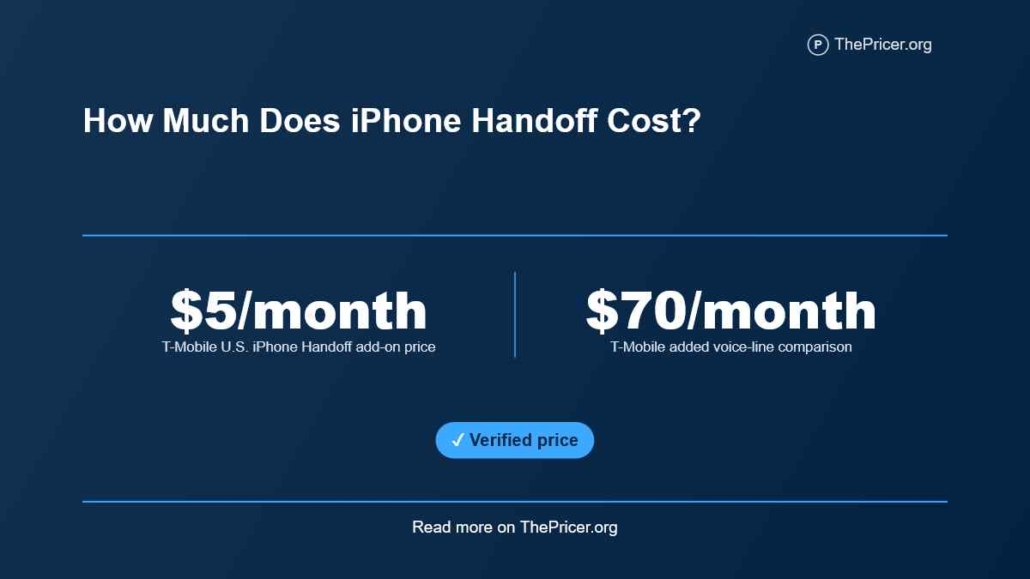
T-Mobile’s launch price is $5 per month. The carrier bills the feature as an add-on for customers who want to use one T-Mobile number across two compatible iPhones. At an unchanged rate, 12 months costs $60 (about 2 hours of work at $30 per hour), two years costs $120 and three years costs $180. Those totals cover the Handoff service only. They do not include either iPhone, the primary T-Mobile voice plan, device financing, taxes, insurance or optional Apple services.
Apple does not charge a separate software price for iPhone Handoff. Its iPhone Handoff setup guide says carrier fees may apply and currently lists T-Mobile in the United States and Telekom in Germany as supported carriers. Apple also requires two devices running iOS 27 or later, Wi-Fi, the same Apple Account, Messages in iCloud and matching FaceTime and iMessage account settings. The carrier relationship is why the same Apple feature can have a different price in another country.
The new name can cause confusion with Apple’s older Handoff system. Traditional Continuity Handoff between devices lets a user start an activity on one Apple device and continue it on another nearby device. It uses Wi-Fi, Bluetooth and the same Apple Account. That feature does not require the new $5 T-Mobile add-on. The paid service covered here is the cellular-number-sharing feature called iPhone Handoff in iOS 27.
Why It Is in the News
iPhone Handoff became a live consumer-cost question with the release of iOS 27 on September 14, 2026. Apple’s iOS 27 release announcement confirms that the new operating system began rolling out that day. T-Mobile announced its support four days earlier, attaching a clear monthly price to a feature that had previously been discussed mainly as an operating-system capability.
The timing also overlaps Apple’s new two-device strategy. T-Mobile promoted Handoff alongside iPhone 18 Pro and the foldable iPhone Duo, while Apple has positioned the Duo as a high-end device that some owners may not want to carry for every activity. A user could keep a smaller or older iPhone for exercise, travel or higher-risk environments while preserving the same mobile number. The current iPhone Duo pricing makes that use case financially relevant because the foldable starts far above a basic secondary iPhone.
The news is also about carrier adoption rather than Apple software alone. A phone can meet Apple’s technical requirements and still lack the feature if its carrier does not support Handoff. Current launch support is narrow, which keeps the U.S. cost answer centered on T-Mobile. Wider carrier support could change the competitive price later, but an announced future carrier should not be assigned T-Mobile’s $5 charge without its own published terms.
What the Monthly Fee Includes
T-Mobile says the secondary iPhone can use calls, texts, cellular data and mobile hotspot when it becomes the active phone. The carrier also says Scam Shield and T-Satellite are available on eligible plans. The result is closer to moving an existing cellular identity between two phones than buying a second independent wireless line. The customer keeps one number and chooses which iPhone is active by using that device.
Apple says calls, voicemail, iMessage, RCS, SMS and MMS, and Find My location move to the iPhone that is active at the time. Other information stored in iCloud continues to sync according to the normal rules for each service or app. The number is active on only one iPhone at a time, so Handoff does not create two simultaneously independent phones. Carrier account controls such as some call-forwarding and caller-ID settings can also remain tied to the main iPhone.
This scope explains why the feature costs much less than a full added voice line. The customer is not purchasing another number with independent simultaneous cellular service. One device is the main iPhone and the other is the secondary iPhone sharing that number. For a user who wants a rugged older phone for hiking or a smaller device for nights out, the restriction may be acceptable. A household or business that needs two people reachable on two phones at the same time needs a different service arrangement.
What You Need to Use It
 The service requires two compatible iPhones running iOS 27 or later. Both phones must connect to Wi-Fi, use the same Apple Account, have Messages in iCloud enabled and use the same Apple Account for FaceTime and iMessage. The service also needs an eSIM from a supported carrier. Once enrolled, one phone becomes the main iPhone and the other becomes the secondary device that shares the number.
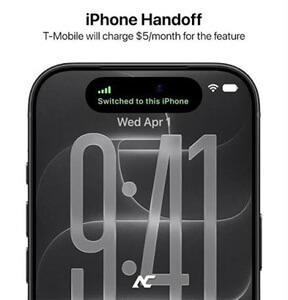
Switching is designed to be simple. Authenticating on the iPhone a user wants to use makes the shared number active on that device. Apple displays a message confirming the switch. Because device access controls which phone becomes active, Apple recommends keeping a passcode enabled and private. Dual SIM is supported when both eSIMs come from carriers that support iPhone Handoff, but each number has to be set up for the feature separately.
A paid iCloud+ storage tier is not listed as a requirement. Messages in iCloud is required, but the feature’s Apple documentation does not say a user must purchase extra iCloud storage solely for Handoff. Users who already pay for storage should keep that bill separate from the carrier fee. The current iCloud plan prices are relevant only when a person’s existing storage needs justify an upgrade, not because iPhone Handoff itself has an iCloud subscription charge.
First-Year Cost
A customer who already owns two eligible iPhones can have a very small incremental first-year cost. Twelve months of T-Mobile Handoff is simply $60 (about 2 hours of work at $30 per hour) before any carrier taxes or fees that may apply. The economics change when the customer needs to buy a second phone solely to use the feature. Apple launched the iPhone 17e from $599 in the United States, giving a current new-device reference for a lower-cost secondary iPhone. Apple’s iPhone 17e price announcement confirms the $599 starting price.
Illustrative first-year total
- iPhone 17e starting price of $599.
- iPhone Handoff at $5 per month.
- 12 months of service at $60.
- First-year subtotal of $659 before sales tax, case, protection or financing.
The hardware represents about 90.9 percent of that $659 subtotal, while the first year of Handoff represents about 9.1 percent. That split is a more useful measure than focusing only on the low monthly fee. Someone keeping an existing older iPhone can avoid nearly all of the hardware cost. Someone buying a dedicated second device because Handoff exists is making a much larger spending decision than the $5 carrier charge suggests.
Handoff vs a Second Line
T-Mobile currently lists an added Experience More 2.0 voice line at $70 per month with an eligible AutoPay method, plus taxes and fees. The carrier’s add-a-line pricing table puts that specific line price beside its other multi-line rates. Compared with Handoff at $5 per month, the service-charge difference is $65 per month or $780 per year.
On price alone, the Handoff charge is about 92.9 percent lower than that particular $70 added-line example. The comparison is not feature-for-feature. An added line has its own phone number and can remain cellular-active independently. Handoff shares one number and makes only one of the two iPhones active on that number at a time. The lower price buys narrower functionality.
The choice comes down to why a second phone exists. A single user who alternates between two personal iPhones may have little reason to pay for a second independent number. In that case, $60 per year can replace a much larger service bill. Two employees, partners or family members cannot use Handoff as a substitute for separate lines because both people may need cellular access at the same time. The iPhone 17 cost guide can help separate the second-device purchase from the ongoing line decision.
Germany and Future Carriers
Deutsche Telekom uses a different pricing structure. The carrier says iPhone Handoff is part of its MultiSIM offering rather than a separately priced Handoff product. An added MultiSIM costs €6.95 per month, which equals €83.40 per year. The carrier’s iPhone Handoff pricing announcement says MagentaMobil L includes one MultiSIM without an added charge, while MagentaMobil XL includes two.
That means the incremental price can be €0 for a customer who already has an unused included MultiSIM, or €6.95 per month for a separately added MultiSIM. The German arrangement also shows why Handoff pricing should be described by carrier and plan. Apple supplies the operating-system feature, but the carrier determines how number sharing is packaged and billed.
| Handoff cost example | Monthly charge | Annual charge |
|---|---|---|
| T-Mobile U.S. | $5 | $60 |
| Telekom added MultiSIM | €6.95 | €83.40 |
| Telekom included MultiSIM | €0 | €0 |
More competition is expected. Independent reporting says Verizon in the United States and EE in the United Kingdom plan to support iPhone Handoff later in 2026. The carrier expansion report did not provide a verified Handoff price for either carrier. Until those companies publish terms, their monthly cost should be treated as unknown rather than copied from T-Mobile or Telekom.
Hidden Costs and Limits
The most important billing trap appears when the customer wants to stop the service. Apple’s iPhone Handoff cancellation instructions say the user must contact the carrier to turn off the feature. Deleting the eSIM from a phone may not stop the carrier charge. A customer who removes the secondary eSIM but leaves the account feature active could keep paying $5 per month until the carrier processes the cancellation.
The Apple Watch also does not switch automatically between the two iPhones. Apple recommends pairing the Watch with the phone used most often. If that paired iPhone is unavailable, some functions can depend on whether the Watch has Wi-Fi or activated cellular service. Wallet has similar boundaries. Payment cards can work on both devices, while certain transit passes, IDs or corporate badges may work on only one device at a time.
Third-party apps can introduce friction without adding a direct carrier fee. Apple warns that some apps may sign a user out on one phone when that person signs in on the other, while banking apps may ask for another approval step. These limits affect value because the service is most useful when switching phones feels nearly invisible. A user who depends on one-device credentials or a tightly paired Apple Watch may pay the monthly charge and still find that parts of the daily workflow do not move cleanly.
Makes sense if
- You already own two compatible iPhones.
- You want one number and use only one phone at a time.
- You regularly switch between a primary phone and a smaller, older or activity-specific iPhone.
Does not make sense if
- You need both phones active independently at the same time.
- You need two separate phone numbers.
- You would buy an expensive second phone for very occasional switching.
Answers to Common Questions
How much does iPhone Handoff cost on T-Mobile?
T-Mobile charges $5 per month, equal to $60 per year if the price remains unchanged for 12 months.
Is Apple’s regular Handoff feature still free?
Yes. The older Continuity Handoff used to move app activity between nearby Apple devices has no separate Handoff subscription. The paid carrier feature discussed here is iPhone Handoff for sharing one cellular number between two iPhones.
Do I need to pay for iCloud+?
Apple requires Messages in iCloud but does not list a paid iCloud+ storage tier as a requirement for iPhone Handoff.
Can both iPhones use the phone number at the same time?
No. The shared cellular number is active on only one iPhone at a time. Authenticating on the other phone switches the number to that device.
Disclosure: Educational content, not financial advice. Prices reflect public information as of the dates cited and can change. Confirm current rates, fees, taxes, and terms with official sources before purchasing. See our methodology and corrections policy.