
How Much Does It Cost to Build a Steel Mill?
Updated on | Written by Alec Pow
This article was researched using 13 sources. See our methodology and corrections policy.
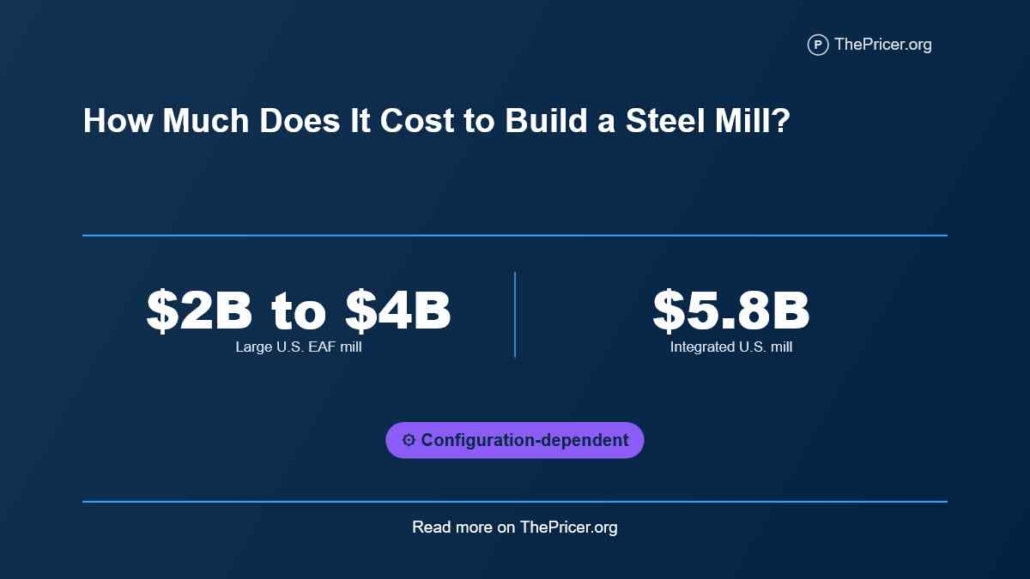
Building a steel mill in the United States can cost from under $1 billion for a smaller rebar mini-mill to roughly $1.7 billion to $4 billion for a modern plate or flat-roll electric arc furnace mill. A more integrated project that adds direct-reduced iron, automotive-grade finishing, and a much larger site can move toward $5.8 billion.
For a large 3-million-ton-per-year flat-roll mill, recent U.S. projects give a particularly useful benchmark. Steel Dynamics put its Sinton mill at $1.9 billion, U.S. Steel expects Big River 2 at about $3.6 billion, and Nucor now estimates total construction cost for its West Virginia sheet mill at about $4 billion. Those are not interchangeable plants, but they show that a realistic greenfield budget is measured in billions, not hundreds of millions.
Article Highlights
Jump to sections
- Smaller rebar mini-mills can cost under $1 billion (at $30 per hour, earning that amount would take about 16 thousand years of full-time work, before taxes); large U.S. sheet and plate mills can reach $1.7 billion to $4 billion.
- Hyundai Steel’s Louisiana integrated EAF project is a disclosed $5.8 billion investment.
- Selected projects work out to roughly $630 to $1,420 per annual ton of capacity.
- Nucor’s West Virginia estimate rose from $2.7 billion to about $4 billion, roughly 48%.
- Hybar allocated $470 million of a $700 million financing package to physical mill construction.
- A 3-million-ton mill equals about 3.3% of U.S. 2025 raw steel production.
How Much Does It Cost to Build a Steel Mill?
A practical 2026 planning range depends first on what kind of steel mill is being built. A compact rebar operation using scrap and an electric arc furnace sits at the lower end. A plate or flat-roll mill with casting, hot rolling, cold rolling, galvanizing, paint lines, and automotive-quality finishing costs much more. Once a project also includes direct-reduced iron, specialized low-carbon process equipment, and broader site infrastructure, the bill climbs again.
For a large U.S. EAF flat-roll plant, $2 billion to $4 billion (about 32 to 64 thousand years of full-time work at $30 per hour) is a defensible starting range from recent disclosed projects. Steel Dynamics describes its 3-million-ton Sinton, Texas mill as a $1.9 billion investment, while its 2026 investor presentation confirms the project and capacity. U.S. Steel’s 3-million-ton Big River 2 mill is expected to cost about $3.6 billion, while Nucor’s 3-million-ton West Virginia project is now estimated near $4 billion in total construction cost.
The broader lesson is the same one that applies to building a factory: the building shell is only one piece of the capital stack. A steel mill is really a linked system of furnaces, casting equipment, rolling lines, finishing lines, cranes, water treatment, environmental controls, substations, laboratories, rail or barge access, and heavy civil works.
Recent Mill Costs
The cleanest way to understand the range is to look at named projects with both disclosed capital and production capacity.
| Project | Mill type | Disclosed cost | Annual capacity | Cost per annual ton |
|---|---|---|---|---|
| Steel Dynamics Sinton, Texas | EAF flat roll | $1.9 billion (about 30 thousand years of full-time work at $30 per hour) | 3.0 million tons | About $633 |
| U.S. Steel Big River 2, Arkansas | EAF flat roll | $3.6 billion | 3.0 million tons | About $1,200 |
| Nucor West Virginia | EAF sheet | $4.0 billion gross construction | 3.0 million tons | About $1,333 |
| Nucor Brandenburg, Kentucky | EAF plate | $1.7 billion | 1.2 million tons | About $1,417 |
| Hybar II, Arkansas | Rebar mini-mill | About $800 million plant cost | About 630,000 tons | About $1,270 |
The figures come from company filings and project disclosures. U.S. Steel’s filing lists Big River 2 at approximately $3.6 billion for 3 million tons of annual capability. Nucor’s Brandenburg release gives $1.7 billion and 1.2 million tons. A 2026 S&P credit analysis puts the second Hybar mill at roughly $800 million for capacity similar to its first 630,000-ton plant.
These numbers should not be averaged blindly. A rebar mill does not need the same finishing assets as an automotive sheet mill, and a plate mill has different rolling equipment again. Site work, rail access, product mix, environmental controls, and how much equipment is included in the announced figure can move the cost substantially.
Cost Per Annual Ton
Dividing capital cost by annual nameplate capacity creates a useful comparison tool. For the five U.S. projects above, the disclosed figures range from roughly $633 to $1,417 per annual ton of capacity. The middle project in that small sample is about $1,270 per annual ton. That is not a national construction-cost standard, but it gives an investor or planner a quick reality check.
Applied to a hypothetical 3-million-ton mill, $1,270 per annual ton would imply about $3.81 billion in capital. That estimate sits between Big River 2 at $3.6 billion and Nucor’s West Virginia construction estimate of about $4 billion. The same method should not be used to claim that every 1-million-ton mill costs $1.27 billion, because steel plants do not scale linearly and finishing equipment can dominate the difference.
The scale is easier to see against national output. The American Iron and Steel Institute reported 90 million net tons of U.S. raw steel production in 2025. A 3-million-ton mill’s nameplate capacity is therefore equal to about 3.3% of that annual production figure. At full nameplate output spread evenly across a year, the mill would average roughly 8,200 tons per day.
Mill Type Changes Cost
A scrap-fed electric arc furnace mill can avoid several major ironmaking systems required by a traditional integrated complex. It still needs enormous electrical service, melt shops, casting equipment, rolling lines, and emissions controls, but the process can be built in a more compact configuration.
The upper end changes when the project starts integrating ironmaking and premium finishing. Hyundai Steel’s new Louisiana facility is a useful 2026 example. Hyundai Motor Group puts the investment at $5.8 billion for 2.7 million metric tons of annual capacity, with an EAF-based integrated design that includes direct reduction and is intended to produce automotive steel.
Hydrogen-based direct reduction can raise capital further. The International Energy Agency estimates early commercial hydrogen DRI-EAF plants can cost 50% to 140% more than conventional blast-furnace/basic-oxygen plants, depending on region. That does not mean every low-carbon mill will cost twice as much. It does show why a low-emissions integrated project cannot be priced from a simple scrap-fed mini-mill benchmark.
What Billions Buy
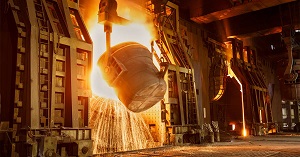 A multibillion-dollar steel mill is not one furnace inside one large warehouse. The steelmaking line begins with raw-material handling and a melt shop, then usually moves through ladle metallurgy, casting, reheating or direct rolling, and one or more rolling stages.
Flat-roll projects can add pickling, tandem cold mills, galvanizing, painting, inspection, and other finishing systems. Each additional product capability adds equipment, buildings, controls, utilities, and commissioning work.
Big River 2 shows how much is packed into a modern flat-roll project. The plant combines two EAFs, endless casting and rolling, cold rolling, galvanizing, and advanced high-strength steel capability. Nucor’s West Virginia sheet mill adds a 76-inch tandem cold mill and two galvanizing lines. That helps explain why comparing a $3 billion sheet mill with a $800 million rebar mill on headline capacity alone can be misleading.
Even the structures themselves are a small slice of the total. A reader comparing this project with ordinary steel building costs is looking at a different product entirely. A mill’s expensive assets are the process equipment and the industrial systems that keep molten metal, high-speed rolling, power, water, dust collection, material handling, and quality control working together continuously.
Where Budgets Blow Up
Recent projects show how quickly a steel mill budget can move. Nucor originally announced its West Virginia sheet mill at about $2.7 billion. Its latest annual filing says total construction cost has risen to approximately $4 billion, with higher labor, material, and equipment costs among the reasons. That is an increase of about $1.3 billion, or roughly 48%.
The same filing says the State of West Virginia has committed $350 million, leaving Nucor with expected net cash outlay of about $3.65 billion. This distinction matters. One article may quote total construction cost, another may quote owner cash outlay after incentives, and both can be technically correct while appearing to disagree.
Big River 2 also moved higher. An earlier U.S. Steel investor presentation put expected capital spending at about $3 billion. The later figure is approximately $3.6 billion, a rise of $600 million, or 20%. On projects this large, a 10% miss can mean several hundred million dollars.
The Hidden Bill
The headline construction number can still understate how much money has to be available before a new mill becomes a stable operating business. Hybar’s first Arkansas rebar project makes the difference unusually visible. TPG’s financing announcement says Hybar raised $700 million, but only $470 million was designated to build the mill. The remaining $230 million covered startup, operations, and certain debt-service costs during construction.
That means roughly one-third of the financing package sat outside the physical mill build. The exact percentage will not transfer to another project, but the categories will. A developer may need working capital, employee hiring and training, spare parts, raw-material inventory, interest during construction, ramp-up losses, commissioning support, and cash for the period when production has started but the plant is not yet running at target utilization.
Site infrastructure is another hidden layer. A steel mill can require new rail spurs, barge access, roads, substations, water intake and treatment, wastewater systems, scrap yards, slag handling, laboratories, fire systems, and environmental controls. These are why a simple factory-shell estimate can miss the real budget by billions. Large industrial power projects show the same pattern: the generating equipment is only one part of a total project, much as with a geothermal power plant.
How Long It Takes
A modern mill usually takes several years from site selection to stable production, although the heavy construction phase can be shorter. Big River 2 began construction in 2022 and produced its first coil in October 2024. Nucor began construction of the West Virginia mill in the third quarter of 2023 and expects completion by the end of 2026. Hybar’s second Arkansas mini-mill is expected to take about 24 months once construction is underway.
The construction calendar is only part of the schedule. Permitting, engineering, long-lead equipment, grid connections, logistics work, hiring, commissioning, and production ramp-up surround the physical build. Reaching first steel does not mean the mill is immediately at full product qualification or steady utilization.
A 3-million-ton nameplate mill averaging 8,200 tons per day at full output normally reaches that scale through a ramp rather than instantly.
Makes sense if the comparison uses mills with similar products and process scope, separates gross project cost from incentives, normalizes capacity only as a secondary check, and reserves additional cash for startup and commissioning.
Does not make sense if a rebar mini-mill is treated as a direct benchmark for automotive sheet, an older project is escalated with no allowance for changed scope, a financing package is mistaken for construction cost, or a building-shell price is used as though it includes furnaces, casters, rolling lines, power infrastructure, and environmental systems.
Answers to Common Questions
How much does a small steel mill cost?
A modern rebar mini-mill can still require roughly $800 million of plant investment in a recent U.S. project. Earlier compact mills were built for less.
How much does a 3-million-ton steel mill cost?
Recent U.S. examples range from about $1.9 billion for Steel Dynamics Sinton to $3.6 billion for Big River 2 and about $4 billion in gross construction cost for Nucor West Virginia. Product mix and finishing equipment explain much of the spread.
Is an EAF mill cheaper than an integrated mill?
A scrap-fed EAF mini-mill can avoid major ironmaking equipment, which can reduce capital needs. Once a project adds direct reduction, premium sheet finishing, and integrated raw-material systems, the cost can rise sharply. Hyundai’s Louisiana EAF-based integrated project is budgeted at $5.8 billion.
How much contingency should a steel mill budget include?
There is no universal percentage. Nucor’s West Virginia estimate rose about 48% from the original figure, while Big River 2 moved about 20% above its earlier capital estimate. Labor, equipment, infrastructure, schedule, and scope can all move the final number.
Disclosure: Educational content, not financial advice. Prices reflect public information as of the dates cited and can change. Confirm current rates, fees, taxes, and terms with official sources before purchasing. See our methodology and corrections policy.