
How Much Does it Cost to Detangle Matted Hair?
Updated on | Written by Alec Pow
This article was researched using 14 sources. See our methodology and corrections policy.
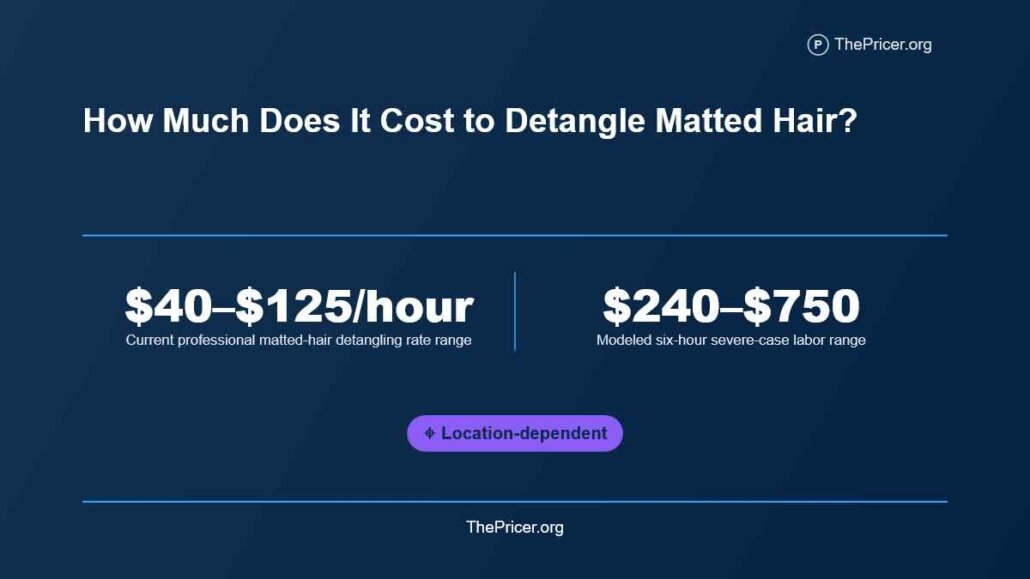
Professional matted-hair detangling currently costs about $40 to $125 per hour across six public U.S. salon listings reviewed for this update. A two-hour appointment at those published rates can land around $80 to $250, while six hours of labor can reach $240 to $750 before shampooing, conditioning, cutting, styling, travel, or other add-ons. Severe cases can take longer.
The old idea of a flat $50 to $200 bill does not fit the way many salons price this work. Time is the main variable. Mat size, how tightly the hair is fused, length, density, curl pattern, product buildup, and whether the mat sits close to the scalp all affect the hours required. A professional may also ask for photos or a consultation before giving a final quote.
Article Highlights
Jump to sections
- Current hourly salon listings reviewed range from $40 to $125 per hour.
- The median of the six published hourly rates in the sample is $57.50 per hour.
- At the sampled low and high rates, two hours of detangling works out to $80 to $250.
- Six hours at the same rate endpoints would cost $240 to $750 before extra salon services.
- A basic DIY comb-and-detangler setup can start around $7.48 to $15.98 using current mass-market prices.
- Painful scalp swelling, pus, crusting, foul odor, rapid hair loss, or inflamed skin calls for medical evaluation rather than a salon-only solution.
How Much Does It Cost to Detangle Matted Hair?
Current salon pricing supports an hourly model more strongly than a flat national price. A Mt. Holly matted-hair service charges $40 per hour. A Round Rock detangling service lists $45 per hour, while a Tucson matted-hair service lists $50 per hour. These are advertised salon rates, not a claim that every salon in those cities charges the same amount.
| Current U.S. service | Published detangling rate | Billing note |
|---|---|---|
| Mt. Holly, North Carolina | $40/hour | Matted-hair detangling, billed by the hour |
| Round Rock, Texas | $45+/hour | Matted or balled-up hair |
| Tucson, Arizona | $50+/hour | Extremely tangled or matted hair |
| Harker Heights treatment | $65+/hour | Professional detangling treatment |
| Houston specialist service | $125/hour | Travel fees can apply for mobile service |
| Cranston detangling service | $125/hour | Matted-hair service only |
The six hourly figures are $40, $45, $50, $65, $125, and $125. The midpoint of the third and fourth observations is $57.50 per hour. That is the sample median, not a U.S. market average. The spread matters more than one midpoint because severe matting can multiply even a moderate hourly rate across a full day of work.
Why the Clock Drives the Bill
Two heads of matted hair can look similar in a photo and require very different amounts of labor. A few compact knots left after taking down braids may separate within one or two hours. Hair that has fused into dense masses near the scalp can require slow sectioning, finger separation, lubrication, comb work, breaks, and repeated checks for damaged strands. Length and density add more hair to work through, while product buildup can make individual strands harder to separate.
Billing rules can also raise the effective price. Some salons round partial hours upward. The Mt. Holly listing states that if work runs 30 minutes into the next hour, that next hour is charged. Other salons use starting prices, minimum blocks, or higher rates after the appointment exceeds its expected duration. A low hourly number can lose its advantage when the billing increment is less forgiving.
Protective-style removal is another common trigger. Hair shed naturally while braids, twists, or extensions are worn can remain trapped until takedown. If the loosened hair is not separated before washing or sleeping on it again, it can bind with neighboring strands. Readers coming out of protective styles can compare the cost of a dreadlock retwist or box braids with the added cost of takedown and detangling when maintenance has been delayed.
A Six-Hour Severe Case
A current Houston salon publishes a staged price structure that shows why severe cases can pass the old $200 ceiling. Its severe detangling service costs $150 for the first two hours, then $50 per hour after those two hours, with a stated $85 per hour rate when work goes beyond four hours. The listing says shampoo and styling are not included. The same salon lists a detox shampoo, deep condition, and blowout without flat ironing at $85.
Using a staged reading of those posted terms, a six-hour case would be $150 for hours one and two, $100 for hours three and four, and $170 for hours five and six. Detangling alone would total $420. Adding the salon’s $85 wash-and-blowout service would bring the modeled visit to $505 before tip or any cut, trim, or style.
This calculation is an illustrative scenario, not a quote for a particular client. The salon may interpret its longer-service pricing differently after seeing the hair, and the job may take fewer or more than six hours. The useful lesson is the interaction between hourly labor and excluded services. A person comparing a $150 starting price with a $200 budget could still face a bill above $500 when the case takes most of a workday and washing is added.
What Professional Dematting Includes
Professional detangling is labor rather than a single standardized salon package. A stylist may work in small sections, separate compacted hair with fingers, apply conditioner or slip products, use a wide-tooth comb, and trim strands that cannot be saved. Some services stop after the mat is opened. Others can be paired with shampooing, deep conditioning, blow-drying, trimming, or a finished style for separate charges.
The current Houston severe-service terms cited above show why inclusions matter. Detangling is priced separately from shampoo and styling, so restoring the hair to a combable state does not automatically mean the appointment ends with clean, dried, finished hair. Other salons may bundle more into one service. Ask whether the quote stops at detangling or carries through washing, conditioning, drying, trimming, and styling.
Photo consultations also have practical value because the stylist can estimate whether the hair can be separated within a normal appointment window. Dense mats close to the scalp may need several hours or more than one session. Mobile specialists can add travel charges. Some salons will decline very severe cases or recommend cutting when continued detangling would create too much pulling, breakage, or discomfort. A professional service reduces guesswork, but it cannot promise that every strand will survive the process.
DIY Detangling Costs and Technique
At-home detangling is cheap when the matting is mild enough to separate safely. Current Target listings show a basic wide-tooth comb at $2.49 to $3.99 and common leave-in or detangling products at about $4.99 to $11.99. Buying one of each creates a basic supply cost of roughly $7.48 to $15.98 before shampoo, rinse-out conditioner, clips, towels, or products already at home.
The safer technique is slow and sectioned. The American Academy of Dermatology recommends using conditioner and a wide-tooth comb, then working from the ends upward to reduce damage. Its healthy-hair detangling advice says thick or curly hair can be combed in the shower before conditioner is rinsed, while straight hair can be allowed to dry somewhat before gentle combing. Pulling from the roots through a dense knot places more force on the hair and scalp.
Curly and coily hair often needs more moisture and smaller working sections. Wetting the hair, adding conditioner or leave-in product, separating with the fingers, and then using a wide-tooth tool can reduce the amount of force needed. Overnight hot-oil soaking is not required. A slippery conditioner or detangling product gives a more controlled starting point than repeatedly pulling a dry compacted mat.
When a Salon Is Not Enough
Some mats need medical care. Acute hair matting can become a compact mass mixed with crust, discharge, dirt, or blood, and it can occur alongside scalp disease or infection. DermNet lists bacterial infection, especially impetigo, among the complications and notes that diffuse nonscarring hair loss can occur. Its acute hair-matting review also lists lice, dermatitis, severe illness, and other conditions among possible contributors.
Seek medical evaluation when the scalp has pus, spreading redness, marked swelling, crusting, foul odor, open sores, fever, painful lymph nodes, or rapid hair loss. A salon can remove tangles, but it cannot diagnose tinea capitis, bacterial infection, inflammatory scalp disease, or another condition that needs treatment. Cutting away a mat may be part of care in severe medical cases, but the underlying scalp problem still needs attention.
Hair loss deserves the same caution. When matting is accompanied by thinning, bald patches, severe scaling, or new scalp pain, repeated aggressive combing can hide the problem while creating more breakage. A dermatologist can examine the scalp and separate hair-shaft damage from infection, inflammatory disease, or another cause that needs treatment.
Preventing Another Matted-Hair Bill
Prevention needs to match hair type. Conditioner after washing reduces friction and makes strands easier to separate. A leave-in product can add slip for hair that is long, curly, dry, chemically treated, or prone to tangling. The amount should match the hair’s density and dryness rather than leaving so much product that buildup becomes another source of sticking and knotting.
Sleeping habits matter because repeated friction can tighten existing tangles. For curly hair, a loose braid, loose high ponytail, twists, or a satin or silk bonnet can help preserve the style and reduce friction. Hair should not be pulled into a painfully tight sleep style. After taking down braids or extensions, separating shed hair before washing can also prevent loose strands from binding together.
Heat does not have to disappear from a hair routine, but excessive heat can weaken hair. Dermatologists recommend limiting blow-drying, flat irons, and curling irons, using lower settings, and using heat protection when appropriate. Regular gentle detangling also needs to follow the hair type. Dry brushing tightly curled hair is not the same maintenance strategy as combing straight hair. A routine that avoids one future four-hour salon detangling session can save $160 to $500 at the sampled hourly endpoints.
Professional Service or DIY?
DIY makes financial sense when the tangling is limited, the scalp is healthy, and individual sections still separate without heavy pulling. The basic supplies can cost under $20, and the work can be paused whenever the scalp becomes sore. It is also easier to control how much hair is trimmed. The tradeoff is time. A person who rushes a dense mat with a brush can create breakage that defeats the purpose of avoiding the salon bill.
Professional service makes more sense when the hair has formed dense masses, the mat is close to the scalp, several hours of work are likely, or the person cannot comfortably reach and separate the affected area. A stylist is also useful after complicated takedowns. Readers maintaining protective styles can compare related costs such as tree braids and budget for removal and detangling before a long-worn style becomes a restoration job.
Makes sense if
- The mat is small enough to separate gently without scalp pain.
- You can work slowly in sections and stop when hair begins snapping.
- The scalp has no open sores, pus, marked swelling, or spreading redness.
- You already own conditioner, clips, and a suitable detangling tool.
Does not make sense if
- The hair is fused into a dense mass against the scalp.
- You are pulling hard enough to cause pain or visible breakage.
- You notice signs of infection, scalp disease, or unexplained hair loss.
- The matting follows a long-worn style and may take many hours to separate.
Answers to Common Questions
How much does professional matted-hair detangling cost?
The six current U.S. hourly services reviewed range from $40 to $125 per hour. The final bill depends mainly on how many hours are needed and whether washing, conditioning, trimming, or styling costs extra.
How much can a severe case cost?
At the sampled hourly endpoints, six hours of labor would equal about $240 to $750 before extra services. Individual salons may use different minimums or longer-session pricing.
Is it cheaper to detangle matted hair at home?
Yes, for mild matting. A basic current retail combination of a wide-tooth comb and detangling product can start around $7.48 to $15.98, before products already owned at home.
Should matted hair be detangled wet or dry?
Technique depends on hair type. Dermatologists recommend conditioner and wet or damp detangling for thick, curly, or coily hair, while straight hair can be allowed to dry somewhat before gentle combing.
When should matted hair be seen by a doctor?
Seek medical care when matting comes with pus, sores, spreading redness, marked swelling, foul odor, fever, painful lymph nodes, rapid hair loss, or another abnormal scalp change.
Disclosure: Educational content, not medical advice. Pricing varies by provider, location, and insurance. Confirm eligibility, coverage, and out-of-pocket costs with a licensed clinician and your insurer. See our methodology and corrections policy.